Small bands need synths that add depth without taking over the stage, rehearsal room, or budget. The best compact models balance playable controls, useful sounds, reliable sequencing, and easy setup.
This roundup compares 10 portable synthesizers and MIDI-focused options for bass lines, pads, leads, textures, and compact live rigs. Use the guide below to match features and workflow to your band’s setup.
Best 10 Synthesizers for Small Bands Picks for 2026
Portable Polyphonic Powerhouse

- JX-8P-inspired sound with 20-voice polyphony
- Two-part sequencing and multitimbral operation
- Battery or USB-C powered with flexible I/O
Best For: Portable pads, layers, and compact band setups
Expressive Control Center
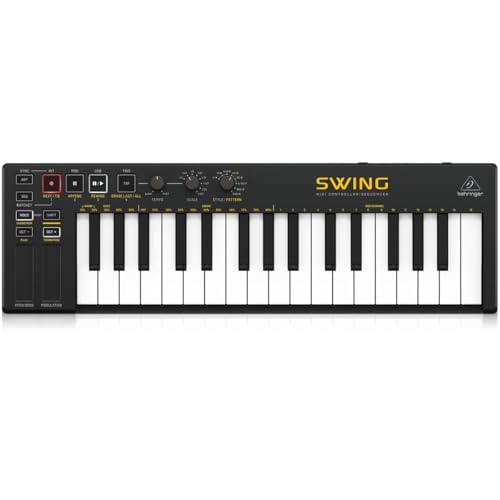
- 32 velocity- and aftertouch-sensitive keys
- Sequencer, arpeggiator, and chord modes
- USB, MIDI, CV/gate, and sync connectivity
Best For: Controlling multiple hardware or software instruments
Analog Acid Bass Specialist

- Fully analog 1-VCO, 1-VCF, 1-VCA design
- 128-pattern memory with song mode support
- Haptic pads, arpeggiator, saturation, and delay
Best For: Sequenced acid basslines and compact live grooves
Simple Compact Keyboard
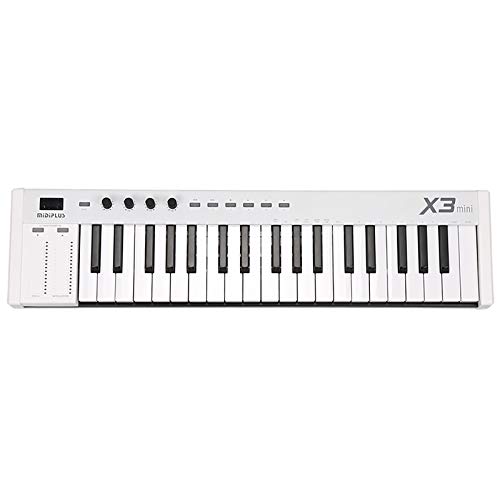
- 37-key compact USB MIDI controller
- Compatible with Mac and Windows systems
- Works with Ableton Live and FL Studio
Best For: Basic laptop-based synth control in tight spaces
Analog Bass Foundation

- Analog VCO, VCF, and VCA circuitry
- 16-step sequencer with MIDI and USB MIDI
- 24 dB/octave filter and distortion effects
Best For: Small bands needing compact analog bass parts
Ultra-Compact Sound Design

- Compact 9.21 x 6.1 x 2.56-inch body
- Lightweight 0.65 kg design
- MIDI connector for setup integration
Best For: Portable, space-conscious MIDI setups
Portable Vector Explorer
Pro VS Mini Hybrid Synthesizer

- Four vector-morphing oscillators per voice
- Analog filter, sequencer, and arpeggiator
- Battery or USB powered portable format
Best For: Portable hybrid textures and sequenced parts
Warm Analog Powerhouse
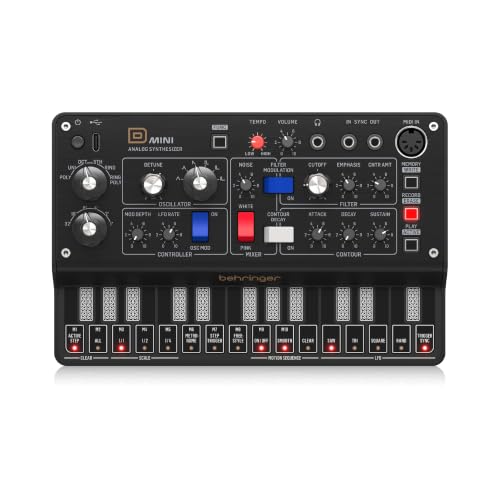
- Warm analog “D-type” circuit
- Five oscillator shapes and six play modes
- 16-step sequencer with pattern storage
Best For: Compact bands prioritizing warm analog basses, leads, and sequences
Compact Polyphonic Explorer

- Four-voice polyphonic hybrid synthesis
- 16 vector oscillators for evolving textures
- Headphones, MIDI, sync, and sequencing included
Best For: Small bands needing chords, sound-design flexibility, and monitoring
Playable Three-Voice Classic

- Three-voice analog polyphony
- 27 touch-sensitive keys
- 16-step sequencer with 3.5mm sync I/O
Best For: Small bands wanting compact keys and straightforward analog polyphony
Portable Polyphonic Powerhouse – Roland JX-08
The Roland JX-08 is a strong choice for small bands needing rich polyphonic textures without a full-size keyboard rig. It delivers JX-8P-inspired sounds, onboard effects, sequencing, and flexible battery or USB-C power in a compact tabletop module.
Best For: Small bands needing portable pads, layered sounds, and compact multitimbral control.
Pros:
- Offers up to 20 voices of polyphony with two-part multitimbral, dual, and split capabilities.
- Includes 143 presets, PG-800 programmer functions, and 17 new effect types.
- Provides a two-part sequencer, arpeggiator, USB-C audio/MIDI, full-size MIDI, and external clock connectivity.
- Runs on four AA batteries or USB-C power and includes onboard speakers.
Cons:
- It is a sound module rather than a complete keyboard, so a separate controller may be needed.
- The broad feature set may take time to learn for players seeking simple plug-and-play operation.
The JX-08 is particularly versatile when a small band needs atmospheric chords, layered parts, and synchronized patterns from minimal stage equipment.
Expressive Control Center – Behringer SWING
The Behringer SWING is a controller-focused option for small bands that already use synthesizers, drum machines, or software instruments. Its 32 velocity- and aftertouch-sensitive keys combine with sequencing, chord, arpeggiator, CV, gate, MIDI, and sync connections.
Best For: Players who want one compact keyboard to control multiple hardware or software instruments.
Pros:
- Provides 32 compact keys with velocity and aftertouch for expressive playing.
- Includes a 64-step, eight-note polyphonic sequencer and eight-style arpeggiator.
- Offers chord play, ratchet and random gate functions, and touch-strip pitch and modulation control.
- Connects through USB, five-pin MIDI, CV/gate, sustain, and sync ports.
Cons:
- It is a MIDI controller and does not include an internal sound engine.
- The 9 V power adapter is optional when USB power is not used.
For a small band with existing sound modules or a laptop-based setup, the SWING can serve as a compact performance hub rather than another standalone synthesizer.
Analog Acid Bass Specialist – Donner Essential B1
The Donner Essential B1 is designed for small bands that need a dedicated analog bass voice with pattern-based performance. Its straightforward 1-VCO, 1-VCF, and 1-VCA signal path, onboard effects, and intuitive sequencer focus on warm, classic acid-style basslines.
Best For: Bands seeking compact analog bass parts, sequenced grooves, and hands-on pattern performance.
Pros:
- Uses a fully analog signal path with one VCO, VCF, and VCA for a focused bass sound.
- Stores 128 patterns and supports song-mode pattern chaining with firmware V1.1.0.
- Includes haptic performance pads and an eight-mode arpeggiator.
- Provides analog saturation and delay plus USB-C MIDI, five-pin MIDI I/O, and sync I/O.
Cons:
- Its single-oscillator architecture is specialized for bass rather than broad polyphonic sounds.
- Some song-mode functionality depends on firmware V1.1.0.
The Essential B1 makes the most sense when the band’s arrangement benefits from a dedicated, playable bass-synth role instead of an all-purpose keyboard.
Simple Compact Keyboard – midiplus X3 mini
The midiplus X3 mini is a straightforward USB MIDI keyboard for small bands using computer-based instruments. Its 37-key layout keeps the controller compact while supporting Windows and Mac systems and software such as Ableton Live and FL Studio.
Best For: Laptop-based bands needing a basic, space-conscious keyboard controller.
Pros:
- Offers 37 keys in a compact mini-keyboard format.
- Works with Windows and Mac OS X through USB.
- Supports listed software including Ableton Live and FL Studio.
- Includes a USB cable and manual.
Cons:
- It is a USB MIDI controller, not a standalone synthesizer with its own sound engine.
- The supplied notes identify USB connectivity but do not list MIDI DIN, CV, or onboard sequencing features.
The X3 mini is best viewed as an affordable computer controller for triggering virtual synthesizers, rather than as the central hardware instrument in a fully standalone stage setup.
Analog Bass Foundation – TD-3-SB Bass Line Synthesizer
For bands looking for synthesizers for small bands, the Behringer TD-3-SB is a compact analog bass-line option built around a true-to-the-original VCO, VCF, and VCA design. Its sequencer, MIDI connectivity, and dedicated filter make it practical for adding focused bass parts and sound-shaping control without taking up much space.
Best For: Small bands that need an analog bass synth with sequencing, MIDI, and hands-on filter control.
Pros:
- Pure analog circuitry with VCO, VCF, and VCA designs.
- 24 dB/octave low-pass filter with adjustable cutoff and resonance.
- Includes a 16-step sequencer, distortion effects, MIDI In/Thru, and USB MIDI.
- Compact 1.8-pound design with a 1/4-inch line output.
Cons:
- Its bass-line-focused design is less suited to broad polyphonic parts.
- The listed line output is unbalanced.
The TD-3-SB is a focused choice when the band’s priority is a recognizable analog bass role. Its compact format and flexible filter make it easy to fit into a small live or studio setup.
Ultra-Compact Sound Design – PHARA-O MINI Synthesizer
The Behringer PHARA-O MINI is a small, lightweight option for musicians comparing synthesizers for small bands. Its compact dimensions and 0.65 kg weight make it convenient where space and portability matter, while its MIDI connector supports integration with a broader setup.
Best For: Space-conscious musicians who want a lightweight mini synthesizer for compact rigs and MIDI-based setups.
Pros:
- Compact 9.21 x 6.1 x 2.56-inch design.
- Lightweight at 0.65 kg for easier transport.
- Includes a MIDI connector for setup integration.
Cons:
- The supplied notes provide limited detail about its synthesis features.
- No specific sequencer, arpeggiator, audio output, or power details are listed.
The PHARA-O MINI stands out primarily for its portability and small footprint. It is worth considering for compact arrangements, though buyers who need clearly specified sequencing or audio connections should verify those details before choosing it.
Portable Vector Explorer – Pro VS Mini Hybrid Synthesizer
For small bands that want more sound-shaping variety in a portable unit, the Behringer Pro VS Mini combines hybrid synthesis with four vector-morphing oscillators per voice, an analog low-pass filter, a 16-step sequencer, and an arpeggiator. Battery or USB power and a headphones output also suit mobile practice and compact performance setups.
Best For: Small bands and electronic performers seeking portable hybrid textures, sequencing, and arpeggiated parts.
Pros:
- Hybrid design with four vector-morphing oscillators per voice.
- Includes an analog low-pass filter, 16-step sequencer, and arpeggiator.
- Portable 8.45 x 5.45 x 2.35-inch format with battery or USB power.
- Provides USB-C connectivity, sync in, and a headphones output.
Cons:
- The supplied specifications conflict, describing it as both a 5-voice and 4-voice synthesizer.
- Its 27 listed keys may be limiting for players who want a larger keyboard.
- The listed 2.5 mm jack connection may require an appropriate adapter or cable.
The Pro VS Mini offers the broadest stated synthesis and performance feature set of these three options. Its portable power options and sequencing tools make it especially appealing when a small band needs evolving parts without a full-size keyboard.
Warm Analog Powerhouse – D MINI
For small bands seeking synthesizers for small bands, the Behringer D MINI offers a compact desktop setup focused on warm analog tones. Its five oscillator shapes, selectable 24dB ladder filter modes, and multiple play modes provide useful flexibility for basses, leads, and layered parts.
Best For: Small bands that want warm analog sounds and onboard pattern sequencing in a compact format.
Pros:
- Faithfully reproduces a classic “D-type” synthesizer circuit.
- Five oscillator shapes and six play modes support varied tones and performance styles.
- Built-in 16-step sequencer stores up to 10 patterns and three-pattern arrangements.
- USB-C connectivity and a compact 9.3-by-6-inch footprint suit crowded setups.
Cons:
- Desktop format does not include a built-in keyboard.
- The sequencer is limited to 16 steps and three-pattern arrangements.
The D MINI is a focused choice when a small band needs recognizable analog warmth, filter-driven shaping, and simple sequencing without taking much space.
Compact Polyphonic Explorer – Pro VS MINI Bundle
The Pro VS MINI is a versatile option among synthesizers for small bands, combining four-voice polyphony with 16 vector oscillators for evolving hybrid textures. This bundle also includes closed-back studio monitor headphones, making it practical for immediate sound design, rehearsal preparation, or monitoring in a compact setup.
Best For: Small bands that need polyphonic chords, evolving textures, flexible MIDI connections, and included monitoring headphones.
Pros:
- Four-voice polyphony supports chords and layered arrangements.
- Sixteen vector oscillators offer complex, evolving sound possibilities.
- Includes 5-pin DIN MIDI, USB-C MIDI, and sync input/output connections.
- Includes headphones plus a 16-step, 16-pattern sequencer and three-pattern arpeggiator.
Cons:
- The four-voice polyphony may limit especially dense arrangements.
- Its plastic body may feel less substantial than a metal instrument.
With headphones included, broad synchronization options, and a hybrid sound engine, the Pro VS MINI bundle is well suited to bands building textured parts without a large studio footprint.
Playable Three-Voice Classic – JT Mini
For bands comparing synthesizers for small bands, the Behringer JT Mini stands out with three-voice analog polyphony and 27 touch-sensitive keys in a compact body. Its state-variable filter, 16-step sequencer, and 3.5mm sync connections make it a practical choice for playable parts and coordinated patterns.
Best For: Small bands wanting a compact analog synth with built-in keys, basic polyphony, and sync capability.
Pros:
- Three-voice analog polyphony supports simple chords and layered parts.
- Twenty-seven touch-sensitive keys provide direct hands-on control.
- Includes a 16-step sequencer for repeating musical patterns.
- 3.5mm sync input/output helps coordinate compatible gear.
Cons:
- Three voices offer less polyphonic headroom than larger instruments.
- The compact 27-key range may require octave changes for wider parts.
- Its plastic body may not feel as substantial as a metal chassis.
The JT Mini balances hands-on playability and compact size, making it a sensible band instrument when built-in keys matter more than extensive polyphony.
How We Picked These Synthesizers for Small Bands
We focused on compact instruments that can contribute meaningfully in a limited live setup. The selection includes analog, hybrid, desktop, tabletop, and controller-style units, with attention to portability, hands-on control, sequencing, sound-shaping options, and connection flexibility.
Because small bands often share transport, power, and monitoring resources, we also considered practical features such as battery operation, onboard speakers, USB MIDI, pattern memory, polyphony, and the ability to cover more than one musical role.
Quick Comparison
| Best For | Look For | Useful Options |
|---|---|---|
| Portable melodic parts | Compact size, keys, built-in sounds | Roland JX-08, Behringer Pro VS Mini |
| Bass and sequenced grooves | Analog tone, step sequencing, effects | Donner Essential B1, Behringer TD-3-SB |
| Sound design and textures | Multiple oscillators, modulation, filtering | Behringer PHARA-O MINI, Pro VS Mini |
| Computer-based rigs | USB MIDI, controller layout, low footprint | Behringer Swing, midiplus X3 mini |
| Polyphonic chords | Multiple voices and accessible controls | Behringer JT Mini, Pro VS Mini |
Key Buying Factors for Synthesizers for Small Bands
Sound and Musical Role
Decide whether the instrument will supply bass, pads, leads, rhythmic sequences, or atmospheric layers. A dedicated bass synth can be more immediate than a general-purpose model, while a polyphonic or hybrid synth may cover more parts during a set.
Polyphony and Playability
Monophonic instruments are excellent for bass and lead lines but cannot produce full chords. If one player must cover sustained harmony or layered parts, prioritize polyphony, chord modes, or a controller connected to a suitable sound source.
Sequencing and Hands-On Control
A built-in sequencer can add movement while freeing the performer’s hands. Check pattern storage, step length, tempo control, arpeggiation, and whether pattern changes are practical during performance. Knob access matters just as much for live filter and effect adjustments.
Connections, Power, and Monitoring
Confirm the available audio outputs, MIDI or USB connections, and power requirements before buying. Battery operation and onboard speakers are useful for rehearsals and travel, but gigging may still require dependable external power, a mixer connection, or a DI box.
Size and Setup
Measure the available stand or tabletop space, especially if the band already uses pedals, mixers, laptops, or drum machines. Smaller controls can save room but may be less comfortable for frequent live tweaking.
Who Should Buy Which Synthesizers for Small Bands?
Choose the Roland JX-08 if portability, recognizable Roland-style synthesis, and standalone convenience matter most. The Donner Essential B1 and Behringer TD-3-SB suit players who mainly need assertive sequenced bass lines.
For flexible digital or hybrid experimentation, consider the Behringer Pro VS Mini models. The PHARA-O MINI and D MINI are better suited to compact sound-design setups, while the JT Mini is a practical choice for players who want polyphonic analog-style sounds.
If your computer is the main sound source, the Behringer Swing or midiplus X3 mini may be the better fit because they focus on MIDI control rather than standalone synthesis. Before ordering, confirm the exact keyboard, audio, and software requirements for your band’s live workflow.