The best compact synthesizers make it easier to create, practice, and perform without giving up hands-on control. This lineup spans hybrid, analog, digital FM, sampler, and novelty instruments for different budgets and workflows.
Use the guide below to compare portability, sound engines, controls, connectivity, and learning curves before choosing the right small synth for your setup.
Best 10 Compact Synthesizers Picks for 2026
Experimental Hybrid Pick
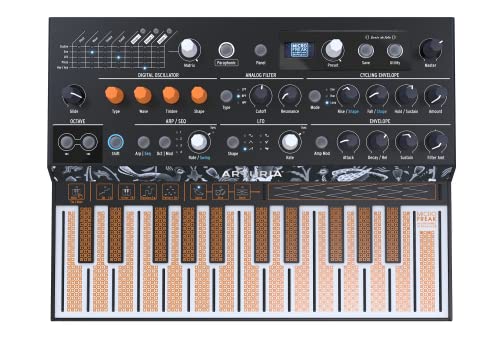
- 17 oscillator types cover diverse hybrid and experimental sounds.
- 25-key touch keyboard provides poly-aftertouch expression.
- CV, USB, and MIDI support flexible studio and modular connections.
Best For: Advanced experimental sound designers
Portable Performance Pick

- SH-101-inspired bass and lead sounds fit compact setups.
- Wave manipulation adds modern sound-design options.
- Onboard sequencing supports portable creative sessions.
Best For: Mobile creators and hands-on performers
Expanded Keyboard Pick
Arturia MiniFreak 37-Key Synth

- 37 keys provide a broader playing range in a compact design.
- Six-voice polyphony supports chords and melodic parts.
- Hybrid digital-and-analog sound profile offers flexible exploration.
Best For: Players wanting compact polyphonic keyboard control
Sampling Sound-Design Pick

- Built-in mic captures samples directly from the environment.
- Chopping, resampling, and chromatic playback support flexible performances.
- Granular controls enable detailed sample manipulation.
Best For: Portable sampling and custom loop creation
Retro Pocket Pick

- Pocket-sized analog synth with three octaves
- Touch-sensitive stylus interface is easy to learn
- Built-in speaker, headphone socket, and computer connectivity
Best For: Beginners and retro-sound enthusiasts
Minimalist Sound-Design Pick

- Compact 9.21 x 6.1 x 2.56-inch design
- Alloy-steel body in a glossy black finish
- MIDI connector for compatible external gear
Best For: Compact MIDI-based setups
Feature-Packed Portable Pick

- Six-operator FM engine with 32 algorithms
- 128 presets, effects, arpeggiator, and 16-step sequencer
- Battery-powered with speaker, keys, and three MIDI options
Best For: Portable sound design and electronic performance
Analog Polyphonic Powerhouse

- 37-key polyphonic analog synthesizer
- Two VCOs plus modulation matrix and dual ADSR envelopes
- Sequencer, arpeggiator, and polyphonic aftertouch
Best For: Expressive analog performance and studio sound design
Playful Portable Oddity

- Touch-sensitive stem with roughly four octaves per setting
- Wah and vibrato effects from squeeze and shake gestures
- 3.5mm output for headphones, speakers, and amplifiers
Best For: Fun gifts, family play, and unusual electronic performances
Travel FM Workstation

- Six-operator FM engine with 128 presets and 12-voice polyphony
- Sequencer, arpeggiator, six effects, and 145-parameter editing
- Bluetooth MIDI, USB-C, built-in speaker, and up to 12-hour battery
Best For: Portable music production and mobile electronic performance
Experimental Hybrid Pick – Arturia MicroFreak
The Arturia MicroFreak is a strong choice among compact synthesizers for adventurous sound designers who want extensive digital oscillator options, an analog filter, and expressive control in a lightweight 25-key format. Its modulation matrix, sequencer tools, and CV connectivity make it especially flexible for experimental setups.
Best For: Advanced users seeking hybrid synthesis, unusual textures, and modular or DAW integration.
Pros:
- Offers multiple oscillator modes spanning physical modeling, wavetable, vocoder, noise, and more.
- 25-key touch-plate keyboard supports individual pressure or poly-aftertouch control.
- Includes modulation-matrix routing, automation recording, Spice and Dice sequencing, CV, USB, and MIDI connectivity.
Cons:
- The touch-plate keyboard may feel less familiar than a traditional moving-key keyboard.
- Its advanced feature set is aimed at experienced users.
- It has only a 25-key range.
Choose the MicroFreak when sound exploration and hands-on experimentation matter more than conventional keyboard feel. Its compact size and broad connectivity make it a capable centerpiece for creative rigs.
Portable Performance Pick – Roland S-1 Tweak Synth
Roland AIRA Compact S-1 Tweak Synth | Ultra-Portable Micro Polysynth. Advanced Tools
Check Price On AmazonThe Roland AIRA Compact S-1 Tweak Synth is a practical option among compact synthesizers for portable beat-making and melodic performance. Inspired by the SH-101, it combines hands-on controls with wave manipulation, onboard sequencing, and a workflow designed to suit both beginners and experienced creators.
Best For: Portable basses, leads, sequencing, and quick hands-on sound creation.
Pros:
- Compact one-pound design is suited to mobile music-making.
- Provides SH-101-inspired bass and lead possibilities alongside futuristic wave manipulation.
- Includes onboard sequencing and performance-focused controls.
Cons:
- The supplied notes do not specify a built-in keyboard size or detailed connectivity beyond the product description.
- Its compact format may offer less physical control than a full-size synthesizer.
The S-1 is a sensible pick when portability and immediate interaction are priorities. It offers a focused way to explore classic-inspired sounds and modern sequencing without committing to a larger instrument.
Expanded Keyboard Pick – Arturia MiniFreak 37-Key Synth
Arturia MiniFreak 37 Key Polyphonic 6-Voice Hybrid Synthesizer Keyboard (Standard, 37 Key)
Check Price On AmazonThe Arturia MiniFreak is a good fit among compact synthesizers for players who want a larger 37-key keyboard without giving up a relatively portable hybrid design. Its six-voice polyphonic architecture and blend of digital and analog sound make it suited to exploring a wide range of playable tones.
Best For: Beginners and players who want polyphonic hybrid synthesis with a more usable keyboard range.
Pros:
- 37-key layout offers more playing room than many compact instruments.
- Six-voice polyphony supports chords and layered melodic parts.
- Hybrid digital-and-analog sound profile encourages broad sound exploration.
- Includes a MiniFreak VST counterpart for software integration.
Cons:
- It is larger and heavier than the MicroFreak, weighing 2.94 kg.
- The supplied details identify USB connectivity but do not list additional connection types.
Consider the MiniFreak if keyboard playability is more important than the smallest possible footprint. It balances a practical 37-key format with polyphony and hybrid synthesis for accessible experimentation.
Sampling Sound-Design Pick – Roland P-6 Creative Sampler
The Roland AIRA Compact P-6 Creative Sampler expands the compact synthesizers category with a pocket-size sampling workflow. Its built-in microphone, chopping and resampling tools, chromatic polyphonic playback, and granular controls make it useful for turning recorded sounds into playable instruments and custom loops.
Best For: Portable sample capture, loop creation, granular sound design, and hands-on sample performance.
Pros:
- Built-in microphone enables quick sampling without external equipment.
- Chop, step-sampling, resampling, and chromatic playback support flexible sample workflows.
- Dedicated filters and envelopes provide per-sample sound shaping.
- Granular parameters include detuning, head position, head speed, spread, and grains.
Cons:
- It is a sampler-focused instrument rather than a conventional keyboard synthesizer.
- Sample editing and import/export use the P-6 Sample Tool software on macOS or Windows.
- The supplied notes specify USB-C but do not detail other connections.
The P-6 is the strongest choice here for creators who build sounds from recordings rather than traditional oscillator patches. Its small footprint and built-in mic make spontaneous sampling especially convenient.
Retro Pocket Pick – Stylophone Original
The Stylophone Original is a distinctive choice among compact synthesizers, combining a pocket-friendly design with an iconic analog sound. Its touch-sensitive metal surface and stylus make it approachable for beginners while still offering a fun way for experienced musicians to add vintage character to a setup.
Best For: Beginners, portable play, retro-sound fans, and musicians seeking an unusual mini instrument.
Pros:
- Extremely compact design at less than 12 cm wide, with a built-in speaker and headphone socket.
- Offers three octaves, optional vibrato, and the Stylophone’s warm, vintage sound.
- Simple stylus-based playing method is easy to learn and engaging to use.
- Can connect to a computer or other gear through a 3.5mm stereo cable.
Cons:
- Runs on three AA batteries rather than a rechargeable battery.
- The stylus-and-touch-surface layout may not suit players seeking conventional keys.
Choose this model for character and simplicity rather than extensive sound design. Its compact size, built-in speaker, and memorable playing interface make it especially appealing for casual experimentation and portable music-making.
Minimalist Sound-Design Pick – Behringer PHARA-O MINI
The Behringer PHARA-O MINI is a straightforward option for shoppers comparing compact synthesizers for a small studio or portable rig. Its supplied specifications emphasize a compact alloy-steel build and MIDI connectivity, making it a focused choice for integrating with compatible music equipment.
Best For: MIDI-based setups and musicians who want a compact, metal-bodied synthesizer.
Pros:
- Compact footprint measuring 9.21 x 6.1 x 2.56 inches.
- Alloy-steel body offers a more substantial construction than a typical lightweight plastic enclosure.
- MIDI connector supports connection with compatible external gear.
Cons:
- The supplied notes do not specify its synthesis features, controls, presets, or built-in speaker.
- At 0.65 kg, it is less lightweight than the smallest pocket instruments.
This is best considered when physical construction and MIDI connectivity matter more than a long list of documented features. Buyers wanting detailed sound-engine information should verify the specifications before purchasing.
Feature-Packed Portable Pick – M-VAVE FM Synthesizer
The M-VAVE FM Synthesizer stands out among compact synthesizers by combining portable keys with a full FM engine and performance tools. Its battery operation, built-in speaker, 128 presets, effects, arpeggiator, sequencer, and multiple MIDI options make it suited to creating and playing away from a traditional studio.
Best For: Portable sound design, FM-synthesis learners, live experimentation, and producers needing flexible MIDI connections.
Pros:
- Six operators and 32 algorithms provide a substantial FM sound-design system.
- Includes 128 presets, six effects, a seven-mode arpeggiator, and a 16-step sequencer.
- Battery operation, built-in speaker, and 27 silicone keys support on-the-go use.
- Offers USB MIDI, wireless Bluetooth MIDI, and 3.5mm MIDI connectivity.
Cons:
- Its compact 27-key layout is not a full-size piano keyboard.
- The extensive FM architecture may be more involved than a beginner needs.
- Its plastic construction and silicone body may feel less substantial than metal-bodied alternatives.
This is the strongest all-around feature choice of the three for portable composing and electronic performance. It delivers considerably more sequencing, synthesis, and connectivity flexibility, while remaining small enough for battery-powered use.
Analog Polyphonic Powerhouse – Sequential Fourm
The Sequential Fourm is a substantial choice for shoppers seeking compact synthesizers with authentic analog polyphony and hands-on performance controls. Its 37-key design combines two VCOs, polyphonic aftertouch, a modulation matrix, dual ADSR envelopes, and built-in sequencing and arpeggiation.
Best For: Players and producers who want analog polyphony, expressive aftertouch, and a deeper keyboard-based workflow.
Pros:
- Polyphonic analog architecture with two VCOs
- 37-key layout with polyphonic aftertouch
- Includes a sequencer, arpeggiator, modulation matrix, and two ADSR envelopes
- Backed by a 2-year warranty
Cons:
- Its 28-inch width is less travel-friendly than truly pocket-sized synthesizers
- The supplied specifications list an HDMI connector, which may require checking compatibility with your setup
Choose the Fourm if expressive analog playing and broad sound-shaping control matter more than minimizing footprint. It is compact relative to larger keyboards, but its steel-and-plastic construction and 37-key format are better suited to a studio or dedicated performance space than casual travel.
Playful Portable Oddity – Otamatone Deluxe
The Otamatone Deluxe takes a very different approach to compact synthesizers, pairing a touch-sensitive stem with a distinctive character and simple physical controls. Players press and slide along the stem for pitch, squeeze the face for a wah effect, and shake it for vibrato.
Best For: Families, gift shoppers, and musicians who want a fun, unusual instrument with amplified performance options.
Pros:
- Touch-sensitive stem offers roughly four octaves across each pitch setting
- Wah and vibrato effects are controlled through expressive physical gestures
- 3.5mm stereo jack connects to headphones, speakers, and amplifiers
- Includes an aux cable, batteries, instruction manual, and strap
Cons:
- Its playful design and touch-stem layout are less conventional than a keyboard synthesizer
- Operation depends on batteries, with the supplied details listing three batteries
The Deluxe is best understood as an entertaining electronic instrument rather than a traditional production synthesizer. Its wider neck, larger size, and audio output make it more practical for learning songs and sharing performances while preserving the Otamatone’s intentionally quirky appeal.
Travel FM Workstation – M-VAVE FM-1 Orange
The M-VAVE FM-1 Orange is one of the most travel-ready compact synthesizers in this lineup. It combines six-operator FM synthesis, 128 presets, a sequencer, arpeggiator, effects, multiple MIDI options, a built-in speaker, and a rechargeable battery in a 27-key portable design.
Best For: Mobile producers, beginners, hobbyists, and performers who want an all-in-one FM workstation for practice and portable creation.
Pros:
- Six-operator FM engine with 32 algorithms, 12-voice polyphony, and 128 presets
- Built-in 16-step sequencer, seven-mode arpeggiator, and six effects
- USB-C, Bluetooth BLE MIDI, and 3.5mm MIDI connectivity
- 2000mAh battery provides up to 12 hours of play, with a built-in speaker and headphone output
Cons:
- The 27-key silicone keyboard uses octave shifting for its wider range
- Its extensive FM editing system may be more involved for beginners than preset-based use
- The listed warranty is one year
For creators who prioritize portability and integrated features, the FM-1 offers an unusually complete package. Its compact 251-gram body, wireless MIDI, battery power, and onboard production tools make it especially flexible for travel, quick sketches, and small live setups.
How We Picked the Best Compact Synthesizers
We focused on instruments that deliver meaningful sound-shaping or performance control in a genuinely portable format. The selection includes compact keyboards, pocket-sized groovebox-style synths, samplers, FM instruments, and approachable novelty options. We considered synthesis type, keyboard or touch controls, sequencing and effects, battery operation, connectivity, speaker availability, and overall usefulness for practice, production, travel, and live performance.
Because “compact” means different things to different musicians, the list includes both serious production tools and inexpensive instruments designed primarily for experimentation or fun. The right choice depends on whether you need a complete music-making device, a sound-design companion, or an easy introduction to synthesis.
Quick Comparison
| Best For | Look For |
|---|---|
| Versatile sound design | Hybrid or digital engines with modulation and effects |
| Portable beatmaking | Built-in sequencing, sampling, and battery power |
| Classic synth practice | Hands-on knobs, playable keys, and clear signal controls |
| FM synthesis | Multiple operators, algorithms, presets, and editing access |
| Beginners and casual players | Simple controls, built-in speaker, and low setup requirements |
Key Buying Factors for Compact Synthesizers
Synthesis Architecture
Analog instruments are often appealing for their direct controls and familiar oscillator-filter workflow. Digital and hybrid synths can provide broader timbral range, polyphony, samples, effects, and more complex modulation. FM synthesizers excel at precise metallic, bell-like, electric-piano, and percussive tones, but their deeper editing can take more practice.
Size, Keys, and Playability
A pocket device may travel easily but offer limited keys or touch controls. Larger compact keyboards are better for melodies, chords, and traditional playing, while small sequencer-oriented units favor pattern creation. Check the control layout, octave-shift options, velocity response, and whether an external MIDI controller can improve playability.
Sequencing, Sampling, and Effects
If you want one device for sketching complete ideas, prioritize a sequencer, arpeggiator, drum or sample functions, and onboard effects. A focused synthesizer may sound excellent but require a computer, MIDI controller, or other gear to build full arrangements.
Power and Connectivity
USB power, batteries, built-in speakers, MIDI, and audio connectivity all affect portability. Confirm whether the instrument supports the connections your setup uses, including headphones, a mixer, an audio interface, or wireless MIDI and audio where applicable.
Who Should Buy Which Compact Synthesizers?
Choose a feature-rich hybrid or polyphonic model if you want one compact instrument for sound design, chords, and studio work. A pocket sampler or sequencer-based synth is better for travel, beatmaking, and spontaneous idea capture. FM models suit producers who enjoy digital textures and detailed tone programming.
For beginners, casual players, and gift buyers, a simple pocket synthesizer or speaker-equipped instrument can provide immediate results with less setup. If live performance is the priority, favor reliable controls, readable displays, accessible pattern features, and outputs that integrate cleanly with your existing rig. Before buying, decide whether portability, synthesis depth, polyphony, or standalone operation matters most; no compact synth maximizes all four.