Choosing among the best synthesizers for recording depends on more than oscillator type. Your workflow, available space, preferred sounds, and need for hands-on control all shape which instrument will earn a place in your studio.
This roundup compares 10 options spanning analog, digital, hybrid, tabletop, portable, and workstation designs. Use the guide below to match features such as polyphony, sequencing, connectivity, and keyboard size to the way you actually make music.
Best 10 Synthesizers for Recording Picks for 2026
Experimental Hybrid Pick
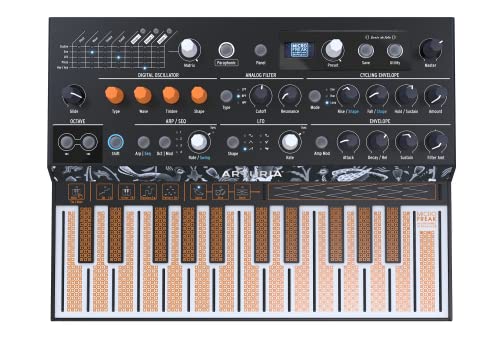
- Hybrid digital engines with a resonant analog filter
- Poly-aftertouch touch-plate keyboard
- CV, USB, MIDI, and creative sequencing tools
Best For: Experimental sound design and compact studio recording
Portable Chord Specialist

- Four-voice JUNO-60 synth engine
- 100 chord sets and 64-step chord sequencer
- USB-C audio and MIDI interface
Best For: Portable songwriting and chord-focused recording
Polyphonic Hybrid Choice

- Six-voice polyphonic hybrid synthesis
- 37-key keyboard for expanded playing range
- Includes a MiniFreak VST counterpart
Best For: Beginner-friendly polyphonic recording setups
Analog Bass Powerhouse

- Two wavefolding VCOs plus sub-oscillator
- 32 full-size velocity- and aftertouch-sensitive keys
- 64-step sequencer and 256 presets
Best For: Analog basses, leads, and expressive studio performance
Flexible MIDI Control

- 37-key controller with pads, knobs, and DAW transport controls
- CV/Gate and MIDI I/O for external synthesizers and modular gear
- Built-in 64-step sequencer plus MPC Beats software
Best For: Home studios needing versatile DAW and hardware control
Classic Digital Sound

- JD-800 sound modeling with 108 original waveforms
- Two-part polyphonic sequencer with motion recording
- Layering and recreated multi-effects in a compact module
Best For: Studio producers wanting classic Roland-style digital synthesis
Portable Standalone Play

- Built-in speaker and over 100 drum and instrument sounds
- 25 mini keys, eight MPC pads, arpeggiator, and four knobs
- Battery or USB power with MIDI controller functionality
Best For: Portable songwriting, beat making, and quick recording sketches
Portable FM Creativity
M-VAVE Wireless FM Synthesizer

- Six-operator FM engine with 32 algorithms
- Battery-powered with speaker and 27 keys
- Effects, sequencer, presets, and triple MIDI
Best For: Portable FM sound design and recording sketches
Full Workstation Workflow

- 61-key synth-action workstation
- Step and MIDI sequencers included
- Mic/line inputs and audio recorder
Best For: Studio production with a full-range keyboard
Compact FM Pattern Maker

- Six-operator FM with 128 presets
- Rechargeable battery and built-in speaker
- 16-step sequencer, effects, and triple MIDI
Best For: Portable FM pattern creation and mobile recording ideas
Experimental Hybrid Pick – Arturia MicroFreak
If you want synthesizers for recording that encourage unusual textures and hands-on experimentation, the Arturia MicroFreak is a compact, highly flexible choice. Its digital oscillator engines, analog filter, touch-sensitive 25-key keyboard, modulation matrix, and CV, MIDI, and USB connectivity make it well suited to sound design and DAW-based production.
Best For: Producers who want experimental hybrid sounds, sequencing tools, and flexible connections in a lightweight desktop-friendly keyboard.
Pros:
- Offers numerous oscillator modes, including wavetable, physical modeling, vocoder, and Noise Engineering options.
- 25-key touch-plate keyboard provides poly-aftertouch and individual note pressure sensitivity.
- Includes automation recording, Spice and Dice sequencing, randomization, and a 5×7 modulation matrix.
- Supports CV pitch, gate, and pressure alongside USB and MIDI connections.
Cons:
- The 25-key touch-plate design may feel less familiar than a conventional moving-key keyboard.
- Its advanced modulation and sequencing features may require a learning period.
The MicroFreak stands out when creative sound exploration matters more than traditional keyboard feel. It is a particularly strong recording option for evolving patterns, unconventional timbres, and hybrid signal-chain experimentation.
Portable Chord Specialist – Roland AIRA Compact J-6
The Roland AIRA Compact J-6 is a practical option for synthesizers for recording when portability and fast chord creation are priorities. Its four-voice JUNO-60 engine, chord library, programmable chord sequencer, arpeggios, effects, and USB-C audio/MIDI interface support quick songwriting and mobile production.
Best For: Songwriters and producers who want compact JUNO-style sounds, ready-made chord progressions, and plug-and-play computer connectivity.
Pros:
- Uses Roland’s ACB technology to provide a four-voice JUNO-60 synth engine.
- Includes 100 chord sets, 64 user patterns, and sequences of up to 64 steps.
- Provides nine arpeggio and phrase styles with 12 variations each.
- Offers delay, reverb, audio/MIDI/sync I/O, and a class-compliant USB-C interface.
Cons:
- Its compact format is focused on chord-based creation rather than full keyboard performance.
- The plastic body may feel less substantial than larger studio synthesizers.
The J-6 is especially useful for generating chord ideas, rhythmic phrases, and polished sketch tracks without a large setup. Its battery-powered portable design and USB-C interface make it convenient for recording away from a traditional studio.
Polyphonic Hybrid Choice – Arturia MiniFreak
Arturia MiniFreak 37 Key Polyphonic 6-Voice Hybrid Synthesizer Keyboard (Standard, 37 Key)
Check Price On AmazonFor producers looking for synthesizers for recording with broader keyboard playability, the Arturia MiniFreak combines a 37-key format with a six-voice polyphonic hybrid design. Its digital-and-analog sound profile and included VST counterpart make it suitable for creating layered parts both in hardware and software workflows.
Best For: Beginners and producers who want a portable polyphonic hybrid synthesizer with a larger key range and matching software instrument.
Pros:
- Provides six-voice polyphony for chords and layered musical parts.
- Offers 37 keys, giving performers more range than compact 25-key instruments.
- Combines digital and analog synthesis characteristics in a portable format.
- Includes a MiniFreak VST counterpart for integrated computer-based production.
Cons:
- The supplied specifications provide limited detail about its onboard controls and connection options beyond USB.
- Its hybrid workflow may be less focused than a dedicated analog monosynth or specialist chord machine.
The MiniFreak is a balanced choice for recording setups that need polyphony, a practical key range, and hardware/software flexibility. It offers an approachable entry point while retaining the broad character associated with hybrid synthesis.
Analog Bass Powerhouse – Moog Messenger
The Moog Messenger is a strong candidate among synthesizers for recording when rich monophonic basses, leads, and expressive keyboard parts are the goal. Its two wavefolding VCOs, sub-oscillator, resonant ladder filter, full-size keys, presets, sequencer, and extensive modulation options provide a substantial studio sound-design platform.
Best For: Producers and performers seeking a hands-on analog monosynth for bass-heavy parts, expressive leads, and detailed sound shaping.
Pros:
- Two variable-shape VCOs, sync, frequency modulation, and a sub-oscillator support weighty sounds.
- Four- or two-pole ladder filter offers low-pass, band-pass, and high-pass responses with resonance bass compensation.
- 32 full-size semi-weighted keys include velocity and aftertouch.
- Features a 64-step sequencer, arpeggiator, 256 presets, CV patch points, MIDI, and USB-C MIDI.
Cons:
- As a monophonic synthesizer, it is not designed for playing polyphonic chords.
- Its larger, heavier format is less portable than compact synthesizer units.
The Messenger is built for producers who want classic Moog-style analog authority with modern performance and sequencing features. Its expressive keys and flexible filter and modulation architecture make it especially compelling for recorded basslines and lead parts.
Flexible MIDI Control – Akai MPK Mini Plus
The Akai Professional MPK Mini Plus is a strong controller choice for producers shopping for synthesizers for recording. Its 37-key layout, DAW controls, pads, knobs, and CV/Gate and MIDI connectivity make it useful for both software-based production and compatible external gear.
Best For: Home-studio producers who want hands-on control of a DAW, modular equipment, sound modules, and synthesizers.
Pros:
- 37 velocity-sensitive keys provide three octaves for melodic and chord performance.
- CV/Gate and MIDI I/O expand connection options beyond a computer.
- Built-in 64-step sequencer supports separate drum and melodic or chord tracks.
- Includes MPC Beats, two months of Splice, and a choice of Komplete 15 Select bundles.
Cons:
- It is a MIDI keyboard controller rather than a standalone synthesizer with built-in sounds.
- USB connectivity is required for computer-based operation.
Choose the MPK Mini Plus when recording workflow and broad control matter more than having an onboard sound engine. The extra keys and external-gear connections give it more room to grow than a basic mini controller.
Classic Digital Sound – Roland JD-08 Boutique
The Roland JD-08 is a compact tabletop sound module for recording setups that need a dedicated synthesizer voice. It recreates the JD-800’s sound and behavior with 108 waveforms, extensive effects, and sequencing features in a small desktop format.
Best For: Producers seeking modeled Roland JD-800 tones, layered patches, and compact tabletop synthesis for studio recording.
Pros:
- Advanced sound modeling recreates the original JD-800 behavior.
- Includes 108 waveforms, original presets, and new presets for patch design.
- Two-part, 64-step polyphonic sequencer includes motion recording and pattern memory.
- Four-part structure and detailed multi-effects section support layered sounds.
Cons:
- The K-25M keyboard is sold separately.
- Its compact tabletop design requires integration with a separate keyboard or controller for hands-on playing.
The JD-08 is particularly appealing if you want a focused sound module rather than a general-purpose controller. Its sequencer, arpeggiator, layered structure, and onboard effects provide substantial sound-design options despite the compact chassis.
Portable Standalone Play – Akai MPK Mini Play MK3
The Akai Professional MPK Mini Play MK3 combines a 25-key MIDI controller with built-in sounds and a speaker, making it a convenient option for recording on the move. For creators exploring synthesizers for recording, it offers synth leads, pads, drum sounds, an arpeggiator, and computer connectivity in a compact package.
Best For: Beat makers, songwriters, and musicians who want portable standalone sounds alongside USB MIDI control.
Pros:
- Over 100 internal drum and instrument sounds include synth leads, pads, and piano sounds.
- Built-in speaker and battery operation support portable music making.
- Offers 25 dynamic mini keys, eight MPC pads, an OLED display, and four encoder knobs.
- Includes MPC Beats, AIR Music Tech instruments, Melodics lessons, and two months of Splice.
Cons:
- Batteries are not included.
- The 25-key layout provides less range than a larger keyboard.
- Its built-in sounds are intended for compact convenience rather than the dedicated synthesis depth of a tabletop sound module.
Pick the MPK Mini Play MK3 when portability and immediate playability are priorities. Its internal sounds and speaker let you sketch ideas without a computer, while USB MIDI keeps it useful in a conventional recording setup.
Portable FM Creativity – M-VAVE Wireless FM Synthesizer
For musicians seeking synthesizers for recording that can also travel easily, the M-VAVE FM Synthesizer combines a six-operator FM engine with battery operation, a built-in speaker, and compact controls. Its 128 presets, effects, arpeggiator, and MIDI connectivity make it a flexible sketching and sound-design tool.
Best For: Portable recording ideas, FM sound exploration, and producers who want a compact MIDI-capable instrument.
Pros:
- Six operators and 32 algorithms provide genuine FM sound design options.
- Battery power and a built-in speaker support cable-free practice and idea capture.
- Includes 128 presets, six effects, a seven-mode arpeggiator, and a 16-step sequencer.
- USB, Bluetooth, and 3.5mm MIDI connections support controller and sound-module use.
Cons:
- The 27-key silicone keyboard is compact rather than a full-size keybed.
- Its FM-focused design may be less immediate for shoppers seeking broad workstation-style sounds.
This is a strong choice when portability and classic digital FM tones matter more than a traditional studio keyboard layout. SYSEX import and multiple MIDI options also give it useful room to fit into a recording setup.
Full Workstation Workflow – Korg Kross 2-61
The Korg Kross 2-61 is aimed at creators who want synthesizers for recording with a larger keyboard and workstation-oriented features. Its 61-key synth-action keybed, EDS-i sound engine, sequencing tools, and audio recorder make it the most comprehensive production-focused option in this group.
Best For: Studio musicians who need a 61-key instrument with sequencing, MIDI, microphone or line inputs, and audio recording.
Pros:
- 61-key synth-action keybed offers more playing range than the compact alternatives.
- EDS-i sound engine supports a broad workstation-style workflow.
- Includes step and MIDI sequencers for arranging ideas.
- Mic/line inputs and an audio recorder support more integrated production.
Cons:
- It is substantially larger and heavier than the portable M-VAVE instruments.
- The supplied notes do not specify battery operation or a built-in speaker.
Choose the Kross 2-61 when recording flexibility and hands-on keyboard range take priority over portability. Its workstation design is better suited to a permanent studio or performance setup than casual mobile use.
Compact FM Pattern Maker – M-VAVE FM-1
The M-VAVE FM-1 suits producers looking for synthesizers for recording that encourage quick pattern creation away from a full studio rig. It pairs six-operator FM synthesis and 128 presets with a rechargeable battery, built-in speaker, color TFT display, and 16-step sequencer.
Best For: Mobile beat and melody sketches, compact FM production, and users who want a portable controller or sound module.
Pros:
- Six operators, 32 algorithms, and SYSEX import offer substantial FM-focused sound variety.
- Rechargeable battery and built-in speaker enable cable-free use.
- 27 keys, six effects, a seven-mode arpeggiator, and a 16-step sequencer encourage hands-on creation.
- USB, Bluetooth, and 3.5mm MIDI can operate together for flexible integration.
Cons:
- The compact 27-key silicone keyboard may not suit two-handed playing.
- Its digital FM architecture is more specialized than a broad workstation sound engine.
The FM-1 is a practical grab-and-go sketchpad for electronic musicians who value immediate sequencing and classic FM timbres. Its display and multiple MIDI modes make it easier to move ideas from portable sessions into a larger recording workflow.
How We Picked the Best Synthesizers for Recording
We evaluated these instruments by looking at the features that matter in a real recording setup: sound-generation options, playable range, polyphony, sequencing, portability, connectivity, and workflow. We also considered whether each model is best suited to software-based production, hands-on hardware recording, live sketching, or complete workstation use.
The selection includes true synthesizers, sound modules, compact song-creation machines, and MIDI keyboard controllers. Controllers do not generate sounds by themselves, but they can be excellent choices when your computer, virtual instruments, or hardware modules form the center of your studio.
Quick Comparison
| Best For | Recommended Type | What to Prioritize |
|---|---|---|
| Learning synthesis | Compact digital or hybrid synth | Accessible controls and presets |
| Analog bass and leads | Monophonic analog synth | Oscillator character and filter control |
| Chord-based production | Polyphonic synth or chord machine | Voice count and sequencing |
| Computer-based recording | MIDI controller | Key feel, pads, knobs, and DAW integration |
| Complete hardware studio | Workstation or multitimbral keyboard | Sound library, storage, and arrangement tools |
Key Buying Factors for Synthesizers for Recording
Sound Engine and Polyphony
Analog instruments are often favored for immediate basses, leads, and rhythmic sequences, while digital and hybrid models can offer broader timbral variety, effects, and complex modulation. Polyphony determines how many notes can sound simultaneously; monophonic models excel at focused lines, while polyphonic instruments are more practical for chords, pads, and layered arrangements.
Keyboard, Sequencer, and Performance Controls
Choose a key count that fits your playing style and space. Compact keyboards are portable and efficient for bass lines or programming, whereas 61-key models are more comfortable for two-handed parts. A built-in sequencer can turn a tabletop synth into a self-contained sketchpad, while pads, arpeggiators, and assignable knobs make software recording faster.
Connections and Studio Workflow
Check for USB MIDI, traditional MIDI, audio outputs, sustain-pedal support, and compatibility with your recording setup. A sound module may save space but requires an external controller. A MIDI keyboard requires software or another sound source, while a synthesizer with audio outputs can record directly into an interface.
Portability and Power
Battery-powered instruments and compact groove-oriented designs are useful for travel, songwriting, and quick ideas away from the desk. For a permanent studio, larger controls, a stronger keybed, and dedicated outputs may be more valuable than minimal size.
Who Should Buy Which Synthesizers for Recording?
Beginners and experimental producers: Start with a compact synth that offers accessible controls, presets, and sequencing without overwhelming complexity.
Electronic musicians focused on bass and leads: Choose a monophonic analog instrument when hands-on filter work and focused single-note sounds are priorities.
Chord and pad players: A polyphonic or chord-focused synth is the better fit for harmonic parts, evolving textures, and layered arrangements.
DAW-first producers: A USB MIDI controller makes sense if your main sounds come from software and you want keys, pads, and knobs without another audio source.
Players building an all-in-one setup: Consider a workstation when you need a broad sound library, many keys, sequencing, and self-contained arrangement capabilities.