Travel-friendly synthesizers make it easier to sketch ideas in hotel rooms, backstage, on trains, or anywhere inspiration strikes. The best options balance expressive controls and useful sound-shaping features with a compact design, dependable power options, and a workflow you can learn quickly.
This roundup compares 10 portable synthesizers for traveling musicians, including keyboard-style instruments, groove-focused devices, ribbon synths, and compact digital models. Use the guide below to narrow your choice based on portability, sound engine, sequencing needs, and performance style.
Best 10 Synthesizers for Traveling Musicians Picks for 2026
Portable Performance Pick

- Analog physical-modeling engine with 8-note polyphony
- 37-key mini keyboard and phrase looper
- Battery powered with built-in speakers
Best For: Traveling performers who prioritize playable keys and self-contained operation
Ultra-Compact Sound Explorer

- One-pound micro polysynth design
- SH-101-inspired bass and lead sounds
- Hands-on controls with sequencing and wave manipulation
Best For: Travelers who want a tiny instrument for mobile sound exploration
Experimental Hybrid Choice
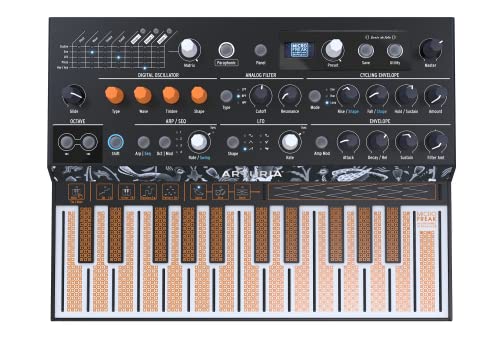
- Hybrid engine with extensive oscillator modes
- 25-key surface with polyphonic aftertouch
- Sequencing, CV, USB, and MIDI connectivity
Best For: Advanced travelers focused on experimental sound design and expressive control
All-in-One Mobile Idea Station

- Combines drums, synths, sampling, and sequencing
- Built-in speaker and microphone
- Rechargeable battery for mobile creation
Best For: Traveling songwriters and producers building complete ideas on the go
Compact Sound Design

- Compact 9.21 x 6.1 x 2.56-inch design
- Lightweight 0.65 kg alloy-steel body
- MIDI connector for compatible gear
Best For: Portable sound-design setups
Portable FM Performance

- Six-voice, six-operator FM synthesis
- 16-step sequencer with motion sequencing
- Battery-powered with built-in speakers
Best For: On-the-go FM sequencing and performance
Hands-On Analog Exploration

- Lightweight 6.4-ounce design
- Analog sound profile with ribbon control
- Includes a case for easier transport
Best For: Tactile analog sound exploration
Best All-in-One FM Pick
M-VAVE Wireless Portable FM Synthesizer

- Battery-powered with built-in speaker
- Six-operator FM engine with 128 presets
- Effects, sequencer, arpeggiator, and three MIDI options
Best For: Travel players wanting a self-contained FM synth
Best for Instant Analog Character

- Battery power and built-in speaker
- Classic analog-style filter
- Ribbon control, pitch LFO, and delay
Best For: Portable analog textures and hands-on experimentation
Best Hybrid Sequencing Option
Behringer Pro VS Mini Portable Hybrid Synth

- Battery or USB-powered portable design
- Vector morphing and wavetable synthesis
- 16-step sequencer and arpeggiator
Best For: Mobile producers building sequenced hybrid patches
Portable Performance Pick – Yamaha REFACE CS
For synthesizers for traveling musicians, the Yamaha REFACE CS balances hands-on performance with a genuinely portable design. Its 37-key mini keyboard, built-in speakers, battery power, and phrase looper make it practical for rehearsals, songwriting, and spontaneous playing away from a full studio.
Best For: Traveling players who want expressive keys, onboard sound, and flexible analog-modeling tones.
Pros:
- Analog physical-modeling engine with multiple synthesis and oscillator types.
- 8-note polyphony supports chords and pads, while mono mode suits bass and lead sounds.
- Built-in speakers, battery power, and phrase looper support mobile idea capture.
- 37-key HQ mini keyboard offers a more natural performance surface than many compact synths.
Cons:
- At 6 pounds and nearly 30 inches wide, it is less compact than micro-sized alternatives.
- The 37-key mini format may still be limiting for players who prefer full-size keys.
The REFACE CS is a strong choice when portability should not mean giving up a playable keyboard. Its speaker system and looper add convenience, while the sound engine provides enough range for live parts and developing song ideas.
Ultra-Compact Sound Explorer – Roland AIRA Compact S-1
Roland AIRA Compact S-1 Tweak Synth | Ultra-Portable Micro Polysynth. Advanced Tools
Check Price On AmazonThe Roland AIRA Compact S-1 is a compelling option among synthesizers for traveling musicians who value minimal size and immediate sound creation. Weighing about 1 pound and measuring roughly 10.25 by 6.6 by 3.5 inches, it is designed for portable experimentation with hands-on controls, sequencing, and wave manipulation.
Best For: Mobile creators seeking a lightweight micro polysynth for basses, leads, sequences, and sound exploration.
Pros:
- Very compact and lightweight for travel.
- Inspired by the Roland SH-101 sound and workflow.
- Combines hands-on controls with onboard sequencing and wave manipulation.
- Suitable for both beginners and experienced synth users.
Cons:
- Its micro format may be less comfortable for extended traditional keyboard performance.
- The supplied notes do not specify a built-in speaker, battery operation, or keyboard dimensions.
The S-1 focuses on portable inspiration rather than a conventional keyboard experience. Its small footprint makes it easy to carry, while the sequencing and performance features help turn travel time into productive music-making sessions.
Experimental Hybrid Choice – Arturia MicroFreak
For musicians who want synthesizers for traveling musicians with unusual sound-design potential, the Arturia MicroFreak packs a broad hybrid engine into a 2.3-pound instrument. Its 25-key touch-sensitive surface, digital oscillator modes, analog filter, sequencer, and flexible connectivity make it particularly capable for experimental composition and performance.
Best For: Advanced traveling musicians who want expressive touch control, evolving sequences, and distinctive hybrid sounds.
Pros:
- Offers numerous oscillator modes spanning physical modeling, wavetable, vocoder, and other textures.
- 25-key PCB keyboard provides polyphonic aftertouch and pressure sensitivity.
- Sequencer includes automation recording, step editing, Spice and Dice, and randomization.
- Supports CV, USB, MIDI, audio output, and headphone connections.
Cons:
- The touch-plate keyboard may feel unfamiliar to players expecting moving keys.
- Requires DC power according to the supplied specifications.
- Its advanced modulation and synthesis options may have a steeper learning curve.
The MicroFreak is less about traditional portability features and more about carrying a deep creative toolkit. It is a strong fit for sound designers who can work with its unconventional keyboard and want extensive sequencing and connectivity in a compact body.
All-in-One Mobile Idea Station – Yamaha SEQTRAK
The Yamaha SEQTRAK approaches synthesizers for traveling musicians as a complete mobile music workstation. It combines drums, synths, sound design, sequencing, sampling, built-in speakers, a microphone, and a rechargeable battery in a compact, lightweight design suited to capturing ideas wherever they happen.
Best For: Songwriters and producers who want to sketch complete arrangements without carrying separate drums, synths, and recording tools.
Pros:
- All-in-one system includes drums, synths, sound design, and sequencing.
- Advanced sequencer supports composition, arrangement, and dynamic playback.
- Built-in speaker, microphone, and rechargeable battery support mobile creation.
- Onboard sampler can capture sounds from the surrounding environment.
Cons:
- Its workflow is centered on sequencing and production rather than a traditional keyboard performance.
- The supplied notes do not provide key count, weight, or specific connectivity details.
The SEQTRAK is especially practical for travelers who want to develop full musical ideas instead of carrying a single sound module. Its integrated sampling, microphone, speaker, and battery reduce the amount of additional equipment needed for mobile sessions.
Compact Sound Design – PHARA-O MINI
For musicians comparing synthesizers for traveling musicians, the Behringer PHARA-O MINI is a compact option with a glossy black finish, alloy-steel construction, and a footprint of 9.21 x 6.1 x 2.56 inches. Its MIDI connector supports integration with compatible gear while keeping the setup easy to transport.
Best For: Traveling musicians who want a small, lightweight synth for compact sound-design setups.
Pros:
- Compact dimensions for portable rigs
- Lightweight 0.65 kg construction
- Alloy-steel body with glossy finish
- MIDI connectivity for compatible equipment
Cons:
- The supplied notes do not specify built-in speakers or battery operation
- Sound-generation features are not detailed in the supplied information
The PHARA-O MINI makes the most sense when portability and basic MIDI integration matter more than a long list of documented features.
Portable FM Performance – Volca FM2
The Korg Volca FM2 is a strong choice among synthesizers for traveling musicians who want substantial sequencing and sound-shaping features in a compact format. It combines six-voice, six-operator FM synthesis with a 16-step sequencer, built-in effects, MIDI connectivity, speakers, and battery-powered operation.
Best For: Musicians creating and sequencing FM sounds on the go, whether practicing, performing, or sketching ideas away from the studio.
Pros:
- Six-voice, six-operator FM synthesis with classic DX7 algorithms
- 16-step sequencer with motion sequence, Pattern Chain, and arpeggiator functions
- Built-in chorus and reverb effects
- Built-in speakers and battery-powered operation for unplugged use
Cons:
- The 16-step sequencer may be limiting for longer arrangements
- FM synthesis can require more sound-design familiarity than simpler architectures
With its compact 7.6 x 4.53 x 1.65-inch body and 14.1-ounce weight, the Volca FM2 offers one of the most travel-ready feature sets in this group.
Hands-On Analog Exploration – monotron DUO
The Korg monotron DUO is a compact analog ribbon synthesizer suited to traveling musicians who value quick, hands-on experimentation. Its 6.4 x 1.6 x 9.2-inch form factor, 6.4-ounce weight, auxiliary connector, and included case make it easy to carry as part of a portable creative setup.
Best For: Musicians seeking a lightweight analog instrument for simple, tactile sound exploration and modulation.
Pros:
- Very light 6.4-ounce design
- Analog sound profile for hands-on experimentation
- Compact form factor with included case
- Simple interface for quick adjustments
Cons:
- The supplied notes provide limited detail about synthesis controls
- Auxiliary connectivity may be less versatile than MIDI for some setups
The monotron DUO is best viewed as a highly portable creative instrument rather than a full-featured sequencing workstation, making it appealing for spontaneous analog exploration.
Best All-in-One FM Pick – M-VAVE Wireless Portable FM Synthesizer
For musicians seeking synthesizers for traveling musicians, the M-VAVE FM Synthesizer combines battery operation, a built-in speaker, compact dimensions, and 27 silicone keys. Its FM engine, effects, arpeggiator, and sequencer provide substantial sound-shaping potential without requiring a larger setup.
Best For: Travel-friendly players who want an independent FM instrument with presets, sequencing, and multiple MIDI options.
Pros:
- Battery-powered design with a built-in speaker for playing away from a studio.
- Six-operator FM synthesis, 32 algorithms, and 128 factory presets.
- Includes six effects, a 16-step sequencer, arpeggiator, and USB, Bluetooth, and 3.5mm MIDI connectivity.
Cons:
- The compact 27-key silicone keyboard may not suit players who prefer full-size keys.
- Its many synthesis and performance features may take time to learn.
This is the most feature-packed travel option in the group, especially if you want a self-contained instrument rather than a simple sound toy. The FM architecture and MIDI flexibility also leave room to integrate it into a larger mobile rig.
Best for Instant Analog Character – Korg Monotron Delay
The Korg Monotron Delay is a highly compact choice among synthesizers for traveling musicians. Battery power, a built-in speaker, and a ribbon controller make it easy to carry, while its analog filter, pitch LFO, and delay focus on immediate, hands-on sound experimentation.
Best For: Musicians who want portable analog-style textures, effects, and expressive ribbon control.
Pros:
- Battery-powered and equipped with a built-in speaker for go-anywhere use.
- Uses an analog filter taken from the classic MS-10 and MS-20.
- Provides delay controls, a pitch LFO, and a wide-range ribbon controller.
Cons:
- The ribbon controller is not a conventional piano-style keyboard.
- Its feature set is focused on analog sound shaping rather than broad preset-based production.
The Monotron Delay is best viewed as a portable sound-design instrument and performance companion. Choose it when tactile control and distinctive analog-style echoes matter more than polyphonic sequencing or extensive connectivity.
Best Hybrid Sequencing Option – Behringer Pro VS Mini Portable Hybrid Synth
The Behringer Pro VS Mini suits musicians looking for synthesizers for traveling musicians with more structured sequencing and hybrid synthesis features. Its small battery-or-USB-powered design includes four vector morphing oscillators per voice, an analog low-pass filter, a 16-step sequencer, and an arpeggiator.
Best For: Mobile producers who want a compact hybrid synth module with vector morphing, sequencing, and arpeggiation.
Pros:
- Portable format with battery or USB power.
- Combines wavetable and vector morphing synthesis with an analog low-pass filter.
- Includes a 16-step sequencer, arpeggiator, sync input, and headphone output.
Cons:
- The supplied specifications describe it as a small module, so it may require external equipment for a broader playing setup.
- Its listed 27 keys are compact rather than full-size.
With its hybrid architecture and built-in sequencing tools, the Pro VS Mini offers a different travel workflow from the simpler Monotron. It is a strong fit for creating evolving patches and rhythmic patterns in a compact, computer-compatible setup.
How We Picked These Synthesizers for Traveling Musicians
We focused on instruments that are genuinely practical away from a studio: compact dimensions, manageable weight, flexible power options, fast setup, and enough hands-on control for sketching or performing. The selection includes battery-powered and USB-powered models, devices with built-in speakers, and instruments that can connect easily to headphones, mixers, computers, or mobile devices.
We also considered workflow variety. Some travelers need a playable keyboard, while others prioritize sequencing, sampling, FM synthesis, analog-style sound design, or an ultra-small instrument for spontaneous experimentation. Because portability means different things to different musicians, no single model is ideal for every use case.
Quick Comparison
| Best For | Look For |
|---|---|
| Portable keyboard performance | Usable keys, expressive controls, and comfortable access to sound-shaping parameters |
| Beat making and full song sketches | Sequencing, sampling, pattern storage, and quick arrangement tools |
| Experimental sound design | Flexible modulation, unusual interfaces, and broad oscillator options |
| Maximum portability | Small footprint, battery operation, built-in speaker, and minimal setup |
| Vintage-inspired synthesis | Analog or analog-modeling architecture with direct hands-on controls |
Key Buying Factors for Synthesizers for Traveling Musicians
Size, Weight, and Power
Measure the instrument against your actual travel setup, not just its listed dimensions. A compact synthesizer is more useful if it fits beside a laptop and does not require a bulky power supply. Battery operation is valuable for transit and outdoor use, while USB power can simplify a mobile rig. Check whether batteries, cables, and adapters are included.
Sound Engine and Controls
Choose the synthesis style that matches how you create. Analog and analog-modeling instruments tend to offer immediate, hands-on tone shaping. FM and hybrid designs can produce brighter, more complex textures, but may require more programming. Ribbon controllers and unconventional interfaces are excellent for improvisation, though they may be less precise than standard keys.
Sequencing, Sampling, and Connectivity
If you want to develop complete ideas while traveling, prioritize a sequencer, pattern memory, sampling, or multiple tracks. Confirm the available audio and MIDI connections, headphone support, synchronization options, and compatibility with your phone, tablet, or laptop. Built-in speakers are convenient for quick practice but should not replace proper monitoring for final mixing.
Who Should Buy Which Synthesizers for Traveling Musicians?
Choose a compact keyboard synthesizer if playing melodies and chords is central to your workflow. A groovebox-style model is better for travelers who want to build rhythmic arrangements and save song ideas without carrying additional equipment. Digital FM and hybrid synthesizers suit musicians seeking distinctive, detailed timbres in a small package.
For casual experimentation, teaching, or ultra-light travel, a tiny ribbon synthesizer can be the easiest option to pack. These are best viewed as inspirational instruments rather than complete production centers. Finally, select a model with deeper sequencing and connectivity if you expect to integrate it into a laptop-based live set or a larger hardware setup.