Finding the right synthesizer under $1,000 means balancing sound design depth, keyboard feel, portability, and workflow. The options in this roundup cover compact instruments, expressive hybrid designs, classic analog voices, and practical performance keyboards.
Whether you are building a first hardware setup or adding a distinctive voice to an existing studio, these picks highlight the features that matter most at this price.
Best 10 Synthesizers Under 1000 Picks for 2026
Hybrid Sound Explorer

- 37-key portable hybrid synthesizer
- Digital-and-analog sound profile
- Includes MiniFreak VST counterpart
Best For: Beginners exploring hardware and software sound design
Portable FM Performer

- Four-operator FM sound engine
- Battery powered with built-in speakers
- Phrase looper and 32 voice memories
Best For: Mobile players and FM synthesis enthusiasts
Experimental Sound Lab
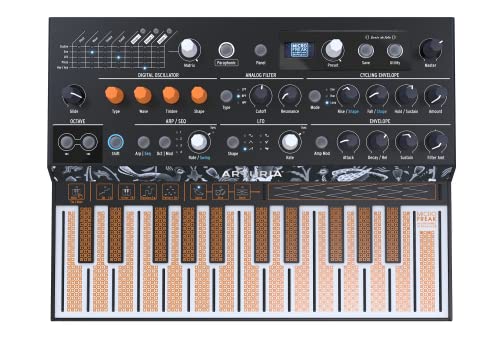
- Hybrid oscillator and analog-filter design
- 25-key poly-aftertouch touch keyboard
- CV, USB, and MIDI connectivity
Best For: Advanced experimental sound designers
Analog Polyphonic Powerhouse

- Four VCOs with classic ladder filter
- Four-voice mono, unison, and poly modes
- Full-size keys, sequencer, and arpeggiator
Best For: Studio players wanting warm analog tones and full-size keys
Best Live-Performance Synth

- 61-note portable keyboard
- Over 3,800 ZEN-Core sounds
- USB-C, sample import, and sequencing
Best For: Gigging keyboardists and versatile home studios
Best Experimental Analog Synth

- Dual VCOs with subharmonic generators
- Four rhythm generators and two sequencers
- Tabletop or 60HP Eurorack format
Best For: Modular musicians and experimental sound designers
Best Pocket Synth

- Pocket-sized retro synthesizer
- Stylus control with three octaves
- Battery-powered with speaker and headphone output
Best For: Beginners, collectors, and portable music-making
Premium Analog Power

- Two wavefolding VCOs plus sub-oscillator
- Expressive 32-key keyboard with aftertouch
- Sequencer, CV, MIDI, and USB-C connectivity
Best For: Analog basses, leads, and advanced sound design
Portable FM Creativity
M-VAVE Wireless FM Synthesizer

- Battery operation and built-in speaker
- Six-operator FM engine with 32 algorithms
- Effects, arpeggiator, sequencer, and MIDI options
Best For: Portable practice, beginners, and mobile music making
Hands-On Analog Character

- Fully analog Brute oscillator architecture
- Steiner-Parker filter and patchable mod matrix
- Compact, knob-focused workflow
Best For: Hands-on analog leads, percussion, and experimentation
Hybrid Sound Explorer – Arturia MiniFreak
Arturia MiniFreak 37 Key Polyphonic 6-Voice Hybrid Synthesizer Keyboard (Standard, 37 Key)
Check Price On AmazonThe Arturia MiniFreak is a strong option among synthesizers under 1000 for players who want a portable 37-key instrument with a hybrid digital-and-analog sound profile. Its included VST counterpart also makes it useful for connecting hardware and software workflows.
Best For: Beginners and electronic musicians seeking an approachable, portable hybrid synthesizer.
Pros:
- 37-key format balances playability with portability.
- Hybrid digital-and-analog sound profile supports varied sonic exploration.
- Includes a MiniFreak VST counterpart for software integration.
Cons:
- Uses corded electric power rather than battery operation.
- The supplied notes do not specify onboard speakers or a built-in looper.
Choose the MiniFreak if you want a compact, beginner-friendly keyboard that encourages experimentation while offering a practical USB connection and companion software.
Portable FM Performer – Yamaha REFACE DX
The Yamaha REFACE DX stands out among synthesizers under 1000 for portable FM synthesis, with a 37-key mini keyboard, battery power, built-in speakers, and phrase looping. It is designed for playing and capturing ideas away from a full studio setup.
Best For: Players who want expressive FM sounds, portable operation, and quick idea capture.
Pros:
- Four-operator FM sound engine delivers dynamic, expressive tones.
- 32 voice memory locations allow favorite voices to be stored and recalled.
- Battery power, built-in speakers, and a phrase looper support mobile playing.
- 37-key mini keyboard offers initial-touch response.
Cons:
- Mini keys may not suit players who prefer full-size keys.
- Its connectivity is listed as auxiliary with a 3.5mm jack rather than USB.
The REFACE DX is a practical pick for musicians who value portability and immediate performance features, especially when FM synthesis and sketching song ideas are priorities.
Experimental Sound Lab – Arturia MicroFreak
The Arturia MicroFreak is one of the most compact synthesizers under 1000 for adventurous sound design. Its digital oscillator modes, resonant analog filter, pressure-sensitive 25-key touch-plate keyboard, sequencer tools, and CV, USB, and MIDI connectivity give it an unusually broad creative range.
Best For: Advanced producers and experimental performers who want deep modulation, unusual oscillator modes, and modular connectivity.
Pros:
- Hybrid architecture combines multiple digital oscillator modes with a resonant analog filter.
- 25-key keyboard provides poly-aftertouch and pressure sensing.
- Includes arpeggiator, step sequencer, Spice and Dice functions, and a modulation matrix.
- Offers CV, USB, and MIDI connectivity for hardware and DAW setups.
Cons:
- Its 25-key touch-plate design may feel unfamiliar to traditional keyboard players.
- The supplied notes identify the skill level as advanced.
- It requires a DC power source rather than battery operation.
The MicroFreak is best suited to users who prioritize experimentation over conventional keyboard feel. Its compact size and extensive control options make it especially capable in hybrid, modular, and DAW-based setups.
Analog Polyphonic Powerhouse – Behringer POLY D
The Behringer POLY D brings a substantial analog-focused feature set to the synthesizers under 1000 category. It combines four VCOs, a classic ladder filter, four-voice polyphonic or paraphonic operation, full-size keys, a sequencer, arpeggiator, chorus, and distortion.
Best For: Players seeking warm, bass-heavy analog tones and a full-size keyboard for studio performance.
Pros:
- Quadruple-VCO design supports fat, rich analog tones.
- Offers mono, unison, polyphonic, and paraphonic modes.
- 37 semi-weighted full-size keys include velocity functionality.
- Includes a 32-step sequencer, arpeggiator, BBD stereo chorus, and distortion.
Cons:
- At 26.1 pounds, it is considerably less portable than compact alternatives.
- Its 37-key design provides four-voice polyphony rather than higher voice counts.
- The supplied notes list mixed connector types without specifying the individual connections.
The POLY D is a compelling choice when hands-on analog character, full-size keys, and substantial performance controls matter more than low weight or maximum portability.
Best Live-Performance Synth – Roland JUNO-D6
For shoppers comparing synthesizers under 1000, the Roland JUNO-D6 is a practical choice for performers who want a portable 61-note keyboard, a broad onboard sound set, and an approachable workflow. It includes over 3,800 ZEN-Core sounds, USB-C audio/MIDI connectivity, sample importing, and an eight-track sequencer.
Best For: Gigging musicians, keyboardists, and producers who need versatile stage sounds in a lightweight keyboard.
Pros:
- 61 synth-action keys in a compact, 12.8-pound design
- Over 3,800 onboard sounds, including pianos, organs, and synths
- USB-C mobile battery support, audio/MIDI connectivity, and WAV sample import
- Built-in eight-track sequencer for arranging ideas
Cons:
- Included components list only the synthesizer
- Sound Packs and Wave Expansions require Roland Cloud
The JUNO-D6 stands out when portability and live usability matter most. Its combination of extensive sounds, sequencing, and flexible USB-C features makes it a strong all-around option for stage and studio work.
Best Experimental Analog Synth – Moog Subharmonicon
Among synthesizers under 1000, the Moog Subharmonicon is aimed at sound designers who want an unconventional analog instrument rather than a general-purpose keyboard. Its two VCOs, four subharmonic generators, four rhythm generators, dual sequencers, and patch bay are built for evolving polyrhythmic patterns.
Best For: Experimental musicians, modular users, and producers creating complex rhythms, drones, and unusual textures.
Pros:
- Six tonal sources from two VCOs and four subharmonic generators
- Four rhythm generators can drive either or both sequencers
- Works as a tabletop synth or a 60HP Eurorack module
- Can expand with compatible Moog instruments such as Labyrinth, Spectravox, Mother-32, or DFAM
Cons:
- Four-step sequencers are specialized rather than suited to conventional arrangements
- Its experimental architecture may be less suitable for players seeking a traditional keyboard
The Subharmonicon rewards exploration and patching. Choose it for its distinctive subharmonic and polyrhythmic design, especially if you already use tabletop or Eurorack gear.
Best Pocket Synth – Stylophone Original
For an inexpensive entry among synthesizers under 1000, the Stylophone Original offers a compact way to experiment with electronic sound. Its touch-sensitive metal surface uses a stylus for playing, while three octaves, vibrato, a built-in speaker, and headphone output provide a simple, portable setup.
Best For: Beginners, casual players, collectors, and musicians who want a pocket-sized retro sound source.
Pros:
- Small, lightweight design that fits in a coat pocket
- Easy stylus-based playing surface with three octaves
- Battery-powered with built-in speaker and headphone socket
- Can connect to a computer or other gear through a 3.5mm stereo cable
Cons:
- Its compact touch surface is less versatile than a conventional keyboard
- Runs on three AA batteries
- Connectivity is auxiliary rather than a full MIDI setup
The Stylophone is best viewed as a fun, highly portable instrument and recording accessory. Its distinctive retro character and simple controls make it approachable, though players needing advanced sequencing or keyboard control should look elsewhere.
Premium Analog Power – MOOG Messenger
If you want synthesizers under 1000 with a classic analog voice and extensive hands-on control, the MOOG Messenger is a compelling monophonic option. It combines two wavefolding VCOs, a sub-oscillator, a versatile ladder filter, full-size expressive keys, and modern sequencing features in a portable format.
Best For: Musicians and producers who want a powerful, performance-ready monosynth for basses, leads, and detailed sound design.
Pros:
- Two continuously variable-shape oscillators with sync, frequency modulation, and a sub-oscillator.
- Flexible ladder filter with low-pass, band-pass, high-pass, and resonance bass compensation.
- 32 semi-weighted keys with velocity and aftertouch, plus 256 presets.
- Integrated 64-step sequencer, arpeggiator, CV connections, MIDI, and USB-C.
Cons:
- Monophonic design limits simultaneous note playing.
- Its 5.14 kg weight and larger footprint are less convenient for highly mobile setups.
The Messenger is the most feature-rich choice here for players who prioritize expressive control, classic analog character, and deep connectivity. Its monophonic architecture makes it especially focused for bass and lead work rather than broad polyphonic arrangements.
Portable FM Creativity – M-VAVE Wireless FM Synthesizer
For shoppers seeking synthesizers under 1000 that can travel anywhere, the M-VAVE Wireless Portable FM Synthesizer offers battery operation, a built-in speaker, and a compact design. Its six-operator FM engine, 128 presets, effects, and sequencing tools make it a flexible sketching and performance instrument.
Best For: Beginners, mobile producers, and creators who want a self-contained FM synth for portable play and quick idea generation.
Pros:
- Battery-powered design with built-in speaker and 27 full-range silicone keys.
- Six operators and 32 algorithms provide substantial FM sound-shaping options.
- Includes 128 presets, six effects, an arpeggiator, and a 16-step sequencer.
- Supports USB MIDI, wireless Bluetooth MIDI, and 3.5mm MIDI connections.
Cons:
- Its compact silicone keyboard may feel less expressive than a traditional keyboard.
- Plastic construction is less substantial than a metal-bodied studio synthesizer.
The M-VAVE stands out for convenience and portability rather than traditional analog workflow. It is a practical pick for learning FM synthesis, importing compatible sound banks, or capturing musical ideas without needing a full studio setup.
Hands-On Analog Character – Arturia MicroBrute UFO
The Arturia MicroBrute UFO is a focused option among synthesizers under 1000 for players who prefer immediate, knob-driven analog control. Its Brute oscillators, Steiner-Parker filter, and patchable modulation matrix encourage experimentation without menu diving.
Best For: Hands-on electronic musicians who want a compact analog instrument for leads, percussion, sequencing, and modular-style experimentation.
Pros:
- Fully analog signal path with Brute oscillators and a Steiner-Parker filter.
- Patchable modulation matrix supports expanded internal and external routing.
- Tactile workflow makes sequencing, patching, and sound tweaking direct and accessible.
- Compact 12.79-inch-wide format fits smaller studio spaces.
Cons:
- The supplied notes list only a mono line/instrument output and headphone output, with fewer connectivity details than the other options.
- Its plastic body may feel less rugged than a metal-bodied synthesizer.
The MicroBrute UFO is best suited to musicians who value immediacy over extensive onboard features. Its analog engine and patching flexibility make it a strong compact choice for distinctive monosynth parts and exploratory sound design.
How We Picked the Best Synthesizers Under 1000
We focused on instruments that offer meaningful sound-design control, dependable playability, and a clear use case for producers, performers, beginners, and mobile musicians. The selection includes analog, digital FM, hybrid, semi-modular, and compact synths so you can compare different approaches rather than choosing between near-identical models.
We also considered keyboard size, polyphony, portability, sequencing or modulation options, connectivity, preset variety, and how easily each instrument can fit into a broader hardware or software setup. Prices can change, so confirm current pricing and included accessories before buying.
Quick Comparison
| Best For | Look For |
|---|---|
| Versatile studio use | Hybrid architecture, modulation, and polyphony |
| Classic analog tones | Dedicated oscillators, filters, and hands-on controls |
| Modern sound design | Digital engines, wavetables, FM, and flexible routing |
| Live performance | Playable keys, presets, effects, and reliable connectivity |
| Travel or limited space | Compact dimensions, battery power, or built-in speakers |
Key Buying Factors for Synthesizers Under 1000
Sound Architecture
Analog oscillators often deliver immediate basses and leads, while FM and digital engines excel at metallic tones, electric-piano sounds, complex textures, and precise layering. Hybrid instruments can provide both hands-on analog-style control and broader digital flexibility.
Polyphony and Keyboard Size
Monophonic synths are well suited to bass and lead lines. Polyphonic models are more practical for chords, pads, and layered parts. A compact keyboard saves space, but full-size or longer keybeds generally feel better for performance. Check whether velocity, aftertouch, or another expressive control is included if those features matter to your playing style.
Workflow and Connectivity
Look for a sequencer, arpeggiator, patch storage, MIDI, USB, and CV or gate connections according to your setup. A synth with deep features is less useful if its controls slow down your workflow, so consider whether you prefer immediate knob-per-function control or menu-based flexibility.
Portability and Expansion
For mobile production, weight, power options, and audio output are important. Studio-focused buyers may prioritize external MIDI, multiple outputs, effects, and integration with a DAW or modular system instead.
Who Should Buy Which Synthesizers Under 1000?
Choose a hybrid or digital-polyphonic model if you want one flexible instrument for pads, chords, basses, and experimental patches. Pick an analog or semi-modular option if tactile controls, signal routing, and classic synthesizer behavior are your priorities. A compact FM or pocket instrument makes sense for travel, quick idea capture, or adding unusual timbres without taking over your desk.
Performers should prioritize the keyboard length, preset access, polyphony, and effects section. Beginners will usually benefit from clear controls, a strong preset library, and a workflow that encourages experimentation. Before ordering, decide whether you need a complete keyboard instrument or a specialized sound source; that single distinction can narrow the field quickly.