Octave pedals with dry blend are a smart choice when you want more low-end thickness without losing your original tone. They’re especially useful for guitarists and bassists who want octave effects that stay musical, clear, and easy to control.
In this roundup, we focused on pedals that balance tracking, tone preservation, and useful control so you can find the right fit for everything from subtle reinforcement to more experimental octave sounds.
Best 10 Octave Pedals with Dry Blend Picks for 2026
Polyphonic Octave with Dry Blend & Modulation

- Independent dry, sub, upper, and mod controls
- Polyphonic tracking works with chords and multi-note lines
- True bypass in a rugged aluminum enclosure
Best For: Players who want flexible octave layering with a dry blend
Poly Octave With Fuzz Control

- Four octave divisions with individual level controls
- Polyphonic and monophonic pitch-shifting modes
- Built-in fuzz option inspired by the Blue Box
Best For: Players who want layered octave voices and fuzz in one pedal
Industry-Standard Poly Octave

- Polyphonic guitar/bass octave with mono and poly modes
- Dry direct output helps retain the original tone
- Lowest-range mode affects only the lowest note in a chord
Best For: Players who want a dependable, straightforward octave pedal
Mini Octave Pitch Shifter With Dry/Wet Control

- Wet and dry knobs support simple blending
- Seven shift types and three tone modes
- Compact true-bypass aluminum enclosure
Best For: Players who want a small, affordable pitch-shift pedal with dry blend control
Preset-friendly polyphonic octave

- 7 saveable preset slots
- Separate ±1 and ±2 octave control
- Dry signal control with true bypass
Best For: Players who want compact polyphonic octave options and preset recall
Three-mode octave versatility
NUX TUTTI Polyphonic Octave Pedal

- Polyphonic, Bassline, and Momentary modes
- Ultra-low latency tracking
- True bypass or buffered bypass
Best For: Players who want a compact octave pedal with flexible bypass and mode switching
Dry-through octave and texture machine
Verdict Polyphonic Octave Pedal

- Analog dry-through keeps the original tone
- 4-voice polyphonic octave tracking
- Adds synth, organ, cello, freeze, and swell effects
Best For: Guitar and bass players who want octave layering with dry-through routing
Polyphonic Layering
Compact 3-Mode Octave Shifter with Dry Blend
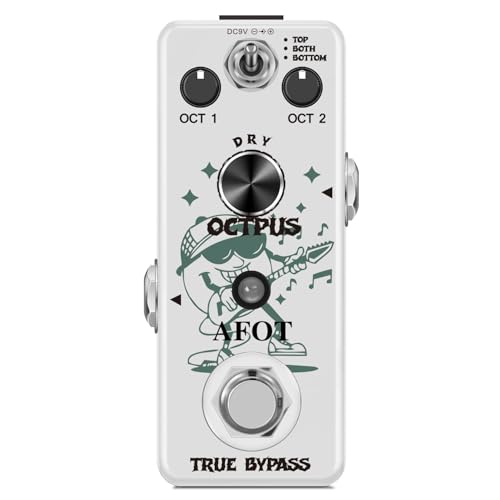
- Independent dry and octave level knobs
- Polyphonic tracking for chords and single notes
- TOP, BOTH, and BOTTOM mode options
Best For: Players who want a small, flexible octave pedal with dry mix control
Analog Lower Octave
Classic Monophonic Octaver with Dry Blend

- 100% analog octave circuit
- Dry signal blended with the octave effect
- One-octave and two-octave-down output
Best For: Players who want an affordable analog octave pedal for blended lower tones
Budget Multi-Mode
Mini Digital Octave Pedal with Preset Memory

- 11 octave modes in a compact metal pedal
- Preset memory for quick recall
- True bypass and broad tone range
Best For: Budget-minded players who want many octave sounds in a tiny pedal
Polyphonic Octave with Dry Blend & Modulation – JOYO XVI Octave
If you want octave pedals with dry blend that can handle chords as well as single notes, the JOYO XVI is built for flexible layering. It gives you independent control over dry, sub-octave, upper-octave, and modulation, so you can move from subtle harmony thickening to huge organ-style textures without losing clarity.
Best For: Players who want a budget-friendly polyphonic octave pedal with separate dry, sub, upper, and modulation controls.
Pros:
- Independent DRY, SUB, UPPER, and MOD knobs for precise blending
- Polyphonic tracking handles chords and multi-note passages
- Built-in modulation adds phaser/vibrato-style movement to the octave voices
- True bypass and rugged aluminum alloy housing
Cons:
- Requires a 9V DC adapter, which is not included
- Modulation is limited to the octave signal, not the dry path
As a practical roundup pick, the XVI stands out if you want lots of control over wet/dry balance and octave layering in one pedal. It’s especially appealing for players chasing thick, synthetic, or organ-like sounds while keeping the original guitar signal present.
Poly Octave With Fuzz Control – MXR Poly Blue Octave
The MXR Poly Blue Octave is a strong choice among octave pedals with dry blend if you want modern and classic pitch sounds in one unit. It offers four separate octave divisions with their own level controls, plus the option to switch between polyphonic and monophonic pitch shifting for different playing styles.
Best For: Guitarists who want multiple octave voices, pitch-shifting modes, and an added fuzz option.
Pros:
- Four octave divisions, each with its own level control
- Switchable polyphonic and monophonic pitch shifting
- Includes a thick fuzz option inspired by the Blue Box pedal
- Expression pedal or tap switch support for added control
Cons:
- No dedicated dry knob is listed in the supplied notes
- Larger footprint than a mini octave pedal
This is a versatile pick if you want a wide pitch palette rather than a simple one-trick octave effect. It fits players who like to shape layered octave tones and explore fuzzier textures without giving up control over the blend.
Industry-Standard Poly Octave – BOSS OC-5
The BOSS OC-5 is a practical benchmark if you want octave pedals with dry blend behavior in a familiar, dependable format. Its polyphonic guitar and bass octave design includes mono and poly modes, plus a dry direct output and a lowest-range setting that applies the octave only to the lowest note in a chord.
Best For: Players who want a straightforward, updated octave pedal with poly mode and dry direct output.
Pros:
- Polyphonic guitar/bass octave design with mono and poly modes
- Dry direct output helps preserve the original signal
- Lowest range setting targets only the lowest note in poly mode
- Updated take on the classic industry-standard octave pedal
Cons:
- Supplied notes do not list separate wet/dry level knobs
- More utilitarian than feature-heavy boutique alternatives
If you want a reliable octave solution that stays close to the core job, the OC-5 makes sense. It focuses on clean tracking, practical mode switching, and a direct signal path rather than extra sound-shaping extras.
Mini Octave Pitch Shifter With Dry/Wet Control – Donner Harmonic Square
The Donner Harmonic Square is a compact option in octave pedals with dry blend if you want simple control over harmonic and direct signal levels. With wet and dry knobs, seven shift types, and three tone modes, it covers octave, semitone, and detune sounds in a small true-bypass enclosure.
Best For: Players who want a small octave and pitch-shift pedal with separate wet and dry knobs.
Pros:
- Wet and dry knobs make signal blending easy
- Seven shift types and three tone modes provide a wide range of sounds
- Compact aluminum-alloy build with true bypass
- Works for octave, semitone, and detune effects
Cons:
- Requires a 9V DC adapter with at least 500mA, not included
- Mini form factor may feel limited for players wanting deeper control
For players who want a straightforward, affordable pitch-shifter with dry blend control, the Harmonic Square is easy to understand and easy to fit on a board. It is best viewed as a compact utility pedal that gives you a lot of combinations without a complex control layout.
Preset-friendly polyphonic octave – FLAMMA FS08 Octave Pedal
If you want octave pedals with dry blend control and a straightforward layout, the FLAMMA FS08 is built for practical sound-shaping. It offers polyphonic octave effects, separate control for ±1 and ±2 octaves, and a dry signal control so you can thicken your tone without losing the core guitar signal.
Best For: Players who want compact polyphonic octave options, saveable presets, and hands-on dry signal control.
Pros:
- 7 preset slots with adjustable, saveable octave settings
- Separate control for ±1 and ±2 octave ranges
- Dry signal control helps keep your original tone present
- True bypass and a compact metal enclosure
Cons:
- Power supply is not included
- Requires a 9V DC supply with more than 306mA
- Focused on octave effects rather than extra ambient features
The FS08 is a solid choice if you mainly want usable octave layering and preset convenience in a small pedalboard-friendly format. Its dry blend-style control and polyphonic tracking make it easy to integrate into a simple guitar rig.
Three-mode octave versatility – NUX TUTTI Polyphonic Octave Pedal
The NUX TUTTI is a practical pick if you’re comparing octave pedals with dry blend needs and want a simple, low-latency solution. Its polyphonic octave engine tracks chords and single notes musically, and the three modes give you quick access to different octave behaviors without a complicated control set.
Best For: Guitarists who want a compact octave pedal with multiple operating modes and flexible bypass options.
Pros:
- Three modes: Polyphonic, Bassline, and Momentary
- Advanced polyphonic tracking with ultra-low latency
- True bypass or buffered bypass for pedalboard flexibility
- Compact design with included hook-and-loop tape and rubber feet
Cons:
- No dedicated dry blend control is listed
- Requires a 9V DC supply and draws 500mA
- Less focused on preset saving than some competitors
Overall, the TUTTI stands out for clean tracking and easy switching between its three modes. It’s a smart fit if you prioritize musical octave response and bypass flexibility over deep parameter editing.
Dry-through octave and texture machine – Verdict Polyphonic Octave Pedal
If you’re shopping for octave pedals with dry blend-style routing for live use, the Verdict is built around keeping your original tone intact. Its analog dry-through path, plus dry/wet separation and true or buffered bypass, makes it a strong option for players who want layered octave sounds without tone loss.
Best For: Guitar and bass players who want octave layering, synth textures, and a dry-through signal path for gigs or studio work.
Pros:
- Analog dry-through routing preserves the original signal
- 4-voice polyphonic tracking covers +1, +2, -1, and -2 octaves
- Includes synth, organ, cello, freeze, and swell-style effects
- True/buffered bypass and dry/wet separation support complex rigs
Cons:
- More complex than a basic octave-only pedal
- Digital signal format may not suit every player
- Best value depends on whether you’ll use the extra ambient features
The Verdict is the most versatile option here if you want octave effects plus ambient and synth-style textures. Its dry-through design is especially appealing for players who need rich processing without sacrificing their core tone.
Polyphonic Layering – Compact 3-Mode Octave Shifter with Dry Blend
If you want octave pedals with dry blend for more control over your core tone, this compact digital shifter is built around that idea. It offers polyphonic tracking for single notes or chords, plus TOP, BOTH, and BOTTOM modes so you can shape the octave mix without losing your original guitar sound.
Best For: Players who want a small, flexible octave pedal with independent dry and octave level control.
Pros:
- Independent dry signal and octave level knobs for precise blending.
- Polyphonic design handles single notes and complex chords clearly.
- Three modes: TOP, BOTH, and BOTTOM for different octave textures.
- True bypass helps preserve the signal when the pedal is off.
Cons:
- Power adapter is not included.
- Digital octave design may not suit players who prefer a classic analog feel.
- Mini format limits the number of onboard controls.
This is a practical choice if you want octave layering with direct control over dry mix and a small footprint on the board. Its strength is flexibility rather than vintage character.
Analog Lower Octave – Classic Monophonic Octaver with Dry Blend
Among octave pedals with dry blend, this analog unit keeps the setup simple and focused. It creates a 2-voice octave sound blended with the dry signal, and its monophonic design is aimed at straightforward lower-octave parts on guitar or bass.
Best For: Players who want an affordable analog octave pedal for blended lower-octave tones.
Pros:
- 100% analog circuit for a classic octave response.
- Blended dry signal keeps the direct note present in the mix.
- Produces one octave lower and two octaves lower tones.
- True bypass and very low latency on guitar.
Cons:
- Monophonic design is not intended for complex chords.
- Power supply is not included.
- Works best as a focused lower-octave effect rather than a wide-range multi-mode pedal.
If you mainly need a dry-blended lower octave for guitar or bass, this pedal is easy to understand and quick to use. It leans more toward traditional octave utility than experimental sounds.
Budget Multi-Mode – Mini Digital Octave Pedal with Preset Memory
If you are comparing octave pedals with dry blend on a budget, this mini digital model stands out for its broad range of sounds. It offers 11 octave modes, a full-range octave setting, and the ability to save a preset, making it useful for players who want more than a basic one-trick octaver.
Best For: Budget-minded players who want many octave sounds in a tiny pedal with preset capability.
Pros:
- 11 different octave modes for a wide sound range.
- Includes preset memory for quick recall.
- Compact metal housing with true bypass.
- Can cover everything from high organ-like tones to deep bass notes.
Cons:
- Power adapter is not included.
- Digital operation may be less straightforward than a single-purpose analog octaver.
- Small size means limited hands-on control compared with larger pedals.
This pedal is best if you value variety and portability over a simple vintage workflow. It offers a practical way to add octave textures without taking much space on the board.
How We Picked These Octave Pedals with Dry Blend
We looked for pedals that make the dry signal easy to keep in the mix, since that’s what helps octave effects stay defined instead of sounding hollow or muddy. Priority went to strong tracking, simple controls, practical mode options, and designs that work well for both guitar and bass where applicable.
We also considered bypass behavior, power needs, and whether each pedal offers enough flexibility for live use, recording, or compact pedalboard setups. The goal was to favor Octave Pedals with Dry Blend that are easy to dial in quickly and hard to outgrow.
Quick Comparison
For clean, traditional octave reinforcement, analog-style and dry-through designs are usually the easiest to place in a mix. For more creative textures, digital polyphonic pedals with extra modes or presets offer broader range and better note-to-note tracking across chords.
Compact mini pedals are best when space matters, but larger units often give you more control over sub octave, upper octave, and tone shaping. If you want one pedal to cover multiple jobs, look for units with mode switching, blend control, and stable bypass options.
Key Buying Factors for Octave Pedals with Dry Blend
Tracking and Note Clarity
Good tracking matters most if you play chords, fast lines, or lower-register parts. Polyphonic designs usually handle complex playing better, while simpler octave circuits can sound great for single-note riffs and bass reinforcement.
Blend Control and Tone Preservation
The best Octave Pedals with Dry Blend let you keep enough of the original signal to preserve attack and phrasing. If your goal is thickness rather than a fully synthetic effect, prioritize pedals with straightforward dry mix or dry-through behavior.
Voicing and Range
Consider whether you need sub octave, upper octave, or both. Some players only need one octave down for weight, while others want multiple voicings for organ-like textures, synth-style sounds, or layered lead parts.
Bypass, Size, and Power
True bypass is common, but buffered bypass can also be useful in longer signal chains. Mini pedals save space, while larger pedals may offer better hands-on control. Check power requirements if you use a pedalboard supply or travel rig.
Who Should Buy Which Octave Pedals with Dry Blend?
Choose a simple analog or lower-octave pedal if you want an easy, always-useful thickening effect. Pick a polyphonic model if you play chords, need better tracking, or want more modern octave textures.
If you’re building a flexible board, look for presets, multiple modes, or independent sub and upper octave controls. That approach gives you more room to shape the dry blend and match the pedal to different songs, instruments, and venues.