Need a faster way to drop tune, add octave weight, or build harmonies without changing basses? The best pitch shifter pedals for bass can do all three while keeping your low end focused.
Below, we’ve rounded up 10 strong options for players who want reliable tracking, low latency, and practical controls for live and studio use.
Best 10 Pitch Shifter Pedals for Bass Picks for 2026
Top Pick for Natural Tracking

- Natural-feel polyphonic pitch shifting
- Up to +/- 7 semitones or +/- 3 octaves
- Balance and detune controls for blending
Best For: Bassists who want clean tracking and simple control
Best for Harmony Control

- Up, down, and dual shift modes
- 11-position knob for interval selection
- EXP input for pitch or glissando control
Best For: Bass players who want flexible interval control
Best Drop-Tuning Shortcut
DigiTech DROP Compact Pitch-Shifter

- Drops pitch from 1 semitone to a full octave
- Polyphonic design with true bypass
- Momentary and latching footswitch modes
Best For: Bass players who need quick drop tuning
Best for Hands-On Expression

- Fast, accurate polyphonic shifting
- Optional dry signal for harmonizing
- Pressure-sensing control for tactile use
Best For: Bassists who want expressive control and harmony options
Compact Drop-Tune Pitch Shifter
Digitech DROP for quick down-tuning

- Polyphonic 1-7 semitone drop settings
- Two octave-down modes included
- True bypass with momentary or latching switching
Best For: Players who want simple, instant down-tuning and octave-drop effects in a compact pedal.
Advanced Pitch Control Workstation
BOSS XS-100 for deep bass tuning

- Eight-octave pitch range with fixed semitone steps
- Detune, pedal curve, and toe-switch customization
- 30 memories for storing setups
Best For: Bassists who want a highly adjustable pitch-shifting pedal with presets and deep performance control.
Mini Harmonizer Pitch Box
Mooer MPS1 for compact bass effects
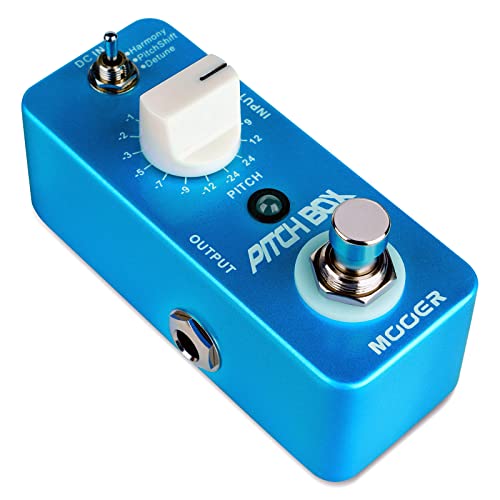
- Three modes: harmony, pitch shift, detune
- Up to ±2 octaves with 16 parameters
- Compact true-bypass metal shell
Best For: Bassists looking for a compact harmonizer with multiple pitch modes and minimal pedalboard space.
Versatile Polyphonic Choice

- 4-in-1 modes: harmony, pitch shift, detune, glide
- 8ms polyphonic tracking for tight live response
- Tight and Classic modes support guitar and bass use
Best For: players needing a flexible bass-capable pitch pedal with lots of control
Compact Octave Utility

- 7 shift types plus 3 tone modes for flexible tones
- Wet and dry knobs help blend the effected sound
- True bypass and mini aluminum housing save space
Best For: bass players who want a small, simple octave and detune pedal
Modern Drop-Tune Performer

- 8ms polyphonic tracking for tight drop tuning
- Dual-tone modes: Tight and Sub
- Dual-channel presets and glide controls add stage flexibility
Best For: heavy players who want fast, compact pitch shifting with quick preset changes
Top Pick for Natural Tracking – BOSS XS-1 Poly Shifter
If you want pitch shifter pedals for bass that keep the core tone intact, the BOSS XS-1 is built around natural feel and clear response. Its polyphonic design can shift bass pitch across +/- seven semitones or +/- three octaves, while the balance knob lets you blend in the direct signal for a more usable result on stage or in the studio.
Best For: Bass players who want a compact pitch shifter with very natural tracking and flexible control.
Pros:
- New BOSS algorithms are designed for class-leading pitch shifting quality
- Works with guitar, bass, and other instruments
- Balance knob helps mix effect and dry tone
- Detune mode adds doubling-style thickness
Cons:
- Best suited to players who want a straightforward pitch-shift tool rather than a deep multi-effect unit
- External footswitches or expression control are optional extras
The XS-1 stands out if you prioritize clean, natural pitch changes over flashy extras. It gives bassists a wide shift range, simple controls, and added switching options without complicating the pedalboard.
Best for Harmony Control – Electro-Harmonix Pitch Fork
The Electro-Harmonix Pitch Fork is a practical choice for bass players who want pitch shifter pedals for bass with simple but flexible control. It offers up, down, and dual modes, plus an 11-position Shift knob for selecting the transposition interval. The EXP input also opens the door to pitch-shift or glissando control with an optional expression pedal.
Best For: Players who want easy interval selection and expression-pedal control in a compact pitch shifter.
Pros:
- Three shift modes: up, down, and dual
- 11-position Shift knob for interval selection
- EXP input supports pitch shift or glissando control
- Latch and momentary modes add flexibility
Cons:
- Expression pedal is optional, so full control requires extra gear
- Compact format may feel minimal if you want more onboard shaping options
For bassists who like to dial in specific intervals quickly, the Pitch Fork keeps the layout simple and the routing flexible. It is a strong fit when you want polyphonic shifting without a lot of menu diving.
Best Drop-Tuning Shortcut – DigiTech DROP Compact Pitch-Shifter
If your goal is to retune quickly, this DigiTech DROP is one of the most focused pitch shifter pedals for bass. It uses polyphonic drop tuning to move your signal from 1 semitone down to a full octave, with true bypass and momentary or latching footswitch behavior for practical live use.
Best For: Bassists who want fast down-tuning without changing instruments.
Pros:
- Polyphonic drop tuning from 1 semitone to a full octave
- Momentary or latching footswitch modes
- True bypass for simpler signal handling
- Power supply included
Cons:
- Designed for dropping pitch, not for upward shifting or harmony effects
- Control set is intentionally minimal
The DROP is ideal when you only need a dependable drop-tune pedal and do not want extra functions getting in the way. It is compact, straightforward, and tailored to quick alternate tuning on bass.
Best for Hands-On Expression – MOOER Pitch Step
The MOOER Pitch Step is a compact option for players looking at pitch shifter pedals for bass with a more tactile control style. It offers fast, accurate polyphonic pitch shifting, optional dry signal for harmonization, and customizable -OCT/+OCT adjustment, while MOOER’s pressure-sensing technology adds a distinctive hands-on feel.
Best For: Bassists who want expressive pitch control and simple harmonized layering.
Pros:
- Fast, accurate polyphonic pitch shifting
- Optional dry signal supports harmonization
- Customizable pitch adjustment for -OCT/+OCT
- Pressure sensing technology adds a unique control feel
Cons:
- Primarily focused on pitch shifting and harmony rather than broader effects
- Battery-powered operation may not suit every pedalboard setup
Pitch Step is a good match if you want a pedal that feels interactive while still keeping the pitch effect straightforward. It works best for bassists who value quick adjustment and the option to blend in dry signal.
Compact Drop-Tune Pitch Shifter – Digitech DROP for quick down-tuning
If you need one of the most straightforward pitch shifter pedals for bass-style down-tuning, the Digitech DROP is built around fast, polyphonic semitone drops and octave-down options. Its true-bypass design helps preserve your tone when it’s off, and the Hold/Tap switch lets you choose momentary or latching behavior depending on how you play.
Best For: Players who want simple, instant down-tuning and octave-drop effects in a compact pedal.
Pros:
- Polyphonic pitch shifting with 1-7 semitone drop settings
- Two extra octave-down modes for deeper tuning changes
- True bypass helps preserve tone when disengaged
- Momentary or latching footswitch operation via Hold/Tap switch
Cons:
- Focused on downward shifting rather than broader harmony effects
- Requires a 9V power supply and 300 mA current
- Best suited to players who mainly need drop-tuning functions
Overall, the DROP is a practical choice if your main goal is fast, reliable down-tuning without a complicated control layout. It keeps the feature set centered on essential pitch changes, which makes it easy to drop into a bass or guitar board and use right away.
Advanced Pitch Control Workstation – BOSS XS-100 for deep bass tuning
The BOSS XS-100 is a serious option among pitch shifter pedals for bass when you want detailed control rather than a basic drop effect. It offers an eight-octave range, fixed semitone pitch settings, detune capability, and onboard pedal control with a toe switch for everything from drop tunings to more expressive pitch moves.
Best For: Bassists who want a highly adjustable pitch-shifting pedal with presets and deep performance control.
Pros:
- Eight-octave range for broad pitch-shifting options
- Fixed semitone settings, detune function, and linear pedal control
- 30 memories for saving favorite setups
- Supports external footswitches or an expression pedal
Cons:
- Larger and heavier than compact pitch pedals
- More complex than a simple drop-tune unit
- Likely more than needed if you only want basic down-shifting
In practice, the XS-100 is aimed at players who want full control over pitch behavior and the ability to store multiple sounds. If you need one pedal that can handle precise tuning changes, detune textures, and performance-style sweeps, this is the most flexible option in this group.
Mini Harmonizer Pitch Box – Mooer MPS1 for compact bass effects
If you want a small, flexible entry in the pitch shifter pedals for bass category, the Mooer MPS1 combines harmony, pitch shift, and detune modes in a tiny metal enclosure. It’s designed for players who need precise polyphonic pitch conversion, a true-bypass signal path, and a pedalboard-friendly footprint without giving up basic pitch-coloring options.
Best For: Bassists looking for a compact harmonizer with multiple pitch modes and minimal pedalboard space.
Pros:
- Three modes: harmony, pitch shift, and detune
- Up to ±2 octaves with 16 optional parameters
- True bypass and compact metal-shell design
- Works with electric guitar and bass
Cons:
- Power adapter is not included
- Mini layout may feel limited for players who want lots of onboard controls
- More focused on basic pitch shaping than advanced workstation features
For bass players who want a small pedal that can still cover harmony and detune duties, the MPS1 is an easy fit. It makes the most sense on crowded boards where footprint matters and you still want a true-bypass pitch effect with some range.
Versatile Polyphonic Choice – Vein Polyphonic Pitch Shifter
If you want pitch shifter pedals for bass that can also handle guitar duties, this Vein pedal is built like a flexible studio-style option. It combines harmony, pitch shifting, detune, and glide/ramp modes with a 17-interval range, plus separate Tight and Classic algorithms so you can tailor the response for clean low-end or more textured pitch effects.
Best For: Bassists and players who want one pedal for octave-style drops, detune, harmony, and expressive glide effects.
Pros:
- Four modes in one pedal: Harmony, Pitch Shifter, Detune, and Glide/Ramp
- 8ms latency and polyphonic tracking for responsive live playing
- Tight and Classic processing modes let you shape the feel for guitar or bass
- Wide +/- 2 octave range with up to 17 intervals and attack/release controls
Cons:
- More feature-heavy than a simple one-knob octave pedal
- Some functions depend on firmware updates to access listed capabilities
- Requires 250mA, so it needs proper pedalboard power planning
Overall, this is the most versatile option in the group if you want a pitch processor that can move between subtle detune, dramatic bends, and bass-friendly drop tuning without changing pedals.
Compact Octave Utility – Donner Harmonic Square Mini
Among pitch shifter pedals for bass, the Donner Harmonic Square is a straightforward mini option for octave moves, semitone shifts, and detune sounds. With 7 shift types, 3 tone modes, and separate wet/dry knobs, it gives you practical control over how much effected signal sits under your clean bass tone.
Best For: Players who want an affordable, compact pitch shifter for octave, detune, and simple bass-friendly tuning changes.
Pros:
- 7 shift types and 3 tone modes for 21 total sound options
- Wet and dry knobs make it easier to blend effect and original signal
- True bypass helps keep the signal transparent when the pedal is off
- Compact aluminum-alloy build fits easily on crowded boards
Cons:
- Requires a 9V DC adapter with at least 500mA, which is not included
- Less deep feature set than the more advanced polyphonic pedals here
- Mini enclosure may feel limited if you want extensive real-time control
If you want a simple, board-friendly pitch option that focuses on octave and detune textures rather than advanced performance features, this Donner pedal is an easy place to start.
Modern Drop-Tune Performer – Dive Polyphonic Pitch Shifter
If you are shopping pitch shifter pedals for bass-adjacent drop tuning and stage-ready effects, the Dive pedal is designed for fast response and heavy riff work. It uses 8ms polyphonic tracking, dual-tone modes, and dual-channel drop-tune presets so you can move between tuned-down settings without stopping the performance.
Best For: Players who want a compact pitch shifter for tight drop tuning, virtual whammy moves, and heavy modern styles.
Pros:
- 8ms tracking helps keep the response tight and synced
- Tight and Sub modes let you choose between clearer attack or deeper low-end voicing
- Dual-channel presets make quick interval changes easier on stage
- Glide attack/release controls support dive-bomb and glissando-style effects
Cons:
- Voicing is clearly aimed at heavier, modern applications
- Limited to a compact control layout rather than expansive hands-on editing
- Uses 150mA, but still needs proper pedalboard power and USB-C update support
This is a good pick if you want a compact drop-tune pedal with quick switching and expressive glide control, especially when tight tracking matters more than a wide menu of pitch options.
How We Picked the Best Pitch Shifter Pedals for Bass
We focused on pedals that make sense for real bass rigs: stable tracking on low notes, usable latency, straightforward controls, and enough flexibility for both drop tuning and creative pitch effects. We also favored models that offer polyphonic processing or bass-friendly operation, since single-note tracking alone can be limiting on bass.
Quick Comparison: What Matters Most
For most players, the biggest difference is whether the pedal is built for simple drop tuning, harmony work, or more advanced pitch manipulation. Compact pedals are great for one-job convenience, while larger units often give you more intervals, presets, and routing options. If you mainly need a quick half-step-to-heavy-drop solution, choose a streamlined model. If you want multiple sounds in one box, look for broader interval control and preset recall.
Key Buying Factors for Pitch Shifter Pedals for Bass
Tracking and Latency
Low notes can expose weak tracking fast. Look for pedals that respond cleanly to open strings and fast playing without glitching or audible lag.
Polyphonic Versus Monophonic
Polyphonic designs are usually the safer choice for bass because they handle chords, double-stops, and sustained notes more naturally. Monophonic pedals can still work well for single-note drop tuning or lead-style lines.
Range and Interval Options
Some players only need a few semitones down, while others want octave jumps, harmony intervals, or full preset flexibility. Make sure the range matches your actual setlist, not just the biggest spec sheet number.
True Bypass, Buffering, and Signal Integrity
Bass tone can lose punch if the pedal weakens your signal path. True bypass is useful in some rigs, but a good buffer can also help preserve clarity over longer pedalboards.
Control Style and Live Use
Footswitch behavior matters. Momentary modes, preset switching, and dedicated drop controls can speed up onstage changes, while simpler layouts reduce mistakes during a set.
Who Should Buy Which Pitch Shifter Pedals for Bass?
If you want fast, reliable alternate tuning, choose a compact drop-tuning pedal. If you need harmonies, octave layering, or more experimental sounds, a more advanced pitch shifter will be worth the extra control. Players with multiple basses and changing setlists should prioritize presets and flexible interval settings, while minimal rigs may be better served by a single-purpose unit that is easy to dial in and easy to trust.
In short, the best choice depends on whether you want convenience, versatility, or maximum control. For most bassists, the sweet spot is a pedal that tracks well, preserves low-end authority, and gets you to the right pitch quickly without slowing down your playing.