Delay can add depth, rhythm, and atmosphere fast—but only if the repeats stay locked to the song. That is why delay pedals with tap tempo are so useful for live players and recording setups alike.
Below, we break down 10 solid options across simple, versatile, and feature-rich designs, helping you choose the right pedal for your board, budget, and playing style.
Best 10 Delay Pedals with Tap Tempo Picks for 2026
Industry Standard

- Onboard tap tempo plus external footswitch support
- 12.5 to 800 ms range with three quick settings
- Direct output for wet/dry amp routing
Best For: players who want a simple, reliable digital delay
Tempo Utility

- Adjustable tip/ring configuration for compatibility
- Rugged road-ready construction
- Designed for use with compatible delay pedals
Best For: players needing an external tap tempo footswitch
Multi-Mode Explorer

- 9 modes including tape, reverse, and lo-fi
- One-footswitch tap tempo with 3000 ms max delay
- Buffered bypass and USB-C or 9V DC power
Best For: players who want versatile delay sounds in one compact pedal
Simple Shape-Shifter
Walrus Audio Fundamental Delay

- Time, Feedback, and Mix controls keep it simple
- Digital, Analog, and Reverse modes
- Quarter, dotted 8th, and 8th divisions
Best For: players who want core delay sounds with easy control
Multi-Voiced Stereo Pick
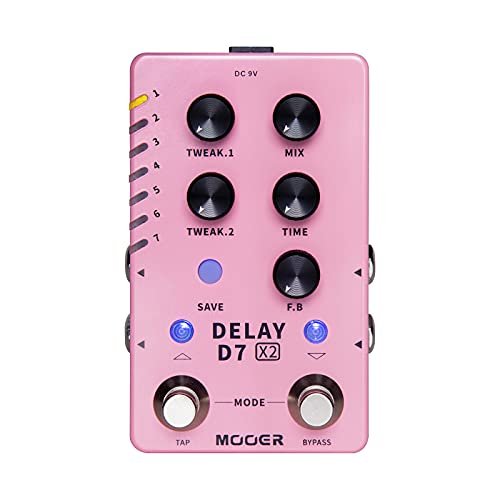
- 14 stereo delay effects from classic to experimental
- Tap tempo for quick timing changes on the fly
- Trail On function for natural fade-outs
Best For: Players who want a versatile stereo delay with deep control
Simple Three-Mode Tapper

- Analog, digital, and reverse delay modes
- Tap Tempo for instant delay-time control
- Buffer bypass for transparent tone
Best For: Players who want a simple delay with core sounds
Compact Dual-Action Choice

- 9 delay engines including analog, reverse, and lo-fi
- Dual footswitch adds tap tempo and MASH freeze
- True stereo I/O with USB-C or 9V DC power
Best For: Guitar, bass, or synth players who want expressive stereo delay control
Stereo delay/reverb combo
Reverb and delay combo with tap tempo

- 3 delay modes and 3 reverb modes for 9 combinations
- Preset storage for quick recall of custom sounds
- Stereo in/out and two tap modes for flexible use
Best For: Guitarists who want a stereo delay/reverb combo with tap tempo and preset recall for live or studio use.
Compact tap-tempo combo
Compact delay and reverb pedal with tap tempo

- Delay/reverb 2-in-1 design in a compact format
- Tap tempo for quick delay-time syncing
- Direct knobs for easy hands-on editing
Best For: Players who want a compact delay/reverb pedal with simple controls and tap tempo for live syncing.
Industry Standard – BOSS DD-3T Digital Delay
If you want delay pedals with tap tempo that stay simple and fast to dial in, the BOSS DD-3T keeps the classic DD-3 approach while adding modern convenience. Its 12.5 to 800 ms delay range is split into three quick ranges, so it’s easy to set the right repeat without menu diving.
Best For: Players who want a straightforward digital delay with onboard tap tempo and a proven, road-ready layout.
Pros:
- Onboard tap tempo can also be used with an external footswitch
- Three delay-time ranges make setup fast and practical
- Short Loop mode adds phrase-loop style utility
- Direct output supports wet/dry routing to separate amps
Cons:
- Single-purpose layout may feel limited if you want multiple delay types
- No extra mode selection beyond the core DD-3T workflow
The DD-3T is a strong pick if you value speed, reliability, and familiar BOSS operation over deep editing. It’s a clean, modern update to a classic delay format.
Tempo Utility – MXR Tap Tempo Switch
For delay pedals with tap tempo that need an external control, the MXR Tap Tempo Switch is a compact add-on built for compatibility and durability. It’s designed to work especially well with the EP103 Echoplex delay, and the adjustable tip/ring configuration helps it adapt to different pedal setups.
Best For: Guitarists who need a rugged external tap tempo switch for compatible delay pedals.
Pros:
- Adjustable tip/ring configuration improves compatibility
- Rugged, road-ready construction
- Works with a variety of pedal types
- Simple dedicated footswitch operation
Cons:
- It is a tap tempo accessory, not a delay pedal by itself
- Best known as a pairing for the EP103 Echoplex delay
If your delay pedal already has tap input support, this is a practical way to bring timing control onto the floor. It’s a straightforward utility piece rather than a tone-shaping effect.
Multi-Mode Explorer – LEKATO EP-04 Delay Pedal
If you’re comparing delay pedals with tap tempo and want a lot of textures in one box, the LEKATO EP-04 covers a wide range of sounds. It offers 9 delay modes, including tape, reverse, lo-fi, and other studio-style variations, plus a one-footswitch tap tempo for rhythmic control.
Best For: Players who want one compact pedal to move between vintage, ambient, and experimental delay styles.
Pros:
- 9 delay modes provide a broad range of sounds
- Tap tempo footswitch supports rhythmic precision
- 32-bit DSP and 3000 ms maximum delay time
- Buffered bypass helps preserve the dry signal
Cons:
- Requires 9V DC at 300mA or USB-C power
- More features mean more complexity than a simple single-mode delay
The EP-04 is a versatile choice if you want tap tempo plus lots of delay flavors without stepping up to a larger multi-effects unit. It balances flexibility with a compact, easy-to-place enclosure.
Simple Shape-Shifter – Walrus Audio Fundamental Delay
For delay pedals with tap tempo-style timing flexibility, the Walrus Audio Fundamental Series Delay keeps the controls focused and easy to use. It gives you Time, Feedback, and Mix control, plus selectable Digital, Analog, and Reverse modes with Quarter, Dotted 8th, and 8th divisions.
Best For: Players who want an easy-to-use delay with multiple core sounds and rhythmic divisions.
Pros:
- Simple Time, Feedback, and Mix control layout
- Digital, Analog, and Reverse modes cover key delay styles
- Quarter, Dotted 8th, and 8th divisions add useful timing options
- Limited lifetime warranty
Cons:
- Requires a 250mA power supply
- Less expansive than multi-mode delay pedals
This is a solid option if you want a compact delay pedal that stays focused on the essentials. It’s a practical fit for players who value quick control and a few well-chosen delay voices.
Multi-Voiced Stereo Pick – D7 X2 Delay Pedal
If you want delay pedals with tap tempo that go beyond a basic echo, the MOOER D7 X2 is built for flexible, performance-friendly control. It packs 14 stereo delay effects, ranging from analog and tape-style sounds to more experimental options like Low-Bit, Galaxy, and PingPong, with tap tempo for fast timing changes on the fly.
Best For: Players who want a compact stereo delay with lots of sound options and easy tap-tempo control.
Pros:
- 14 built-in stereo delay effects cover classic and more experimental textures.
- Tap tempo makes delay timing easy to adjust during a set.
- Tweak 1, Tweak 2, MIX, TIME, and FEEDBACK controls allow detailed shaping.
- Trail On function lets repeats fade out naturally.
Cons:
- Powered by 9V, 300mA requirements, so it needs suitable pedalboard power.
- The many effects and controls may be more than you need if you only want a simple delay.
The D7 X2 stands out if you need stereo delay pedals with tap tempo and a wide palette of voices in one unit. It is a strong pick when flexibility, preset-style versatility, and natural-sounding trails matter more than minimalism.
Simple Three-Mode Tapper – Donner Tap Delay
Donner Tap Delay Guitar Effect Pedal, 3 Delay Modes Digital Reverse Analogue with Tap Tempo Control
Check Price On AmazonThe Donner Tap Delay is a straightforward option for players shopping delay pedals with tap tempo and a simple control layout. It offers analog, digital, and reverse delay modes, plus LEVEL, FEEDBACK, and DELAY knobs for dialing in everything from classic echo to thicker ambient repeats.
Best For: Guitarists who want an easy-to-use delay pedal with tap tempo and three core delay voices.
Pros:
- Three delay modes: analog, digital, and reverse.
- Tap Tempo function allows instant delay-time control.
- Simple LEVEL, FEEDBACK, and DELAY knobs keep operation easy.
- Buffer bypass is designed for transparent tone.
Cons:
- Requires a 9V DC adapter, which is not included.
- Does not offer the deeper sound-shaping range of more advanced multi-effect delays.
This pedal makes sense if you want a no-fuss tap-tempo delay that covers the essentials without a steep learning curve. It is especially practical for players who prefer classic delay types and a compact control set.
Compact Dual-Action Choice – Elemental Pro Delay Pedal
The M-VAVE Elemental Pro is a compact option for players comparing delay pedals with tap tempo and extra performance features. It includes 9 delay engines such as ANALOG, REVERSE, and LOFI, dual-footswitch tap tempo control, and a MASH freeze function for infinite sustain, making it useful for more expressive ambient work.
Best For: Guitar, bass, or synth players who want a compact digital delay with stereo routing and expressive footswitch control.
Pros:
- 9 delay engines cover a wide range of sounds, including analog, reverse, and lo-fi.
- Dual-footswitch design adds tap tempo and MASH freeze control.
- True stereo I/O supports flexible 1-in-1-out or 2-in-2-out setups.
- USB-C or 9V DC power gives it flexible powering options.
Cons:
- Its feature set is more specialized than a basic delay pedal.
- 3.7V listed voltage may make it less straightforward to power than standard 9V-only pedals.
The Elemental Pro is a smart choice if you want a compact delay that can do more than standard repeats. With stereo I/O, tap tempo, and freeze functionality, it suits players who need creative control in a small footprint.
Multi-mode tap-tempo delay – 9-mode digital delay with tap tempo
If you want delay pedals with tap tempo that also cover a lot of creative ground, the GOKKO GK-72 is built for experimentation. It offers 9 delay modes, including Analog, Dual, Duck, Trem, Reverse, Tape, Ice, Lo-Fi, and Pattern, plus a hold function for frozen, ambient textures. The compact layout keeps the main delay controls on the surface, so it stays practical for rehearsal, recording, or a simple pedalboard setup.
Best For: Players who want a compact tap-tempo delay with multiple modes for ambient and rhythmic sound design.
Pros:
- 9 delay modes for everything from vintage echo to lo-fi and patterned repeats
- Tap tempo plus a TIME knob for fast tempo setting and fine adjustment
- Hold function can freeze the wet signal for swells and extended textures
- Dedicated knobs for time, feedback, mix, and mode-specific parameters
Cons:
- Mono I/O only
- Digital delay character may not suit players seeking a fully analog signal path
- Requires either 9V DC or USB-C style power options, so setup depends on your rig
Overall, the GK-72 is a flexible choice if you want a tap-tempo delay pedal that can move from straightforward repeats to more experimental textures without a complicated control scheme.
Stereo delay/reverb combo – Reverb and delay combo with tap tempo
Among delay pedals with tap tempo, the Donner Yellow Fall II stands out for combining delay and reverb in one unit. It gives you 3 delay modes and 3 reverb modes for 9 total combinations, plus preset storage for recalling custom settings quickly. The stereo input/output design and tap modes for desktop or live use make it a practical option for players who need flexibility across different setups.
Best For: Guitarists who want a stereo delay/reverb combo with tap tempo and preset recall for live or studio use.
Pros:
- 2-in-1 delay and reverb pedal with 9 effect combinations
- Tap Mode and Tempo Mode support both desktop use and live performance
- Preset saving helps you store and recall custom sounds quickly
- Stereo input/output design adds routing flexibility
Cons:
- 9V DC adapter is not included
- Controls are split between delay and reverb shaping, so it may take longer to dial in
- Higher current draw than simpler compact pedals
This is a strong pick if you want one pedal to cover both space and repeats, especially when tap tempo and preset storage matter more than ultra-simple controls.
Compact tap-tempo combo – Compact delay and reverb pedal with tap tempo
If you prefer delay pedals with tap tempo in a small, straightforward format, the Donner Revecho keeps things easy to use. It combines delay and reverb in a compact 2-in-1 pedal and gives you direct knob control over effect level, delay time, delay feedback, and reverberation time. The tap tempo function is designed for instant delay-time syncing, making it especially useful for jams and live playing where timing needs to stay tight.
Best For: Players who want a compact delay/reverb pedal with simple controls and tap tempo for live syncing.
Pros:
- 2-in-1 delay and reverb design in a compact form factor
- Tap tempo helps sync delay time to the song tempo quickly
- Direct knobs for delay time, feedback, effect level, and reverb time
- Effect tail feature lets notes and chords decay naturally when disengaged
Cons:
- Analog signal format may be less flexible than digital multi-mode units
- Fewer mode options than larger multi-effect pedals
- Adapter-powered operation means it depends on your power supply setup
The Revecho is a good fit if you want a practical tap-tempo delay pedal that stays compact, easy to control, and useful for everyday playing.
How We Picked These Delay Pedals with Tap Tempo
We focused on pedals that make timing control easy, sound usable across common styles, and fit real-world boards. Priority factors included tap-tempo accuracy, delay range, mode variety, stereo support, preset or trail options, bypass behavior, and overall value.
We also looked for models that serve different users well, from straightforward digital delays to multifunction units that combine delay with other effects.
Quick Comparison
If you want the simplest path, a compact single-purpose delay is usually easiest to dial in. If you need more flexibility, look for multi-mode designs, preset memory, stereo I/O, or separate tap control. Players who switch sounds often will benefit from Delay Pedals with Tap Tempo that also save presets or support trails.
Key Buying Factors for Delay Pedals with Tap Tempo
Tap-Tempo Implementation
Check whether tap tempo is built in, requires an external switch, or can be assigned in multiple ways. A responsive tap system matters most for live use and song-to-song tempo changes.
Delay Types and Repeat Character
Digital, tape-style, analog-voiced, reverse, and multi-mode delays each feel different. Choose the style that matches your genre and how polished or gritty you want the repeats to sound.
Controls and Preset Features
More controls can mean more flexibility, but also a steeper learning curve. Preset storage is valuable if you use several delay sounds during a set.
Signal Path and Connectivity
Look at mono versus stereo I/O, true bypass or buffered bypass, and whether the pedal preserves trails when switching off. These details affect clarity, ambience, and how well the pedal integrates with the rest of your rig.
Board Size and Power
Compact pedals are easier to place on crowded boards, while larger units may offer more functionality. Also confirm power requirements before buying so the pedal matches your supply.
Who Should Buy Which Delay Pedals with Tap Tempo?
Choose a simple tap-tempo delay if you want fast setup and dependable core sounds. Go for a multi-effects delay if you need presets, stereo operation, or multiple delay textures in one box. If you already use an external tap solution, a dedicated tap switch can be the most affordable upgrade. For players building around Delay Pedals with Tap Tempo as a performance tool, focus on responsiveness, repeat quality, and the features you will actually use on stage.