Digital delay pedals can do much more than repeat a note. They can add space, tighten a lead line, and shape your whole rig with everything from clean echoes to ambient textures.
In this roundup, we focused on pedals that make it easy to find the right delay for practice, recording, and live use, whether you want a simple stompbox or a feature-packed unit.
Best 10 Digital Delay Pedals Picks for 2026
Flagship Multi-Mode Choice
BOSS DD-8 Digital Delay Guitar Effects Pedal

- 11 delay modes including shimmer, mod, and looper
- Up to 40 seconds of looping with overdub
- Stereo output and tap tempo support
Best For: Players who want a compact, highly versatile delay pedal
Classic Simple Delay

- Three delay time modes for quick setup
- Delay time range from 12.5 ms to 800 ms
- Hold function repeats delay indefinitely
Best For: Players who want a simple, classic delay with fast adjustment
Budget Multi-Mode Option
Donner Echo Square Delay Pedal
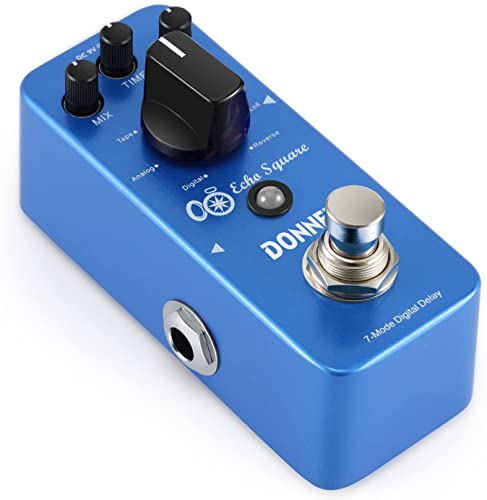
- Seven delay modes including analog, tape, and reverse
- Three-knob control for mix, time, and feedback
- True bypass in a compact aluminum housing
Best For: Players who want an affordable multi-mode delay pedal
Updated Classic with Tap Tempo
BOSS DD-3T Digital Delay Guitar Effect Pedal

- Updated DD-3 with tap tempo and short loop
- 12.5 to 800 ms delay range in three ranges
- Direct output supports wet/dry amp setups
Best For: Players who want a classic BOSS delay with modern tap tempo
Mini Art Delay
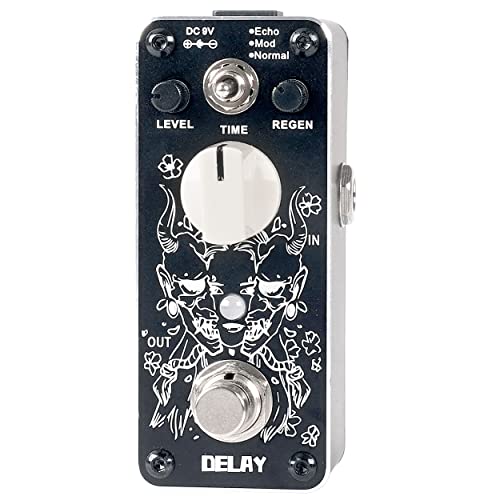
- 3 delay modes: Echo, Mod, and Normal
- Compact mini aluminum-alloy enclosure
- True bypass with simple Level, Regen, and Time controls
Best For: Players who want a compact, easy-to-use delay with modulation and normal echo options.
Feature-Packed Workhorse

- 12 delay modes for a wide range of sounds
- 32-bit processing with 96 kHz sampling rate
- Four memories plus a 60-second phrase looper
Best For: Guitarists who want a versatile delay pedal with deep sound options and memory recall.
Tap Tempo Classic

- Three modes: analog, digital, and reverse
- Tap tempo for instant delay timing
- Buffer bypass with simple knob-based controls
Best For: Players who want simple delay control with tap tempo and three useful modes.
Delay + Reverb Combo
SONICAKE Levitate 2-in-1 Digital Delay Pedal

- Combines digital delay and plate reverb
- Up to 2000ms delay time with tap tempo
- Buffer bypass helps keep the signal clean
Best For: Players who want delay and reverb in one pedal for live use
Warm Analog-Voiced Delay
JOYO JF-08 Analog-Voiced Digital Delay Pedal

- Special filter circuit creates a warm, mellow repeat
- 25ms to 600ms range suits slapback and lead delay
- True bypass helps preserve your dry tone
Best For: Players who want a simple, warm-sounding delay for guitar or bass
Mini True Bypass Delay
AODSK Compact Digital Echo Pedal

- Low-noise design keeps repeats clean
- True bypass helps preserve original tone
- Compact zinc-alloy enclosure saves pedalboard space
Best For: Players who want a small, straightforward digital delay pedal
Flagship Multi-Mode Choice – BOSS DD-8 Digital Delay Guitar Effects Pedal
BOSS DD-8 Digital Delay Guitar Effects Pedal | Diverse Sonic Range, Maximum Delay Power
Check Price On AmazonIf you want one of the most flexible digital delay pedals in a compact format, the BOSS DD-8 is built for that job. It covers everything from basic digital delay to vintage echoes, shimmer, mod, looper, and newer sounds like Warm, +RV, and GLT, so it can handle both straightforward repeats and more creative ambient textures.
Best For: Players who want a compact delay with a wide range of modes, stereo output, and looper features.
Pros:
- Eleven delay modes cover standard, ambient, and experimental sounds
- Looper provides up to 40 seconds of recording time with overdub capability
- Tap tempo input allows up to 10 seconds of delay time
- Stereo audio output adds flexibility for more advanced rigs
Cons:
- Requires 300 mA, so it needs enough pedalboard power
- Feature depth may be more than players who only need a simple delay
The DD-8 stands out if you want a single delay pedal that can cover a lot of ground without leaving the compact BOSS format. It is especially useful for players who like to move between practical delay duties and more creative looping or modulation effects.
Classic Simple Delay – Boss DD-3 Digital Delay Pedal
The Boss DD-3 is a straightforward digital delay pedal for players who want the core BOSS sound in an easy-to-use format. With three delay time modes and a delay time control covering 12.5 ms to 800 ms, it is well suited to quick setup and classic repeat tones without extra complexity.
Best For: Guitarists who want a simple, reliable delay pedal with fast adjustment and a classic sound.
Pros:
- Three delay time modes make setup quick and practical
- Delay time control covers 12.5 ms to 800 ms
- Hold function can repeat delay sound indefinitely for special effects
- Compact BOSS pedal format with five-year warranty
Cons:
- Less feature-rich than newer multi-mode delay pedals
- Does not include the tap tempo or expanded options found on some updates
The DD-3 is a strong pick if you value simplicity and want an established delay pedal that gets to the point quickly. It is best for players who prefer basic controls over a long list of effect types.
Budget Multi-Mode Option – Donner Echo Square Delay Pedal
The Donner Echo Square is a practical choice if you want digital delay pedals with multiple textures at a compact price-point style. It offers seven modes, including digital, analog, tape, mod, sweep, lofi, and reverse, plus simple three-knob control for dialing in mix, time, and feedback.
Best For: Players who want an affordable, pedalboard-friendly delay with a variety of delay voices.
Pros:
- Seven delay modes provide a wide range of tones
- Three knobs make sound shaping simple and direct
- True bypass helps preserve transparent tone when disengaged
- Mini aluminum-alloy build is compact and board-friendly
Cons:
- Requires a DC 9V adapter that is not included
- Maximum delay time of 838 ms is shorter than some higher-end options
This pedal makes sense if you want multiple delay flavors without stepping into a bigger or more complicated unit. Its compact size and straightforward controls are especially useful for smaller boards and easy gigging setups.
Updated Classic with Tap Tempo – BOSS DD-3T Digital Delay Guitar Effect Pedal
The BOSS DD-3T is an updated take on the industry-standard DD-3, aimed at players who want fast, practical control in a digital delay pedal. It keeps the familiar 12.5 to 800 ms delay range while adding tap tempo, a short loop setting, and a direct output for wet/dry routing.
Best For: Guitarists who want the DD-3 concept with modern conveniences like tap tempo and direct output.
Pros:
- Updated version of the DD-3 with enhanced functionality
- Tap tempo can be entered with the onboard switch or an external footswitch
- Short Loop setting adds phrase-loop style use
- Direct output supports separate dry and wet amp setups
Cons:
- Still focused on core delay functions rather than broad multi-mode effects
- Needs compatible 9V power and 100 mA current
If you like the straightforward DD-3 approach but want a few modern upgrades, the DD-3T is the most practical step up here. It keeps the pedal easy to use while adding tempo control and output routing options that help in real-world rigs.
Mini Art Delay – Sondery Mini Digital Delay
If you want one of the more compact digital delay pedals for a small board, this Sondery mini unit keeps things simple with three controls and three delay voices. It is aimed at players who want easy delay shaping without a complicated setup, and its true bypass switching helps keep the signal path straightforward when the pedal is off.
Best For: Guitarists who want a compact, easy-to-use delay with modulation and normal echo options.
Pros:
- Three modes: Echo, Mod, and Normal.
- Simple Level, Regen, and Time controls for fast tweaking.
- True bypass hardware switching.
- Mini aluminum-alloy enclosure with LED status indicator.
Cons:
- Power adapter is not included.
- No onboard battery option listed in the notes.
- Fewer controls than larger delay pedals.
Overall, this is a practical pick if you value footprint and simplicity over deep editing. It gives you a few useful delay flavors in a sturdy mini format, which makes it a solid fit for smaller rigs and straightforward live use.
Feature-Packed Workhorse – BOSS DD-200 Digital Delay
The BOSS DD-200 stands out among digital delay pedals if you want a wider range of delay types and a more advanced feature set. It combines 32-bit AD/DA conversion, 32-bit floating point processing, and 96 kHz sampling with twelve delay modes, so it is built for players who need versatility and polished sound quality.
Best For: Guitarists who want a versatile delay pedal with deep sound options and memory recall.
Pros:
- 12 delay modes cover a broad range of delay sounds.
- 32-bit AD/DA, 32-bit floating point processing, and 96 kHz sampling rate.
- Four memories for storing favorite sounds.
- Phrase looper with up to 60 seconds of recording time.
Cons:
- Larger and heavier than mini delay pedals.
- Corded power only, with no battery option listed.
- More advanced feature set may be more than casual users need.
In practical terms, this is the most feature-rich option in the group and the best fit when you want flexibility instead of a minimal layout. If you need one pedal that can cover many delay styles and store your go-to sounds, the DD-200 is built for that job.
Tap Tempo Classic – Donner Tap Delay Pedal
Donner Tap Delay Guitar Effect Pedal, 3 Delay Modes Digital Reverse Analogue with Tap Tempo Control
Check Price On AmazonThe Donner Tap Delay is a straightforward choice for players comparing digital delay pedals that cover classic echo duties without a big learning curve. It offers three delay modes, hands-on knobs for shaping the effect, and a tap tempo function that makes it easier to match delay timing on the fly.
Best For: Players who want simple delay control with tap tempo and three useful modes.
Pros:
- Three delay modes: analog, digital, and reverse.
- Tap tempo for quick delay time changes.
- LEVEL, FEEDBACK, and DELAY knobs make setup simple.
- Buffer bypass and LED indicator are included.
Cons:
- Requires a 9V DC adapter, which is not included.
- Fewer controls than more advanced delay units.
- No memory or looper features listed.
For a no-fuss delay pedal, this model focuses on the core tools most players actually use. It is a sensible pick if you want tap tempo and three delay flavors in a compact twin-pedal format.
Delay + Reverb Combo – SONICAKE Levitate 2-in-1 Digital Delay Pedal
If you’re comparing digital delay pedals and want more than a basic echo, the SONICAKE Levitate gives you delay and plate reverb in one compact unit. It offers up to 2000ms of delay time, tap tempo for live use, and a buffer bypass circuit designed to keep your guitar signal pristine.
Best For: Players who want a delay pedal with built-in reverb and live-friendly tap tempo.
Pros:
- 2-in-1 design combines digital delay and plate reverb.
- Up to 2000ms delay time for longer ambient repeats.
- Tap tempo helps match delay timing during live shows.
- Buffer bypass circuit is designed to preserve clarity.
Cons:
- Requires a 9V center-negative power supply, which is not included.
- Reverb and delay share a compact control layout, so setup may take a little dialing in.
The Levitate stands out if you want a flexible digital delay pedal with extra ambience options and a practical live-performance feature set. It is a good fit for players who prefer one pedal to cover both echo and reverb duties.
Warm Analog-Voiced Delay – JOYO JF-08 Analog-Voiced Digital Delay Pedal
The JOYO JF-08 is a straightforward choice among digital delay pedals if you want a warmer, more analog-style repeat. Its special filter circuit is built to soften the echo as it fades, while the simple three-knob layout keeps setup fast for slapback, ambience, and lead boosts.
Best For: Guitarists and bass players who want a warm, analog-voiced digital delay with simple controls.
Pros:
- Special filter circuit adds a mellow, analog-like character.
- 25ms to 600ms delay range covers slapback and longer repeats.
- Three-knob control set is easy to use on the fly.
- True bypass helps preserve your core tone when disengaged.
Cons:
- Power supply is not included.
- Delay time maxes out at 600ms, which is less than some longer-range pedals.
This pedal is a strong pick if you value feel and simplicity over deep editing. It delivers an easy, warm delay sound that works well for everyday playing, especially when you want the repeats to sit naturally behind the note.
Mini True Bypass Delay – AODSK Compact Digital Echo Pedal
For players shopping digital delay pedals on a budget, the AODSK compact echo pedal focuses on the essentials: clean repeats, true bypass, and a small metal enclosure. It covers 20 to 600ms of delay time with level and repeat controls, making it easy to dial in anything from a quick slapback to more spacious echo.
Best For: Guitarists who want a compact, low-noise digital delay with simple controls.
Pros:
- Low-noise design helps keep hiss and hum under control.
- True bypass preserves your original tone when the pedal is off.
- 20ms to 600ms delay range covers a useful range of echo sounds.
- Mini zinc-alloy enclosure is pedalboard-friendly and road-ready.
Cons:
- No battery operation; it requires a 9V DC adapter, which is not included.
- Only level and repeat controls are provided, so it is less flexible than more advanced delays.
This is a practical pick if you want a compact pedal that gets straight to the point. It should suit players who need reliable repeats, easy setup, and a space-saving enclosure more than deep feature control.
How We Picked These Digital Delay Pedals
We looked for pedals that balance sound quality, usability, and real-world value. Priority went to models with reliable bypass options, useful delay ranges, tap tempo where it matters, and controls that make dialing in repeats straightforward.
We also considered format and flexibility. Some players want a compact pedal with a simple set of knobs, while others need presets, multiple modes, or expanded editing for live sets and ambient work.
Quick Comparison
At the simple end of the range, smaller Digital Delay Pedals are best for basic slapback, short repeats, and fast setup. Mid-range options often add mode switching, tap tempo, or more expressive tone shaping. Higher-feature pedals are better suited to players who want deeper control, multiple delay styles, and stronger performance features on stage.
If you mainly need a dependable echo sound, a straightforward pedal can be the smartest buy. If you build layered parts or switch between songs often, a more advanced model will usually justify the extra cost.
Key Buying Factors for Digital Delay Pedals
Delay Time and Repeat Control
Check the available delay range and whether the pedal gives you enough repeat adjustment for your style. Shorter ranges work well for rockabilly, slapback, and rhythm enhancement, while longer ranges are better for ambient playing and lead lines.
Tap Tempo and Presets
Tap tempo is especially helpful if you play live or need delays to sit tightly with a song’s tempo. Presets are even more useful for players who move between multiple sounds during a set.
Modes and Tone Shaping
Some Digital Delay Pedals stay close to a clean digital echo, while others add analog-style warmth, tape character, modulation, or reverse effects. Choose a pedal whose voice matches your genre and how much character you want in the repeats.
Size, Power, and Build
Mini pedals save board space, but larger enclosures may offer easier control and more features. Also confirm power requirements and build quality if the pedal will travel often.
Who Should Buy Which Digital Delay Pedals?
Beginners and budget-minded players should look for a simple, compact delay with clear controls. Gigging guitarists will usually benefit from tap tempo, stronger switching, and more flexible sound shaping. Players who want ambient textures or studio-style control should focus on feature-rich Digital Delay Pedals with multiple modes and deeper editing options.
If you are unsure where to start, choose the pedal that best matches how you play most often: simple echo for utility, versatile delay for all-around use, or advanced multi-mode control for creative sound design.