If you want tighter low-end control, more even note response, and a polished signal that sits better in a mix, the right compressor can make a bass rig feel instantly more professional.
This roundup of the best studio style bass compressor pedals for 2026 focuses on pedals that balance transparency, musical compression, and practical controls for real-world players.
Best 10 Studio Style Bass Compressor Pedals Picks for 2026
Studio-Controlled Bass Tone

- Attack EQ for response shaping
- Blend, Sustain, and Volume controls
- 9V battery or adapter powered
Best For: Bass players who want hands-on compression shaping with blend and attack control
Transparent Studio Limiter
Keeley Bassist Transparent Compressor

- High-fidelity compression and limiting
- Transparent, low-noise sound profile
- Over 20 KHz bandwidth
Best For: Players who want a clean, transparent compressor that preserves tone detail
Clear Headroom Control
MXR Bass Compressor with LED Reduction

- CHT Constant Headroom Technology
- 10 gain-reduction status LEDs
- True bypass and transparent voicing
Best For: Bassists who want transparent compression with obvious gain-reduction monitoring
Vintage Tube Studio Feel
Universal Audio LA2A Studio Compressor

- Authentic LA-2A optical tube emulation
- Mix control for parallel compression
- Stock/Fast attack switch
Best For: Bassists who want vintage-style optical compression with a mix control
Classic Transparent Comp

- Retuned Dyna Comp sound for bass
- Simple output and sensitivity controls
- Includes 9V adapter
Best For: Players wanting a classic, easy-to-use bass compressor with preserved low end
Studio-Style RMS Control

- RMS compression with simple UI
- Two ratio settings plus internal attack/release
- Pad switch supports active basses
Best For: Players seeking studio-style compression with straightforward operation
Pro-Grade Transparent Control
Empress Effects Bass Compressor CPBB
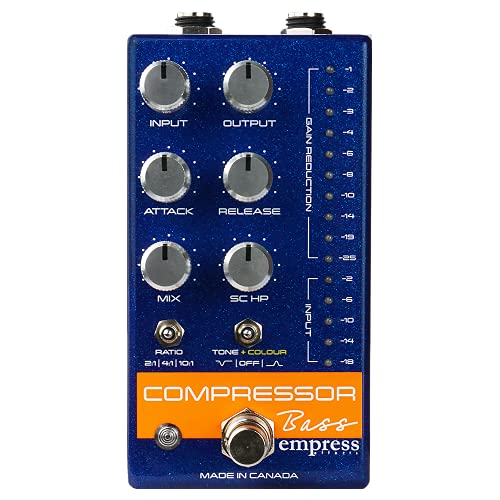
- All-analog and highly transparent
- Three ratios with blend, tone, and metering
- Sidechain and high-pass filtering options
Best For: Bassists who want advanced, transparent compression with extensive tweaking
Studio-Ready Natural Compression
BOSS BC-1X Bass Compressor Pedal

- Adaptive compression for different registers
- 18V input electronics for clean headroom
- Digital design helps reduce noise
Best For: Players who want transparent compression with a simple, studio-minded workflow
Bass-Focused Sustain Control
Electro-Harmonix Bass Preacher Compressor

- Fits passive and active basses
- Three attack settings for timing control
- True bypass and up to 21 dB reduction
Best For: Bass players who want a straightforward compressor/sustainer with flexible attack options
Transparent Optical Control
JOYO SCYLLA R-27 Bass Compressor

- Optical circuit for smooth, transparent compression
- Six controls for detailed shaping
- True bypass and rugged aluminum build
Best For: Players who want a feature-rich optical compressor with precise bass control
Studio-Controlled Bass Tone – Seymour Duncan Studio Bass
If you want one of the more flexible studio style bass compressor pedals, the Seymour Duncan Studio Bass keeps the focus on shaping dynamics with practical controls. Its Attack EQ, Sustain, Volume, and Blend layout makes it easy to dial in compression that supports the performance instead of flattening it.
Best For: Bass players who want hands-on compression shaping with blend and attack control.
Pros:
- Attack EQ helps you fine-tune how the compression responds.
- Blend control makes parallel-style compression easier to manage.
- Sustain and Volume give you straightforward level and compression adjustment.
- Runs on 9V power and supports battery or external adapter use.
Cons:
- No detailed noise or transparency specs are listed in the supplied notes.
- Fewer technical studio-style details than some more specified competitors.
Overall, this is a practical compressor for players who want control without a complicated interface. The control set is especially useful if you like shaping the feel of your bass compression by ear.
Transparent Studio Limiter – Keeley Bassist Transparent Compressor
The Keeley Bassist stands out among studio style bass compressor pedals if you want high-fidelity control with a transparent sound profile. Built around the THAT Corp. 4320, it offers compression and limiting in a compact stompbox, with enough bandwidth and low noise to keep your bass detail intact.
Best For: Players who want a clean, transparent compressor that preserves tone detail.
Pros:
- True high-fidelity compression and limiting in a pedal format.
- Transparent sound profile with low noise and over 20 KHz bandwidth.
- Uses high-performance VCA, RMS detector, and op-amps.
- Very affordable studio-grade compressor design.
Cons:
- Supplied notes do not list extensive onboard tone-shaping controls.
- Style information in the notes appears unrelated, so feature details are better taken from the compressor specs.
This is a strong choice when your priority is keeping the bass tone natural while controlling peaks. It is especially appealing if you want studio-grade compression without adding obvious color.
Clear Headroom Control – MXR Bass Compressor with LED Reduction
The MXR Bass Compressor is a strong pick in studio style bass compressor pedals if you want a transparent pedal with clear visual feedback. Its CHT Constant Headroom Technology and ten gain-reduction LEDs make it easy to keep dynamics under control while letting your full range shine through.
Best For: Bassists who want transparent compression with obvious gain-reduction monitoring.
Pros:
- CHT Constant Headroom Technology supports clear, clean performance.
- Ten gain-reduction LEDs provide easy visual compression monitoring.
- True bypass design helps preserve your signal when disengaged.
- Transparent voicing lets the full dynamic range come through until threshold is reached.
Cons:
- The notes do not describe deep tone-shaping features beyond transparent compression.
- Corded electric power is listed in the supplied details, so power setup may be less flexible than battery-powered options.
For players who want studio-level control without sacrificing clarity, this pedal is straightforward and effective. The LED gain-reduction display is especially useful for dialing in compression quickly on stage or in the studio.
Vintage Tube Studio Feel – Universal Audio LA2A Studio Compressor
Among studio style bass compressor pedals, the Universal Audio LA2A is aimed at players who want an authentic optical tube compressor sound in a compact pedal. It emulates the Teletronix LA-2A circuit with vintage transformers, tube amplifiers, and a T4 optical cell, while the mix control makes parallel compression simple.
Best For: Bassists who want vintage-style optical compression with a mix control.
Pros:
- Authentic emulation of the LA-2A optical tube compressor/limiter.
- Mix control supports easy parallel compression effects.
- Stock/Fast attack switch adds useful response options.
- True/buffered bypass and USB-C hardware interface are included in the notes.
Cons:
- Higher power draw than the other pedals listed, at 100 mA.
- Supplied notes emphasize emulation and controls more than bass-specific voicing.
This pedal is a good match if you want a more characterful compressor with classic studio inspiration. The mix control and attack switch make it flexible enough for both subtle leveling and more obvious compression.
Classic Transparent Comp – MXR Dyna Comp Bass Compressor
If you want one of the more familiar studio style bass compressor pedals in a compact format, the MXR Dyna Comp Bass Compressor is built around the classic Dyna Comp sound but re-tuned to keep the low end, dynamics, and transparency bass players need. The familiar output and sensitivity controls make it easy to set volume and sustain without a complicated learning curve.
Best For: Bass players who want a simple, classic compressor sound with low-end retention and straightforward controls.
Pros:
- Retuned to preserve low end and transparency for bass
- Simple output and sensitivity controls for quick setup
- Compact pedal format with included 9V adapter
- Analog compression in a small, board-friendly enclosure
Cons:
- Does not offer the deeper control set found on more advanced compressors
- Less feature-rich than pedals with blend, ratios, or attack/release controls
For players who want a familiar compressor feel without a lot of tweaking, this pedal keeps the focus on clean sustain and usable low-end response. It is a practical choice when you want classic compression behavior in a bass-specific design.
Studio-Style RMS Control – Bassman Compressor Pedal
The Bassman Compressor Pedal is aimed squarely at studio style bass compressor pedals, pairing RMS compression with a simple UI and a pedalboard-friendly size. Two dialed-in ratio settings let you choose light compression or smooth limiting, while internal attack and release controls provide extra fine-tuning when you want to match the pedal to your bass and playing style.
Best For: Bassists who want studio-style RMS compression with simple controls and enough adjustability for active or passive instruments.
Pros:
- Studio-style RMS compression in a compact pedal
- Two ratio settings for light compression or smooth limiting
- Internal attack and release controls for deeper tuning
- Side-mounted pad switch helps with active basses
Cons:
- Attack and release controls are internal, not front-panel accessible
- Uses a 3.5mm audio jack hardware interface rather than a standard 1/4-inch description in the specs
This is a strong fit if you want compressor behavior that feels more like a studio tool than a one-knob effect. Its simple front end and hidden fine-tuning make it appealing for players who want clean results without overcomplicating the board.
Pro-Grade Transparent Control – Empress Effects Bass Compressor CPBB
The Empress Effects Bass Compressor is one of the most feature-rich studio style bass compressor pedals here, with an all-analog signal path and a very transparent approach to dynamic control. It adds compression without changing the original tone, then expands the toolset with three ratios, attack and release control, blend, metering, tone and color shaping, and sidechain options.
Best For: Bass players who want maximum control, transparency, and advanced studio-like shaping options.
Pros:
- All-analog, transparent compression that preserves instrument tone
- Three ratios plus attack, release, and parallel blend control
- Separate meters for gain reduction and input
- Sidechain send/return and a variable high-pass filter for precise low-end control
Cons:
- Higher 300 mA current draw than simpler compressors
- Many controls may be more than needed for players who want a basic set-and-forget pedal
If you want a compressor that behaves like a studio processor on a pedalboard, this one offers a deep feature set while staying transparent and analog. It is especially compelling for players who want to fine-tune feel, low-end response, and tonal character in detail.
Studio-Ready Natural Compression – BOSS BC-1X Bass Compressor Pedal
If you want one of the more polished studio style bass compressor pedals for a clean, controlled low end, the BOSS BC-1X is built around intelligent circuitry that adapts compression to your playing. It aims to keep the fundamental bass tone intact while giving you natural gain reduction, plenty of headroom, and a quieter signal path than many standard compressors.
Best For: Bassists who want transparent, easy-to-use compression with clean headroom and minimal noise.
Pros:
- Intelligent circuitry adapts to different registers and playing nuance
- 18-volt input electronics provide ample headroom for clean, punchy output
- High-resolution gain reduction indicator makes compression easy to monitor
- Digital circuitry is designed to reduce noise
Cons:
- Less hands-on than pedals with dedicated attack, release, and ratio controls
- Only offers stompbox-style control over a more complex internal processor
The BC-1X is a practical choice if you want compression that stays out of the way and simply makes your bass sound more even and finished. It looks especially appealing for players who value headroom, low noise, and a straightforward workflow.
Bass-Focused Sustain Control – Electro-Harmonix Bass Preacher Compressor
Among studio style bass compressor pedals, the Electro-Harmonix Bass Preacher focuses on bass-friendly control and sustain without making the setup complicated. Its input sensitivity range is designed to work with both passive and active basses, and the attack switch gives you three timing choices so you can shape compression to fit your playing.
Best For: Bassists who need a bass-focused compressor/sustainer with simple controls and flexible input handling.
Pros:
- Input sensitivity is suited to passive and active basses
- Attack toggle offers fast, medium, and slow settings
- Maximum gain reduction of 21 dB with make-up gain available
- True bypass helps preserve the signal path when off
Cons:
- Less detailed control than multi-parameter studio compressors
- Uses a straightforward knob-and-switch layout rather than deeper editing
The Bass Preacher makes sense if you want sustain and leveling aimed specifically at bass rather than a more general-purpose compressor. It is a solid option for players who want usable dynamics control without a steep learning curve.
Transparent Optical Control – JOYO SCYLLA R-27 Bass Compressor
If you are comparing studio style bass compressor pedals and want a more fully featured optical design, the JOYO SCYLLA R-27 gives you detailed control over dynamics and tone. Its light-dependent resistor circuit is meant to deliver smooth, musical compression with high-headroom transparency, while the six-knob layout lets you shape attack, release, ratio, and input/output levels more precisely.
Best For: Bassists who want transparent optical compression with deeper tone-shaping controls.
Pros:
- Optical circuit is designed for smooth, transparent compression
- Six controls cover attack, release, ratio, tone, input, and output
- True bypass relay design preserves the signal when disengaged
- R Series build includes rugged aluminum alloy housing and gain reduction LED
Cons:
- Requires a 9V DC adapter and does not support battery operation
- More involved control set may take longer to dial in than simpler pedals
The SCYLLA stands out if you want a transparent compressor that still offers enough control to fine-tune feel and response. It is a strong pick for players who want studio-inspired compression in a compact pedal format.
How We Picked the Best Studio Style Bass Compressor Pedals
We focused on pedals that are genuinely useful for bass players, not just general-purpose compressors with a bass label. Priority went to low-end retention, quiet operation, intuitive control layouts, and the ability to handle everything from subtle leveling to more noticeable studio-style compression.
We also favored models with enough flexibility to suit different rigs: simple one-knob units for fast setup, and more advanced pedals for players who want attack, release, ratio, blend, or limiting-style control.
Quick Comparison
If you want the simplest path to polished bass dynamics, look for a compressor with a blend or parallel mix control. If your goal is transparent leveling, studio-inspired designs are usually the safest choice. For more character or stronger squeeze, some of the more vintage-voiced options can add extra punch and sustain.
Key Buying Factors for Studio Style Bass Compressor Pedals
Transparency Vs. Character
Some Studio Style Bass Compressor Pedals are designed to be nearly invisible, preserving attack and natural tone. Others add a smoother, more colored response that can feel more musical in rock, funk, or pop settings.
Control Layout
Basic controls are great for quick dialing-in, but attack, release, ratio, and blend controls give you far more precision. More control is especially helpful if you switch between fingerstyle, pick, slap, or active basses.
Low-End Integrity
A strong bass compressor should keep your fundamental notes full and stable instead of thinning them out. Look for designs known for clean headroom and strong sub-bass preservation.
Noise and Headroom
Because compression raises softer details, a noisy pedal can become distracting fast. Cleaner gain staging and solid headroom matter a lot if you use bright pickups, hot output, or an already-driven pedalboard.
Bypass and Utility Features
Buffered bypass, true bypass, metering, sidechain options, and blend controls can all affect how easy a pedal is to integrate into a live or studio rig. Choose based on whether you value simplicity or fine-tuning.
Who Should Buy Which Studio Style Bass Compressor Pedals?
Choose a transparent studio compressor if you want consistent leveling for recording, live gigs, or session work. Pick a more feature-rich model if you like dialing in exact compression behavior and tailoring response to different styles. If you want easy setup, a simpler pedal is often the best choice; if you want maximum control, a more advanced compressor will likely suit you better.
In short, the best Studio Style Bass Compressor Pedals are the ones that improve your feel without getting in the way of your tone. Match the pedal’s control set and voicing to how you actually play, and you’ll end up with a more musical and reliable bass sound.