Great bass recordings start with a solid front end. The right preamp pedal can shape your tone, tighten your low end, and give your interface or mixer a more polished signal right away.
Below, we focus on bass preamp pedals for recording that balance tone shaping, direct outputs, and practical studio features without overcomplicating your setup.
Best 10 Bass Preamp Pedals for Recording Picks for 2026
Budget DI Modeling
Behringer V-Tone BDI21 Bass Amp Modeler / Direct Recording Preamp / DI Box

- Bass amp modeler, preamp, and DI box in one pedal
- Compact size for pedalboards and recording rigs
- Runs on a single 9V battery
Best For: Affordable direct recording and basic tone shaping
Feature-Packed DI

- Distortion channel with gain, volume, and blend controls
- Color knob and 3-band EQ for tone shaping
- Phantom power support and direct output utility
Best For: Bassists who want recording flexibility and onboard drive
Studio-Ready Tone Control
Tone Hammer Preamp Direct Box Pedal V2

- Preamp, DI box, and distortion pedal in one
- Bass, treble, gain, and blend controls
- Sturdy aluminum chassis with XLR output
Best For: Recording and gigging players wanting versatile tone control
Clean EQ Recording Preamp

- Separate input and output level controls
- 3-band EQ with sweepable mids
- Studio-quality direct out with pre/post EQ
Best For: Clean direct recording with flexible EQ shaping
Multi-Effects Recording Tool
Zoom MS-60B+ MultiStomp Bass Effects Pedal

- 75 effects plus 11 amp models
- Mix up to 6 effects/amps/preamps
- Stereo output with dry/amp splitting
Best For: Players who want a compact, flexible recording pedal with lots of tone options
Direct-Input Preamp
JOYO TIDAL WAVE R-30 Bass Preamp & DI

- Blend clean and driven signal
- XLR DI out with cab sim
- Mid/Bass shift switches for EQ control
Best For: Players who want a direct recording preamp with DI convenience
Budget All-in-One Option
SONICAKE Boom Ave Bass Preamp Pedal
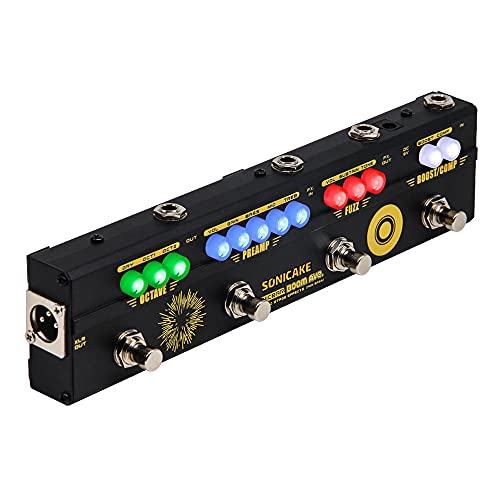
- Analog preamp with Ampeg-style EQ
- Compressor, boost, fuzz, and octave included
- XLR out plus FX loop for recording
Best For: Budget-minded players who want a compact recording and effects hub
Studio-Ready Drive & EQ
Battalion Black Bass Preamp & DI

- 4-band EQ with three signal-flow modes
- Built-in compressor and noise gate
- MOSFET drive with blend and tone control
Best For: Flexible recording rigs that need EQ, compression, drive, and DI in one pedal
Precision EQ & Cab Sim
MONOMYTH R-26 Bass Preamp & DI

- 6-band graphic EQ for detailed shaping
- XLR DI with built-in cab sim
- Blend, Voice, Level, and Drive controls
Best For: Direct recording setups that need precise EQ and speaker-style DI tone
Clean Comp & Overdrive
SONICAKE B Factory Bass Preamp

- Analog preamp with optical compression
- 3-band EQ with pre/post selection
- Balanced XLR output for direct recording
Best For: Compact recording setups that need compression, EQ, and XLR output
Budget DI Modeling – Behringer V-Tone BDI21 Bass Amp Modeler / Direct Recording Preamp / DI Box
If you want bass preamp pedals for recording without spending much, the Behringer V-Tone BDI21 is built around direct recording use, amp modeling, and DI functionality in one compact pedal. It gives you a simple way to shape bass tone before it hits an interface, mixer, or recorder.
Best For: Players who need an affordable all-in-one bass preamp, amp modeler, and DI box for direct recording.
Pros:
- Combines a bass amp modeler, direct recording preamp, and DI box in one unit
- Compact 1.97 x 3.94 x 5 inch footprint for easy pedalboard placement
- Requires only a single 9V battery for power
Cons:
- Single-purpose feature set compared with more fully loaded preamp pedals
- No extra onboard details like EQ bands are listed in the supplied specs
As a straightforward recording tool, this pedal keeps the focus on getting bass into your setup quickly through direct output and preamp-style shaping. It is a practical choice when simplicity and low cost matter more than advanced control.
Feature-Packed DI – MXR Bass D.I.+
For bass preamp pedals for recording, the MXR Bass D.I.+ stands out with a distortion channel, a color knob, and a 3-band EQ. It is designed to give you both direct-output utility and extra tone control when you want more than a basic DI.
Best For: Recording players who want a DI pedal with built-in distortion and flexible tone shaping.
Pros:
- Distortion channel with gain, volume, and blend controls
- Color knob plus 3-band EQ for broader tone shaping
- Includes phantom power support and a direct output-focused design
- Compact 4.5 x 2.75 x 5.75 inch size with included power supply and cable
Cons:
- More complex than a simple clean preamp pedal
- The added distortion section may be more than some recording setups need
This is a versatile option if you want one pedal to handle both clean recording duties and more aggressive tones. Its control layout makes it better suited to players who want to dial in a deliberate bass sound before tracking.
Studio-Ready Tone Control – Tone Hammer Preamp Direct Box Pedal V2
The Tone Hammer Preamp Direct Box Pedal V2 is aimed at bass preamp pedals for recording when you want preamp, DI box, and distortion functions in one rugged unit. With bass, treble, gain, and blend controls, it gives you direct tone shaping for both clean and driven sounds.
Best For: Studio or stage players who want a durable preamp/DI pedal with flexible clean-to-distorted control.
Pros:
- Functions as a preamp, DI box, and distortion pedal
- Bass, treble, gain, and blend controls for precise tone shaping
- Sturdy aluminum chassis for stage or studio use
- XLR output supports direct recording connections
Cons:
- AC power only, so it is less flexible than battery-powered pedals
- May offer more capability than players need if they only want a simple clean DI
This pedal makes sense when you want a single recording front end that can stay on the board and handle multiple bass tones. The added footswitch and XLR output make it especially practical for setups that move between clean and dirty sounds.
Clean EQ Recording Preamp – MXR Bass Preamp
If your priority is clean bass preamp pedals for recording, the MXR Bass Preamp focuses on straightforward level control, a 3-band EQ, and a studio-quality direct out. It is built for players who want a practical direct-recording signal path with solid EQ adjustment.
Best For: Bassists who want a clean preamp with direct out and simple, effective EQ control for recording.
Pros:
- Separate input and output level controls for gain staging
- 3-band EQ with sweepable midrange for tone adjustment
- Studio-quality direct out with pre/post EQ output mode
- Compact metal-cased design weighing about 0.5 pounds
Cons:
- No distortion or drive section is listed in the supplied specs
- More focused on clean shaping than on colorful character tones
This is a strong fit if you want a dependable recording preamp that stays centered on clarity and EQ flexibility. The direct-out options make it especially useful when tracking bass straight into a recording chain.
Multi-Effects Recording Tool – Zoom MS-60B+ MultiStomp Bass Effects Pedal
If you want bass preamp pedals for recording that can cover a lot of ground without taking up much space, the Zoom MS-60B+ is built for exactly that. It combines preamps, amp models, and a deep effects library in a compact pedal, so you can build tones, stack processing, and shape a recorded bass sound with plenty of flexibility.
Best For: Bass players who need an all-in-one recording pedal with preamps, amp models, and chaining options.
Pros:
- Includes 75 effects and 11 amp models, including Ampeg SVT and Acoustic 370-style tones.
- Can mix up to 6 effects, amp models, and preamps at once for layered recording chains.
- Split output lets you send amp/IR signal to PA while keeping a dry signal for an amp.
- Built-in tuner and color LCD make it easy to navigate and tweak quickly.
Cons:
- Its huge feature set may be more than you need if you only want a simple preamp.
- Menu-driven editing can be less immediate than a single-purpose pedal.
This is a strong choice if you want one compact unit that can handle tone shaping, amp-style coloration, and flexible signal routing. For recording, the combination of preamps, stereo output, and effect chaining makes it especially practical.
Direct-Input Preamp – JOYO TIDAL WAVE R-30 Bass Preamp & DI
For bass preamp pedals for recording, the JOYO TIDAL WAVE R-30 is aimed at players who want a dedicated preamp/DI path with direct-to-interface convenience. It offers blendable drive, a flexible 3-band EQ, and built-in cab simulation on the XLR output, which makes it a practical option for clean captures or pushed tones straight into a recorder or mixer.
Best For: Bassists who want a DI-ready preamp with cab sim and flexible EQ for recording.
Pros:
- Blend control lets you mix clean signal with the drive circuit for anything from transparent to gritty tones.
- Mid Shift and Bass Shift switches give you precise control over the EQ center points.
- XLR DI output with cab sim is designed for direct connection to PA systems, mixers, or audio interfaces.
- Ground lift and pad switch add useful recording and live connectivity options.
Cons:
- Cab sim applies only to the XLR output, not the 1/4-inch output.
- Requires a 9V DC adapter and does not support battery operation.
If you want a simple but capable preamp that connects easily to recording gear, this pedal covers the essentials well. The blend function and shift switches make it easier to dial in a useful bass tone without needing a separate DI box.
Budget All-in-One Option – SONICAKE Boom Ave Bass Preamp Pedal
If you’re shopping for bass preamp pedals for recording and want one unit that covers several common studio needs, the SONICAKE Boom Ave is a straightforward option. Its analog preamp uses a 3-band EQ with an Ampeg-style tone, while the built-in compressor, boost, fuzz, octave, FX loop, and XLR output make it useful for direct recording and broader pedalboard setups.
Best For: Bassists who want a compact multi-effect preamp with direct recording features.
Pros:
- Analog preamp with 3-band EQ recreates an Ampeg-style bass tone.
- Includes compressor, boost, fuzz, and octave modules for broad tonal options.
- XLR output connects directly to a PA, mixer, or audio interface.
- FX loop allows you to insert other pedals into the signal chain.
Cons:
- Tracking on the octave effect can be tricky with some high-fret playing.
- It is a multi-effect unit, so it may be more than needed if you only want a plain preamp.
This pedal makes sense if you want a budget-friendly, do-more box for recording bass parts. The built-in XLR out and core effects give you enough flexibility to capture usable tones without assembling a larger rig.
Studio-Ready Drive & EQ – Battalion Black Bass Preamp & DI
If you’re shopping for bass preamp pedals for recording, the Electro-Harmonix Battalion is a strong all-in-one option for tracking. It combines 4-band EQ, MOSFET distortion, compression, a noise gate, and DI output, so you can shape a finished bass tone without loading up a separate pedal chain.
Best For: Players who want a flexible preamp/DI with drive, compression, and EQ for direct recording or reamping.
Pros:
- 4-band EQ plus three signal-flow modes for different tonal placements.
- Built-in compressor adds thump and sustain with dedicated controls.
- MOSFET distortion section includes Level, Blend, Drive, and Tone controls.
- Flexible I/O and XLR DI make it easy to fit into recording setups.
Cons:
- Distortion-focused design may be more than you need if you want only clean tone shaping.
- Many controls can take longer to dial in than simpler preamps.
- Battery-powered operation may be less convenient for studio use than fixed DC power.
As a recording tool, the Battalion stands out because it covers tone shaping, dynamics, and gritty texture in one pedal. If you want a bass preamp that can move from clean control to driven character without extra gear, this is a versatile pick.
Precision EQ & Cab Sim – MONOMYTH R-26 Bass Preamp & DI
The JOYO MONOMYTH R-26 fits well into bass preamp pedals for recording when you want detailed tone control and direct-output convenience. Its 6-band graphic EQ, blend/voice/drive controls, and XLR DI with cab sim give you a practical way to build polished bass tones straight into an interface or mixer.
Best For: Recording players who want surgical EQ, onboard overdrive, and cab simulation on the DI output.
Pros:
- 6-band graphic EQ offers precise tone shaping for studio work.
- Blend, Voice, Level, and Drive controls add flexible overdrive options.
- Built-in cab sim on the XLR DI output helps create a more speaker-like direct sound.
- Includes headphone output and ground lift for practical recording and silent practice use.
Cons:
- Cab simulation is only active on the XLR output, not the 1/4-inch or headphone outputs.
- Requires a 9V DC adapter and does not support battery power.
- Its many controls may be more than players need for simple plug-and-play use.
For direct bass recording, the MONOMYTH gives you a lot of control without needing an amp. The combination of EQ precision, cab sim, and independent drive shaping makes it a good choice when you want to record a more finished bass tone at the source.
Clean Comp & Overdrive – SONICAKE B Factory Bass Preamp
Among bass preamp pedals for recording, the SONICAKE B Factory is a straightforward option if you want analog preamp tone with compression and overdrive in a compact format. Its 3-band EQ with pre/post selection and balanced XLR output make it practical for shaping a track-ready bass sound directly into a recorder or interface.
Best For: Bassists who want a compact analog preamp with compression, EQ flexibility, and balanced XLR output.
Pros:
- Analog preamp with classic optical compression for controlled dynamics.
- 3-band EQ includes PRE/POST selection for flexible tone shaping.
- XLR balanced output supports direct recording and interface use.
- High-impedance input and buffer bypass help keep the signal clean.
Cons:
- Power supply is not included.
- Do not connect the XLR output to phantom power, which limits some setups.
- Fewer controls than larger preamp/DI pedals if you need more advanced shaping.
The B Factory is appealing if you want a simpler recording solution that still covers the essentials: compression, EQ, overdrive, and balanced output. It won’t be the most feature-packed choice, but it should suit players looking for a compact, practical preamp for clean-to-lightly driven bass tracks.
How We Picked the Best Bass Preamp Pedals for Recording
We prioritized pedals that make tracking easier: usable EQ, reliable DI or XLR output options, cab simulation where helpful, and enough headroom to keep bass dynamics intact. We also looked for models that fit different recording workflows, from simple plug-and-play setups to more flexible multi-effect units.
Quick Comparison of the 10 Picks
For straightforward recording, pedals with clean DI paths and simple tone controls are the fastest route to a finished sound. If you want more shaping power, look for mid controls, blend options, and drive sections. Multi-effects units are best when you need compression, amp models, or extra utility in one box, while dedicated preamps usually offer the most direct and predictable bass tone.
Key Buying Factors for Bass Preamp Pedals for Recording
DI and Output Options
An XLR DI output is valuable for sending bass directly to an audio interface, mixer, or recorder. If your pedal also includes cab simulation, it can help the direct signal sound less harsh and more amp-like.
EQ Shape and Mid Control
Recording bass often comes down to controlling the mids as much as boosting lows. A 3-band or 4-band EQ, plus frequency-shift or blend controls, can make it easier to fit the bass into a mix without excess boosting.
Gain Structure and Clean Headroom
For Bass Preamp Pedals for Recording, clean headroom matters. A good preamp should stay articulate at higher input levels and let you choose whether you want transparent enhancement or audible drive.
Extra Tools: Compression, Mute, and Noise Control
Compression can even out performances before they hit the DAW, while noise gate and mute functions are useful for quiet studio work. These features are especially helpful if you record direct often.
Who Should Buy Which Bass Preamp Pedals for Recording?
If you want the simplest path to a polished direct bass tone, choose a dedicated preamp/DI with strong EQ and cab sim. If you need all-in-one flexibility, a multi-effect preamp can cover compression, drive, and utility features in a single pedal. Players who record in multiple styles should favor models with blend controls and broader EQ ranges, while anyone on a tighter budget can still get excellent results from a straightforward DI-style preamp.
In short, the best choice depends on how much control you want and how many tones you need from one pedal. For most recording setups, clarity, output flexibility, and easy EQ adjustment matter more than flashy extras.