Mini volume pedals are a smart way to keep precise level control on a crowded pedalboard without giving up too much space. The best options balance smooth sweep, solid build quality, and the right impedance for your rig.
In this roundup, we focus on compact models that suit guitarists who need practical control for swells, mute use, and live adjustments in 2026.
Best 10 Mini Volume Pedals Picks for 2026
Compact Control for Pedalboards

- Mini footprint for travel boards and tight setups
- Band-Drive action tested to over one million cycles
- Internal controls add tuner/expression flexibility
Best For: Players who need a compact, durable volume pedal with adjustable feel and extra routing options.
Classic Board-Friendly Volume

- Jr-size design saves pedalboard space
- Taper switch gives two swell rates
- Built for passive signal volume control
Best For: Passive-signal players who want a compact volume pedal with switchable swell response.
Two-in-One Compact Effect Control

- Wah and active volume in one compact pedal
- Fits pedalboards with a lightweight footprint
- Metal hinge and indicator lights support durability
Best For: Guitarists who want a compact wah/volume combo for pedalboard convenience.
Space-Saving Pro Pedalboard Choice

- Compact footprint helps save pedalboard space
- Rugged aluminum die-cast body
- Smooth pivot with stereo input/output
Best For: Pedalboard users and digital-instrument players who need a compact stereo volume pedal.
Mini Volume Pedal / Expression Combo
SONICAKE Vexpress 2-in-1 Mini Pedal
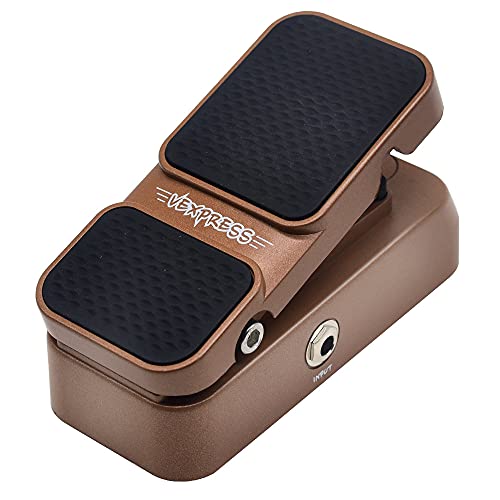
- Passive volume and expression in one pedal
- Automatically detects volume or EXP mode
- No battery or power supply required
Best For: Compact rigs that need both volume and expression control
Compact Passive Pick
DOD MiniVOL-U Compact Volume Pedal

- 500kΩ potentiometer for volume control
- Treble bleed helps preserve highs
- Ultra-compact footprint for pedalboards
Best For: Players who want a simple compact volume pedal with tonal consistency
2-in-1 Budget Control
Donner Viper Mini Volume/Expression

- Passive volume and expression in one pedal
- Automatic switching by input jack detection
- No power supply required
Best For: Budget-minded players needing one compact pedal for two jobs
Best with Extra Features
Passive Stereo Pedal with Mute Function

- No power required for simple pedalboard use
- Mute-on-press function for silent transitions
- Works with guitar, bass, keys, synths, and multi-effects
Best For: Compact rigs needing silent volume and expression control
Two-in-One Utility
Ampero Press 2-in-1 Passive Volume/Expression

- Volume and expression control in one passive pedal
- Independent output jacks for flexible routing
- Includes a 15 cm TS cable
Best For: Players wanting one pedal for both volume and expression
Space-Saving Option
Ampero Press Passive EXP Pedal

- Passive design needs no power supply
- Volume and expression in one analog pedal
- Compact 3.19-inch length fits tighter boards
Best For: Compact boards needing a simple two-function pedal
Compact Control for Pedalboards – Volume X Mini Pedal
If you want one of the more capable mini volume pedals for a crowded board, the Volume (X) Mini Pedal keeps the footprint small without giving up hands-on control. It’s built for smooth swells, adjustable resistance, and flexible routing, so it works well when you need precise expression control in a travel-friendly size.
Best For: Players who need a compact, durable volume pedal with adjustable feel and extra routing options.
Pros:
- Mini footprint with full volume control for tight pedalboards
- Low Friction Band-Drive is tested to over one million cycles
- Internal controls let you set heel/toe polarity and minimum heel-down levels
- Aux jack can switch between tuner and expression use
Cons:
- Internal switches mean setup takes a little extra adjustment
- No power required, but it still depends on your rig’s routing needs
- Smaller format may feel less substantial than a full-size pedal
Overall, this is a practical choice if you want mini volume pedals that still feel refined underfoot. The combination of smooth action, rugged tread, and flexible internal configuration makes it a strong fit for compact, performance-focused boards.
Classic Board-Friendly Volume – Ernie Ball VP JR 250K
The Ernie Ball VP JR 250K is a straightforward option if you want mini volume pedals that stay practical on a pedalboard. It uses a Jr-size design, supports passive signals, and includes a taper switch for two different swell rates, making it a simple tool for shaping volume changes without taking up full-size space.
Best For: Passive-signal players who want a compact volume pedal with switchable swell response.
Pros:
- Jr size fits pedalboards better than larger volume pedals
- Mono volume control keeps operation simple
- Taper switch offers two distinctive swell rates
- Designed for passive signals
Cons:
- Passive-signal use means it is not the most universal choice
- Six-month manufacturer warranty is shorter than some alternatives
- Basic feature set compared with more flexible compact pedals
For players who want a familiar, no-frills board companion, this pedal gets the job done with minimal fuss. Its compact size and taper switch make it especially useful if you prefer simple, reliable volume shaping in a smaller format.
Two-in-One Compact Effect Control – Donner Vowel Mini
The Donner Vowel is a practical pick if you want mini volume pedals with added wah functionality in the same unit. Its compact footprint, active volume control, and lightweight build make it easy to place on a busy board, while the classic-inspired wah sound gives it a broader role than a standard volume pedal.
Best For: Guitarists who want a compact wah/volume combo for pedalboard convenience.
Pros:
- Combines wah and active volume in one pedal
- Compact footprint fits pedalboards well
- Active volume control helps eliminate signal loss
- Durable housing with a solid metal hinge design
Cons:
- Power adapter is not included
- No battery compartment
- Plastic housing may not feel as heavy-duty as metal alternatives
This pedal makes sense when space is limited but you still want multiple foot-controlled effects. It is less of a dedicated volume pedal and more of a flexible board utility, which is exactly what many compact rigs need.
Space-Saving Pro Pedalboard Choice – BOSS FV-30L Compact
The BOSS FV-30L is a strong option if you’re comparing mini volume pedals for a pedalboard-first setup. It uses a compact die-cast body, a smooth pivot, and stereo input/output, which makes it a good fit for players who want trusted BOSS reliability in a smaller footprint.
Best For: Pedalboard users and digital-instrument players who need a compact stereo volume pedal.
Pros:
- Compact design saves space on the pedalboard
- Rugged aluminum die-cast body supports durability
- Smooth pivot provides silky volume control
- Stereo input and output suit the FV-30L version
Cons:
- Low-impedance design may not suit every rig
- Does not include a tuner out jack on this model
- Larger than ultra-mini effects pedals, despite being compact
If you want a compact pedal that still feels like a serious stage tool, this one lands in a very usable middle ground. It keeps the footprint modest while preserving the smooth response and build quality BOSS users typically expect.
Mini Volume Pedal / Expression Combo – SONICAKE Vexpress 2-in-1 Mini Pedal
If you want one of the most flexible mini volume pedals for a compact rig, the SONICAKE Vexpress gives you both passive volume control and expression control in a single pedal. It automatically detects the function from the connection, and its small footprint makes it easy to fit on a crowded board.
Best For: Players who want a lightweight, no-power mini pedal that can handle both volume and expression duties.
Pros:
- 2-in-1 design works as both a passive volume pedal and an expression pedal.
- Automatically detects volume or EXP mode when connected correctly with a TRS cable.
- No battery or pedal power supply required.
- Compact and lightweight for easy transport and pedalboard placement.
Cons:
- Volume control may not work gradually if you do not use a TRS cable.
- Built for passive use, so it depends on the connected setup for proper operation.
For players who need a simple, space-saving control pedal, this model is a practical pick. Its strength is versatility: one compact unit can serve multiple roles without needing power.
Compact Passive Pick – DOD MiniVOL-U Compact Volume Pedal
The DOD MiniVOL-U is a straightforward choice if you want mini volume pedals with a true pedalboard-friendly footprint. It uses a high-quality 500kΩ potentiometer, a gear drive for reliable performance, and treble bleed to help keep high frequencies present at lower volume settings.
Best For: Guitarists who want a compact passive volume pedal with reliable hardware and tone-preserving features.
Pros:
- High-quality 500kΩ potentiometer designed for volume pedal use.
- Treble bleed helps maintain high frequencies at lower volumes.
- Gear drive is built for reliable performance.
- Ultra-compact footprint fits easily on a pedalboard.
Cons:
- Requires a DC power supply according to the supplied details.
- Single-purpose design, so it does not double as an expression pedal.
This is a practical no-nonsense option for players who mainly need volume control in a small format. It focuses on core performance features rather than extra functions.
2-in-1 Budget Control – Donner Viper Mini Volume/Expression
The Donner Viper is a useful pick if you want mini volume pedals that can also handle expression duties. It combines passive volume and expression control in one unit, switches automatically by detecting the input jack, and keeps things simple with no power supply required.
Best For: Players who want an affordable compact pedal that can serve as either a volume pedal or an expression pedal.
Pros:
- 2-in-1 passive volume and expression pedal design.
- Automatic switching based on the connected input jack.
- No power supply required for operation.
- Compact hard-plastic build keeps it lightweight.
Cons:
- Does not include a battery compartment.
- Hard-plastic casing may feel less substantial than metal alternatives.
For a compact control pedal that keeps setup simple, the Viper covers the basics well. It is especially appealing if you want one small pedal to handle more than one role on the board.
Best with Extra Features – Passive Stereo Pedal with Mute Function
If you want one of the more flexible mini volume pedals for a compact rig, this passive stereo model keeps things simple while still giving you real-time control over volume or expression. It works without power, adds a mute-on-press function for silent swaps, and is built for guitars, basses, keyboards, synths, and multi-effects setups.
Best For: Players who want a power-free mini volume pedal for compact boards, live mute control, and broad instrument compatibility.
Pros:
- Passive design requires no batteries or power supply
- Mute function supports silent transitions between songs or tones
- Non-slip tread and heavy-duty chassis are built for stage use
- Works with guitars, bass, keyboards, synths, and multi-effects units
Cons:
- Uses a larger footprint than some ultra-compact mini pedals
- Relies on 1/4-inch audio connections, so compatibility depends on your rig
This is a practical choice if you want straightforward, dependable control without adding power management to your pedalboard. The 100,000+ press durability claim and mute function make it especially useful for live players who need consistency and quick silent changes.
Two-in-One Utility – Ampero Press 2-in-1 Passive Volume/Expression
Among mini volume pedals, this Hotone 2-in-1 design is aimed at players who want both volume and expression control in one passive unit. It uses independent output jacks, needs no power supply, and includes an extra 15 cm TS cable in the box, which is helpful if you want a ready-to-use setup.
Best For: Guitarists and multi-effects users who want a passive two-function pedal with separate output jacks and an included cable.
Pros:
- Combines volume and expression control in one pedal
- Passive design needs no power supply
- Independent output jacks add routing flexibility
- Includes an extra 15 cm TS cable
Cons:
- Large 6.38-inch square footprint for a mini-volume category search
- Details list 9V/0.5A specs even though the design is described as passive
This model makes sense if you want a single pedal to handle two jobs without adding a powered device to your board. The included cable and separate outputs are practical touches, though the larger size may matter if space is tight.
Space-Saving Option – Ampero Press Passive EXP Pedal
Hotone Volume Expression 2 in 1 Guitar Effects Pedal Passive EXP Ampero Press Guitar Pedal
Check Price On AmazonThis Hotone Ampero Press version is a straightforward option if you are comparing mini volume pedals and want a passive 2-in-1 volume and expression unit. It keeps the setup simple with no power supply needed and uses a compact, pedalboard-friendly layout for players who prefer a dedicated control surface.
Best For: Players who want a compact passive volume and expression pedal with a simple analog setup.
Pros:
- Passive operation means no power supply is needed
- Combines volume and expression functions in one pedal
- Compact 3.19-inch length helps save board space
- Compatible with multi-effects pedals and a variety of instruments
Cons:
- No included cable is listed in the supplied details
- Warranty is only a 30-day free return period
If your priority is a simple analog pedal that handles two control roles without extra wiring complexity, this model is easy to place on a board. The smaller footprint is the main draw here, especially for players building a tighter setup.
How We Picked the Best Mini Volume Pedals
We prioritized compact size, treadle feel, sweep consistency, and real-world compatibility with passive and active setups. For Mini Volume Pedals, the most important detail is matching the pedal to your signal chain so you avoid tone loss, scratchy taper, or unusable travel.
We also looked at durability, whether the pedal needs power, and whether it can double as an expression pedal for broader pedalboard use.
Quick Comparison
Before you buy, compare footprint, input/output type, impedance, and whether you need passive operation or active buffering. Some Mini Volume Pedals are designed for passive guitar signals, while others work better with line-level gear or expression-compatible rigs.
Compact Footprint
If space is tight, smaller chassis dimensions matter more than extra features. A tiny pedal can free up room for delay, reverb, or switching tools.
Control Feel
A good sweep should feel smooth and predictable from minimum to maximum level. If you use swells or subtle volume changes, treadle resistance and taper are worth paying attention to.
Key Buying Factors for Mini Volume Pedals
Impedance Match
Passive pickups usually pair best with pedals rated for passive signals, while low-impedance or buffered systems may suit other designs. The wrong match can dull highs or make the pedal feel inconsistent.
Volume Only Vs. Volume and Expression
Some Mini Volume Pedals are dedicated to volume control, while others add expression functionality. If you already use amp or multi-effects expression inputs, a dual-purpose model may save space and money.
Mute Function and Range
Mute-at-heel or toe-down behavior can be useful for silent tuning and stage breaks. Also check how much usable sweep the pedal offers, since not every compact model gives the same control range.
Build and Board Compatibility
Look for a sturdy chassis, reliable jacks, and a size that leaves room for patch cables. Non-slip bottoms and pedalboard-friendly shapes make daily use easier.
Who Should Buy Which Mini Volume Pedals?
Choose a compact passive model if you want simple, no-power volume control for a standard guitar rig. Go with a low-impedance or buffered option if your signal chain demands better matching and consistency.
If you need more than one function, Mini Volume Pedals with expression support are best for players using multi-effects units, modelers, or rigs that benefit from pedalboard flexibility. For players with very limited space, the smallest reliable pedal is often the best long-term choice.