Acoustic guitar resonance pedals can add body, clarity, and a more natural feel to piezo-heavy or DI-based acoustic setups. The right pedal can make a flat pickup sound more like a miked guitar without turning your rig into a complicated effects chain.
In this roundup, we focused on 10 options that help shape acoustic tone for stage, recording, and practice, with choices ranging from simple enhancer pedals to multi-effects units with XLR output and IR loading.
Best 10 Acoustic Guitar Resonance Pedals Picks for 2026
Acoustic Resonance Preamp
BOSS AD-2 Natural Acoustic Preamp

- Restores unplugged-style acoustic resonance
- Studio-quality ambience plus notch filter
- Balanced DI and amp outputs for live use
Best For: Players wanting natural resonance and easy stage feedback control
Acoustic Drive Pedal
Fender Smolder Acoustic Overdrive

- Adds overdrive and acoustic distortion options
- Pickup compensation and 3-band EQ
- Onboard cabinet simulation for finished tone
Best For: Players wanting colored acoustic tone with drive and EQ control
Pickup Enhancement Pedal
TC Electronic BODYREZ Acoustic Pickup Enhancer

- Restores natural resonance from under-saddle pickups
- One-knob control for fast setup
- Phase footswitch mode helps reduce feedback
Best For: Under-saddle pickup players wanting simple resonance recovery
All-in-One Acoustic Preamp
SONICAKE Sonic Wood Acoustic Pedal

- Analog preamp with 2-band EQ
- Chorus, delay, and reverb built in
- XLR output for direct PA or interface use
Best For: Gigging players needing preamp, effects, and direct output in one unit
Tone Restorer
MOOER Acoustikar Acoustic Guitar Pedal Simulator

- 3 acoustic voicings: Piezo, Standard, Jumbo
- Analog, knob-based control layout
- Compact pedalboard-friendly size
Best For: players wanting a simple acoustic-style simulator
Compact Analog Converter
Acoustic Guitar Simulator Pedal with True Bypass
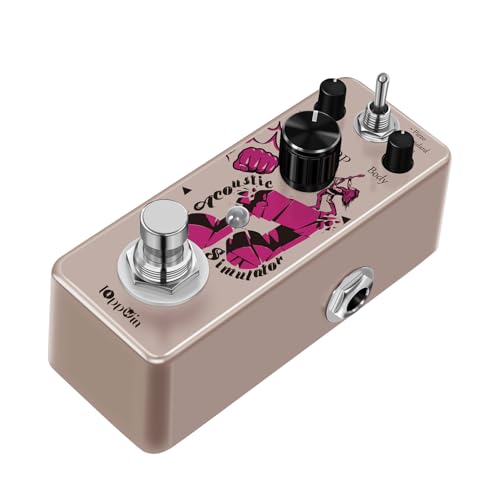
- 3 modes: Piezo, Standard, Jumbo
- True bypass and analog signal path
- Metal housing in a compact footprint
Best For: guitarists needing a simple, durable acoustic simulator
Stage-Ready Acoustic Preamp Pedal
SONICAKE A Factory Acoustic Effects Pedal

- Analog preamp with digital reverb
- Notch filter and mute for feedback control
- High-impedance input with XLR balanced output
Best For: Players who want a practical acoustic preamp pedal with reverb and stage output flexibility
Simple Acoustic Simulation Pedal
AC Stage Acoustic Guitar Simulator Pedal

- Three modes: Piezo, Standard, and Jumbo
- Analog conversion for realistic acoustic-style tone
- True bypass and compact construction
Best For: Guitarists or multi-instrument players who want a simple acoustic simulation pedal with three tone flavors
All-in-One Acoustic Multi-Effects Pedal
M-VAVE Cube Baby AC Multi-Effects Pedal

- 9 preamp models with 8 IR cabinet slots
- EQ, compression, delay, reverb, and more
- Bluetooth, OTG recording, tuner, and rechargeable battery
Best For: Acoustic players who want an all-in-one portable pedal for tone shaping, practice, and recording
Acoustic Resonance Preamp – BOSS AD-2 Natural Acoustic Preamp
If you want one of the most practical acoustic guitar resonance pedals for stage use, the BOSS AD-2 focuses on making a piezo-equipped acoustic feel more natural. Its resonance processing aims to recreate the complex body feel of an unplugged guitar, while the ambience and notch filter controls give you useful performance tools without a complicated layout.
Best For: Acoustic-electric players who want natural resonance enhancement, simple controls, and quick feedback control.
Pros:
- Acoustic resonance processing helps restore unplugged-style body feel.
- Ambience knob adds studio-quality reverb tailored for acoustic guitar.
- Notch filter provides instant feedback reduction on stage.
- Includes normal amp output plus balanced DI output for direct PA connection.
Cons:
- Designed as a resonance/preamp tool rather than a full multi-effects unit.
- Requires external power and is not battery powered.
Overall, the AD-2 is a focused choice if your priority is improving the natural character of an acoustic-electric signal with straightforward, gig-friendly controls.
Acoustic Drive Pedal – Fender Smolder Acoustic Overdrive
Among acoustic guitar resonance pedals, the Fender Smolder takes a different approach by adding drive and tone shaping instead of pure resonance enhancement. It includes pickup compensation, drive, a 3-band EQ, filter controls, and onboard cabinet simulation, making it a good fit when you want to thicken or color an acoustic signal for specific songs or live settings.
Best For: Acoustic players who want overdrive, tone shaping, and cabinet-style processing in one pedal.
Pros:
- Pickup compensation helps tailor the pedal to acoustic-electric signals.
- Drive control adds acoustic distortion/overdrive options.
- 3-band EQ and filter controls offer broad tone shaping.
- Onboard cabinet simulation adds a finished live sound.
Cons:
- Not intended for players seeking purely natural acoustic resonance.
- More of a creative effect than a transparent enhancement tool.
The Smolder is best viewed as a specialty effects pedal for players who want their acoustic to do more than just sound natural, especially when tonal character and drive matter.
Pickup Enhancement Pedal – TC Electronic BODYREZ Acoustic Pickup Enhancer
If your search for acoustic guitar resonance pedals is really about making an under-saddle pickup sound more like an acoustic guitar in the room, the TC Electronic BODYREZ is built for that job. It uses simple one-knob control, subtle compression, and filtering to bring back natural resonance, while its phase-control footswitch mode helps with low-frequency feedback.
Best For: Under-saddle pickup users who want an easy, ultra-compact resonance enhancer with feedback suppression.
Pros:
- Designed specifically to restore natural acoustic resonance from under-saddle pickups.
- One-knob operation keeps setup fast and simple.
- Phase control footswitch mode helps kill low-frequency feedback.
- Ultra-compact size is easy to fit on crowded pedalboards.
Cons:
- Single-knob design limits deep tone shaping.
- Focused on pickup enhancement rather than a full effects suite.
BODYREZ is a strong option when your main goal is natural tone recovery with minimal fuss, especially if you want a small pedal that does one acoustic job very well.
All-in-One Acoustic Preamp – SONICAKE Sonic Wood Acoustic Pedal
For players comparing acoustic guitar resonance pedals that can also handle a full live signal chain, the SONICAKE Sonic Wood goes beyond resonance alone. It combines an analog preamp with 2-band EQ, chorus, delay, and reverb, plus tap tempo, tail on/off, and XLR output for direct connection to a PA, mixer, or interface.
Best For: Acoustic performers who want a compact all-in-one preamp with effects and direct output.
Pros:
- Analog preamp with 2-band EQ provides warm, natural acoustic tone.
- Includes chorus, delay, and reverb for flexible live use.
- XLR output makes direct PA, mixer, or interface connection easy.
- Tap tempo and tail on/off add practical control over effects.
Cons:
- Larger and more feature-heavy than a simple resonance pedal.
- Requires a DC adapter rather than battery power.
The Sonic Wood is a sensible choice if you want one pedal to cover preamp duties, basic effects, and direct-output needs without building a bigger acoustic board.
Tone Restorer – MOOER Acoustikar Acoustic Guitar Pedal Simulator
If you want acoustic guitar resonance pedals that quickly turn an electric guitar into a more acoustic-voiced instrument, the MOOER Acoustikar is a straightforward option. Its 3 mode layout gives you Piezo, Standard, and Jumbo-style sounds, so you can choose between brighter, balanced, and fuller acoustic textures.
Best For: Players who want a compact analog acoustic simulator with simple mode switching for different acoustic textures.
Pros:
- 3 modes: Piezo, Standard, and Jumbo for different acoustic-style voices
- Designed to restore an acoustic guitar sound from an electric guitar
- Analog signal format and knob controls keep operation simple
- Compact footprint makes it easy to fit on a pedalboard
Cons:
- Requires a 9V adapter-style power setup
- No extra effects beyond the acoustic simulation voicing
Overall, the Acoustikar is a good fit if you mainly need an easy, dedicated acoustic simulator rather than a full multi-effects unit. It focuses on basic tone shaping and keeps the layout minimal.
All-in-One Acoustic Processor – LEKATO Acoustic Multi Effects Pedal
For shoppers comparing acoustic guitar resonance pedals with more than just body simulation, this LEKATO unit adds amp modeling, IR loading, and basic effects in one box. It includes 9 amp models, 8 IR cabinet body models, and effects like chorus, tremolo, delay, and reverb, making it a flexible practice and recording tool.
Best For: Players who want an acoustic multi-effects pedal with presets, IR support, Bluetooth playback, and battery power.
Pros:
- 9 amp models and 8 IR cabinet body models for broader tone shaping
- Includes chorus, tremolo, delay, and reverb effects
- Built-in battery supports portable use and charging while working
- Bluetooth playback plus PC/phone recording support for practice and tracking
Cons:
- More complex than a dedicated acoustic simulator pedal
- Requires using the Cube-Suite software for third-party IR file management
This is the most feature-rich option here if you want acoustic processing plus practice-friendly extras. It makes sense for players who need presets, headphone monitoring, and recording support in the same pedal.
Compact Analog Converter – Acoustic Guitar Simulator Pedal with True Bypass
If your goal is a focused electric-to-acoustic conversion pedal, this model keeps the feature set centered on realistic acoustic voicing. It offers 3 cabinet modes—Piezo, Standard, and Jumbo—along with analog technology and true bypass, so it is aimed at players who want a simple stage-friendly solution.
Best For: Guitarists who want a small true-bypass acoustic simulator with three clearly different body-style modes.
Pros:
- 3 cabinet modes: Piezo, Standard, and Jumbo
- Analog signal path is designed for organic acoustic textures
- True bypass helps avoid tone loss when the pedal is off
- Metal housing and compact size suit stage and studio use
Cons:
- Basic feature set compared with multi-effects acoustic pedals
- Uses corded power rather than a built-in battery
For players who want one of the more direct acoustic guitar resonance pedals with minimal fuss, this is a practical pick. It emphasizes conversion, durability, and pedalboard efficiency over extra processing.
Stage-Ready Acoustic Preamp Pedal – SONICAKE A Factory Acoustic Effects Pedal
If you want acoustic guitar resonance pedals that add useful stage control without complicating your setup, the SONICAKE A Factory is built around a simple analog preamp and digital reverb combination. It also adds a notch filter and mute function, plus high-impedance input and balanced XLR output for more flexible live use.
Best For: Players who want a practical acoustic preamp pedal with reverb, feedback control, and XLR output for performance use.
Pros:
- Analog preamp with digital reverb for basic tone shaping and ambience
- Notch filter and mute help quickly reduce whistle/feedback issues
- High-impedance input and XLR balanced output support stage connections
- Buffer bypass circuit is designed to keep the signal pristine
Cons:
- Runs on a 9V center-negative power supply that is not included
- Reverb-focused feature set is narrower than full multi-effects units
Overall, this is a straightforward choice if your priority is cleaner amplification, quick feedback control, and a touch of reverb rather than a deep effects menu.
Simple Acoustic Simulation Pedal – AC Stage Acoustic Guitar Simulator Pedal
Among acoustic guitar resonance pedals, the AC Stage is aimed at turning a dry electric signal into a more realistic acoustic-style tone. Its analog design offers three selectable modes—Piezo, Standard, and Jumbo—so you can choose between a brighter, leaner sound or a fuller, deeper response.
Best For: Guitarists or multi-instrument players who want a simple acoustic simulation pedal with three tone flavors and true bypass.
Pros:
- Three sound modes: Piezo, Standard, and Jumbo
- Analog conversion is designed to mimic a realistic acoustic guitar tone
- True bypass helps preserve transparent tone when the pedal is off
- Compact build with LED indicator for working status
Cons:
- DC 9V adapter is not included
- More of a simulator than a full-featured acoustic effects pedal
This is a focused option if you mainly need an acoustic-style voice from an electric instrument and prefer a small, uncomplicated pedal with simple mode switching.
All-in-One Acoustic Multi-Effects Pedal – M-VAVE Cube Baby AC Multi-Effects Pedal
If you want acoustic guitar resonance pedals with more versatility, the M-VAVE Cube Baby AC combines preamp models, an IR loader, and a full effects section in a compact battery-powered unit. It is built to shape body resonance, add common acoustic effects, and support practice or recording with Bluetooth, OTG recording, and headphone output.
Best For: Acoustic players who want an all-in-one portable pedal for tone shaping, practice, and basic recording features.
Pros:
- 9 acoustic preamp models plus 8 IR cabinet slots
- Includes EQ, compression, feedback killer, chorus, phaser, tremolo, delay, and reverb
- Built-in tuner with mute function for silent tuning
- Rechargeable battery, Bluetooth, OTG recording, and headphone out add portability
Cons:
- Digital multi-effects approach may be more than needed for players who only want basic resonance control
- Battery-based workflow may not suit users who prefer a simple pedalboard power setup
This is the most flexible pick here if you want one compact unit to handle acoustic tone shaping, practice features, and mobile recording without carrying separate gear.
How We Picked These Acoustic Guitar Resonance Pedals
We prioritized pedals that address the most common acoustic tone problems: quack, thin low end, harsh highs, and lack of air or resonance. We also looked at usability on real rigs, including live performance features, bypass behavior, output options, and whether the pedal is simple enough for quick adjustments on stage.
Because players use Acoustic Guitar Resonance Pedals differently, we included both straightforward tone-shaping pedals and more flexible multi-effects units. That gives you options whether you want subtle enhancement or a full acoustic signal chain.
Quick Comparison
For the simplest setup, choose a dedicated enhancer or preamp-style pedal. If you want more control over ambiance and processing, a multi-effects pedal with chorus, delay, reverb, or IR loading may be a better fit. Players using direct-to-PA rigs should pay close attention to XLR outputs and feedback control, while home users may value compact size and easy tone shaping more than advanced routing.
Key Buying Factors for Acoustic Guitar Resonance Pedals
Pickup Type and Source Tone
These pedals work best when matched to the source. Piezo pickups often benefit most from body enhancement, smoothing, and resonance correction. Magnetic acoustic pickups or undersaddle systems may need less correction and more subtle EQ or ambience.
Connectivity and Output Options
If you play live, balanced XLR output, DI-friendly routing, and reliable bypass matter a lot. For recording or practice, standard 1/4-inch output may be enough, but IR loading can add realism if you want a more miked acoustic feel.
Control Simplicity Vs. Flexibility
Some Acoustic Guitar Resonance Pedals are designed for one-job improvement, while others offer multiple amp models, effects, and cabinet simulations. Simple pedals are quicker to dial in; multi-effects units are better if you want one box to cover several tones and venues.
Noise, Headroom, and Stage Use
Acoustic instruments expose noise quickly, so look for quiet operation, enough headroom for strumming dynamics, and stable tone at higher volumes. A pedal should improve resonance without making the instrument sound processed or compressed.
Who Should Buy Which Acoustic Guitar Resonance Pedals?
If you want the fastest path to a more natural acoustic sound, start with a dedicated enhancement pedal. If you sing and play live, a preamp or XLR-equipped model may be the smarter all-in-one choice. If you want ambient polish or alternative voicings, choose a multi-effects pedal with reverb, delay, or IR tools.
In short, the best Acoustic Guitar Resonance Pedals are the ones that match your pickup, your output needs, and how much control you want over your tone. Focus on the features you will actually use, not the longest spec sheet.