Acoustic guitar body enhancer pedals can make a direct pickup sound more natural, fuller, and more mix-ready without changing your playing style.
Whether you need subtle tone shaping, onboard reverb, or a more convincing acoustic simulation, the right pedal can improve both live performance and recording workflow.
Best 10 Acoustic Guitar Body Enhancer Pedals Picks for 2026
Natural Tone Restore
TC Electronic BODYREZ Acoustic Pickup Enhancer

- Restores resonance for under-saddle pickups
- Phase control helps suppress feedback
- Ultra-compact one-knob operation
Best For: Under-saddle pickup players wanting natural tone recovery
Compact Ambient Color

- Hall, plate, and spring reverb options
- Compact with decay, tone, and level controls
- True bypass plus buffered bypass option
Best For: Players wanting a tiny acoustic reverb pedal
Warm Edge Drive
Fender Smolder Acoustic Overdrive Pedal

- Pickup compensation for acoustic signals
- Drive, EQ, and filter controls
- Onboard cabinet simulation included
Best For: Players wanting acoustic overdrive and tone shaping
All-In-One Acoustic Rig
SONICAKE Sonic Wood Multi Effects Pedal

- Analog preamp with 2-band EQ
- Chorus, delay, and reverb built in
- XLR output for direct PA connection
Best For: Gigging acoustic players needing an all-in-one pedal
Acoustic Simulator Pick
MOOER Acoustikar Acoustic Guitar Pedal Simulator

- 3 acoustic body modes: Piezo, Standard, and Jumbo
- Simulates a warmer acoustic texture on electric guitar
- Compact, lightweight, and easy to place on a board
Best For: Players who want a simple acoustic simulator pedal
Stage Utility Upgrade
GOKKO SPANISHFLY GK-32 Preamp & DI Acoustic Pedal
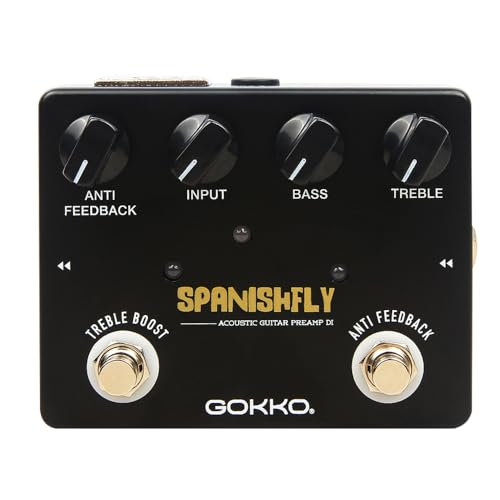
- Preamp and DI box in one compact pedal
- Anti-feedback control helps on louder stages
- Treble boost adds clarity and presence
Best For: Gigging acoustic players who need feedback control and output shaping
Acoustic Modeling Classic
BOSS AC-3 Advanced Acoustic Simulator Guitar Pedal

- Four acoustic simulation modes
- Built-in reverb for added space
- Compact analog pedal format
Best For: Players who want a compact acoustic simulator with easy mode switching
Stage-Ready Acoustic Preamp
SONICAKE A Factory Acoustic Pedal

- Analog preamp with digital reverb
- Notch filter helps tame feedback
- XLR balanced output for live use
Best For: Acoustic players needing preamp control and balanced stage output
Compact Body-Shape Simulator
Acoustic Guitar Simulator Pedal
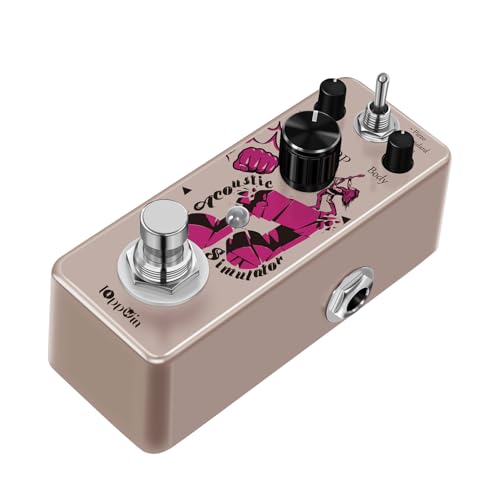
- Three body-style cabinet modes
- Analog design for organic texture
- True bypass in a metal housing
Best For: Guitarists wanting a compact analog acoustic simulator for pedalboards
Natural Tone Restore – TC Electronic BODYREZ Acoustic Pickup Enhancer
If you want one of the most focused acoustic guitar body enhancer pedals for under-saddle pickups, the TC Electronic BODYREZ is built to bring back resonance and a more natural playing feel. Its one-knob design keeps things simple while the internal filtering, subtle compression, and phase control help restore acoustic ambiance and reduce low-frequency feedback.
Best For: Players using under-saddle pickups who want a quick, no-fuss way to improve natural tone and control feedback.
Pros:
- Restores natural acoustic resonance for pickup-equipped guitars
- Built-in feedback suppression with phase control footswitch mode
- Ultra-compact design with very simple one-knob operation
- Subtle compression helps preserve a more acoustic playing feel
Cons:
- Designed specifically around under-saddle pickup enhancement
- Lacks broader effects like reverb or delay
For players who mainly need tone correction rather than a full effects chain, BODYREZ keeps the job targeted and easy to use. It is a practical choice when the goal is to make a pickup sound more like the guitar itself.
Compact Ambient Color – Fishman AFX AcoustiVerb Mini
The Fishman AFX AcoustiVerb Mini is a compact pick for players who want acoustic guitar body enhancer pedals that add space without taking over the sound. With hall, plate, and spring reverb options plus decay, tone, and level controls, it gives you a straightforward way to shape ambience on an acoustic rig. True bypass and a buffered bypass option also make it easier to fit into different setups.
Best For: Acoustic players who want a tiny reverb pedal for adding ambience and control.
Pros:
- Hall, plate, and spring reverb types in a mini enclosure
- Decay, tone, and level controls keep setup simple
- True bypass with optional buffered bypass
- Dual path routing adds flexibility in a compact design
Cons:
- External 9V power is required and sold separately
- Only covers reverb, not broader acoustic preamp duties
If you want a small pedal that adds polish rather than heavy processing, the AcoustiVerb Mini fits that role well. It is best viewed as a space-saving ambience tool for acoustic rigs.
Warm Edge Drive – Fender Smolder Acoustic Overdrive Pedal
The Fender Smolder is aimed at players looking for acoustic guitar body enhancer pedals that can push an acoustic signal into more expressive territory. It combines pickup compensation, drive, a 3-band EQ, filter controls, and onboard cabinet simulation, giving you more control over how acoustic distortion and overdrive are shaped. This is less about subtle enhancement and more about adding character while keeping the acoustic voice managed.
Best For: Acoustic players who want controlled overdrive and tone-shaping rather than transparent enhancement.
Pros:
- Pickup compensation helps adapt the pedal to acoustic signals
- Drive plus 3-band EQ and filter controls for detailed shaping
- Onboard cabinet simulation adds a more finished output feel
- Useful when you want acoustic distortion or overdrive effects
Cons:
- Not a subtle resonance-restoration pedal
- Higher current draw than simpler acoustic enhancement pedals
Smolder makes the most sense for players who want creative breakup and heavier shaping from an acoustic rig. If you need a pedal that changes the sound more dramatically, this one is built for that purpose.
All-In-One Acoustic Rig – SONICAKE Sonic Wood Multi Effects Pedal
The SONICAKE Sonic Wood is one of the more versatile acoustic guitar body enhancer pedals if you want a single box for a full gig setup. Its analog preamp and 2-band EQ aim for a warm, natural acoustic tone, while the built-in chorus, delay, and reverb give you practical effects for different performance situations. With tap tempo, tail on/off, and XLR output, it is designed to handle more than basic tone enhancement.
Best For: Acoustic performers who want a compact all-in-one pedal with preamp, effects, and direct output.
Pros:
- Analog preamp with 2-band EQ for warm, natural tone
- Includes chorus, delay, and reverb for gig-ready flexibility
- XLR output for direct connection to PA, mixer, or interface
- Tap tempo and tail on/off improve effect control
Cons:
- More of a multi-effects solution than a dedicated tone enhancer
- Requires a DC adapter power setup
For players who want one pedal to cover preamp duties and common acoustic effects, Sonic Wood is the most complete option here. It is especially useful when you need direct output and simple stage-ready control.
Acoustic Simulator Pick – MOOER Acoustikar Acoustic Guitar Pedal Simulator
If you want acoustic guitar body enhancer pedals that make an electric guitar sound more like an acoustic, the MOOER Acoustikar is built for that exact job. Its 3 modes—Piezo, Standard, and Jumbo—let you choose a more nature-like or smooth acoustic character depending on the song and pickup feel.
Best For: Electric players who want a compact acoustic-style simulator with multiple body voicings.
Pros:
- 3 selectable acoustic modes: Piezo, Standard, and Jumbo
- Designed to restore acoustic-style texture on an electric guitar
- Very compact and lightweight for pedalboard use
- Simple knob-based control layout
Cons:
- Needs a 9V adapter with fairly high current draw
- No built-in DI or feedback control features
- Focused on simulation rather than full acoustic processing
For straightforward acoustic-body simulation, this pedal keeps the concept simple and practical. It is a solid pick if your main goal is to shift an electric guitar toward an acoustic texture without adding a lot of extra features.
Stage Utility Upgrade – GOKKO SPANISHFLY GK-32 Preamp & DI Acoustic Pedal
Among acoustic guitar body enhancer pedals, the GOKKO SPANISHFLY GK-32 stands out as a practical preamp and DI box for live use. It adds treble boost for extra clarity, includes an anti-feedback function, and gives you input control to avoid overloading your guitar’s EQ.
Best For: Acoustic players who need a compact preamp/DI with anti-feedback and tone shaping.
Pros:
- Works as both a preamp and a DI box
- Anti-feedback switch and adjustment knob for live performance control
- Treble boost adds brightness and presence
- Compact, low-power design for easy gigging
Cons:
- Requires a 9V DC center-negative power supply
- More utility-focused than effect-heavy
- Uses a fairly simple knob-and-switch layout
This is the most stage-ready option in the group if you want cleaner output and better control rather than a modeled acoustic effect. It is especially useful when feedback management and tone clarity matter more than added ambience or body simulation.
All-in-One Modeler – LEKATO Acoustic Multi Effects Pedal with IR Loading
If you want acoustic guitar body enhancer pedals with more editing and recording flexibility, the LEKATO multi-effects pedal is the most feature-rich choice here. It combines 9 amp models, 8 IR cabinet body models, preset/live modes, Bluetooth playback, and recording support for practice or home tracking.
Best For: Players who want an all-in-one acoustic effects unit with IR loading and practice/recording tools.
Pros:
- 9 amp models and 8 IR cabinet body models
- Supports third-party IR file loading and deletion
- Built-in battery for portable practice sessions
- Bluetooth playback, headphone output, and PC/phone recording support
Cons:
- More complex than a simple single-purpose pedal
- Requires software for third-party IR management
- Best features may be more than casual users need
This pedal is aimed at players who want to shape acoustic tone and also handle rehearsal, monitoring, and recording from one unit. If you need body modeling plus versatility, it offers the broadest toolkit of the three.
Acoustic Modeling Classic – BOSS AC-3 Advanced Acoustic Simulator Guitar Pedal
If you want one of the most established acoustic guitar body enhancer pedals for turning an electric guitar into a convincing acoustic-style voice, the BOSS AC-3 is built around acoustic-guitar modeling rather than simple EQ shaping. Its four simulation modes let you move between standard, jumbo, enhanced, and piezo-equipped sounds, while the built-in reverb helps add the space that makes the result feel more natural.
Best For: Players who want a compact, straightforward acoustic simulator with multiple body-style voicings and onboard reverb.
Pros:
- Four simulation modes: standard, Jumbo, Enhanced, and piezo-equipped
- Built-in reverb optimized for acoustic-guitar simulation
- Compact pedal format with analog signal path
- Simple knob-based controls and 1/4-inch audio interface
Cons:
- Designed for simulation rather than full acoustic preamp features
- Uses a 9V, 30 mA power requirement specific to pedalboard setup
The AC-3 is a practical choice if your goal is quick acoustic-style body enhancement from an electric guitar in a small footprint. The mode selection and onboard reverb make it versatile without adding complexity.
Stage-Ready Acoustic Preamp – SONICAKE A Factory Acoustic Pedal
The SONICAKE A Factory is aimed at players looking for acoustic guitar body enhancer pedals that do more than just mimic tone shape. It combines an analog preamp with digital reverb, plus a notch filter and mute function with gain and frequency adjustment to help manage feedback and fine-tune the sound. The high-impedance input and XLR balanced output also make it a flexible option for amplified acoustic setups.
Best For: Acoustic players who need preamp control, feedback management, and balanced output for stage use.
Pros:
- Analog preamp with built-in digital reverb
- Notch filter and mute function for quick feedback control
- High-impedance input and XLR balanced output
- Buffer bypass circuit designed to keep the sound pristine
Cons:
- Requires a 9V center-negative power supply, not included
- Higher current draw than basic compact pedals
This is a strong fit if you want a pedal that supports both tonal shaping and live performance practicality. The extra output and feedback tools make it more stage-oriented than a simple simulator.
Compact Body-Shape Simulator – Acoustic Guitar Simulator Pedal
This acoustic guitar simulator pedal is built for electric-to-acoustic conversion with a focus on realistic body character. Its three cabinet modes—Piezo, Standard, and Jumbo—give you options ranging from bright modern resonance to a warmer large-body sound, while the analog design aims to avoid digital artifacts. If you are comparing acoustic guitar body enhancer pedals for a small pedalboard, its true bypass and metal housing are especially practical.
Best For: Guitarists who want a compact analog simulator with multiple body-style voicings and true bypass.
Pros:
- Three cabinet modes: Piezo, Standard, and Jumbo
- Analog technology designed for organic, dynamic textures
- True bypass helps reduce tone loss when disengaged
- Metal housing and compact footprint for stage or studio use
Cons:
- No built-in reverb or XLR output listed
- Uses a corded 9V power setup with a 2.1mm DC jack
Overall, this pedal is a clean fit for players who want acoustic-body simulation in a durable, small package. The mode selection keeps it useful for different tonal targets without adding much complexity.
How We Picked the Best Acoustic Guitar Body Enhancer Pedals
We focused on Acoustic Guitar Body Enhancer Pedals that solve the most common real-world problems: thin pickup tone, weak low end, harsh highs, feedback risk, and limited output options. Priority went to pedals with practical controls, usable EQ or body modeling, stage-friendly outputs, and simple operation.
Quick Comparison
For a fast choice, think in categories. Basic enhancers and body-shaping pedals are best if you already like your core tone and just want more realism. Multi-effects and preamp/DI units are better if you need reverb, chorus, IR loading, or direct-to-PA flexibility. Acoustic simulators are the strongest fit when you are converting a more electric or piezo-like source into a fuller acoustic-style sound.
Key Buying Factors for Acoustic Guitar Body Enhancer Pedals
Tone Shaping and Body Modeling
Look for controls that add low-mid warmth, reduce quack, and restore resonance without making the signal muddy. The best Acoustic Guitar Body Enhancer Pedals should improve natural character, not just add effects.
Connectivity and Live Output
If you play gigs, check for XLR output, DI functionality, and anti-feedback tools. These features make setup easier and help your acoustic signal translate better through a PA or interface.
Effects Versus Straight Enhancement
Some players want a nearly transparent enhancer, while others want reverb, chorus, delay, or amp simulation in one box. Choose the pedal that matches your actual workflow so you do not overpay for features you will never use.
Size, Power, and Ease of Use
Compact pedals are ideal for minimal boards and fast setup. Larger processors can offer more flexibility, but only if you are comfortable managing presets, modes, or extra controls.
Who Should Buy Which Acoustic Guitar Body Enhancer Pedals?
If you want the simplest improvement to an onboard pickup sound, choose a dedicated enhancer or acoustic simulator. If you perform live and need a dependable direct signal, a preamp/DI with feedback control is often the smartest buy. Players who want ambience and versatility should look at multi-effects models, while anyone seeking the most natural “mic-like” tone should prioritize body enhancement and resonance controls over heavy processing.
In short, the best Acoustic Guitar Body Enhancer Pedals are the ones that solve your specific tone problem with the least extra complexity.