Polyphonic octave pedals can instantly thicken riffs, add synth-like textures, and create massive low-end without forcing you to play single notes only. The best models keep tracking clean, blend naturally, and respond well across the fretboard.
Below, we focus on pedals that balance sound quality, ease of use, and real-world pedalboard practicality so you can find the right octave effect faster.
Best 10 Polyphonic Octave Pedals Picks for 2026
Polyphonic Precision

- Polyphonic octave pedal for guitar and bass
- Mono/Poly modes with Dry Direct Output
- Lowest Range affects only the lowest note in a chord
Best For: Players who want a dependable octave pedal for chords and single-note parts
Drop-Tune Utility
DigiTech DROP Compact Pitch-Shifter

- Polyphonic drop tuning from 1 semitone to a full octave
- Momentary or latching footswitch modes
- True bypass with included 9VDC power supply
Best For: Players who need compact drop tuning with flexible switching
Analog Octave Texture

- 100% analog with true bypass
- Blends dry signal with one- and two-octave tones
- Compact design for guitar and bass
Best For: Players who want a small analog octave effect for single-note lines
Polyphonic Sound Design

- Tracks chords, sweeps, and single notes smoothly
- Offers 12-string, bass, and organ-like sounds
- Adjustable dry, octave up, and octave down volumes
Best For: Players who want versatile polyphonic octave textures and clean tracking
Budget Multi-Voicing
Donner Harmonic Square Octave/Pitch Shifter

- 7 shift types plus 3 tone modes
- Wet and dry knobs for easy blending
- True bypass and aluminum-alloy housing
Best For: players wanting a low-cost, highly varied octave/pitch shifter
Preset Control Pick
FLAMMA FS08 Polyphonic Octave Pedal

- 7 saveable preset slots
- Individual control for ±1 and ±2 octaves
- Dry signal control with true bypass
Best For: players who want saveable octave presets and flexible layer control
Low-Latency Performer
NUX TUTTI Polyphonic Octave Pedal

- Ultra-low-latency polyphonic octave engine
- Three modes: Polyphonic, Bassline, Momentary
- True bypass or buffered bypass options
Best For: players who want responsive octave tracking for live performance
Polished Polyphonic Texture

- Independent sub, upper, dry, and mod controls
- Polyphonic tracking handles chords and multi-note passages
- True bypass aluminum build with road-ready design
Best For: Players who want deep control and organ-like octave textures
Compact Digital Layering
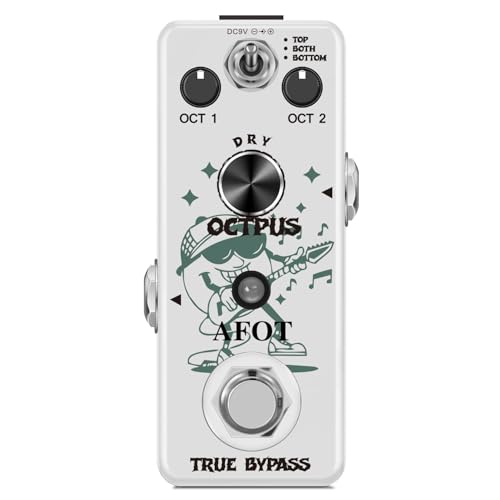
- TOP, BOTH, and BOTTOM octave modes
- Three knobs for dry and octave balance
- Compact aluminum enclosure with true bypass
Best For: Players who want a small, easy-to-use octave pedal
Mini Octave Control

- 11 octave modes for more tonal variety
- TOP, BOTTOM, and BOTH switching
- Solid aluminum-alloy mini enclosure
Best For: Players who want a compact pedal with multiple octave voices
Polyphonic Precision – BOSS OC-5 Octave Pedal
The BOSS OC-5 is one of the most practical polyphonic octave pedals if you want an industry-standard option with updated features. It works for guitar and bass, offers Mono and Poly modes, and includes a Dry Direct Output for more control in a live or studio rig.
Best For: Players who want a dependable octave pedal for guitar or bass, especially when using chords in Poly mode.
Pros:
- Poly mode applies the octave effect to only the lowest note in a chord when set to Lowest Range.
- Supports both guitar and bass with Mono/Poly operation.
- Includes a Dry Direct Output for flexible signal routing.
- Compact, standard BOSS format with analog signal handling.
Cons:
- Runs on 9V power with an AC adapter rather than battery power.
- Its feature set may be more than needed if you only want a simple octave effect.
For players comparing polyphonic octave pedals, the OC-5 stands out as a straightforward upgrade to a familiar pedal format. It focuses on usable tracking and routing options without overcomplicating the layout.
Drop-Tune Utility – DigiTech DROP Compact Pitch-Shifter
The DigiTech DROP is a compact choice in the broader world of polyphonic octave pedals when you need quick drop tuning instead of a traditional octave blend. It offers polyphonic drop tuning from 1 semitone to a full octave, plus momentary or latching footswitch modes for flexible performance use.
Best For: Guitarists who want an easy drop-tuning pedal with polyphonic tracking and a compact footprint.
Pros:
- Polyphonic drop tune range from 1 semitone down to a full octave.
- Momentary or latching footswitch modes add performance flexibility.
- True bypass design helps preserve your signal when disengaged.
- Includes a 9VDC power supply.
Cons:
- It is more of a drop tuner than a classic octave generator.
- Powered by corded electric supply rather than battery operation.
If your priority is fast tuning changes with solid polyphonic behavior, the DROP is a very practical tool. It is best viewed as a focused pitch-shifting pedal rather than a traditional octave pedal.
Analog Octave Texture – SONICAKE Analog Octave Pedal
The SONICAKE Octave Guitar Pedal is a compact analog option for players looking at simpler polyphonic octave pedals, though its design is monophonic. It creates a 2-voice octave sound blended with the dry signal and can produce notes one octave lower and two octaves lower than the direct signal.
Best For: Guitar and bass players who want a small, analog octave pedal with straightforward octave layering.
Pros:
- 100% analog design with true bypass.
- Blends a 2-voice octave sound with the dry signal.
- Can generate one-octave-lower and two-octaves-lower tones.
- Compact size and low power draw at 9 milliamps.
Cons:
- Monophonic, so it is not a true polyphonic octave pedal.
- Power supply is not included.
This pedal makes sense if you want an analog octave effect in a small footprint and do not need chord tracking. It is a practical budget-minded choice for simple octave work.
Polyphonic Sound Design – Electro-Harmonix Nano POG
The Electro-Harmonix Nano POG is a strong pick if you want one of the more versatile polyphonic octave pedals for chord work and layered textures. It tracks chords, sweeps, and single notes without hitches or glitches, and it can deliver 12-string-like sounds, bass-style tones, and organ-like textures.
Best For: Guitarists who want smooth polyphonic tracking and a wide range of octave-based sounds.
Pros:
- Tracks chords, sweeps, and single notes with no hitches or glitches.
- Creates 12-string guitar, bass, and organ-like sounds.
- Adjustable original pitch, one octave up, and one octave down volumes.
- Silent footswitching and a road-worthy die-cast package.
Cons:
- Uses 9V power and ships with an adapter, which may matter for simple board setups.
- Its multi-voice capabilities may be more than needed for basic octave duties.
For players who want an octave pedal that can do more than just one trick, the Nano POG is especially flexible. It is built for smooth tracking and convincing layered sounds that fit both live and creative use.
Budget Multi-Voicing – Donner Harmonic Square Octave/Pitch Shifter
If you want one of the more flexible polyphonic octave pedals without a complicated layout, the Donner Harmonic Square is built for quick sound changes. It combines 7 shift types with 3 tone modes, giving you 21 options for semitone, octave, and detune textures, plus separate wet and dry level controls for balancing the effect.
Best For: Players who want an affordable octave/pitch shifter with lots of preset-style variations and simple knob control.
Pros:
- 7 shift types and 3 tone modes create 21 sound combinations
- Wet and dry knobs make level balancing straightforward
- True bypass helps keep the signal transparent when disengaged
- Aluminum-alloy build feels sturdy for a mini pedal
Cons:
- Requires a 9V DC adapter, which is not included
- Needs at least 500mA for optimal performance
- Best suited to compact setups rather than deep onboard editing
This is a practical choice if you mainly need broad octave and detune coverage in a small format. It trades advanced control for variety and ease of use, which makes it appealing for players building a versatile board on a budget.
Preset Control Pick – FLAMMA FS08 Polyphonic Octave Pedal
The FLAMMA FS08 is a strong fit if you want polyphonic octave pedals with straightforward preset management and dedicated control over octave layers. It offers 7 saveable preset slots with combinations like +OCT, -OCT, and stacked ±1 and ±2 octave settings, while the dry signal control helps you shape the blend without adding distortion.
Best For: Guitarists who want editable, saveable octave presets and individual control over multiple octave ranges.
Pros:
- 7 preset slots let you save adjusted octave settings
- Individual control for ±1 and ±2 octave ranges
- Dry signal control helps keep the tone practical and playable
- Full metal shell and true bypass add durability and board-friendly use
Cons:
- Power supply is not included
- Needs a 9V DC supply with more than 306mA
- Menu/preset workflow is more specialized than a basic one-knob octave pedal
For players who want more than a fixed octave sound, the FS08 delivers useful preset depth in a compact format. Its strength is control: you can save variations, tailor the dry mix, and cover a wide range of octave combinations without a lot of fuss.
Low-Latency Performer – NUX TUTTI Polyphonic Octave Pedal
The NUX TUTTI is aimed at players who want polyphonic octave pedals that track accurately and stay responsive in real use. Its octave engine is designed for highly musical, ultra-low-latency performance, and the three modes—Polyphonic, Bassline, and Momentary—make it easy to switch the pedal’s role from song to song.
Best For: Players who need a fast, musical octave pedal for chords, single notes, and flexible live use.
Pros:
- Polyphonic octave algorithm is built for musical, low-latency tracking
- Three modes: Polyphonic, Bassline, and Momentary
- Supports both true bypass and buffered bypass
- Compact footprint with included hook & loop tape and rubber feet
Cons:
- Requires a 9V DC power supply; not all players may have a spare
- No detailed knob-based control list is provided in the notes
- More focused on performance modes than deep parameter editing
If you value tracking and feel over a feature-heavy control set, the TUTTI stands out. It’s a clean, performance-oriented octave pedal that should fit well on a crowded board and adapt quickly to different playing situations.
Polished Polyphonic Texture – JOYO XVI R-13
If you want polyphonic octave pedals that can handle chords without falling apart, the JOYO XVI is built for flexible layering. Its independent SUB, UPPER, DRY, and MOD controls let you move from subtle harmonies to huge organ-style sounds, while the modulation adds extra movement to the octave voices.
Best For: Players who want a feature-rich octave pedal with deep control over sub, upper, dry, and modulation blend.
Pros:
- Independent sub-octave and upper-octave volume knobs for precise blending
- Mod control adds phaser/vibrato-style movement to the octave signal
- Dry blend makes it easier to keep your core guitar tone clear
- True bypass and rugged aluminum chassis for pedalboard use
Cons:
- Requires a 9V DC adapter, which is not included
- More controls than a basic octave pedal, so setup takes a little more time
The JOYO XVI stands out if you want one of the more flexible polyphonic octave pedals in this group, especially for ambient, thickened rhythm parts, or dramatic synth-like textures. It is less about simplicity and more about giving you real tonal range in a compact enclosure.
Compact Digital Layering – STRICH Mini Polyphonic Octave
This compact entry in polyphonic octave pedals is aimed at players who want simple octave layering in a small footprint. The STRICH mini gives you TOP, BOTH, or BOTTOM modes, plus three knobs for dry and octave balance, making it easy to build clear harmonies or low-end reinforcement without a complicated layout.
Best For: Guitarists who want a small, straightforward octave pedal with selectable top, bottom, or combined voices.
Pros:
- Three octave modes: TOP, BOTH, and BOTTOM
- Three knobs for independent dry and octave level control
- Compact aluminum build that is easy to fit on a crowded board
- True bypass design with no-loss signal path noted by the manufacturer
Cons:
- Power adapter is not included
- Limited to the pedal’s core octave functions, with no extra modulation features listed
The STRICH mini is a practical choice if you want polyphonic octave pedals that stay simple and portable. It focuses on usable octave tones and easy operation rather than extra sound-shaping extras.
Mini Octave Control – VSN LEF-3806 Mini Octave
The VSN LEF-3806 is a compact option in polyphonic octave pedals for players who want straightforward mode selection and a focused sound. It offers 11 octave modes, plus a TOP, BOTTOM, and BOTH switch, so you can quickly move between bright high octaves, low octave reinforcement, or combined layering.
Best For: Players who want a small octave pedal with multiple mode options and a simple control layout.
Pros:
- 11 different octave modes for broader tonal variety
- TOP, BOTTOM, and BOTH switching for fast voice selection
- Polyphonic octave design with true bypass
- Solid aluminum-alloy build in a mini format
Cons:
- Heavier than some other mini pedals at 408 g
- 9V adapter is included in the notes, but power options are still basic compared with larger units
If you want a compact octave pedal with more mode variety than the simplest options, the VSN is worth a look. It keeps the controls readable and the footprint small while still offering enough switching flexibility to cover a range of octave textures.
How We Picked These Polyphonic Octave Pedals
We looked for models that handle chords and double-stops reliably, offer useful octave ranges, and stay easy to dial in on a live rig or recording setup. We also prioritized true bypass or buffer options, compact enclosures, and controls that make it simple to blend dry and effected signals.
Because Polyphonic Octave Pedals are often used for both subtle reinforcement and dramatic pitch-shift effects, we gave extra weight to tracking stability, tone preservation, and versatility across guitar and bass use cases.
Quick Comparison: What Matters Most
If you want the cleanest tracking, look for digital designs with strong note separation and low latency. If you want a more organic or vintage-inspired response, simpler analog-style units can be appealing, especially for lower-octave reinforcement. For players with crowded boards, mini enclosures and presets matter more than extra features.
Best for Clean Tracking
Choose a pedal that is known for handling chords and fast runs without glitching.
Best for Tonal Flexibility
Look for dry blend, independent octave controls, and mode switching.
Best for Small Pedalboards
Compact Polyphonic Octave Pedals can save space while still covering most standard octave needs.
Key Buying Factors for Polyphonic Octave Pedals
Tracking: The most important factor. Good pedals should follow bends, chords, and low-register notes without obvious warble or dropout.
Octave range: Decide whether you need only a lower octave, an upper octave, or both. Some players want octave-down thickness, while others need harmonized textures or octave-up lead tones.
Blend and EQ control: A dry mix lets your original tone stay present, which is especially useful for bass and rhythm guitar. Tone shaping can help the effect sit better in a band mix.
Bypass and buffering: True bypass is great for preserving tone when the pedal is off, while buffered bypass can help long signal chains.
Power and size: Mini pedals are easier to fit on a crowded board, but larger enclosures may offer better control layouts and more performance options.
Who Should Buy Which Polyphonic Octave Pedals?
If you want the most straightforward option for dependable performance, choose a pedal with strong tracking and simple controls. If you play modern rock, worship, pop, or experimental parts, prioritize pedals with multiple modes, presets, or independent octave blends. Bass players should focus on units that keep the low end clear, while guitarists may prefer pedals that can move between subtle reinforcement and pronounced octave effects.
For players building a flexible board, the best choice is usually the pedal that combines stable tracking, a usable dry blend, and the octave range you’ll actually use most often. That way, your effect stays musical instead of gimmicky.