Learning to keep steady time is easier when your practice has a clear, consistent pulse. The best metronomes for beginners make tempo simple to hear, adjust, and follow across instruments such as piano, guitar, violin, drums, and ukulele.
This roundup compares 10 practical choices, from compact rechargeable digital models with voice counting to loud mechanical metronomes and versatile tuner combinations. Use the guide below to match features, sound, and controls to your practice routine.
Best 10 Metronomes for Beginners Picks for 2026
Best Rechargeable Option
Sondery ProBeat Digital Metronome
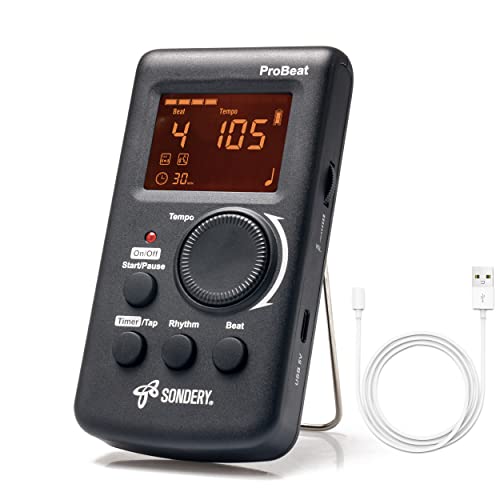
- Rechargeable battery with USB charging
- Vocal counting, tap tempo, and timer
- Color screen plus LED beat indication
Best For: Beginners wanting flexible digital practice features
Best Battery Life

- Approximately 400 hours on alkaline batteries
- Large display with beat visuals
- Tap tempo, timer, and sound-out modes
Best For: Beginners needing a loud, long-lasting digital metronome
Best Mechanical Design
Wood-Grain Mechanical Metronome

- Metal movement for stable performance
- 40–208 bpm range with five beat selections
- Simple wind-up operation for beginners
Best For: Beginners and children learning rhythm with a pendulum
Best Traditional-Style Digital

- Mechanical-inspired digital design
- Eight sounds, including a mechanical sound
- 19 beat patterns for varied practice
Best For: Beginners wanting traditional style with digital flexibility
Classic Rhythm Pick

- 40–208 BPM adjustment
- Five selectable bell settings
- Beginner-friendly mechanical design
Best For: Traditional home practice for beginners and children
Feature-Rich Pick
Rechargeable Digital Metronome

- LCD display with voice or electronic beats
- 10 rhythm patterns and 40–208 BPM range
- USB-C charging and headphone jack
Best For: Portable, customizable practice
Colorful Starter Pick

- Beginner- and child-friendly operation
- 40–208 BPM adjustable tempo
- Pink finish with selectable bell accents
Best For: Traditional practice with a colorful look
Best Versatile Pick
Donner Rechargeable Trainer Metronome

- Trainer mode gives visual rhythm feedback
- Built-in tuner and tempo detection
- Rechargeable, compact, and headphone-ready
Best For: Beginners wanting guided practice plus tuning in one device
Best Classic Design
AUPHY Universal Mechanical Metronome

- Traditional pendulum with audible accent bell
- No batteries required
- 40–208 BPM with five beat settings
Best For: Students who prefer simple, hands-on tempo practice
Best Simple Mechanical Option

- Clear click and bell for audible practice
- Battery-free wind-up mechanism
- Easy controls for children and beginners
Best For: Home learners who want a loud traditional metronome
Best Rechargeable Option – Sondery ProBeat Digital Metronome
For beginners comparing metronomes for beginners, the Sondery ProBeat is a flexible digital choice with a color screen, rotary tempo control, and multiple practice aids. Its rechargeable battery and compact size make it convenient for regular practice at home or on the go.
Best For: Beginners who want vocal counting, visual tempo feedback, and flexible rhythm-training features.
Pros:
- Offers vocal counting, three digital sounds, 10 beat patterns, and tap tempo.
- Color display and top LED provide clear visual tempo indications.
- Rechargeable Li battery, timer settings, and earphone output support varied practice routines.
- Compact 5-by-3-by-1-inch design weighs only 0.26 pounds.
Cons:
- Requires charging rather than standard replaceable batteries.
- Plastic construction may feel less substantial than a traditional mechanical model.
With a 40–208 bpm range and several ways to hear or see the beat, the ProBeat is a practical all-around pick for developing timing skills across piano, guitar, drums, and other instruments.
Best Battery Life – Korg MA-2 Digital Metronome
The Korg MA-2 is a straightforward choice for beginners seeking a clear, portable metronome. Its larger display, louder buzzer, tap tempo, and long alkaline-battery life make it easy to use during daily practice or with louder instruments.
Best For: Beginners who prioritize an easy-to-read display, audible clicks, and extended battery life.
Pros:
- 30% larger display includes beat visuals for easier monitoring.
- Louder electronic buzzer helps the click remain audible with high-volume instruments.
- Supports pendulum, full-step, and tap tempo settings, plus 0–9 beats and eight rhythm types.
- Alkaline batteries provide approximately 400 hours of continuous operation.
Cons:
- Uses replaceable AAA batteries rather than a rechargeable battery.
- Its feature set may be more than beginners need for basic tempo practice.
The MA-2 balances simple controls with useful training modes, making it a dependable option for building steady timing without frequent battery changes.
Best Mechanical Design – Wood-Grain Mechanical Metronome
For beginners who prefer a traditional learning tool, this wood-grain mechanical metronome offers a visible swinging pendulum and a simple wind-up setup. Its metal movement is designed for stable performance across common instruments.
Best For: Beginners and children who want an easy-to-operate mechanical metronome for learning steady rhythm.
Pros:
- Metal movement is intended to provide long-term use and reliable operation.
- Covers 40–208 bpm and supports 0, 2, 3, 4, and 6 beat selections.
- Works with piano, guitar, violin, bass, drums, and other instruments.
- Simple wind-up operation and removable stopper are approachable for beginners.
Cons:
- At 1.12 pounds and nearly 8 inches deep, it is less portable than the digital options.
- Requires winding before practice and does not offer digital features such as tap tempo or a timer.
The pendulum motion gives learners a direct visual reference for the beat, while the broad tempo range makes this a useful foundational tool for rhythm practice.
Best Traditional-Style Digital – Korg KDM-3 Metronome
The Korg KDM-3 combines the look of a mechanical metronome with digital convenience. For beginners comparing metronomes for beginners, its one-touch operation, readable display, and range of sounds and patterns offer an approachable way to practice different musical styles.
Best For: Beginners who like a traditional metronome appearance but want digital sounds and rhythm options.
Pros:
- Mechanical-inspired design provides a familiar traditional appearance.
- Includes eight metronome sounds, including a mechanical metronome sound.
- Supports 19 beat patterns for songs across different genres.
- One-touch operation and an easy-to-read display simplify practice sessions.
Cons:
- Its supplied notes do not specify a rechargeable battery or extended battery-life rating.
- The larger 3-by-2.5-by-4.5-inch body may be less pocket-friendly than a compact digital model.
The KDM-3 is a good middle ground for learners who enjoy the character of a mechanical sound and design but want the flexibility of digital beat patterns.
Classic Rhythm Pick – Black Mechanical Metronome
For shoppers comparing metronomes for beginners, this mechanical model offers straightforward operation without a digital display or charging requirement. Its adjustable 40–208 BPM range and selectable bell accents cover practice needs for piano, guitar, violin, drums, and other instruments.
Best For: Beginners and children who want a traditional, easy-to-use metronome for home practice.
Pros:
- Simple mechanical operation designed for beginners and children
- Adjustable tempo range from 40 to 208 BPM
- Selectable 0, 2, 3, 4, and 6 beat bell settings
- Includes a 30-day unconditional return policy and 1-year manufacturer warranty
Cons:
- At 1.2 pounds, it is less portable than the listed digital option
- Plastic and metal construction may appeal less to shoppers seeking an all-metal design
This is a practical choice if you prefer visible, traditional tempo control and a steady mechanical approach. The black finish and full bell-setting range make it a versatile starter option.
Feature-Rich Pick – Rechargeable Digital Metronome
Among metronomes for beginners, this SDREAM digital model stands out for its LCD display, voice-counting option, and rechargeable design. Button controls set tempos from 40 to 208 BPM, while the compact body and headphone jack support practice at home or on the go.
Best For: Beginners and musicians who want adjustable digital features, portability, and quieter headphone-based practice.
Pros:
- Offers human English voice beats or electronic metronome beats
- Includes 10 rhythm patterns and tempo settings from 40 to 208 BPM
- Rechargeable via USB-C and operates for more than 8 hours
- Compact 5-ounce design with a 3.5mm headphone jack
Cons:
- Requires charging or its included battery-powered setup rather than purely mechanical operation
- Its multiple digital features may be more than beginners seeking the simplest controls need
This is the most flexible option in the group for practice away from home or in shared spaces. Its voice counting, rhythm patterns, and headphone support provide more control than a basic mechanical metronome.
Colorful Starter Pick – Pink Mechanical Metronome
This pink mechanical model is a simple option for shoppers seeking metronomes for beginners, especially children or players who prefer a traditional setup. It provides 40–208 BPM adjustment, selectable bell accents, and compatibility with piano, guitar, violin, and other instruments.
Best For: Beginners and children who want an approachable mechanical metronome in a pink finish.
Pros:
- Easy-to-use design intended for beginners and children
- Adjustable tempo from 40 to 208 BPM
- Selectable 0, 2, 3, 4, and 6 beat bell sounds
- Backed by a 30-day unconditional return policy and 1-year manufacturer warranty
Cons:
- Mechanical operation lacks the digital display and headphone jack of the SDREAM model
- Its 8.5-inch height may be less convenient for carrying in smaller instrument bags
The pink finish gives this otherwise traditional metronome a more distinctive look, while its broad tempo and bell settings keep it useful beyond early lessons. It is a sensible pick when simplicity and appearance matter.
Best Versatile Pick – Donner Rechargeable Trainer Metronome
For beginners comparing metronomes for beginners, this Donner model offers more feedback than a basic click track. Its trainer rhythm mode, tempo detection, tuner, and bright display make it a practical choice for learning steady timing across several instruments.
Best For: Beginners who want a rechargeable metronome with built-in tuning and rhythm feedback.
Pros:
- Trainer mode uses the microphone and light display to provide dynamic rhythm feedback.
- Combines a metronome, chromatic tuner, and tempo detection function.
- Offers 30–280 BPM, selectable beat patterns, adjustable volume, and a headphone jack.
- Compact rechargeable design with a bright, full-angle VA LCD display.
Cons:
- A USB-C charging cable is not included.
- Its many functions may be more than beginners need for simple tempo practice.
The Donner is the most feature-rich option here, especially for students who also need an instrument tuner. Choose it when guided practice and portability matter more than a traditional mechanical feel.
Best Classic Design – AUPHY Universal Mechanical Metronome
This mechanical model is a straightforward option for beginners choosing metronomes for beginners. It uses a visible pendulum, audible clicks, and an accent bell, so learners can practice tempo without batteries or complicated digital menus.
Best For: Beginners who prefer a traditional wind-up metronome for piano, guitar, drums, or other instruments.
Pros:
- Simple pendulum operation with a clear audible beat and selectable accent bell.
- Offers 40–208 BPM and beat settings of 0, 2, 3, 4, and 6.
- Wind-up operation requires no batteries; one full wind produces about 2,160 clicks.
- Stable lowered center of gravity and a durable PC-and-alloy construction.
Cons:
- It is larger and heavier than a pocket digital metronome.
- Tempo range is narrower than the Donner model.
- Requires winding and horizontal placement before use.
The AUPHY keeps rhythm practice tangible and easy to understand. Its traditional controls and accent bell suit students who benefit from a strong physical and audible tempo reference.
Best Simple Mechanical Option – Ueteto Loud-Sound Metronome
For learners seeking uncomplicated metronomes for beginners, the Ueteto provides a clear mechanical beat with minimal setup. Its audible click and bell help students maintain tempo while reading music, and its wind-up design avoids battery management.
Best For: Children and beginners who need a loud, easy-to-operate metronome for home practice.
Pros:
- Designed for easy use, with straightforward steps for setting the beat and tempo.
- Audible click and bell ring provide a strong rhythm reference.
- Supports 40–208 BPM and beat selections of 0, 2, 3, 4, and 6.
- Wind-up mechanism needs no batteries and delivers about 2,160 clicks per full wind.
Cons:
- Its mechanical design is relatively bulky and weighs about 1.2 pounds.
- It lacks digital features such as a tuner, display, or headphone output.
The Ueteto is a good fit when loud, uncomplicated operation is the priority. It gives beginners a traditional tempo tool for piano, violin, guitar, bass, drums, and similar instruments.
How We Picked the Best Metronomes for Beginners
We focused on the features that matter most during early practice: clear beats, dependable tempo control, easy-to-read displays or visible pendulums, useful tempo ranges, and controls that do not distract from playing. The selection includes both digital and mechanical designs so beginners can choose between precision, portability, and traditional visual feedback.
We also considered practical extras such as rechargeable batteries, vocal counting, rhythm training modes, loudness, tuner functions, and suitability for different instruments. A good beginner metronome should be easy to start using immediately and flexible enough to remain useful as skills improve.
Quick Comparison
| Type | Best for | Main advantage | Potential drawback |
|---|---|---|---|
| Digital | Most beginners and portable practice | Precise settings, visible display, and adjustable sound | Requires batteries or charging |
| Rechargeable digital | Frequent practice and travel | Convenient USB charging and added functions | Electronic controls may take time to learn |
| Digital with tuner | String players | Combines timing and tuning in one device | May offer more features than some users need |
| Mechanical | Players who prefer visual, traditional feedback | No battery required and an easy-to-follow pendulum | Less compact and usually less flexible for sound control |
Key Buying Factors for Metronomes for Beginners
Sound and Volume
Choose a click that is audible over your instrument without becoming harsh or distracting. Digital models with adjustable volume, accent settings, or vocal counting can work well for piano, guitar, and drums. Mechanical models may provide a naturally prominent sound, but room size and instrument volume still matter.
Tempo Control and Beat Options
A broad tempo range gives you room to practice slowly and gradually increase speed. Digital units are typically easier to set precisely, while mechanical models use a sliding weight and may offer fewer rhythm patterns. Beginners should prioritize simple beat selection before advanced subdivisions.
Power, Size, and Display
For lessons and travel, a compact digital metronome is usually the easiest choice. Rechargeable models reduce disposable-battery use, while battery-powered units can be convenient when charging is unavailable. A bright, readable display helps when practicing in low light, but mechanical pendulums provide excellent visual timing feedback.
Extra Functions
A tuner is valuable for guitar, bass, violin, and ukulele players. Voice counting can reinforce beat awareness, and trainer or rhythm modes can make repetitive practice more structured. Avoid paying for features you are unlikely to use if straightforward tempo clicking is your main goal.
Who Should Buy Which Metronomes for Beginners?
Choose a digital metronome if you want precise tempo changes, portability, and straightforward controls. A rechargeable digital model suits frequent players who prefer not to replace batteries, while a tuner-metronome combination is especially practical for string instruments.
Select a mechanical metronome if you like a classic design, a visible moving pendulum, and operation without batteries. It is a strong fit for home piano or general instrument practice, provided its size and fixed sound suit your space. For most first-time buyers, prioritize audible beats, easy tempo adjustment, and dependable construction over a long list of extras.