The best guitar tuners make accurate tuning quick, clear, and repeatable—whether you are practicing at home, preparing for a performance, or switching between instruments. This lineup includes compact clip-on models, pedal tuners, soundhole designs, rechargeable options, and value multipacks.
Use the guide below to compare tuning modes, display visibility, power options, mounting styles, and overall convenience before choosing the tuner that fits your playing routine.
Best 10 Guitar Tuners Picks for 2026
Simple Clip-On Pick

- Full-color display
- Guitar-and-bass frequency range
- Front- or back-of-headstock mounting
Best For: Straightforward everyday tuning
Stage-Ready Pedal

- High-visibility 21-segment LED meter
- +/- one-cent tuning accuracy
- Silent tuning and drop-tuning support
Best For: Live guitar and bass rigs
Versatile Headstock Tuner
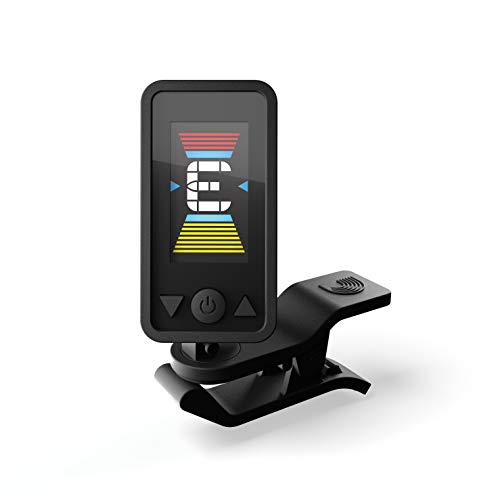
- Large full-color vertical screen
- 435–450Hz adjustable calibration
- Dual swivels and strong clamp
Best For: Flexible guitar, bass, and ukulele tuning
Precision Polyphonic Clip

- Tunes all six strings simultaneously
- Chromatic and ultra-precise strobe modes
- Adaptive 108-LED matrix display
Best For: Fast checks and precision guitar tuning
Most Discreet
D'Addario NS Micro Soundhole Tuner

- Discreet soundhole placement
- Piezo vibration sensing
- Color display and non-marring clip
Best For: Acoustic players wanting an unobtrusive tuner
Best All-Around Clip-On
Fender FT-1 Professional Tuner

- Supports guitar and bass
- Dual-rotating hinges
- Backlit LCD with green in-tune signal
Best For: Multi-instrument players wanting simple clip-on tuning
Best Rechargeable Option
D'Addario Eclipse Rechargeable Tuner

- Up to 24 hours per charge
- USB-C rechargeable power
- Large adjustable full-color display
Best For: Players seeking convenient rechargeable headstock tuning
Best Multi-Instrument Value

- Three tuners included
- Five instrument modes
- Rotatable display and auto shutoff
Best For: Players who need multiple tuners or backups
Best Heavy-Duty Pick

- USB-C rechargeable battery
- Up to 10 hours of tuning
- Color display with open tuning detection
Best For: Players wanting a compact rechargeable tuner
Best Simple Single Tuner

- Vibration sensing for noisy settings
- Supports several stringed instruments
- 360-degree rotatable screen
Best For: Individual players wanting a straightforward tuner
Simple Clip-On Pick – Snark SN5X
The Snark SN5X is a straightforward choice for guitar tuners shoppers who want an easy-to-read clip-on model. Its full-color display and guitar-and-bass-focused frequency range make everyday tuning simple, while the reversible design lets you attach it to either side of the headstock.
Best For: Guitarists, bassists, and violinists who want a practical full-color clip-on tuner.
Pros:
- Full-color display is easy to read.
- Frequency range is tailored to guitar and bass.
- Can be used on the front or back of the headstock.
Cons:
- The supplied notes do not specify calibration range, accuracy, or battery details.
The SN5X focuses on useful basics rather than extra tuning modes. It is a sensible option when you value a clear display and flexible headstock placement.
Stage-Ready Pedal – BOSS TU-3
The BOSS TU-3 is a strong choice among guitar tuners for players who need dependable visibility and silent tuning on stage. Its tank-tough stompbox housing, high-brightness 21-segment LED meter, and professional-grade accuracy are designed for demanding live use.
Best For: Performing guitarists and bassists who need a durable pedal tuner with drop-tuning support.
Pros:
- Accurate to +/- one cent and includes Accu-Pitch visual confirmation.
- High-brightness, adjustable 21-segment LED meter improves visibility.
- Supports guitar/bass modes, seven-string guitars, six-string basses, and drop tunings up to six semitones.
- Automatically mutes the signal for silent tuning and can power up to seven BOSS compact pedals.
Cons:
- Its pedal format requires a 9-volt power source.
- It is less compact and portable than a clip-on tuner.
With stage-focused visibility, muting, broad tuning support, and rugged construction, the TU-3 is particularly well suited to live rigs and players who want a pedalboard-based solution.
Versatile Headstock Tuner – D'Addario Eclipse
The D’Addario Eclipse is a practical clip-on option for guitar tuners shoppers who want quick tuning and flexible positioning. Its full-color vertical screen, dual swivels, and strong adjustable clamp make it easy to mount and view from different angles.
Best For: Guitar, bass, and ukulele players who want an adjustable tuner with a broad calibration range.
Pros:
- Quick tuning with a large, full-color display.
- 435–450Hz calibration range supports precise adjustment.
- Dual swivels accommodate varied viewing angles and left- or right-handed placement.
- Strong clamp is designed to mount securely anywhere on the headstock.
Cons:
- The supplied notes specify a CR2 battery but do not provide battery life.
- The notes do not specify a dedicated violin mode or polyphonic tuning.
The Eclipse combines broad instrument compatibility with useful screen and mounting adjustability. It is a solid everyday choice when viewing flexibility matters as much as tuning convenience.
Precision Polyphonic Clip – TC Electronic POLYTUNE CLIP
The TC Electronic POLYTUNE CLIP stands out among guitar tuners for its combination of polyphonic, chromatic, and strobe modes. You can tune all six strings simultaneously in polyphonic mode, then switch to highly precise strobe tuning when fine accuracy is the priority.
Best For: Guitarists who want fast multi-string checks plus highly precise strobe tuning in a clip-on design.
Pros:
- PolyTune technology checks all six strings simultaneously.
- Chromatic accuracy is +/- 0.5 cent, while strobe accuracy is +/- 0.02 cent.
- Adaptive 108-LED matrix display is designed for clear readout in different orientations.
- Includes flat-tuning and capo modes with a durable stainless-steel clip.
Cons:
- Polyphonic tuning is specified for six strings, so the notes do not confirm support for extended-range instruments.
- The supplied notes do not specify battery type or battery life.
The POLYTUNE CLIP is a feature-rich choice for players who want speed and precision together. Its multiple modes and adaptive display make it especially appealing for detailed guitar setup and performance tuning.
Most Discreet – D'Addario NS Micro Soundhole Tuner
If you want a low-profile option among guitar tuners, the D’Addario NS Micro sits inside an acoustic guitar or acoustic bass sound hole. Its piezo transducer reads instrument vibrations rather than relying on room sound, while the color display helps with visibility in darker settings.
Best For: Acoustic guitarists and acoustic bass players who prefer discreet, non-marring tuning.
Pros:
- Discreet soundhole design keeps the tuner out of the way.
- Piezo vibration sensing supports accurate tuning.
- Color screen is easier to see in dark environments.
- Non-marring plastic mounting clip protects the instrument.
Cons:
- Designed for acoustic instruments with a suitable sound hole.
- Uses a CR2 battery rather than a rechargeable power system.
The NS Micro is a particularly practical choice when unobtrusive placement matters. Its 410–480Hz calibration range also gives players useful flexibility for precise tuning.
Best All-Around Clip-On – Fender FT-1 Professional Tuner
The Fender FT-1 is a versatile clip-on choice for guitar tuners, supporting electric, acoustic, and bass instruments. Its dual-rotating hinges allow flexible positioning, while the LCD display and illuminated tuning indicator make pitch adjustments straightforward.
Best For: Players who want one compact chromatic tuner for guitar, bass, and different viewing angles.
Pros:
- Works with electric guitar, acoustic guitar, bass, and more.
- Dual-rotating hinges support flexible placement.
- LCD backlight and green in-tune indicator are easy to read.
- Includes a CR2032 battery and a limited warranty.
Cons:
- Plastic construction may feel less substantial than metal-bodied alternatives.
- Relies on a replaceable coin-cell battery.
With broad instrument compatibility and a simple visual interface, the FT-1 is a sensible everyday tuner for players who want straightforward clip-on operation without limiting themselves to acoustic guitar.
Best Rechargeable Option – D'Addario Eclipse Rechargeable Tuner
The D’Addario Eclipse stands out among guitar tuners with a rechargeable design and a large, full-color vertical screen. Its strong clamp and dual swivels let you position it on the headstock for clear viewing, whether you play left- or right-handed.
Best For: Guitar and bass players who want rechargeable power and flexible headstock placement.
Pros:
- Provides up to 24 hours of tuning time per charge.
- USB-C charging avoids regularly buying replacement batteries.
- Full-color screen has flexible viewing angles.
- Strong clamp and dual swivels support secure, adjustable mounting.
Cons:
- Requires access to USB power for recharging.
- Headstock clip-on placement is more visible than a soundhole tuner.
The Eclipse is a strong fit for players who tune frequently and prefer a rechargeable workflow. Its adjustable 435–450Hz calibration range and large display add useful precision and convenience.
Best Multi-Instrument Value – 3-Pack Clip-On Tuner
Guitar Tuner Clip On 3 Pack Tuners for Acoustic Electric Guitar Bass Ukulele Violin banjo Tuning
Check Price On AmazonIf you need guitar tuners for several instruments—or want spares in different cases—this three-pack offers practical flexibility. Each clip-on tuner supports chromatic, guitar, bass, ukulele, and violin modes, with vibration-based sensing for quick tuning.
Best For: Players, families, or teachers who want multiple tuners for several stringed instruments.
Pros:
- Includes three tuners in one package.
- Supports chromatic, guitar, bass, ukulele, and violin modes.
- 360-degree rotatable clip and screen help with viewing angles.
- Automatic shutoff activates after three minutes without continued operation.
Cons:
- Uses replaceable CR2032 batteries rather than USB-C charging.
- The three-pack may be more than needed for a single instrument.
This is a convenient choice when backup availability matters. Its multi-mode support and adjustable display make it a versatile guitar tuner set for home practice, lessons, or keeping one in multiple instrument cases.
Best Heavy-Duty Pick – Color-Screen Clip-On Tuner
For shoppers comparing guitar tuners with simpler power management, this rechargeable clip-on model combines a vivid color screen with USB-C charging. It supports several instruments, offers open tuning detection for guitar, and provides up to 10 hours of tuning per charge.
Best For: Guitarists who prefer a rechargeable tuner with a clear display for practice, studio, or stage use.
Pros:
- High-resolution color screen improves note visibility in different lighting.
- Supports guitar, bass, ukulele, violin, cello, chromatic, and open guitar tuning.
- 360-degree rotatable screen allows flexible viewing.
- USB-C charging and up to 10 hours of tuning reduce battery-swapping needs.
Cons:
- Only one tuner is included.
- Requires charging when its built-in battery is depleted.
Its rechargeable design and compact size make it especially convenient for musicians who carry a tuner between rehearsals and performances. The silicone-padded clamp is also designed to grip securely without damaging the instrument.
Best Simple Single Tuner – Sensitive Clip-On Model
Guitar Tuner Clip On 1 Pack Tuners for Acoustic Electric Guitar Bass Ukulele Violin banjo Tuning
Check Price On AmazonThis single-pack option keeps guitar tuners straightforward: clip it onto a stringed instrument, use its vibration sensor, and adjust from the 360-degree display. It is designed for acoustic and electric guitars, bass, ukulele, banjo, violin, and chromatic tuning.
Best For: Individual players seeking an affordable, easy-to-use tuner for a range of stringed instruments.
Pros:
- Vibration sensor can handle noisy surroundings.
- Works with guitar, bass, ukulele, banjo, violin, and chromatic tuning.
- Rotatable screen supports easier viewing from different positions.
- Automatic shutoff activates after three minutes without continued operation.
Cons:
- Only one tuner is included.
- No rechargeable battery or charging connection is listed.
This model is a sensible everyday choice when you want broad instrument compatibility without extra features. Its compact clip-on format and noise-resistant vibration sensing suit routine practice and quick tuning sessions.
How We Picked These Guitar Tuners
We selected these models based on the features that matter most in everyday tuning: accuracy, readable displays, response speed, instrument compatibility, mounting security, power convenience, and value. The selection covers several use cases, from discreet acoustic tuning to pedalboard integration and quick clip-on tuning for guitar, bass, ukulele, violin, and banjo.
We also considered practical differences between chromatic, polyphonic, strobe, and instrument-specific modes. A tuner does not need every feature to be useful, but the right combination can make tuning faster and easier in your particular environment.
Quick Comparison
- Best for pedalboards: BOSS TU-3 Compact Chromatic Tuner.
- Best for advanced visual feedback: TC Electronic POLYTUNE CLIP.
- Best for discreet acoustic use: D’Addario NS Micro Soundhole Tuner.
- Best simple clip-on options: Snark SN5X, D’Addario Eclipse, and Fender FT-1.
- Best for rechargeable convenience: D’Addario Eclipse Rechargeable and New Bee Rechargeable.
- Best for multi-instrument value: The three-pack and one-pack clip-on tuner options.
Key Buying Factors for Guitar Tuners
Tuning Modes and Accuracy
A chromatic tuner is the most versatile choice because it detects any note across compatible instruments. Polyphonic tuning can show multiple strings at once, while strobe-style displays provide especially detailed visual feedback. For standard practice, a responsive chromatic mode is usually sufficient.
Display Visibility
Choose a bright, high-contrast display if you tune on dark stages or in brightly lit rooms. A rotating screen and adjustable viewing angle are useful for headstock-mounted tuners, while a large LED display is easier to read on a pedalboard.
Power and Battery Life
Replaceable batteries are convenient when you need a quick swap, while rechargeable models reduce ongoing battery purchases. Pedal tuners typically use a power supply or battery, so check compatibility with your existing board setup.
Mounting and Instrument Fit
Clip-on tuners should grip securely without marking the finish. Soundhole tuners are less visible and work well for acoustic guitars, but they are not suitable for every instrument. Confirm the tuner supports your guitar, bass, ukulele, violin, or other instrument before buying.
Who Should Buy Which Guitar Tuners?
Choose a compact clip-on model if you want affordable, portable tuning for practice, lessons, or casual performances. Pick a pedal tuner if you need dependable operation in a live rig and want tuning muted from the audience. A polyphonic or strobe-capable tuner is worthwhile for players who want faster checks or more precise setup work.
Acoustic guitarists who prefer a low-profile accessory should consider a soundhole tuner. Rechargeable models suit frequent players who want fewer disposable batteries, while multipacks make sense for households, teaching studios, or players who use several instruments. For most buyers, the best choice is the model with the clearest display and most convenient power system for the places you tune most often.