Whether you need a clean direct tone, vintage grit, or a flexible all-in-one front end, the right bass DI pedal with preamp can simplify your rig fast.
Below, we focus on pedals that balance tone shaping, DI output quality, and real-world gigging convenience so you can choose with confidence.
Best 10 Bass Di Pedals with Preamp Picks for 2026
Budget Preamp/DI With Flexible EQ
JOYO TIDAL WAVE R-30 Bass Preamp & DI

- Blend control adds clean/drive mixing
- MID SHIFT and BASS SHIFT tighten EQ control
- XLR DI out includes cab sim and ground lift
Best For: Players wanting affordable bass di pedals with preamp flexibility
Classic Distortion DI Workhorse

- Distortion channel with gain, volume, and blend
- 3-band EQ plus Color knob for tone shaping
- Phantom power support for DI setups
Best For: Bassists needing a simple all-in-one DI and distortion pedal
Premium Preamp/Direct Box Pedal
Aguilar Tone Hammer Preamp Direct Box Pedal V2

- Preamp, DI box, and distortion in one pedal
- Bass, treble, gain, and blend controls
- Sturdy aluminum chassis with XLR output
Best For: Players wanting a durable, feature-rich bass preamp/DI
Speaker-Emulated Bass Preamp DI

- Bass DI/preamp with speaker emulation
- Character control for versatile tones
- Parallel output and XLR output for routing
Best For: Players wanting amp-like bass direct tone with flexible outputs
Compact all-in-one DI board
VALETON Dapper Bass DI Preamp Multi-Effects Pedal

- Analog DI/preamp with 3-band EQ
- Built-in compressor, filter, octave, chorus, and tuner
- Dry thru output plus FX loop for flexible routing
Best For: Gigging players who want a compact bass preamp with extra effects
Clean direct-out tone shaper
MXR Bass Preamp M81 with Sweepable Mid EQ

- Separate input and output level controls
- 3-band EQ with sweepable midrange
- Studio-quality direct out with pre/post EQ
Best For: Players who want precise EQ and a clean DI-ready preamp
Drive-focused direct box
JOYO MONOMYTH R-26 Bass Preamp & DI with Cab Sim

- 6-band EQ with blend, voice, drive, and level controls
- Dedicated overdrive with treble and gain boost
- XLR DI out, cab sim, headphone jack, and ground lift
Best For: Bassists who want a DI preamp with onboard drive and cab simulation
All-in-one gig solution
SONICAKE Boom Ave Multi Effects Pedal
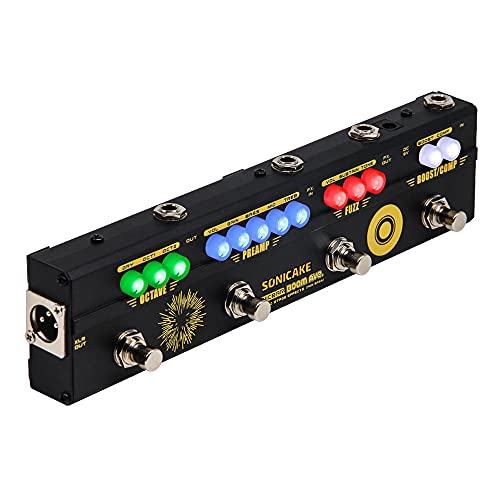
- Analog preamp with 3-band EQ
- Compressor, boost, fuzz, octave included
- XLR output and FX loop support
Best For: Players wanting a compact bass preamp plus core effects
Flexible preamp and DI
Electro-Harmonix Battalion Bass Preamp & DI

- 4-band EQ, compressor, and noise gate
- MOSFET distortion with blend and tone controls
- Three signal flow modes for routing flexibility
Best For: Bassists wanting a versatile DI pedal with advanced tone options
Clean preamp with drive

- Analog preamp with compression and overdrive
- 3-band EQ with PRE/POST selection
- Balanced XLR output with buffer bypass
Best For: Players wanting a simple bass preamp with direct-out convenience
Budget Preamp/DI With Flexible EQ – JOYO TIDAL WAVE R-30 Bass Preamp & DI
If you want bass di pedals with preamp features that cover both clean shaping and driven tones, the JOYO TIDAL WAVE R-30 gives you a lot of control for the money. Its blend control lets you keep your clean low end intact or mix in the drive circuit, while the MID SHIFT and BASS SHIFT switches make the EQ more precise than a basic bass preamp.
Best For: Bass players who want affordable DI versatility, from clean punch to gritty overdrive.
Pros:
- Blend control mixes clean signal with harmonically rich drive
- MID SHIFT and BASS SHIFT switches add targeted EQ control
- XLR DI out includes cab sim, plus ground lift and pad options
- Rugged all-metal enclosure with ambient LED lighting
Cons:
- Cab sim works on the XLR output only
- Requires a 9V DC adapter; battery operation is not supported
- Knobs do not have numerical markings
Overall, this is a strong pick if you need a practical preamp/DI that can handle both stage and direct recording duties. It is especially appealing for players who want punchy bass tone, flexible EQ, and an easy route to direct output.
Classic Distortion DI Workhorse – MXR Bass D.I.+ M80
The MXR Bass D.I.+ is one of the more straightforward bass di pedals with preamp-style utility if you want built-in distortion, EQ, and direct output in a single box. It gives you gain, volume, blend, a color knob, and a 3-band EQ, so you can move from a basic clean signal to a more aggressive bass tone without adding extra pedals.
Best For: Bassists who want an all-in-one DI, EQ, and distortion pedal for live use.
Pros:
- Includes a distortion channel with gain, volume, and blend controls
- 3-band EQ and Color knob provide quick tone shaping
- Phantom power support adds convenience in DI setups
- Compact, proven design for stage and practice rigs
Cons:
- Details focus more on utility than advanced voicing options
- 9 mA current spec is listed, but power setup still needs attention
- No cab sim is mentioned in the supplied notes
If you want a no-nonsense DI pedal with preamp-like control and onboard grit, this MXR model is built for that job. It is a practical option for players who need quick tone shaping and direct output in one reliable unit.
Premium Preamp/Direct Box Pedal – Aguilar Tone Hammer Preamp Direct Box Pedal V2
Among bass di pedals with preamp features, the Aguilar Tone Hammer Preamp Direct Box Pedal V2 stands out as a versatile option for players who want preamp, DI box, and distortion duties in one pedal. With bass, treble, gain, and blend controls, it is designed for precise shaping, and the XLR output makes it easy to send a direct signal to a recorder or PA.
Best For: Bassists who want a durable preamp/DI pedal with clean-to-dirty switching.
Pros:
- Functions as a preamp, DI box, and distortion pedal
- Bass, treble, gain, and blend controls support detailed tone shaping
- Footswitch allows quick switching between clean and distorted tones
- Sturdy aluminum chassis is built for stage or studio use
Cons:
- Power is AC-based according to the supplied details
- Listed dimensions are relatively large for compact boards
- Notes do not mention cab simulation or phantom power
This is a strong fit if you want a more full-featured bass preamp/DI that can also handle drive. Its combination of flexible controls, XLR output, and rugged construction makes it easy to justify for serious rigs.
Speaker-Emulated Bass Preamp DI – Tech 21 SansAmp VT Bass DI
If your priority is classic bass di pedals with preamp character and speaker emulation, the Tech 21 SansAmp VT Bass DI is built around that idea. It combines a bass DI/preamp section with character control, parallel output, and XLR output, making it a strong option when you want a direct signal that can still feel amp-like.
Best For: Bass players who want speaker-emulated direct tone with flexible routing.
Pros:
- Bass DI/preamp with speaker emulation built in
- Character control helps shape versatile bass tones
- Parallel output gives added routing flexibility
- XLR output makes direct connection simple
Cons:
- Supply notes do not list detailed EQ controls
- Power is battery powered per the provided details, which may not suit every rig
- No distortion channel is mentioned in the notes
For players who care more about amp-style character than heavy onboard effects, this Tech 21 pedal is an easy one to understand. It focuses on direct tone, flexible output options, and the kind of preamp behavior many bassists want on a pedalboard.
Compact all-in-one DI board – VALETON Dapper Bass DI Preamp Multi-Effects Pedal
If you want bass di pedals with preamp capability in a compact all-in-one format, the VALETON Dapper Bass is built for simple stage use and fast setup. It combines an analog DI/preamp with multi-effects, including compression, envelope filter, octave, chorus, and a built-in tuner, so you can cover core bass tones and utility functions without a large pedalboard.
Best For: Gigging bassists who want a compact preamp/DI with extra onboard effects and a tuner.
Pros:
- Analog DI and preamp in a very compact, easy-to-carry format
- 3-band EQ covers everything from clean to dirty rock bass tones
- Includes compressor/boost, envelope filter, octave, chorus, and tuner
- Dry thru output and FX loop add routing flexibility
Cons:
- Uses a 9V center-negative adapter, so you’ll need pedal power available
- More of a multi-effects solution than a dedicated single-purpose preamp
The Dapper Bass makes sense if you want practical, grab-and-go bass tone shaping with extra effects built in. It is especially appealing for players who value portability and straightforward live utility over a more focused, stripped-down preamp.
Clean direct-out tone shaper – MXR Bass Preamp M81 with Sweepable Mid EQ
The MXR Bass Preamp is a straightforward choice if you want bass di pedals with preamp control focused on clean shaping and direct output. Its 3-band EQ includes a sweepable midrange, along with separate input and output level controls, giving you precise adjustment for stage or direct-to-PA use.
Best For: Bassists who want a clean, studio-style preamp with flexible EQ and direct out options.
Pros:
- Separate input and output level controls for more exact gain staging
- 3-band EQ with sweepable midrange for detailed tone shaping
- Studio-quality direct out with pre/post EQ switching
- Compact metal-style build that fits easily on a pedalboard
Cons:
- Does not include extra effects like chorus, octave, or compression
- More focused on clean preamp duties than on expanded feature sets
This pedal is a strong fit if your priority is reliable EQ control and a clean direct signal. It keeps the feature set focused, which makes it especially practical for players who want a dependable bass preamp rather than a multi-effects unit.
Drive-focused direct box – JOYO MONOMYTH R-26 Bass Preamp & DI with Cab Sim
If you’re shopping bass di pedals with preamp features and want built-in drive control, the JOYO MONOMYTH R-26 gives you a more aggressive, flexible approach. It pairs a 6-band graphic EQ with blend, voice, level, and drive controls, plus a dedicated overdrive section, XLR DI out, cab sim, headphone output, and ground lift for practical direct use.
Best For: Bassists who want a preamp/DI pedal with onboard distortion, cab sim, and modern routing features.
Pros:
- 6-band graphic EQ offers detailed bass tone shaping
- Blend, voice, level, and drive controls help preserve low-end clarity
- Dedicated overdrive section with treble boost and gain boost
- XLR DI out, cab sim, headphone jack, and ground lift support direct rigs
Cons:
- Requires a 9V DC center-negative adapter, which is not included
- Battery operation is not supported
This is the most feature-packed option here for players who want dirt, EQ, and direct-output convenience in one pedal. It suits bassists who need more than a standard preamp and want to shape an aggressive sound for live or practice use.
All-in-one gig solution – SONICAKE Boom Ave Multi Effects Pedal
If you want bass di pedals with preamp features that can cover a full gig without building a large board, this SONICAKE multi-effects unit is a practical option. It combines an analog preamp with 3-band EQ, compressor, boost, fuzz, octave, and FX loop support, so you can shape a bass tone and add commonly used effects in one place.
Best For: Bass players who want a compact, one-stop pedal for preamp tone shaping plus core effects for live playing.
Pros:
- Analog preamp with 3-band EQ for broad bass tone shaping
- Includes compressor, boost, fuzz, and octave modules for common bass setups
- XLR output makes direct connection to a PA, mixer, or interface easier
- FX loop lets you add other pedals into the chain
Cons:
- Octave tracking is noted as tricky on some high frets
- Multi-effect design may be more than you need if you only want a simple preamp
This is a strong fit if you want a bass preamp with built-in utility and direct-out flexibility. It is geared toward players who value convenience and coverage over a single-purpose pedal.
Flexible preamp and DI – Electro-Harmonix Battalion Bass Preamp & DI
For players comparing bass di pedals with preamp sections, the Electro-Harmonix Battalion stands out as a flexible shaping tool with compression, noise gate, 4-band EQ, and MOSFET distortion. Its three signal-flow modes give you different ways to place distortion relative to the EQ, which makes it useful when you want more control over how your bass tone sits in a rig.
Best For: Bassists who want a feature-rich preamp and DI with distortion options and flexible signal routing.
Pros:
- 4-band EQ plus compressor and noise gate for detailed tone control
- MOSFET distortion section with level, blend, drive, and tone controls
- Three signal flow modes add routing flexibility
- Flexible I/O is designed to fit many bass rigs and applications
Cons:
- More complex than a basic preamp pedal
- Heavy feature set may be unnecessary if you only need clean tone shaping
This pedal is a good match if you want a DI/preamp that can do more than basic EQ and output duty. It is built for players who like to fine-tune distortion placement and overall signal behavior.
Clean preamp with drive – SONICAKE B Factory Bass Pedal
If you are shopping for bass di pedals with preamp features and want something straightforward, the SONICAKE B Factory focuses on analog preamp tone shaping, compression, and classic overdrive. It also adds a 3-band EQ with PRE/POST selection, giving you a simple way to place the EQ in the signal path based on how you want the pedal to respond.
Best For: Bass players who want a compact analog preamp with compression, overdrive, and balanced XLR output.
Pros:
- Analog preamp with compression and overdrive in one pedal
- 3-band EQ includes PRE/POST selection for tone-shaping flexibility
- High-impedance input and balanced XLR output support direct use
- Buffer bypass circuit is designed to keep the sound pristine
Cons:
- Power supply is not included
- Do not connect the XLR output to phantom power
This is a clean, practical choice when you want a preamp-first bass pedal with a little edge from the overdrive section. It should appeal to players who want direct-output convenience without extra complexity.
How We Picked the Best Bass Di Pedals with Preamp
We prioritized Bass Di Pedals with Preamp features that matter on stage and in the studio: reliable XLR direct output, usable EQ, practical gain staging, and enough headroom to handle different basses and playing styles. We also favored pedals that can serve as a main tone-shaping tool rather than just a backup direct box.
Quick Comparison
In this category, the biggest differences usually come down to voicing and workflow. Some Bass Di Pedals with Preamp are designed for transparent control and simple signal cleanup, while others add amp-like color, compression, drive, or cab simulation. Compact models suit minimalist boards, while multi-function pedals are better if you want one unit to cover more jobs.
Key Buying Factors for Bass Di Pedals with Preamp
Tone Style
Decide whether you want a clean, studio-style preamp or a more characterful sound. If you use pedals or amp modeling already, a neutral DI may integrate better. If you go straight to front-of-house often, a voiced preamp can help your bass sit in the mix faster.
EQ and Shaping Tools
Look for EQ bands that match how you work. Mid control is especially important for bass, since it affects how easily you cut through a band mix. Blend controls, drive, compression, and presence or contour options can add flexibility, but only if you’ll actually use them.
DI and Cab Simulation
A strong XLR output is essential, and cab simulation can be a big advantage when going direct. If you regularly send signal to a PA or interface, cab sim may make the direct tone feel more natural and less harsh. Check whether the unit offers pre/post EQ switching, ground lift, or balanced output options.
Headroom and Noise
Higher-output active basses and aggressive playing styles can expose weak headroom or noisy circuits. For Bass Di Pedals with Preamp duties, a quiet floor and stable performance matter as much as tone knobs.
Who Should Buy Which Bass Di Pedals with Preamp?
Choose a simpler preamp DI if you want fast setup, consistent tone, and easy gigging. Pick a feature-rich model if you want your pedal to replace part of your amp’s front end or cover multiple tones. If you record direct often, prioritize clean signal path and flexible routing. If you play genre-specific gigs, a more colored preamp may give you the character you want with less effort.