Choosing the right DI can make a bigger difference to your bass tone than many players expect. The best active DI boxes for bass guitar preserve low end, reduce noise, and give front-of-house or interface inputs a strong, consistent signal.
In this roundup, we focus on practical features that matter on real gigs: headroom, power options, ground-lift controls, and overall build quality.
Best 10 Active Di Boxes for Bass Guitar Picks for 2026
Bass DI with Drive

- Distortion channel with gain, volume, and blend
- 3-band EQ plus Color knob
- Phantom power support
Best For: Bass players who want onboard drive and tone shaping
Durable Basic DI
Samson MDA1 Mono Active Direct Box

- All-metal, impact-resistant build
- 0dB/-15dB pad and ground lift
- 48V phantom or 9V battery power
Best For: Bassists who want a simple, durable active DI
Clean High-Headroom DI
Klark Teknik PRO DI ACTIVE DI 10A

- Custom-built MIDAS transformer
- High headroom for cleaner output
- Phantom or battery-powered with auto switchover
Best For: Players who want a clean, high-headroom active DI
Compact Phantom DI
Radial Pro48 Active 48-Volt Compact Direct Box
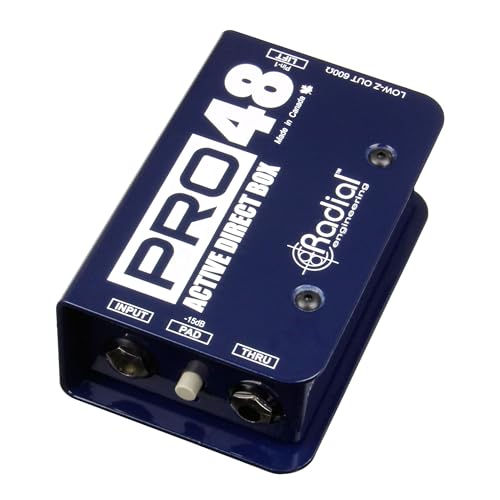
- Phantom-powered active direct box
- -15dB pad for passive basses
- Low-noise proprietary analog circuit
Best For: Bass and guitar players who want a compact phantom-powered DI
Studio-Ready Balance

- 0 dB and -20 dB input attenuation
- Balanced XLR output for bass routing
- Simple single-channel active DI
Best For: Bass players needing flexible input matching
High-Impedance Utility Pick
Radial StageBug SB-1 Active DI

- 800k-ohm input impedance
- 15 dB pad and polarity switch
- 48V phantom-powered active DI
Best For: Passive bass players wanting simple control
Flexible Live Routing Choice
Mackie MDB-1A Active Direct Box

- High-impedance 1/4" input with thru
- Ground lift, low cut, and polarity switch
- Merge switch sums stereo to mono
Best For: Bass rigs needing extra routing and cleanup
Flexible Power Pick
Bolanle J22 Active Stereo DI Box

- Three power options: phantom, battery, or USB
- Dual-channel stereo output keeps left/right separation
- Ground lift and polarity switch help manage noise
Best For: musicians who need a stereo active DI with backup power options
Stereo Input Utility
Dual 1/4" Active DI Box with Type-C Power

- Dual high-impedance inputs support stereo or mono use
- Type-C charging or 9V battery power options
- Ground lift and buzz-canceling design for cleaner audio
Best For: bass players and multi-instrument rigs that need flexible stereo input handling
Phantom-Powered Stage Pick
SGPRO SG-DB01 Active Direct Box

- 48V phantom power for live or studio use
- Ground lift helps reduce hum and loop noise
- -12 dB pad handles hotter pickups and line sources
Best For: bassists who want a compact active DI with phantom power and input control
Bass DI with Drive – MXR Bass D.I.+
If you want an active DI box for bass guitar that can do more than just send a clean signal to the board, the MXR Bass D.I.+ is built for exactly that. It combines a distortion channel with gain, volume, and blend controls, plus a Color knob and 3-band EQ, so you can shape both your direct tone and your driven sound in one unit.
Best For: Bass players who want an active DI box with onboard distortion and flexible tone shaping.
Pros:
- Distortion channel with gain, volume, and blend controls
- 3-band EQ and Color knob for tone shaping
- Phantom power support
- Compact DI format with included power supply and cable
Cons:
- Not a plain transparent DI if you want a fully clean signal path
- May be more features than players need for simple bass routing
The MXR Bass D.I.+ stands out if your bass rig needs both direct-out convenience and onboard character. For players comparing active DI boxes for bass guitar, it’s a strong pick when tonal control and built-in drive matter as much as clean signal delivery.
Durable Basic DI – Samson MDA1 Mono Active Direct Box
The Samson MDA1 is a practical active DI box for bass guitar when you want a straightforward, neutral signal path. Its all-metal, impact-resistant design, balanced XLR output, and 1/4″ input and thru make it easy to use on stage or in rehearsal, while the 0dB/-15dB attenuation switch helps with level management.
Best For: Bassists who want a simple, durable active DI with basic control options.
Pros:
- All-metal, impact-resistant design
- 0dB/-15dB attenuation switch for level control
- Ground lift switch for basic noise management
- 48V phantom and 9V battery power options
Cons:
- Mono-only design
- Lacks tone-shaping features found on more advanced DI boxes
If you want an uncomplicated direct box rather than an effects-heavy tool, the MDA1 fits that role well. It focuses on durable construction and core DI functions, which makes it a sensible choice among active DI boxes for bass guitar.
Clean High-Headroom DI – Klark Teknik PRO DI ACTIVE DI 10A
The Klark Teknik PRO DI ACTIVE DI 10A is designed as a general-purpose active DI box for bass guitar and other sources where signal integrity matters. It uses a custom-built MIDAS transformer, offers high headroom for superior sound quality, and can run from +48V phantom power or an internal battery with automatic switchover if phantom power fails.
Best For: Players who want a clean, high-headroom active DI with flexible power options.
Pros:
- Custom-built MIDAS transformer for signal integrity
- High-headroom design for better sound quality
- Phantom power or internal battery operation
- Automatic battery switchover if phantom power fails
Cons:
- Battery is not included
- Built as a general-purpose DI, so it has fewer bass-specific extras
This is a strong choice if your priority is clean, reliable direct output rather than onboard bass processing. For active DI boxes for bass guitar, the DI 10A is especially appealing when you value transformer quality and power flexibility.
Compact Phantom DI – Radial Pro48 Active 48-Volt Compact Direct Box
The Radial Pro48 is a compact active DI box for bass guitar built around a phantom-powered, high-resolution design. It includes a -15dB pad for passive guitars and basses, uses a proprietary analog circuit with a low-noise op-amp, and keeps the format simple for direct stage or studio use.
Best For: Bass and guitar players who want a compact active DI with phantom power and a pad for passive instruments.
Pros:
- Phantom-powered active direct box
- -15dB pad for passive guitars and basses
- Proprietary analog circuit with low-noise op-amp
- Compact design with balanced mono output
Cons:
- Battery powered in the supplied details is listed, but phantom powering is the main highlighted feature
- Fewer onboard controls than more feature-heavy bass DI units
If you want a no-fuss DI that stays focused on clean signal transfer, the Pro48 is easy to work with. It makes sense for active DI boxes for bass guitar when you need a compact unit with pad support and a reputation for straightforward performance.
Studio-Ready Balance – BSS AR-133 Active DI Box
If you want active di boxes for bass guitar that can handle both instrument and line-level sources, the BSS Audio AR-133 is built for that kind of flexible stage or studio use. Its switchable input attenuation makes it easy to match guitar-type pickups or hotter signals, while the balanced XLR output keeps your bass feed ready for recording or front-of-house.
Best For: Bass players and engineers who need a straightforward active DI with selectable input attenuation for different signal levels.
Pros:
- Switchable 0 dB and -20 dB input attenuation for pickup or line-level sources
- Balanced XLR output for sending bass to a mixer or interface
- Useful as a practical single-box solution for live or recording setups
Cons:
- No extra pad, polarity, or ground-lift details were provided in the notes
- Single-channel design only
For bass guitar players who mainly need reliable level matching, the AR-133 keeps the feature set focused and usable. It’s a sensible pick when you want a clean active DI without extra complexity.
High-Impedance Utility Pick – Radial StageBug SB-1 Active DI
Among active di boxes for bass guitar, the Radial StageBug SB-1 stands out for its high-impedance 800k-ohm input, which is a helpful fit for passive instruments. It also adds a 15 dB pad and polarity switch, giving you a bit more control when plugging into a live sound or recording chain.
Best For: Bassists who want a compact active DI with high input impedance and a few essential signal controls.
Pros:
- 800k-ohm input impedance suits passive bass-style signals
- 15 dB pad helps with hotter inputs
- Polarity switch adds flexibility in setup
- 48V phantom powered active direct box
Cons:
- Single-channel only
- No additional output-routing features were listed
The SB-1 keeps the focus on core DI functionality with a useful impedance spec and a few practical controls. It’s a strong option if you want an active DI that stays compact but still covers the basics well.
Flexible Live Routing Choice – Mackie MDB-1A Active Direct Box
If you’re comparing active di boxes for bass guitar and want a model with routing extras, the Mackie MDB-1A offers a high-impedance 1/4″ input, thru output, and balanced XLR output. It also includes a ground lift, low cut, polarity switch, and a merge switch for summing stereo sources to mono, all powered by 48V phantom power.
Best For: Bass players and small-stage setups that benefit from added signal-shaping and routing tools.
Pros:
- High-impedance 1/4″ input with thru output
- Balanced XLR output plus ground lift
- Low cut and polarity switches for signal cleanup
- Merge switch can sum stereo sources to mono
Cons:
- Only one channel
- Requires 48V phantom power
The MDB-1A is the most feature-rich of the group, especially if you want control over routing and basic tone-shaping. For bass rigs that need a practical active DI with extra utilities, it’s a versatile choice.
Flexible Power Pick – Bolanle J22 Active Stereo DI Box
If you need active DI boxes for bass guitar, the Bolanle J22 is a flexible option for rigs that may face different power situations. It can run from 48V phantom power, a 9V battery, or 5V USB power, so it is useful when you want one box that can still work if the stage setup changes. Its dual-channel design and ground lift also make it practical for clean live signal routing.
Best For: Players who want a stereo-capable active DI with multiple power options for stage, church, or studio use.
Pros:
- Runs on 48V phantom, 9V battery, or 5V USB power
- Dual-channel design preserves stereo separation
- Ground lift helps reduce hum on noisy stages
- Polarity switch and metal housing add practical control and durability
Cons:
- Bulky compared with a simple single-channel DI
- Batteries are not included
- Dual-channel features may be more than some bass players need
The J22 stands out most for flexibility, not just connectivity. If you want a DI that can adapt to different power sources and still give you clean balanced output, it is an easy fit for demanding live setups.
Stereo Input Utility – Dual 1/4" Active DI Box with Type-C Power
For active DI boxes for bass guitar, this direct box is built around dual high-impedance 1/4-inch inputs and stereo XLR output, which makes it useful when you need clean signal conversion from bass, guitar, keyboards, or processors. It also offers two power options: 5V Type-C charging or a built-in slot for 9V GF22 batteries. The ground lift and hum-cancellation focus make it a practical live-sound choice.
Best For: Players and small rigs that need a stereo-capable active DI with flexible input and power options.
Pros:
- Dual 1/4-inch inputs support stereo or mixed mono sources
- Offers both Type-C power and 9V battery operation
- Ground lift helps reduce buzz and hum
- Works with bass, guitar, keyboards, and other line sources
Cons:
- Battery is not included
- Large, general-purpose design may be more than a simple bass-only setup needs
- Product details are less streamlined than more established stage DI units
This is a good fit if your setup changes from gig to gig and you want a DI that can handle stereo sources as well as typical instrument signals. The power flexibility is especially helpful when you cannot rely on phantom power alone.
Phantom-Powered Stage Pick – SGPRO SG-DB01 Active Direct Box
If you are comparing active DI boxes for bass guitar, the SGPRO SG-DB01 is a straightforward phantom-powered option made for clean impedance matching and long cable runs. It uses 48V phantom power, includes a ground lift for noise control, and adds a -12 dB pad to handle hotter signals. That makes it a solid utility box for live performance, recording, or broadcasting.
Best For: Bassists who want a compact phantom-powered DI with a pad for hotter instruments and line sources.
Pros:
- 48V phantom powered for stage and studio use
- Ground lift helps break ground loops and reduce noise
- -12 dB pad supports high-output pickups and line-level sources
- Compact build for easy transport
Cons:
- Depends on phantom power rather than battery or USB backup
- Single-purpose layout is less flexible than stereo DI units
- Best suited to standard stage and recording setups, not power-free rigs
For players who mainly need a dependable active DI and already have phantom power available, this is a practical no-fuss choice. The pad is especially helpful if your bass has active electronics or strong output.
How We Picked These Active Di Boxes for Bass Guitar
We focused on models that suit bass players who need reliable direct-to-mixer or direct-to-interface performance. Priority went to boxes with strong low-frequency handling, useful connectivity, and dependable noise control. We also favored designs with either phantom power or battery support so they can work in more than one setup.
Quick Comparison
For simple live use, compact mono boxes are usually the easiest choice. If you need more tone shaping, onboard level control, or a stereo-friendly setup, larger feature-rich models may fit better. Passive basses with weak pickups often benefit from a strong active input stage, while high-output active basses usually do well with any well-built DI that offers enough headroom.
Key Buying Factors for Active Di Boxes for Bass Guitar
Headroom and Low-End Clarity
Bass can overload weaker DI circuits quickly, especially with slapped notes, aggressive picking, or boosted onboard EQ. Look for a DI that can handle transients without flattening the attack or thinning the bottom end.
Power Options
Phantom power is the most convenient option for stage and studio work, but battery or USB support can be useful when phantom is unavailable. If you move between rehearsal spaces, clubs, and home recording, flexible power makes the box more versatile.
Noise Rejection and Ground Lift
A ground-lift switch is one of the most valuable features in Active Di Boxes for Bass Guitar because it helps eliminate hum and buzz from problematic venue wiring. Balanced XLR output quality matters too, especially when long cable runs are involved.
Input and Output Flexibility
Most bass players only need a single instrument input, but stereo inputs can help if you also run effects, keyboards, or dual-source rigs. Extra outputs, polarity switches, and pad controls are useful when you want more control over gain staging.
Who Should Buy Which Active Di Boxes for Bass Guitar?
If you want a compact, dependable stage solution, choose a simple mono DI with phantom power and a ground lift. If you need more control over your sound or plan to use the box for multiple instruments, a feature-rich model is the better fit. Players building a home recording or fly-rig setup should prioritize portability, low noise, and easy power access. In short, the best choice depends on whether you value minimalism, flexibility, or extra tone-shaping control.