Wireless in-ear monitors can make rehearsals cleaner, performances tighter, and stage volume far easier to control. For guitarists, the right system should deliver stable signal, low latency, and a mix that feels natural under pressure.
Below, you’ll find a practical roundup of the best wireless in-ear monitor systems for guitarists in 2026, chosen for everyday usability, monitoring performance, and value across different setups.
Best 10 Wireless in Ear Monitor Systems for Guitarists Picks for 2026
Easy-Setup Multi-Receiver Pick
2.4GHz Stereo IEM With Auto-Pairing
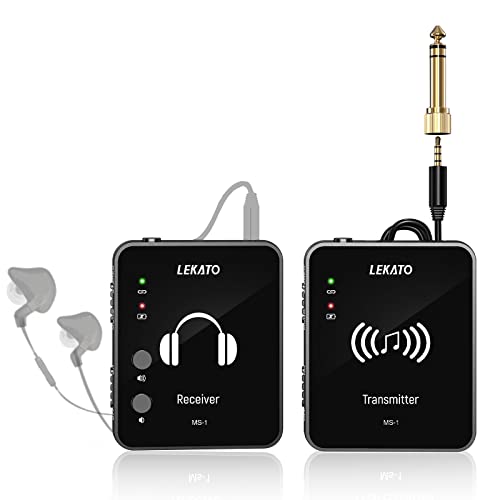
- Auto-pairs without channel selection
- Supports up to 6 simultaneous device sets
- True stereo with 100 ft open-area range
Best For: small bands and guitarists who need simple monitoring
Compact Touring-Friendly Option
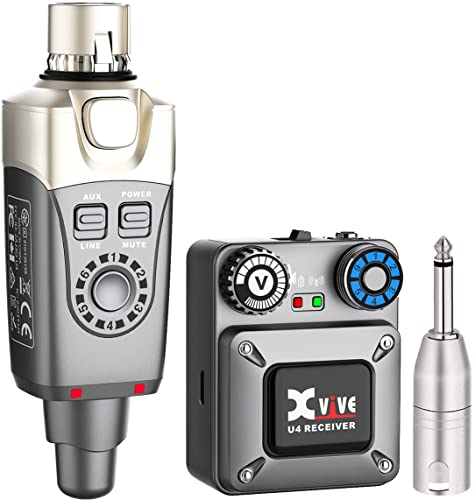
- Less than 5ms latency for tight monitoring
- Over 90 ft range for small venues
- Rechargeable system with 6-channel support
Best For: portable guitar monitoring in clubs, rehearsals, and small stages
Rack-Mount UHF Control Pick

- 900MHz UHF with 89 tunable frequencies
- Up to 160 ft range and 5-system operation
- EQ, balance, limiter, and lock functions
Best For: stage rigs that need rack mounting and detailed mix control
Long-Battery Performance Pick
131ft Low-Latency Wireless IEM

- Up to 131 ft range on 2.4GHz
- Up to 10 hours of playtime
- Works with guitars, mixers, and computers
Best For: performers who want long runtime and simple portable monitoring
Editor’s Pick

- 192kHz / 24-bit audio with less than 6 ms latency
- Stereo or mono mode with automatic channel finding
- Lightweight beltpack receiver with color screen
Best For: Guitarists who want simple, low-latency monitoring
Battery Life Champ
LEKATO MS-20 Charging IEM System

- Up to 30 hours with the charging case
- One transmitter can support up to 10 receivers
- OTG support for phones and USB-C devices
Best For: Long rehearsals, gigs, and multi-receiver band setups
Low-Latency Pro Pick

- 1 ms latency for tight real-time monitoring
- 7 UHF channels help reduce interference
- XLR input with AUX/LINE switch and USB-C charging
Best For: Live guitarists who want fast, stage-ready monitoring
Starter Practice Pick
JOYO JW-07 Wireless IEM for Guitar Practice

- <5ms low-latency monitoring
- 48kHz/16bit audio clarity
- 8+ hour battery life
Best For: Guitar beginners and solo practice
Multi-RX Rehearsal Pick
LEKATO MS-02 Stereo IEM System

- One transmitter supports up to 4 receivers
- Under 4.5ms mono latency
- 6-8 hour battery life
Best For: Small bands and church rehearsal monitoring
Live Gig Starter Pick
LEKATO MS-20 Wireless IEM for Stage Use
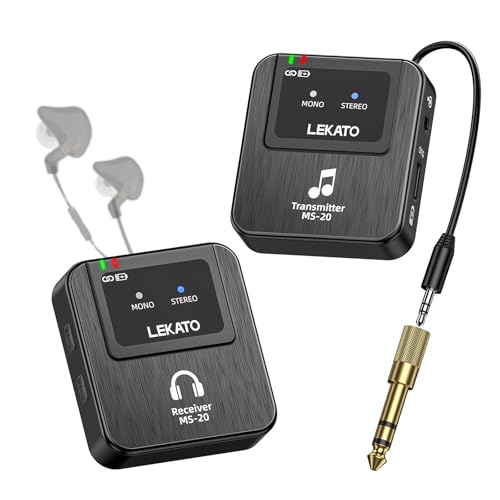
- Up to 10 receivers supported
- OTG support for phones and tablets
- 8+ hour battery life
Best For: Starter bands and guitarists playing live shows
Easy-Setup Multi-Receiver Pick – 2.4GHz Stereo IEM With Auto-Pairing
If you want wireless in ear monitor systems for guitarists that are simple to set up and flexible for band use, the LEKATO MS-1 is built around convenience. It supports true stereo transmission, auto-pairing, and one transmitter feeding multiple receivers, making it a practical fit for rehearsals, church teams, and small gigs.
Best For: Guitarists and small bands that want easy setup and multiple receivers on one transmitter.
Pros:
- Supports up to 6 sets working simultaneously, with multiple receivers on one transmitter
- Auto-pairing keeps setup straightforward
- True stereo transmission with a stereo/mono input switch
- 2.4GHz design with low latency, 24-bit/48kHz audio, and 100 ft open-area range
Cons:
- Battery life is listed at just over 5 hours per charge
- Needs a stereo source and stereo cable for full stereo use
- Best suited to small and medium performance spaces
Overall, the MS-1 focuses on easy operation and stage-friendly monitoring rather than advanced rack features. For players who want a compact, straightforward wireless IEM setup, it covers the core needs well.
Compact Touring-Friendly Option – Compact 2.4GHz IEM Set
The Xvive U4 is a compact choice among wireless in ear monitor systems for guitarists who want a minimal, portable monitor rig. It uses 2.4GHz wireless, offers over 90 feet of range, and keeps latency under 5ms, which makes it a solid fit for quick setup at clubs, rehearsal rooms, and touring situations.
Best For: Guitarists who want a portable, no-fuss in-ear monitor set for small venues and rehearsals.
Pros:
- Less than 5ms latency for distraction-free monitoring
- Over 90 feet of working range
- Supports 6 channels for simultaneous broadcasts
- Rechargeable transmitter and receiver with up to 5 hours of battery life
Cons:
- Battery life is limited to about 5 hours
- Range is better suited to small clubs and venues than large stages
- Package is basic, with just the core components and adapter
If portability and low latency matter most, the U4 keeps things simple and performance-ready. It is best viewed as a streamlined monitor solution for players who value easy transport and fast deployment.
Rack-Mount UHF Control Pick – Rack-Mount UHF Stereo IEM
For players comparing wireless in ear monitor systems for guitarists, the Phenyx Pro PTM-10 stands out for its UHF stereo design and more install-friendly feature set. It uses the 900MHz band, offers selectable frequencies, and includes EQ, balance, limiter, and lock functions for more control over the monitor mix.
Best For: Guitarists and bands that want a rack-mountable UHF monitor system with more mix controls.
Pros:
- True stereo monitoring with mono/stereo mode selection
- 900MHz operation with 89 tunable frequencies and up to 5 simultaneous systems
- Up to 160 ft / 50m range
- EQ, balance, limiter, PAD, and lock functions for added control
Cons:
- Bulkier than compact clip-on 2.4GHz systems
- Designed more for installed or rack-based setups
- Uses AA batteries for the receiver
The PTM-10 is a strong option when you want more than basic wireless monitoring and value extra shaping tools. Its rack-friendly build and UHF platform make it a practical fit for more structured stage or studio use.
Long-Battery Performance Pick – 131ft Low-Latency Wireless IEM
The Stormee SM-2 is aimed at performers who want wireless in ear monitor systems for guitarists, singers, and full bands without a complicated setup. It uses a 2.4GHz connection, offers up to 131 feet of range, and is built for clear real-time monitoring during live performance, rehearsal, and recording.
Best For: Guitarists and performers who want long battery life and a straightforward wireless IEM setup.
Pros:
- Up to 131 ft wireless range on the 2.4GHz band
- Up to 10 hours of battery life
- Low-latency monitoring for guitar, drums, keyboards, and vocals
- Compatible with guitars, mixers, active speakers, computers, and more
Cons:
- Noise control is listed as none
- Single-set package is more basic than multi-receiver systems
- Best suited to users who are comfortable with a simple, portable layout
The SM-2 is a practical pick if battery life is high on your list and you want dependable wireless monitoring for performance use. It keeps the feature set focused on range, runtime, and easy compatibility.
Editor’s Pick – Donner CV-3 Stereo IEM System
If you want wireless in ear monitor systems for guitarists that keep setup simple while still sounding detailed, the Donner CV-3 is built around practical stage use. It offers stereo or mono monitoring, a 2.4 GHz connection with automatic channel finding, and less than 6 ms latency for tighter real-time playback during rehearsals or live sets.
Best For: Guitarists who want a compact, lightweight IEM system with stereo/mono flexibility and low-latency monitoring.
Pros:
- 192kHz sampling and 24-bit depth for clear, low-distortion audio
- Less than 6 ms latency for responsive monitoring
- 2.4 GHz wireless transmission with up to 100 feet of range
- Lightweight zinc alloy beltpack receiver with color screen
Cons:
- Range is listed at 100 feet, which may be limiting for larger stages
- Battery life is up to 10 hours, but not class-leading
The Donner CV-3 is a straightforward pick for players who want dependable wireless monitoring without a complicated workflow. Its low latency, clear display, and broad compatibility make it a sensible choice for guitar rigs, mixers, and practice spaces.
Battery Life Champ – LEKATO MS-20 Charging IEM System
Among wireless in ear monitor systems for guitarists, the LEKATO MS-20 stands out if battery life and portability are your priorities. It includes a charging box, auto-pairing, OTG support for phones and USB-C devices, and a one-to-many setup that can send one transmitter to multiple receivers.
Best For: Guitarists, bands, and rehearsal setups that need long runtime and easy sharing to multiple receivers.
Pros:
- Up to 30 hours of usage time with the charging case
- Supports one transmitter to up to 10 receivers
- 150-foot open-area transmission range
- OTG support for direct connection to smartphones and USB-C devices
Cons:
- Earphones are not included
- Audio specs are solid, but described as decent rather than premium
The MS-20 is a strong value for players who need a portable monitoring setup that lasts through long practice days and gigs. Its auto-pairing, long runtime, and multi-receiver support make it especially useful for band environments.
Low-Latency Pro Pick – POGOLAB UHF 7-Channel IEM
If you need wireless in ear monitor systems for guitarists with more stage-focused performance features, the POGOLAB UHF model leans into speed and flexibility. It uses a UHF connection with 7 selectable channels, a 164-foot range, and 1 ms ultra-low latency, which is useful when you want monitoring that stays tightly locked to your playing.
Best For: Guitarists and live performers who want ultra-low latency, UHF channel selection, and XLR-based mixer connectivity.
Pros:
- 1 ms ultra-low latency for real-time monitoring
- UHF system with 7 selectable channels to reduce interference
- XLR input plus AUX/LINE switch for flexible signal routing
- Rechargeable transmitter and receiver with USB-C charging
Cons:
- Battery life is up to 5 hours, shorter than some rivals
- Range is solid at 164 feet, but not the longest in class
This is a practical choice for players who care most about tight timing and stage-ready connectivity. The channel options, color-coded indicators, and included adapters make setup easier for live band use and soundchecks.
Starter Practice Pick – JOYO JW-07 Wireless IEM for Guitar Practice
If you want wireless in ear monitor systems for guitarists mainly for practice, the JOYO JW-07 is built around simple setup, solid clarity, and low-latency monitoring. Its 2.4GHz connection, automatic pairing, and 48kHz/16bit audio make it a practical choice for rehearsing at home, recording practice runs, or checking your playing without a cable attached.
Best For: Guitar beginners and players who want an easy wireless IEM for personal practice and monitoring.
Pros:
- <5ms latency for real-time feedback while practicing
- 48kHz/16bit audio clarity for monitoring and recording use
- 40-60ft operating range in open space
- Over 8 hours of battery life on a full charge
Cons:
- One transmitter is not supported to connect multiple receivers
- Best suited to practice and small setups rather than multi-person monitoring
Overall, the JW-07 makes sense if your priority is an affordable, easy-to-use practice monitor rather than a larger stage system. It focuses on low-latency personal use and stable transmission, which is exactly what many guitarists need for solo rehearsals.
Multi-RX Rehearsal Pick – LEKATO MS-02 Stereo IEM System
Among wireless in ear monitor systems for guitarists, the LEKATO MS-02 stands out if you need one transmitter feeding multiple receivers for rehearsal or small-stage use. It combines low-latency mono transmission, 24bit/48KHz audio, and auto-pairing in a compact beltpack-style setup that is easy to add to a band practice routine.
Best For: Small bands, church teams, and guitarists who need one-to-many monitoring.
Pros:
- One transmitter to up to 4 receivers
- Ultra-low latency under 4.5ms in mono mode
- 24bit/48KHz audio with low noise
- 6-8 hours of battery life plus volume/battery LED indicators
Cons:
- Earbuds are not included
- Open-area range is listed at 100 feet, so performance depends on environment
- Mono/stereo switching may be more than some beginners need
For guitarists who play with other musicians, the MS-02 is a practical step up because it supports shared monitoring without making setup overly complicated. Its low latency and multi-receiver design make it especially useful for rehearsals and small live gigs.
Live Gig Starter Pick – LEKATO MS-20 Wireless IEM for Stage Use
The LEKATO MS-20 is a strong fit if you want wireless in ear monitor systems for guitarists that can move from rehearsal to live show use. It adds OTG support for smartphones or tablets, up to 10 receivers from one transmitter, and a compact clip-on design that can attach to belts, pockets, or guitar straps for easier mobility on stage.
Best For: Guitarists and starter bands that want a flexible monitor for practice, streaming, and gigs.
Pros:
- Up to 10 receivers from one transmitter
- 24bit/48KHz HD audio with 20Hz-20KHz frequency range
- OTG support for phones and tablets
- 8+ hour battery life with auto-pairing and clip-on portability
Cons:
- Earphones are not included
- More receiver capacity than some solo players need
- Best value comes when you actually need multi-person monitoring
As a starter-friendly stage monitor, the MS-20 gives guitarists a useful mix of portability, multi-receiver support, and simple connectivity. If you need one system that can handle practice, backing tracks, and small live performances, this model is easy to justify.
How We Picked the Best Wireless in Ear Monitor Systems for Guitarists
We focused on wireless in-ear monitor systems for guitarists that balance sound quality, connection stability, and ease of setup. Priority went to systems with low latency, dependable wireless range, stereo monitoring support, and hardware that works well on a pedalboard, rehearsal stage, or small venue.
We also considered battery life, pairing simplicity, receiver comfort, transmitter flexibility, and whether a system is better suited to solo practice, full-band monitoring, or more demanding live use.
Quick Comparison
If you want the simplest setup, 2.4GHz systems are usually easiest to deploy and are often the most portable. If you need more control over interference-heavy environments or want a more stage-oriented format, UHF models can be the better fit. Guitarists who rehearse often should also pay attention to battery endurance and charging convenience.
Key Buying Factors for Wireless In-Ear Monitor Systems for Guitarists
Latency and Feel
Latency is one of the most important factors for guitar players. Even modest delay can make timing feel disconnected, especially when you’re hearing your dry guitar signal directly in the mix. Look for systems marketed as low latency or ultra-low latency.
Wireless Band and Range
2.4GHz systems are common, portable, and easy to use, while UHF systems may offer more channel options and better control in crowded RF environments. Range matters too, but real-world performance is usually more important than the maximum number on the box.
Stereo Vs. Mono
Stereo monitoring can help guitars, vocals, and click tracks feel more separated and natural. Mono is simpler and may be fine for practice or basic live monitoring. If you run backing tracks or multiple sources, stereo is often worth it.
Battery Life and Charging
Longer battery life matters for rehearsals, gigs, and church sets. Charging cases, USB-C support, and clear battery indicators can save time and reduce surprises before showtime.
Inputs, Outputs, and Compatibility
Check whether the transmitter accepts XLR, AUX, or line-level input, and whether the receiver includes clip-on, beltpack, or plug-in designs. Guitarists using mixer sends, modelers, or pedalboard interfaces should match the system to their signal chain.
Who Should Buy Which Wireless in Ear Monitor Systems for Guitarists?
Home players and rehearsal musicians often do best with compact 2.4GHz options that are easy to pair and carry. Gigging guitarists who want more channel flexibility may prefer a UHF system. If you need long runtime and frequent recharging, look for systems with a charging case or extended battery support.
For the best overall value, choose the system that fits your monitoring needs first, then compare latency, range, and connection options. That approach will help you pick a setup that feels good on stage and stays dependable when it matters.