A weighted keyboard can make the move from piano to synthesizer feel more natural. But key action is only part of the decision: sounds, controls, and workflow determine how well an instrument fits your music.
These seven 88-key models span performance-focused synths and full workstations. Use the guide below to narrow the field by feel, features, and how you plan to play.
Best 7 Synthesizers with Weighted Keys Picks for 2026
Best for Piano Players

- 88-note GHS weighted action
- Class-compliant USB audio/MIDI
- Motif engine with 128-note polyphony
Best For: Pianists playing live and recording over USB
Best for Deep Sound Design

- Weighted hammer action with aftertouch
- Multiple synthesis and organ engines
- 2,042 programs; 256-voice polyphony
Best For: Advanced players exploring layered synthesis
Best for Flexible Gigs

- 88-note hammer-action keyboard
- Over 3,800 onboard sounds
- USB-C audio/MIDI and WAV import
Best For: Gigging players needing varied sounds and USB-C
Best for Expressive Control

- GEX action with polyphonic aftertouch
- Three engines; 400-note total polyphony
- Seamless Sound Switching
Best For: Performers seeking per-note expression
Best for Onboard Production
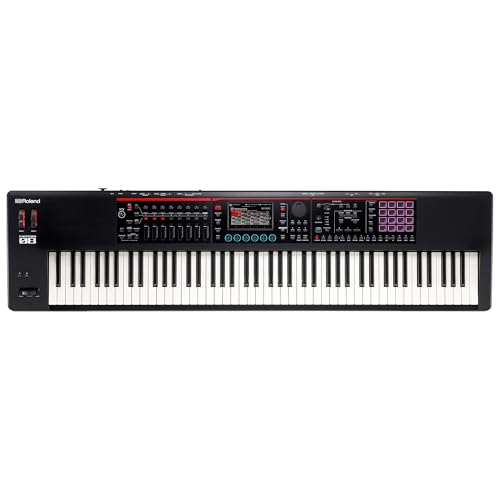
- 88-note weighted keyboard
- ZEN-Core and SuperNATURAL sounds
- Sampling and clip-based sequencing
Best For: Weighted-key players who create tracks onboard
Best for Piano-Style Expression
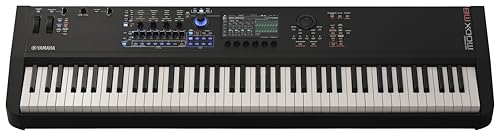
- 88-key graded-hammer action
- Three versatile sound engines
- Faders, Super Knob, and DAW plugin
Best For: Pianists exploring synth sounds and DAW workflows
Best for Live Set Organization

- Four-stage weighted hammer action
- Nine sound engines
- Set List Mode for live access
Best For: Performers managing varied sounds onstage
Best for Piano Players – Yamaha MX88
Among synthesizers with weighted keys, the Yamaha MX88 pairs an 88-note GHS action with the Motif sound engine. Its keys feel heavier in the low register and lighter up high, making it a practical choice for players who want piano-style touch alongside synth sounds.
Best For: Pianists who want a weighted keyboard for live playing and USB-based recording.
Pros:
- GHS weighted action provides a piano-inspired response.
- Class-compliant USB audio/MIDI connects without driver installation.
- Motif sound engine offers up to eight controllable elements per voice.
- 128-note polyphony supports layered playing and sequences.
Cons:
- Its three-digit LED and two-line LCD offer limited display space.
- At 30.6 pounds, it still requires planning for transport.
The MX88 makes sense if weighted feel and straightforward computer connectivity matter more to you than a large display.
Best for Deep Sound Design – Kurzweil K2088
The Kurzweil K2088 is one of the synthesizers with weighted keys aimed at players who want substantial sound-design options. Its 88-key, fully weighted hammer action includes aftertouch, while V.A.S.T., virtual analog, FM, and organ engines provide several approaches to building sounds.
Best For: Advanced players seeking weighted performance and multiple synthesis engines.
Pros:
- Fully weighted hammer-action keys include aftertouch.
- Includes 2,042 factory programs and 587 multi combinations.
- V.A.S.T., VA1, six-operator FM, and KB3 organ engines offer varied sound creation.
- 256-voice polyphony supports demanding arrangements.
Cons:
- At 49.3 pounds, it is a substantial keyboard to move.
- Its advanced synthesis options may be more than a player seeking simple presets needs.
Choose the K2088 when expressive key control and an extensive sound palette justify its size and depth.
Best for Flexible Gigs – Roland JUNO-D8
For performers comparing synthesizers with weighted keys, the Roland JUNO-D8 combines an 88-note hammer-action keyboard with a broad selection of ready-to-play sounds. Its ZEN-Core engine, USB-C audio/MIDI, and support for USB-C mobile battery power make it worth considering for both stage and computer-based setups.
Best For: Gigging players who need piano-style keys, varied sounds, and flexible USB-C connectivity.
Pros:
- Weighted hammer action offers a piano-style playing experience.
- More than 3,800 onboard sounds cover pianos, organs, synths, and other instruments.
- USB-C audio/MIDI connects to mobile devices and computers.
- Sample import lets you play and edit user WAV files.
Cons:
- Roland Cloud Sound Packs and Wave Expansions are separate from the stated onboard sound count.
- Its 54.84-inch width needs room in a gigging setup.
The JUNO-D8 is a practical pick when you want a weighted stage keyboard with a large built-in library and options to add your own sounds.
Best for Expressive Control – Yamaha MONTAGE M8X
The Yamaha MONTAGE M8X stands out among synthesizers with weighted keys for its GEX action and polyphonic aftertouch. It lets players modulate individual held notes with pressure, while three sound engines and dedicated performance controls support detailed sound exploration.
Best For: Players who want expressive per-note control and a multi-engine flagship synthesizer.
Pros:
- Polyphonic aftertouch enables pressure-based modulation of individual notes.
- Three engines deliver 400-note total polyphony.
- AN-X provides analog-style sounds with modulation options.
- Seamless Sound Switching supports transitions between sounds.
Cons:
- At 61.9 pounds, it is the heaviest model in this roundup.
- Its extensive controls and sound engines may exceed the needs of players seeking a simpler keyboard.
Consider the MONTAGE M8X if per-note expression is central to how you perform and you can accommodate its substantial weight.
Best for Onboard Production – Roland FANTOM-08
Among synthesizers with weighted keys, the Roland FANTOM-08 suits players who want to build tracks and perform from one 88-key instrument. Its ZEN-Core and SuperNATURAL sound technologies cover electronic and acoustic sounds, while sampling and sequencing tools support hands-on production.
Best For: Players who want weighted-key performance and onboard track-building tools in the same synth.
Pros:
- Expressive 88-note weighted keyboard with SuperNATURAL piano sounds.
- Thousands of electronic and acoustic sounds, plus a Virtual ToneWheel Organ.
- Onboard sampling, clip-based sequencing, and a TR-REC sequencer.
- Touchscreen, sliders, pads, and dedicated synth controls offer hands-on operation.
Cons:
- Its 16-layer scenes and multiple production tools may be more than a player seeking straightforward piano sounds needs.
- At 40 pounds, it still takes planning to transport.
The FANTOM-08 is the flexible choice here if creating patterns and shaping sounds matter as much as weighted-key playing.
Best for Piano-Style Expression – Yamaha MODX M8
The Yamaha MODX M8 is one of the synthesizers with weighted keys aimed squarely at pianists: its 88-key graded-hammer action feels heavier in the low register and lighter up high. Three sound engines and real-time controls give that familiar playing surface a broad palette.
Best For: Pianists who want graded-hammer feel alongside synth sounds and DAW integration.
Pros:
- Graded-hammer action provides a piano-style response across 88 keys.
- Three engines cover classic analog synths, modern FM, and realistic instruments.
- Eight physical faders and a Super Knob support real-time expression.
- Expanded Softsynth Plugin brings MODX M sound creation and editing into a DAW.
Cons:
- At 40.5 pounds, moving the 88-key instrument still requires some effort.
- The range of engines and controls may be unnecessary for buyers who only need piano sounds.
Choose the MODX M8 when the keyboard’s graded feel is a priority but you also want substantial sound-design and studio options.
Best for Live Set Organization – Korg Nautilus 88
Korg Nautilus 88-Key Full Size Weighted Keyboard Music Workstation | Power Supply
Check Price On AmazonFor performers comparing synthesizers with weighted keys, the Korg Nautilus 88 pairs a four-stage weighted hammer action with nine sound engines. Its Set List Mode puts the sounds and sequences for a performance within quick reach on a color-coded touchscreen.
Best For: Live players who need piano-style action and organized access to varied sounds.
Pros:
- 88-key, four-stage weighted hammer action is designed for realistic piano playing.
- Nine sound engines and effects support a wide range of sounds.
- Set List Mode organizes Programs, Combinations, and Sequences for performances.
- Dynamics Knob adjusts keyboard sensitivity to suit the playing situation.
Cons:
- At 60.3 pounds, it is the heaviest of these three keyboards.
- Its broad workstation features may be excessive if you only need a few basic sounds.
The Nautilus 88 makes the strongest case when live sound organization and a substantial hammer-action keybed outweigh portability.
How We Picked These Synthesizers with Weighted Keys
We focused on the seven selected 88-key models and the differences that matter most to buyers: weighted-key feel, sound options, live controls, sequencing and production tools, portability, and connectivity. A specification can tell you what a keyboard offers, but not whether its action suits your hands or its workflow suits your set. If possible, play your finalists before buying.
Quick Comparison: Which Type Fits Your Setup?
For a straightforward stage keyboard with synth sounds and piano-style keys, start with the Yamaha MX88 or Roland JUNO-D8. Consider the Kurzweil K2088 if deep sound editing is a priority. The Roland FANTOM-08 and Korg Nautilus 88 are stronger starting points when you want a broader workstation workflow alongside live performance tools. The Yamaha Montage M8X targets players seeking expressive performance controls, including polyphonic aftertouch. The other Yamaha 88-key Music Synthesizer in this selection is worth comparing on its stated graded-hammer, performance-focused design; confirm its exact model and feature set before purchase.
Key Buying Factors for Synthesizers with Weighted Keys
Key Action and Expression
“Weighted” does not mean every keyboard feels alike. Compare resistance, repetition, and control at low volumes. Graded-hammer actions aim to mimic the heavier bass and lighter treble of an acoustic piano. If you also play organ or fast synth leads, test whether a hammer action feels comfortable for those parts. Aftertouch can add expression without taking a hand off the keys, but its implementation varies by model.
Sounds and Editing
Check the sounds you will actually use—pianos, electric pianos, pads, leads, and splits—rather than judging by preset count alone. Players who build patches should examine synthesis options, effects routing, and how quickly they can edit a sound. Audition favorites through your own headphones or speakers where possible.
Workflow, Connections, and Size
For gigs, look at how easily you can recall setups, layer sounds, and adjust levels mid-song. For studio work, check sequencing needs and compatibility with your computer and other gear. Verify the audio, MIDI, pedal, and USB connections you require; do not assume every 88-key synth has the same ports. Measure your stand or desk and check weight before committing to a board you will move regularly.
Who Should Buy Which Synthesizers with Weighted Keys?
Choose the MX88 or JUNO-D8 if accessible stage performance matters more than extensive onboard production. Look at the K2088 if you enjoy shaping complex sounds. Shortlist the FANTOM-08 or Nautilus 88 if a workstation is central to your writing or live setup. Consider the Montage M8X if expressive control is worth prioritizing. If acoustic-piano feel leads your decision, compare the actions in person—including the graded-hammer Yamaha listing—and confirm the exact model, accessories, and current specifications with the seller.