Parametric EQ pedals can do more than “tweak” your tone—they can fix problem frequencies, tighten your low end, and help a guitar sit better in a mix. For players who want precision instead of broad-stroke tone changes, they’re some of the most useful pedals you can own.
Below, we’ve rounded up 10 of the best options for 2026, from simple gig-friendly EQs to advanced pedals with deeper control for studio-level shaping.
Best 10 Parametric Eq Pedals for Guitar Picks for 2026
Precision Studio EQ
Empress Effects ParaEq MKII Pedal

- Three parametric bands with variable bandwidth
- Up to 30dB footswitchable boost
- 27V internal operation for high headroom
Best For: Players who want surgical tone shaping and a clean boost in one pedal
Five-Band Tone Sculptor

- Five-band parametric EQ with Q controls
- 30Hz to 14.5kHz frequency range
- Master volume for simple level management
Best For: Players who want broad frequency coverage with hands-on control
Deluxe Boost EQ
Empress Effects ParaEq MKII Deluxe

- Three parametric bands with variable bandwidth
- Up to 30dB gain for solos or preamp push
- True and buffered bypass modes
Best For: Players who want a transparent EQ with a strong boost section
Parametric Mid Booster
Electro-Harmonix LPB-3 EQ Pedal

- Active EQ with parametric mids section
- Up to 33dB of boosting power
- Selectable buffered or true bypass
Best For: Guitarists who want mid-focused EQ with lots of output boost
Active Dual-Parametric Tone Shaper
Orange Two Stroke Active Dual-Parametric EQ/Boost
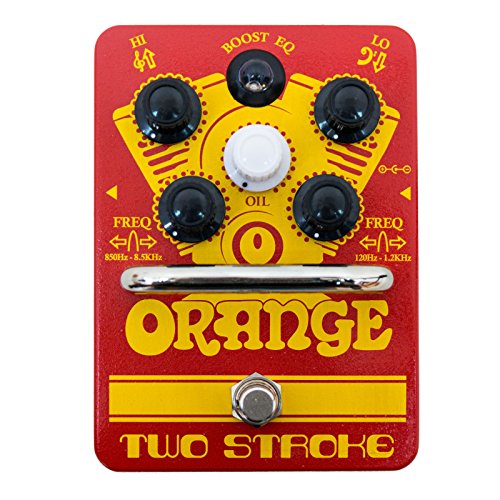
- Active dual-parametric EQ
- 12dB clean boost for amp drive
- Transparent buffered bypass
Best For: Guitarists who want flexible EQ shaping plus a boost in one pedal
Graphic Precision EQ

- Six guitar-optimized EQ bands
- ±18dB boost or cut
- Illuminated sliders with true bypass
Best For: Players who want simple, precise tone shaping with visible controls
Sweepable Midrange Cutter
JHS Haunting Mids Sweepable Midrange EQ

- Sweepable 400Hz to 7.5kHz mids
- Up to +10dB boost with EQ flat
- Includes power supply and cable
Best For: Players who need a focused midrange EQ to cut through the mix
Classic 7-Band Control
BOSS GE-7 Graphic EQ for Guitar

- 7 guitar-optimized bands for fast shaping
- ±15 dB boost/cut per band
- Compact pedal with level slider and 5-year warranty
Best For: Players who want a simple, reliable EQ for quick tone correction and boost
Semi-Parametric Flexibility

- Two semi-parametric mid controls for targeted shaping
- Fixed bass and treble with marked sweet spots
- Top-mounted jacks and plenty of output
Best For: Guitarists who want easy, flexible mid control in a compact EQ pedal
Deep 10-Band Shaping

- 10 fixed bands for detailed tone control
- ±12 dB cut/boost with 18-volt headroom
- Two outputs and bright LEDs for live use
Best For: Players who want detailed EQ control and extra headroom for stage or studio setups
Precision Studio EQ – Empress Effects ParaEq MKII Pedal
If you’re comparing parametric eq pedals for guitar and want maximum control, the Empress Effects ParaEq MKII is built for detailed tone shaping. Its three highly adjustable bands, switchable EQ/boost section, and high internal headroom make it a strong fit when you need surgical cuts, broad boosts, or a clean level lift without getting in the way of your core tone.
Best For: Players who want a highly customizable parametric EQ with clean boost capability and a transparent feel.
Pros:
- Three parametric EQ bands with up to 15dB of boost/cut each
- Adjustable bandwidth per band for more precise shaping
- Switchable linked or independent EQ/boost operation
- High headroom with 27V internal operation and up to 30dB boost
Cons:
- May offer more control than casual users need
- Compact layout can feel feature-dense at a glance
This is a strong option if you want a premium parametric EQ pedal that can do exact correction or bold tonal changes. It stands out for flexibility, especially when transparency and clean boost performance matter.
Five-Band Tone Sculptor – Ibanez PTEQ Pentatone EQ
The Ibanez PTEQ Pentatone is a practical choice if you’re shopping parametric eq pedals for guitar and want a more guided approach to shaping tone. With five bands, Q controls, and a master volume, it gives you enough range to adjust problem frequencies or fine-tune your sound across a wide 30Hz to 14.5kHz span.
Best For: Guitarists who want a five-band parametric EQ with straightforward control and broad frequency coverage.
Pros:
- Five-band parametric EQ layout for broad tonal adjustment
- Master volume adds practical level control
- Q controls help refine each band’s effect
- Wide 30Hz to 14.5kHz frequency range
Cons:
- More elaborate than a simple tone-shaping EQ
- External power adapter may be needed if not using a battery
For players who want a versatile EQ pedal without jumping straight into an ultra-surgical studio-style unit, this Ibanez is easy to justify. It offers a useful balance of range, control, and everyday pedalboard practicality.
Deluxe Boost EQ – Empress Effects ParaEq MKII Deluxe
If you want parametric eq pedals for guitar with a strong boost section built in, the Empress Effects ParaEq MKII Deluxe is an appealing pick. It offers three parametric bands with fully variable bandwidth, plus up to 30dB of gain to help a solo stand out or push a preamp into overdrive.
Best For: Players who want a transparent parametric EQ with a powerful solo boost and flexible bypass options.
Pros:
- Three parametric bands with up to 15dB boost/cut each
- Fully variable bandwidth for precise shaping
- Up to 30dB of gain for leads or preamp drive
- True bypass and buffered bypass options
Cons:
- May be more pedal than players need for simple EQ correction
- Corded power only, so it is less flexible on battery-based boards
This Deluxe version makes sense when you want EQ and utility in one compact unit. It keeps the deep control of a parametric design while adding enough output to serve as a serious level tool on stage or in the studio.
Parametric Mid Booster – Electro-Harmonix LPB-3 EQ Pedal
The Electro-Harmonix LPB-3 is a smart option if you’re looking at parametric eq pedals for guitar and want targeted mid control with serious boost. Its active EQ, parametric mids section, and high-voltage rails are designed for precision tone sculpting while giving you up to 33dB of boosting power.
Best For: Guitarists who want a boost pedal with an active EQ and a focused parametric mids section.
Pros:
- Active EQ supports precise tone sculpting
- Parametric mids section helps cut through a mix
- Up to 33dB of boosting power
- Selectable buffered or true bypass
Cons:
- More of a boost/EQ hybrid than a traditional multi-band parametric EQ
- Corded power design may not suit every board setup
The LPB-3 is best when you need one pedal to add level and focus your mids at the same time. It is less about deep multi-band editing and more about practical, mix-ready punch.
Active Dual-Parametric Tone Shaper – Orange Two Stroke Active Dual-Parametric EQ/Boost
If you want parametric eq pedals for guitar that do more than just tame frequencies, the Orange Two Stroke is built for flexible tone shaping and a real volume lift. Its active dual-parametric EQ gives you seamless control, while the clean boost can add up to 12dB to push an amp’s front end.
Best For: Players who want a versatile EQ and boost pedal for shaping tone and driving their amp harder.
Pros:
- Active dual-parametric EQ for detailed tone control
- Clean boost up to 12dB for saturating an amp’s front end
- Internal charge pump raises operating voltage to 18V
- Transparent buffered bypass helps keep the signal clean
Cons:
- More of a specialized tone tool than a simple set-and-forget EQ
- Requires corded electric power
For guitarists who want one pedal to refine EQ and add usable boost, the Two Stroke is a strong option. It is aimed at players who like hands-on control and a transparent effect that can stay in the chain without getting in the way.
Graphic Precision EQ – JOYO 6-Band Guitar EQ Pedal
Among parametric eq pedals for guitar, this JOYO 6-band model is the straightforward choice when you want fast, exact control over problem frequencies. Its six guitar-optimized bands cover 100Hz to 3.2kHz, with ±18dB of boost or cut for detailed tone sculpting.
Best For: Players who want a compact, budget-friendly graphic EQ for precise stage or rig adjustments.
Pros:
- Six fixed bands designed around guitar-friendly frequencies
- ±18dB range for strong boost or cut
- Illuminated sliders make stage adjustments easier
- True bypass helps preserve signal when off
Cons:
- Uses fixed graphic bands instead of sweepable parametric controls
- Power supply or battery is not included
This is a practical EQ pedal for players who want visible, repeatable adjustments rather than deep menu-style control. It can tighten muddy tones, add warmth, or reshape a distortion sound without much fuss.
Sweepable Midrange Cutter – JHS Haunting Mids Sweepable Midrange EQ
If you’re shopping parametric eq pedals for guitar and need something focused on the mids, the JHS Haunting Mids keeps the layout simple while still being highly usable. It offers a sweepable midrange frequency from 400Hz to 7.5kHz and can boost up to +10dB with EQ flat, making it easy to find the right spot to cut through a mix.
Best For: Guitarists who want a dedicated sweepable midrange EQ for solos, mix cutting, and focused tone shaping.
Pros:
- Sweepable center frequency from 400Hz to 7.5kHz
- Can boost up to +10dB with EQ flat
- Simple control set makes it easy to dial in mids quickly
- Includes power supply, cable, and manual
Cons:
- Midrange-focused design is less broad than a full EQ
- Requires standard 9V DC negative power
This pedal is a strong fit when the mids are where your tone needs help. It is less about broad shaping and more about finding the exact mid frequency that lets your guitar stand out.
Classic 7-Band Control – BOSS GE-7 Graphic EQ for Guitar
If you want a straightforward option in the world of parametric eq pedals for guitar, the BOSS GE-7 is really a graphic EQ built for fast, musical tone shaping. Its seven guitar-optimized bands and level slider make it easy to trim problem frequencies or add a clean volume boost without a complicated setup.
Best For: Players who want a compact, easy-to-use EQ for quick tone correction and volume balancing.
Pros:
- 7 guitar-optimized bands: 100 Hz, 200 Hz, 400 Hz, 800 Hz, 1.6 kHz, 3.2 kHz, and 6.4 kHz
- ±15 dB boost/cut per band for flexible shaping
- Level slider helps balance overall volume or add boost
- Compact pedal format with BOSS five-year warranty
Cons:
- It is a graphic EQ, not a true parametric EQ pedal
- Only seven fixed frequency points, so it offers less precision than semi-parametric designs
For players who want simple, dependable EQ control, the GE-7 is a practical choice that focuses on core tones rather than deep frequency editing. It is best suited to guitarists who value quick adjustments and a pedalboard-friendly footprint.
Semi-Parametric Flexibility – Wampler EQuator Advanced EQ
For players shopping parametric eq pedals for guitar, the Wampler EQuator stands out because it combines fixed bass and treble controls with two semi-parametric mid controls. That makes it a strong pick when you want more targeted tone shaping than a standard graphic EQ, while still keeping the layout easy to dial in.
Best For: Guitarists who want flexible mid control and a compact EQ pedal with easy-to-find sweet spots.
Pros:
- Two semi-parametric mid controls for more precise frequency targeting
- Fixed bass and treble controls keep the layout simple
- Marked sweet spots help speed up dialing in tones
- Top-mounted jacks make pedalboard placement easier
Cons:
- Not a fully parametric EQ, since bass and treble are fixed
- Fewer controls than more complex EQ pedals with deeper band shaping
The EQuator is a smart middle ground if you want a pedal that is more flexible than a basic EQ but still quick to use on a board. It offers practical tone-shaping control and enough output to help push the front of an amp.
Deep 10-Band Shaping – MXR Ten Band EQ for Guitar
If you are comparing parametric eq pedals for guitar and want maximum band control, the MXR Ten Band EQ is a strong option thanks to its 10 separate frequency bands. It is built for detailed tone shaping, and the added headroom from 18-volt operation helps it stay clear when you are boosting or cutting aggressively.
Best For: Guitarists who want detailed EQ shaping with multiple bands and high-headroom operation.
Pros:
- 10 frequency bands for more detailed control
- Up to ±12 dB cut or boost per band
- 18-volt operation adds headroom
- LEDs improve visibility on dark stages or bright sunlight
Cons:
- Not a true parametric EQ, since the frequencies are fixed
- Larger footprint than simpler compact EQ pedals
- Requires 18-volt operation rather than standard 9-volt use
This pedal is best if you want more detailed control than a basic EQ and do not mind the larger size. With true bypass and two outputs, it also offers practical routing flexibility for more involved setups.
How We Picked These Parametric Eq Pedals for Guitar
We focused on pedals that give guitarists practical, usable control over frequency, gain, and overall output. Priority went to models with enough range to solve real tone problems, not just add another color to the signal chain. We also favored pedals with a reputation for low noise, reliable build quality, and controls that make sense on a live board or in a studio setup.
Quick Comparison: What Stands Out
Some Parametric Eq Pedals for Guitar are designed for surgical precision, while others lean toward simple graphic EQ or EQ-plus-boost functionality. High-control options like the Empress and Wampler models are best for players who want detailed shaping. The BOSS GE-7 and MXR Ten Band are more straightforward and familiar for quick adjustments. Pedals like the Orange Two Stroke and JHS Haunting Mids are especially appealing if your main goal is midrange focus, boost, or cutting through a dense mix.
Key Buying Factors for Parametric Eq Pedals for Guitar
Frequency Control
True parametric EQ gives you control over the frequency you target, how much you boost or cut it, and often how wide or narrow that adjustment is. That extra control is what separates it from a standard graphic EQ.
Band Count and Precision
More bands usually mean finer control, but not every player needs maximum complexity. If you want broad cleanup or simple tone correction, fewer controls can be faster and easier. If you’re chasing exact problem frequencies, look for a pedal with deeper adjustability.
Boost, Volume, and Headroom
Many players use EQ pedals as clean boosts. Make sure the pedal can add level without unwanted clipping and that it has enough headroom for your pickups, amp, and playing style.
Noise and Transparency
A good EQ should shape tone without adding harsh noise or flattening your core sound. This matters a lot with high-gain rigs and when stacking pedals.
Bypass and Power Needs
Check whether the pedal uses true bypass or buffered bypass, and confirm whether it needs standard 9V power or something more specialized. These details affect board integration and convenience.
Who Should Buy Which Parametric Eq Pedals for Guitar?
If you want the most precise control and are comfortable dialing in detailed settings, choose a higher-end parametric option. If you need a simple utility pedal for quick tone fixes, a graphic EQ may be the better fit. Players who mainly want midrange shaping for solos, rhythm clarity, or amp voicing should look for a pedal that makes the mids easy to target. In short, the best choice depends on whether you want surgical correction, broad tone shaping, or a dependable boost that also improves your sound.