The right DI box can make a vocal recording setup easier to connect, quieter, and more flexible—especially when microphones, preamps, mixers, and stage gear share a signal path.
These 10 picks cover passive and active designs, stereo and multichannel options, and different approaches to impedance matching, isolation, and hum reduction.
Best 10 Di Boxes for Recording Vocals Picks for 2026
Studio-Ready Passive Choice
Radial Pro DI Passive Direct Box

- Passive mono design with custom transformer
- Rugged stainless-steel I-beam construction
- Suitable for studio, live, and console use
Best For: Instrument-focused studio and live setups
Simple Signal Conversion
Hosa DIB-443 Sidekick Passive DI Box

- Converts 1/4-inch TS to balanced XLR3M
- Requires no external power
- Metal housing for live-use durability
Best For: Straightforward instrument-to-mixer connections
Flexible Powered Operation
Klark Teknik PRO DI 10A Active DI Box

- Custom Midas transformer
- High-headroom active design
- Phantom or battery operation with switchover
Best For: Powered studio and multimedia signal routing
Budget-Friendly Passive Routing
Behringer Ultra-DI DI400P Passive Direct Box

- Converts unbalanced signals to balanced mic level
- Thru/Out enables amplifier pass-through
- Compact metal housing with TRS and XLR
Best For: Affordable guitar, bass, and mixer routing
Best Stereo Multimedia DI

- Passive two-channel design
- RCA, 1/4-inch, 3.5mm, and XLR connectivity
- Compact stainless-steel construction
Best For: Stereo multimedia sources and flexible vocal recording setups
Best Four-Channel Rack DI

- Four-channel active DI box
- Also functions as a booster and line isolator
- Designed for multi-channel routing
Best For: Larger vocal and line-level setups needing four DI channels
Best Budget Hum-Reducing DI
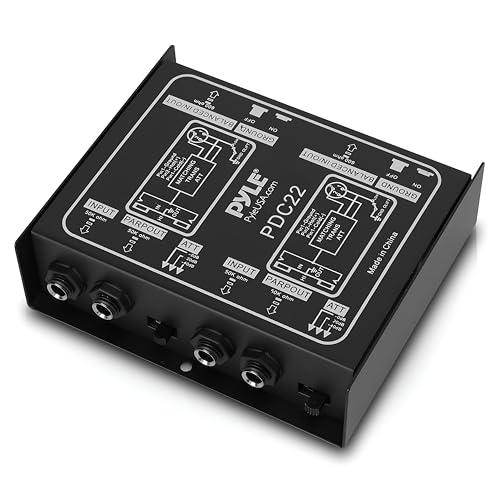
- 1/4-inch connector and impedance transformer
- Ground lift and hum-cancellation features
- Two-channel steel construction
Best For: Unbalanced instruments and line sources prone to buzz or hum
Best Multi-Channel Pick

- Four independent DI channels
- Per-channel pad and ground lift
- Volume and pan controls for mixer output
Best For: Multi-source recording setups
Best Passive Multimedia Option
Klark Teknik PRO DI AV 2 DI 22P

- Passive stereo operation
- Midas transformers and high headroom
- 1/4-inch, 1/8-inch TRS, and RCA inputs
Best For: Stereo and multimedia recording
Best Straightforward Stereo Pick
Radial ProD2 Passive 2-Channel DI

- Passive two-channel stereo design
- Isolation transformer with lift switch
- 15 dB pad and 1/4-inch/XLR connectivity
Best For: Simple stereo vocal recording setups
Studio-Ready Passive Choice – Radial Pro DI Passive Direct Box
For anyone comparing DI boxes for recording vocals and other studio sources, the Radial Pro DI offers a straightforward passive design with a custom transformer and rugged stainless-steel construction. Its mono XLR output suits routing instruments into professional consoles and snake systems.
Best For: Live or studio setups using acoustic guitars, bass, keyboards, or drum machines.
Pros:
- Passive mono direct box with a custom transformer.
- Rugged I-beam construction and stainless-steel enclosure.
- Designed for live or studio performances and professional console connections.
Cons:
- Mono operation may not suit stereo sources.
- Passive design does not provide active powering options.
The Radial Pro DI is a durable, purpose-built option when dependable passive signal routing matters more than extra features.
Simple Signal Conversion – Hosa DIB-443 Sidekick Passive DI Box
The Hosa DIB-443 is a practical pick among DI boxes for recording vocals when you need to convert an unbalanced 1/4-inch TS signal to balanced XLR. Its passive, plug-and-play design requires no external power and helps reduce noise on long cable runs.
Best For: Connecting electric guitars, basses, or keyboards to mixers, PA systems, and amplifiers.
Pros:
- Converts unbalanced 1/4-inch TS signals to balanced XLR3M.
- Passive operation requires no external power.
- Robust metal construction is suited to live performance use.
Cons:
- Designed around a single 1/4-inch-to-XLR signal path.
- Its listed applications focus on instruments rather than microphones.
Choose the DIB-443 for uncomplicated connections and basic hum and noise reduction in compact recording or performance rigs.
Flexible Powered Operation – Klark Teknik PRO DI 10A Active DI Box
The Klark Teknik PRO DI 10A brings active operation to the DI boxes for recording vocals category, with a custom-built Midas transformer and a high-headroom design. It can run from +48V console phantom power or an internal battery, with automatic battery switchover if phantom power fails.
Best For: Recording and multimedia setups that need active operation and backup power flexibility.
Pros:
- Active design with a custom-built Midas transformer.
- High-headroom circuitry is intended for extended dynamic range.
- Supports +48V phantom power or internal battery operation.
Cons:
- The internal battery is not included.
- Active operation adds power requirements compared with passive alternatives.
With phantom-power support and battery backup, the PRO DI 10A is a versatile choice when signal integrity and operational flexibility are priorities.
Budget-Friendly Passive Routing – Behringer Ultra-DI DI400P Passive Direct Box
The Behringer DI400P is a compact passive option for DI boxes for recording vocals and instrument-based recording setups. It converts unbalanced line-level signals to balanced mic-level output, supports long cable runs, and includes a Thru/Out jack for sending a signal to an amplifier.
Best For: Guitar, bass, mixer, and amplifier connections in compact audio rigs.
Pros:
- Passive design needs no dedicated power connection.
- Helps match impedance and signal levels for mixer connections.
- Thru/Out jack supports simultaneous amplifier and mixer routing.
- Compact metal enclosure with TRS and XLR connectivity.
Cons:
- It is a mono direct box rather than a stereo solution.
- Its supplied applications center on instruments and general audio use.
The DI400P offers useful routing flexibility in a small enclosure, making it a sensible choice for basic recording, rehearsal, and live setups.
Best Stereo Multimedia DI – ProAV2 Stereo Direct Box
The Radial Engineering ProAV2 is a practical option when comparing di boxes for recording vocals alongside keyboards, playback devices, or other stereo sources. Its passive two-channel design includes RCA, 1/4-inch, 3.5mm, and XLR connectivity for flexible studio and live-sound setups.
Best For: Stereo multimedia sources and vocal recording setups that need broad connector compatibility.
Pros:
- Two-channel passive DI configuration
- Supports RCA, 1/4-inch, 3.5mm, and XLR connections
- Compact 1.43-pound stainless-steel unit
Cons:
- Passive design may not suit every signal-boosting requirement
- Its stereo multimedia focus may be more than needed for a simple single-source setup
The ProAV2 stands out for connection flexibility and two-channel operation. It is a sensible choice when your vocal recording chain also needs to accommodate stereo consumer or multimedia sources.
Best Four-Channel Rack DI – ULTRA-DI PRO DI4800A
Behringer ULTRA-DI PRO DI4800A Professional 4 Channel Active DI-Box, Booster and Line Isolator
Check Price On AmazonThe Behringer ULTRA-DI PRO DI4800A is worth considering among di boxes for recording vocals when a setup requires multiple simultaneous channels. This active four-channel DI box is also described as a booster and line isolator, making it suited to larger routing needs.
Best For: Multi-channel vocal, instrument, or line-level setups that need four DI channels in one unit.
Pros:
- Provides four channels
- Active DI design includes booster and line-isolator functionality
- Designed as a professional-format multi-channel unit
Cons:
- Four channels may be unnecessary for a basic one-microphone setup
- The supplied specifications do not identify connector types or detailed controls
The DI4800A is the most channel-dense option in this group. Choose it when your recording or live rig benefits from four active DI paths rather than a compact, minimal setup.
Best Budget Hum-Reducing DI – PDC22 Passive DI Unit
The PYLE-PRO PDC22 is a straightforward choice among di boxes for recording vocals when you need to connect unbalanced sources to balanced or unbalanced equipment. It has a 1/4-inch input, impedance transformer, ground-lift capability, and hum-cancellation features for instruments, keyboards, submixers, and other line sources.
Best For: Home and live recording setups connecting guitars, basses, keyboards, or other unbalanced sources while addressing buzz and hum.
Pros:
- Supports 1/4-inch device connections
- Ground-lift and hum-cancellation functionality
- Two-channel, all-steel construction
- Works with instruments, keyboards, submixers, and consumer stereo sources
Cons:
- Passive design may not provide active signal boosting
- The supplied notes do not specify detailed frequency or noise performance
- Its broad source compatibility may be unnecessary for a simple vocal-only chain
The PDC22 emphasizes practical connectivity and noise troubleshooting. It is a useful fit for recording environments where ground loops, unbalanced outputs, or multiple source types are part of the setup.
Best Multi-Channel Pick – dbx DI4 4-Channel Active DI
For recording vocals with multiple sources, the dbx DI4 offers four independent active DI channels in a compact half-rack package. Its per-channel controls make it practical when you need flexible signal routing and level management.
Best For: Home studios and recording setups handling several instruments or line-level sources alongside vocals.
Pros:
- Provides four independent DI box channels.
- Each channel has a 20 dB pad and ground-lift switch.
- Individual volume and pan controls support the line mixer output.
Cons:
- Requires corded electric power.
- Its 1/2-rack format may be more than needed for a single vocal setup.
The DI4 is the most feature-rich option here for multi-source recording. Choose it when channel count and independent controls matter more than a simple passive design.
Best Passive Multimedia Option – Klark Teknik PRO DI AV 2 DI 22P
The Klark Teknik PRO DI AV 2 is a passive stereo DI box suited to recording vocals with general-purpose or multimedia sources. Its multiple stereo input formats make it useful when your setup includes 1/4-inch, 1/8-inch TRS, or RCA connections.
Best For: Stereo vocal, multimedia, and general-purpose recording applications where passive operation is preferred.
Pros:
- Passive design requires no power supply.
- Custom-built Midas transformers support signal integrity.
- Accepts stereo 1/4-inch, 1/8-inch TRS, and RCA inputs.
- High-headroom design is intended for clean sound quality.
Cons:
- It is a stereo DI rather than a four-channel unit.
- The supplied notes do not list pad or ground-lift controls.
This model is a convenient choice for passive stereo routing, especially when your vocal recording setup also includes consumer or multimedia connections. Its broad input compatibility is the main advantage.
Best Straightforward Stereo Pick – Radial ProD2 Passive 2-Channel DI
The Radial ProD2 is a compact passive two-channel direct box for recording vocals and other stereo sources. Its isolation transformer, lift switch, and 15 dB pad provide useful signal-management features without requiring external power.
Best For: Users seeking a simple passive stereo DI with transformer isolation and basic level control.
Pros:
- Passive design avoids the need for a power supply.
- Two-channel stereo configuration suits paired sources.
- Includes an isolation transformer lift switch and 15 dB pad.
- Uses 1/4-inch and XLR connectors.
Cons:
- Offers two channels rather than four independent inputs.
- Its supplied feature list does not mention per-channel volume or pan controls.
The ProD2 keeps the feature set focused on essential passive DI duties. It is a strong fit when you want stereo operation, transformer isolation, and a pad in a straightforward unit.
How We Picked the Best Di Boxes for Recording Vocals
We focused on signal-path reliability, connection flexibility, transformer isolation, channel count, and practical studio or live-use features. The selection includes passive boxes for simple, robust setups; active models for higher flexibility and gain handling; and stereo or multichannel units for keyboards, playback rigs, mixers, and larger recording systems.
Because a DI box is not normally a replacement for a microphone preamp, we also considered how easily each design fits between instruments, line-level sources, interfaces, mixers, and other equipment. Balanced XLR outputs, ground-lift controls, pad switches, phantom-power support, and rugged construction were treated as meaningful advantages where applicable.
Quick Comparison
| Best For | What to Look For |
|---|---|
| Simple instrument or auxiliary connection | Passive operation, ground lift, and a durable enclosure |
| Low-output or source-sensitive signals | Active circuitry and phantom or battery power |
| Two-channel stereo sources | Matched channels and stereo-friendly inputs and outputs |
| Complex studio or stage rigs | Four channels, line mixing, or multiple isolation options |
Key Buying Factors for Di Boxes for Recording Vocals
Passive Versus Active Design
Passive DI boxes use transformers and generally need no power, making them simple and dependable. Active models can offer higher input impedance and more headroom for certain sources, but they require phantom power, batteries, or an external supply. For a microphone-centered setup, choose based on the source feeding the box rather than assuming active is always better.
Input and Output Compatibility
Check whether the unit accepts 1/4-inch TS, TRS, RCA, or other connections and whether its output is a balanced XLR intended for a mixer or interface. Some boxes are designed for instrument-level sources, while others also accommodate line-level equipment. Matching the box to the source helps prevent weak, overloaded, or noisy signals.
Isolation, Ground Lift, and Noise Control
Transformer isolation can help break ground loops between connected devices. A ground-lift switch is useful when hum appears, but it should be used thoughtfully and never as a substitute for safe electrical grounding. Pads and polarity controls can also help manage hot sources and multi-microphone setups.
Channel Count and Portability
A single-channel DI is usually enough for a basic instrument or auxiliary feed. Stereo keyboards, playback devices, and multiple vocal-related sources may justify a two- or four-channel model. For mobile recording, prioritize compact construction and straightforward controls.
Who Should Buy Which Di Boxes for Recording Vocals?
Choose a compact passive unit if you need a reliable solution for one source and want minimal setup. An active DI is a better fit when the source needs a higher input impedance, extra headroom, or convenient phantom/battery operation. Stereo models suit keyboards and playback equipment, while four-channel boxes make more sense for studios, venues, and production rigs with several connected sources.
Before buying, confirm the source type, expected signal level, available power, required channel count, and the distance to your interface or mixer. Those details matter more than feature count when choosing among Di Boxes for Recording Vocals.