The right DI box can make instruments, laptops, and other unbalanced sources easier to connect to a podcast mixer or audio interface. It can also help reduce hum, preserve signal quality, and simplify a multi-source recording setup.
We selected 10 passive direct boxes covering practical needs from solo podcasting and remote interviews to music-focused shows and stereo playback. The guide below explains which features matter and how to choose the best fit.
Best 10 Di Boxes for Podcasting Picks for 2026
Simple Passive Choice

- No power required
- Pad and ground-lift switches
- 1/4-inch input and through output
Best For: Basic mono instrument connections
Stereo Keyboard Specialist

- Stereo passive DI design
- -15 dB pad and ground lift
- Includes 10-foot XLR cable
Best For: Keyboards and stereo digital instruments
Studio Signal Workhorse

- Balanced XLR output from 1/4-inch input
- Passive, battery-free operation
- Thru output for amp or pedals
Best For: Mono instrument-to-interface routing
Dual-Channel Workflow Pick
StudioMan DI-2 Dual Passive DI

- Two independent isolated channels
- Per-channel ground switches and pads
- Balanced XLR/TRS connectivity
Best For: Two-instrument recording and streaming setups
Transformer-Isolated Pick

- High 140kΩ input impedance
- Transformer-isolated output
- Includes mic cable and cloth
Best For: Instrument-based podcasting and recording setups
Flexible Stereo Pick

- Two passive channels
- Per-channel -15dB pads
- Ground lift and polarity controls
Best For: Stereo instruments and hot line-level sources
Laptop Audio Pick

- 3.5 mm input for portable devices
- Integrated 10-foot cable
- Balanced mic-level XLR output
Best For: Routing laptop or tablet audio into XLR equipment
Road-Ready Signal Control
JCANOL PD200 Stereo Passive DI Box

- Balanced XLR output from unbalanced instruments
- Ground lift helps reduce hum
- Compact housing with thru output
Best For: Guitar, bass, and keyboard setups needing portable DI conversion
Flexible Two-Input Routing
Passive DI Box with Merge Function

- Converts unbalanced signals to balanced XLR
- Ground lift and attenuation controls
- Rugged housing for live audio use
Best For: PA, club, monitor, and DJ setups needing flexible passive routing
Mobile Device Connectivity
Kopul LT-PDI Laptop Direct Box
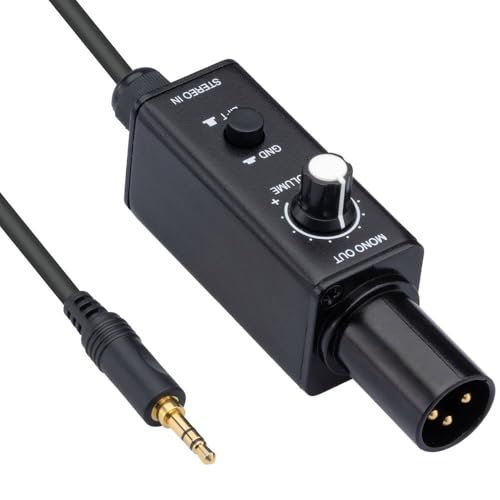
- Accepts 3.5mm stereo device output
- Provides balanced mono XLR mic-level output
- Compact aluminum body with ground lift
Best For: Laptops, phones, and tablets feeding mixers or PA systems
Simple Passive Choice – Compact Passive DI Box
For basic DI boxes for podcasting setups, this compact passive model converts a 1/4-inch instrument signal to a balanced XLR output without batteries or phantom power. Its pad and ground-lift controls are useful when connecting guitars, keyboards, or other sources to a mixer or interface.
Best For: Simple, budget-conscious mono connections for instruments and small recording setups.
Pros:
- Requires no power.
- Includes a 1/4-inch through output for a parallel signal path.
- Pad switch helps soften hot sources.
- Ground lift can help reduce grounding-related buzz.
Cons:
- Provides one output channel.
- Passive operation offers fewer controls than an active DI.
This is a straightforward option when you need balanced XLR connectivity and basic noise-management controls without adding a powered device to your setup.
Stereo Keyboard Specialist – Radial ProD2 Stereo DI Bundle
This stereo passive DI bundle is a strong fit for podcasting setups that include keyboards, digital pianos, drum machines, or other stereo sources. It combines the Radial ProD2 with a 10-foot XLR cable and polishing cloth, while custom transformers, pad, and ground lift support clean, practical signal routing.
Best For: Stereo keyboards, digital instruments, and users who want a bundled cable with a rack-mountable DI.
Pros:
- Designed for stereo signal conversion.
- Custom transformers handle high signal levels and massive transients.
- Includes -15 dB pad and ground-lift controls.
- Bundle includes a 10-foot Pig Hog XLR cable.
Cons:
- Heavier and larger than a basic mono DI.
- Its stereo features may be unnecessary for a single microphone or instrument source.
Choose this bundle when stereo connectivity and touring-oriented construction matter more than the smallest possible footprint.
Studio Signal Workhorse – Samson S-Max MD1 Passive DI
The Samson S-Max MD1 is a practical choice for DI boxes for podcasting when you need to send a 1/4-inch instrument or line-level source to a balanced mic-level XLR input. Its passive circuit needs no power, while the thru output, pad settings, and ground lift add useful flexibility for studio or live routing.
Best For: Guitar, keyboard, and line-level sources feeding mixers or USB audio interfaces.
Pros:
- Converts unbalanced 1/4-inch signals to balanced XLR.
- Requires no batteries or phantom power.
- Thru output supports pedals, amplifiers, or monitoring.
- Steel chassis and Mu-Metal shielding support durable, low-noise operation.
Cons:
- It is a mono DI box.
- Passive operation may not suit setups needing active gain or buffering.
With its useful thru connection and robust enclosure, the MD1 is a versatile mono DI for routing instruments into an interface while retaining a separate amp or monitor path.
Dual-Channel Workflow Pick – StudioMan DI-2 Dual Passive DI
For podcasting or streaming setups that connect several instruments, this dual-channel passive DI converts two independent high-impedance sources to balanced XLR outputs. Independent ground switches, -30 dB pads, and 50KΩ inputs make it suited to guitars, basses, keyboards, and synths in studio or live configurations.
Best For: Two-source recording, live streaming, and setups combining instruments such as guitar and keyboard.
Pros:
- Two isolated channels increase routing flexibility.
- Independent ground switches address channel-specific hum.
- -30 dB pads help accommodate high-output devices.
- Compact chassis supports pedalboard or gig-bag use.
Cons:
- It is passive and does not provide active gain.
- Its dual-channel features may be more than needed for a single source.
The DI-2 is the most efficient option here for handling two instrument feeds at once, especially when independent noise control and balanced mixer or interface connections are priorities.
Transformer-Isolated Pick – Radial ProDI Bundle
For podcasters routing instruments into an interface or mixer, the Radial Engineering ProDI Bundle is a straightforward passive DI option. Its custom-wound transformer is designed to handle high signal levels, while transformer isolation can help reduce ground-loop noise.
Best For: Podcasters and recording setups that need a rugged passive DI for instruments, plus a cable included in the bundle.
Pros:
- High 140kΩ input impedance helps accommodate instrument signals.
- Transformer-isolated output helps address ground-loop noise.
- Passive, plug-and-play operation requires no complex setup.
- Bundle includes a Pig Hog mic cable and polishing cloth.
Cons:
- It is a single passive instrument DI rather than a stereo or dual-channel model.
- The included cable and cloth may be unnecessary if you already have accessories.
The ProDI is a focused choice when clean transformer isolation and simple operation matter more than extra routing features. Its high input impedance and signal-handling design make it a practical fit for instrument-based podcasting and recording.
Flexible Stereo Pick – Bolanle D2 Stereo DI Box
The Bolanle D2 is one of the more flexible DI boxes for podcasting when your setup includes stereo keyboards, synths, or multiple instruments. It provides two passive channels, per-channel -15dB pads, thru outputs, and controls for ground lift and polarity.
Best For: Podcasters, musicians, and small production setups connecting stereo instruments or hot line-level sources to an XLR mixer or interface.
Pros:
- Dual channels support stereo keyboards, synths, or two separate instruments.
- Per-channel -15dB pads help manage hot signals before they reach the mixer.
- Ground lift and polarity switches address hum and phase issues.
- Thru outputs allow local amplifier monitoring while sending balanced output onward.
Cons:
- Its larger feature set may be more than needed for a single instrument or simple voice setup.
- As a passive DI, it does not provide powered features or battery operation.
Choose the D2 when routing flexibility is a priority. The stereo design, attenuation pads, and troubleshooting switches give it a strong advantage for more involved podcasting and music-production signal chains.
Laptop Audio Pick – On-Stage DB100
The On-Stage DB100 is a compact solution for connecting consumer playback devices to a mixer or interface. Its 3.5 mm input and integrated 10-foot cable are designed for laptops, tablets, and MP3 players, converting unbalanced audio to a balanced mic-level output.
Best For: Podcasters who need to feed laptop, tablet, or MP3-player audio into balanced XLR equipment.
Pros:
- 3.5 mm input works with common laptop, tablet, and MP3-player outputs.
- Converts unbalanced source audio to balanced mic-level output.
- Integrated 10-foot cable makes it easier to reach remote playback devices.
- Passive operation requires no power supply.
Cons:
- It has one channel, so it is not intended for stereo dual-channel DI routing.
- Its input is aimed at 3.5 mm consumer audio sources rather than instrument connections.
The DB100 is a practical choice for podcast playback, remote guests’ media, or background audio from a portable device. Its fixed long cable favors convenience, while the metal enclosure supports dependable routine use.
Road-Ready Signal Control – JCANOL PD200 Stereo Passive DI Box
For musicians building a practical setup with DI boxes for podcasting, the JCANOL PD200 is a compact passive option for converting unbalanced instrument signals to balanced XLR output. Its ground lift and attenuation controls can help when connecting guitars, basses, keyboards, mixers, or amplifiers in recording and live environments.
Best For: Musicians and small recording setups that need instrument-to-XLR conversion with ground-loop control.
Pros:
- Converts unbalanced guitar, bass, and keyboard signals to balanced XLR output.
- Ground lift switch helps reduce hum from ground loops.
- Input attenuator supports signal-level matching, while the thru output can feed an amplifier.
- Compact aluminum housing with shock-proof foot pads is suited to portable use.
Cons:
- It is a passive instrument DI rather than a dedicated laptop or smartphone interface.
- The supplied notes do not specify phantom-power operation or detailed frequency specifications.
The PD200 is a straightforward choice when your priority is clean, balanced instrument connectivity in a compact enclosure. The ground lift, attenuation, and thru connection make it especially useful for flexible stage or studio routing.
Flexible Two-Input Routing – Passive DI Box with Merge Function
Among DI boxes for podcasting and general audio routing, this passive direct box focuses on impedance conversion, noise reduction, and level matching. Its two-input merge function and XLR connectivity can help integrate multiple sources into live sound, PA, monitor, club, or DJ systems.
Best For: Live sound and installed audio users who need passive conversion with flexible input routing.
Pros:
- Converts high-impedance unbalanced signals to low-impedance balanced XLR signals.
- Ground lift switch can reduce hum caused by multiple connected devices.
- Attenuation switch helps match signal levels with connected equipment.
- High-strength housing is designed for steady, long-term use.
Cons:
- The supplied information does not detail the exact input and output layout for the merge function.
- It is a passive direct box, so the notes do not indicate built-in gain or active signal boosting.
This model makes the most sense for users who value routing flexibility alongside basic DI duties. The ground lift and attenuator address common connection issues, while the rugged housing suits repeated live or system use.
Mobile Device Connectivity – Kopul LT-PDI Laptop Direct Box
For podcasting workflows that rely on a laptop, phone, or tablet, the Kopul LT-PDI is a purpose-built option among DI boxes for podcasting. It converts stereo line-level output from portable devices into balanced mono mic-level audio through a 3.5mm TRS input and XLR output.
Best For: Podcasters, presenters, and AV users connecting laptops, smartphones, or tablets to mixers, PA systems, or recorders.
Pros:
- Designed for unbalanced stereo line-level signals from laptops, smartphones, and tablets.
- Converts the source to balanced mono mic-level output for mixers, PA systems, and interfaces.
- Ground lift switch helps address hum and unwanted noise.
- Lightweight aluminum construction is easy to carry in a gear bag.
Cons:
- The stereo source is converted to mono output, which may not suit stereo playback needs.
- The supplied notes do not list additional attenuation controls or detailed technical specifications.
The LT-PDI is the most targeted choice here for mobile-device audio. Its input and output format, compact build, and ground lift make it convenient for routing spoken audio or playback from portable devices into professional sound systems.
How We Picked the Best Di Boxes for Podcasting
We focused on practical performance and setup flexibility rather than brand name alone. The lineup includes mono and stereo models, laptop-specific options, dual-channel units, and boxes with useful controls such as ground-lift switches, input pads, and merge functions. We also considered connection options, impedance compatibility, passive circuit simplicity, portability, and suitability for studio or live podcast workflows.
For podcasting, a DI box should provide a dependable path from an unbalanced 1/4-inch or consumer output to a balanced XLR input. Hum control and straightforward operation are especially valuable when several devices share power or when a laptop is connected to a mixer.
Quick Comparison
- Best for general instrument use: A single-channel passive model with a ground lift and pad offers a simple, versatile setup.
- Best for stereo sources: Choose a two-channel unit for keyboards, playback devices, or stereo laptop audio.
- Best for laptops: A laptop DI is designed to connect computer headphone or line outputs to balanced mixer inputs.
- Best for multiple sources: Dual-channel boxes or models with a DI/merge function can reduce the need for extra hardware.
- Best for premium reliability: Radial options are worth considering when rugged construction and consistent stage-ready performance are priorities.
Key Buying Factors for Di Boxes for Podcasting
Mono or Stereo Channels
Mono is sufficient for a microphone-adjacent instrument, single playback source, or one laptop feed mixed to mono. Choose stereo when you need to retain left-right music, sound effects, keyboard output, or a two-channel media source.
Ground Lift and Input Attenuation
A ground-lift switch can help break unwanted ground loops, while a pad reduces an overly strong input signal before it reaches the mixer. These controls are useful when connecting laptops, powered devices, keyboards, or active instruments.
Connections and Compatibility
Check that the DI accepts the source connector you plan to use, typically 1/4-inch TS or TRS, and provides the balanced XLR outputs your interface or mixer requires. Passive DI boxes generally work without batteries or external power, but verify whether phantom power passes safely through the intended setup.
Build and Portability
Metal housings, protected switches, and secure jacks matter if the box will travel between recording locations. For a permanent desk setup, compact size and easy access to the ground switch may matter more than extreme stage durability.
Who Should Buy Which Di Boxes for Podcasting?
Solo podcasters should choose a compact mono DI for one instrument or a laptop, especially if desk space is limited. Music and interview shows will benefit from stereo or dual-channel models when playback and instruments need separate paths. Mobile creators should prioritize a rugged, passive unit with no battery requirement. Studios and production teams may prefer premium models with clearer labeling, stronger chassis construction, and flexible attenuation or merge controls.