The best DI boxes under $200 can solve common signal problems without adding unnecessary complexity or cost. They help connect instruments and other unbalanced sources to mixers, interfaces, and stage snakes while reducing noise and preserving a usable tone.
This roundup covers passive, active, stereo, dual-channel, and multi-channel options for home studios, live rigs, rehearsal spaces, and installations. Use the guide below to match features such as ground lift, attenuation, channel count, and input compatibility to your setup.
Best 10 Di Boxes Under 200 Picks for 2026
Best Stereo Pick
Mackie MDB-2P Passive Stereo DI Box

- Dual 1/4-inch inputs for stereo sources
- 15 dB pads handle hot signals
- No power required; includes ground lift
Best For: Stereo keyboards, DJ rigs, and backing-track setups
Best Simple Mono Choice
Radial Pro DI Passive Direct Box

- Passive mono design with custom transformer
- Rugged I-beam construction
- Works with guitar, bass, keyboards, and more
Best For: Live or studio mono instrument connections
Best for Reamping

- Combines active DI and reamping
- 48V phantom-powered operation
- Includes pad, filter, polarity, and ground lift
Best For: Guitar and bass recording with reamping
Best Dual-Channel Controls

- Two-channel passive transformer design
- 0, -20, and -40 dB attenuation
- Includes filter, phase, and ground-lift switches
Best For: Dual-source setups needing flexible passive control
Compact Hum Control

- 1/4-inch and XLR connectivity
- Hum and buzz cancellation
- Steel chassis; supports up to 10 pedals
Best For: Compact instrument and consumer-audio setups
Four-Channel Routing

- Four fully isolated passive channels
- 0, -20, and -40 dB attenuation
- Routes to amp and mixer simultaneously
Best For: Multi-channel stage and studio rigs
Low-Noise Stage Utility
Donner Special-I Passive DI Box

- Transformer-isolated signal matching
- Ground lift reduces ground-loop hum
- 1/4-inch TS and XLR connections
Best For: Instrument-to-PA setups with amp-through routing
Best Value Pair
Seismic Audio SA-DI1 Passive DI Boxes

- Two passive DI boxes included
- Three attenuation settings: 0, -20, and -40 dB
- Parallel output and ground lift for flexible setups
Best For: PA, DJ, church, karaoke, and dual-input applications
Best for Mobile AV
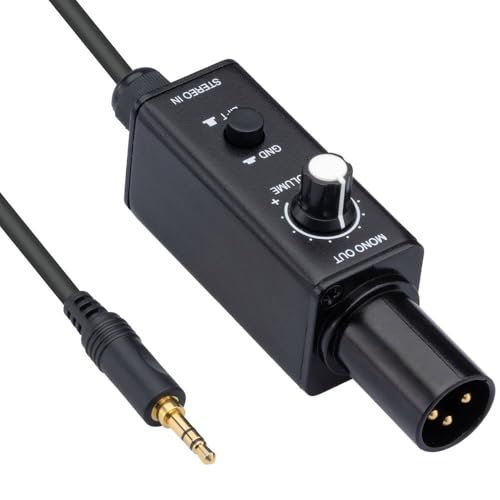
- Accepts 3.5mm TRS device output
- Converts unbalanced stereo to balanced mono mic level
- Compact aluminum design with ground lift
Best For: Laptops, smartphones, tablets, presentations, and portable AV
Best for Instruments
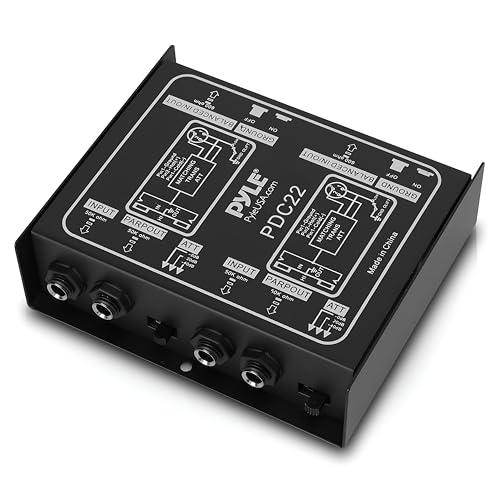
- Two-channel design for live sound connections
- Ground lift helps reduce buzz and hum
- Steel chassis supports durable use
Best For: Guitar, bass, keyboard, processor, and PA connections
Best Stereo Pick – Mackie MDB-2P Passive Stereo DI Box
Among DI boxes under 200, the Mackie MDB-2P is a practical choice for stereo sources such as keyboards, DJ controllers, and backing-track rigs. Its passive design needs no power, while the pad and ground lift help manage hot signals and unwanted hum.
Best For: Stereo keyboards, DJ rigs, and playback setups needing simple, passive signal conversion.
Pros:
- Dual 1/4-inch high-impedance inputs support stereo sources.
- 15 dB pads help prevent distortion from hot signals.
- Ground lift helps address ground-loop buzz.
- Roadworthy steel case and no power requirement suit live use.
Cons:
- Passive stereo design may be more than needed for a single mono source.
- Its listed features focus on instrument and line-level applications rather than advanced routing.
The MDB-2P stands out when you need two-channel passive DI functionality without batteries or an adapter. It is especially well matched to stereo stage and playback setups.
Best Simple Mono Choice – Radial Pro DI Passive Direct Box
For shoppers comparing DI boxes under 200, the Radial Pro DI offers a straightforward passive mono solution. Its custom transformer and rugged I-beam construction are suited to live or studio use with instruments such as acoustic guitar, bass, keyboards, and drum machines.
Best For: Musicians and engineers who need a durable passive mono DI for live or studio signal paths.
Pros:
- Passive mono design uses a custom transformer.
- Rugged I-beam construction is built for demanding use.
- Works with guitars, basses, keyboards, and drum machines.
- Includes a 2-year warranty.
Cons:
- Single-channel design is less suitable for stereo sources.
- No active circuitry or additional control features are listed.
The Radial Pro DI keeps the job focused: convert an instrument signal for a balanced XLR connection in a compact passive box. Choose it when reliability and simplicity matter more than extra routing options.
Best for Reamping – JOYO JDI-48 Active DI Box
The JOYO JDI-48 adds reamping to the usual DI function, making it a flexible option among DI boxes under 200 for guitarists, bassists, and home or studio engineers. Its active DI runs on 48V phantom power and includes controls for filtering, attenuation, polarity, and ground-loop noise.
Best For: Guitar and bass recording workflows that need both clean DI capture and reamping.
Pros:
- Combines active DI and reamping in one unit.
- 48V phantom power eliminates disposable batteries during compatible setups.
- Includes an 80 Hz low-cut filter, -15 dB pad, polarity reverse, and ground lift.
- All-metal chassis is suitable for studio and gigging use.
Cons:
- Requires 48V phantom power for the active DI section.
- Its added controls may be unnecessary for basic mono DI duties.
The JDI-48 is the most workflow-oriented option in this group. It makes sense when you want to record a clean signal now and send it back through an amp later for tone shaping.
Best Dual-Channel Controls – ART DualZDirect Passive DI
The ART DualZDirect is a strong candidate among DI boxes under 200 when you need two passive channels and more signal-shaping controls. It converts high-impedance inputs to balanced outputs and provides switchable attenuation, low-pass filtering, phase inversion, and ground lift.
Best For: Stereo or dual-source setups requiring passive operation and flexible signal management.
Pros:
- Two channels support stereo or dual-instrument configurations.
- Fully passive transformer design requires no battery.
- Selectable 0, -20, and -40 dB attenuation helps accommodate different signal levels.
- Low-pass filter, phase invert, and isolated ground lift add useful control.
Cons:
- Passive operation does not provide the additional gain of an active DI.
- Its multiple switches may be more than needed for a basic setup.
With dual channels and unusually broad passive control options, the DualZDirect is well suited to more involved stage or recording rigs. It is a practical pick when attenuation and phase management are important.
Compact Hum Control – Pyle PDC21 Passive DI Box
For musicians comparing DI boxes under 200, the Pyle PDC21 is a compact passive option for connecting guitars, basses, keyboards, and other unbalanced sources to balanced XLR equipment. Its impedance transformer and ground-lift design are aimed at reducing buzz and hum in live or recording setups.
Best For: Musicians and home studios needing a compact DI box for instruments, keyboards, effects processors, or consumer audio sources.
Pros:
- Supports 1/4-inch connections and balanced or unbalanced XLR routing.
- Includes buzz and hum cancellation through impedance transformation and ground lifting.
- Steel chassis and capacity to power up to 10 effects pedals.
Cons:
- Passive design may offer fewer controls than an active DI box.
- Supplied notes do not specify frequency-response or attenuation settings.
The PDC21 stands out as a straightforward, durable choice when basic signal conversion and hum reduction matter more than extensive channel or control options.
Four-Channel Routing – ART PDB4 Passive Direct Box
Among DI boxes under 200, the ART PDB4 is designed for setups that need multiple isolated channels in one unit. Its four passive channels include switchable input attenuation and support simultaneous routing to an instrument amplifier and mixer.
Best For: Stage and studio rigs that need four passive DI channels with flexible attenuation and amplifier-to-mixer routing.
Pros:
- Provides four fully isolated passive channels.
- Offers selectable 0 dB, -20 dB, and -40 dB input attenuation.
- Can feed an instrument amplifier and mixer at the same time.
Cons:
- At 2.2 pounds, it is less portable than a compact single-channel DI box.
- The supplied notes do not identify individual connector types or a ground-lift control.
The PDB4 is the practical pick when channel count and attenuation flexibility are more important than the smallest possible footprint.
Low-Noise Stage Utility – Donner Special-I Passive DI Box
For shoppers seeking DI boxes under 200, the Donner Special-I offers passive signal matching for guitars, basses, keyboards, and other instrument or line-level sources. Its transformer isolation and ground-lift switch are designed to address ground-loop hum while sending a signal to a PA and a thru signal to an amplifier.
Best For: Stage and studio users who need a compact passive DI box with transformer isolation, ground lift, and amp-through routing.
Pros:
- Converts unbalanced instrument or line-level signals to balanced low-impedance mic-level output.
- Transformer isolation and ground lift help reduce hum and buzz from ground loops.
- Provides 1/4-inch TS and XLR connectivity in a compact enclosure.
Cons:
- Plastic construction may be less rugged than a steel-chassis alternative.
- It is a single-channel DI box rather than a multi-channel unit.
The Special-I is a useful low-noise option for straightforward instrument-to-PA connections, especially when an amp-through output and ground-loop control are priorities.
Best Value Pair – Seismic Audio SA-DI1 Passive DI Boxes
For shoppers comparing DI boxes under 200, this two-pack offers flexible signal handling for instruments, keyboards, mixers, and DJ equipment. Its switchable attenuation and ground lift make it practical for matching levels and reducing hum in live or installed systems.
Best For: Clubs, churches, PA systems, karaoke setups, DJs, and users who need two passive DI boxes.
Pros:
- Two passive DI boxes are included in the pack.
- 0 dB, -20 dB, and -40 dB attenuation settings support different output levels.
- Parallel output allows connection to two inputs, such as an amplifier and mixer.
- Ground lift helps address ground-loop hum.
Cons:
- It is a passive, corded unit rather than a wireless solution.
- The pair may be more equipment than needed for a single-channel setup.
Choose this pair when flexible routing and level matching matter more than a compact single-channel design. The metal enclosure and XLR connectivity suit regular PA and stage use.
Best for Mobile AV – Kopul LT-PDI Laptop DI Box
Among DI boxes under 200, the Kopul LT-PDI is a straightforward choice for sending laptop, smartphone, or tablet audio to a PA, mixer, or recorder. Its 3.5mm TRS input and XLR output are tailored to common consumer-device-to-audio-system connections.
Best For: Presentations, mobile playback, AV integration, and sound engineers who need a compact laptop or smartphone DI box.
Pros:
- Converts unbalanced stereo line-level signals to balanced mono mic-level output.
- 3.5mm TRS input and XLR output support common AV connections.
- Ground lift switch helps reduce hum and unwanted noise.
- Lightweight aluminum construction fits easily in a gear bag.
Cons:
- It provides one channel, so it may not suit users needing multiple independent DI channels.
- The stereo source is converted to a mono mic-level signal.
This is a focused option for device playback rather than a broad instrument DI. Its compact build and computer-friendly connectivity make it especially convenient for portable AV work.
Best for Instruments – Pyle PDC22 Passive DI Box
If you are searching for DI boxes under 200 for live instruments, the Pyle PDC22 provides a practical way to connect guitars, basses, keyboards, and other unbalanced sources to a PA or recording mixer. Its ground-lift function and steel chassis add useful stage-oriented features.
Best For: Musicians and live sound users connecting guitars, basses, keyboards, effects processors, or consumer stereo sources.
Pros:
- Supports guitars, basses, keyboards, outboard processors, and other unbalanced sources.
- Ground lift helps cancel buzz and hum.
- Two-channel design accommodates multiple signal paths.
- Steel chassis is built for durable use.
Cons:
- The product notes specify a detachable AC power cord, so it is not presented as a purely passive power-free design.
- Its 1.12-pound weight is higher than some compact DI options.
- The supplied details do not list specific attenuation values.
The PDC22 is a versatile pick when instrument connectivity and hum reduction are priorities. Its two-channel layout and steel construction make it a useful fit for live sound rigs and recording setups.
How We Picked the Best Di Boxes Under 200
We focused on practical features that matter when connecting instruments and line-level sources to professional audio equipment. The selection includes established passive direct boxes, compact single-channel models, stereo and dual-channel designs, and four-channel units for larger setups.
Our comparisons emphasize input and output flexibility, ground-lift and attenuation controls, passive versus active operation, construction, portability, and overall value. Because prices and package contents can change, confirm the current specifications before buying.
Quick Comparison
| Type | Best For | Features to Look For |
|---|---|---|
| Single-channel passive | Guitar, bass, keyboards, and simple live rigs | Ground lift, through output, durable enclosure |
| Dual-channel or stereo | Stereo instruments and two-source setups | Independent inputs, balanced outputs, channel isolation |
| Active DI | Passive pickups and sources needing extra headroom | Phantom power or battery operation, low-noise circuitry |
| Multi-channel | Drum machines, keyboards, and installations | Four channels, consistent controls, rack or stage convenience |
Key Buying Factors for Di Boxes Under 200
Passive or Active Design
Passive DI boxes are simple, dependable, and usually do not require batteries or phantom power. They work especially well with active instruments and strong line-level sources. Active models can better accommodate weaker passive pickups and may offer higher input impedance, but they need a power source and can introduce more setup considerations.
Inputs, Outputs, and Channel Count
Check whether you need one channel, two independent channels, or stereo operation. A through output is useful when sending the original signal to an amplifier while feeding a balanced signal to the mixer. Verify connector types and whether the box accepts instrument-level, line-level, or both types of sources.
Ground Lift and Attenuation
A ground-lift switch can help reduce hum caused by differing electrical grounds, although it should not be treated as a substitute for safe wiring. Input attenuation is valuable when connecting keyboards, mixers, or other hot sources that could overload the DI input.
Build and Portability
For touring and frequent rehearsals, choose a sturdy metal enclosure, clearly marked switches, and connectors that can withstand repeated cable changes. A compact unit may be preferable for a pedalboard or laptop rig, while multi-channel models make more sense for fixed setups.
Who Should Buy Which Di Boxes Under 200?
Guitarists and bassists: Choose a straightforward passive box with a ground lift and through output for reliable amp-and-PA connections.
Home-studio users: Consider an active DI when recording passive pickups, or a versatile model with attenuation for guitars, basses, and keyboards.
Stereo keyboard and playback users: A dual-channel or stereo DI keeps left and right signals organized and avoids carrying two separate boxes.
Installers, bands, and production teams: A four-channel unit can reduce clutter and provide consistent connections for several sources. Finally, confirm your mixer’s input needs, phantom-power availability, and the expected signal level before choosing among these DI boxes under $200.