The best compact DI boxes make it easier to connect instruments and stereo sources to mixers, interfaces, and PA systems without sacrificing signal quality or portability.
We compared 10 compact DI boxes across active and passive designs, power options, ground-lift features, attenuation controls, and practical use cases for live sound and recording.
Best 10 Compact Di Boxes Picks for 2026
Phantom-Powered Precision
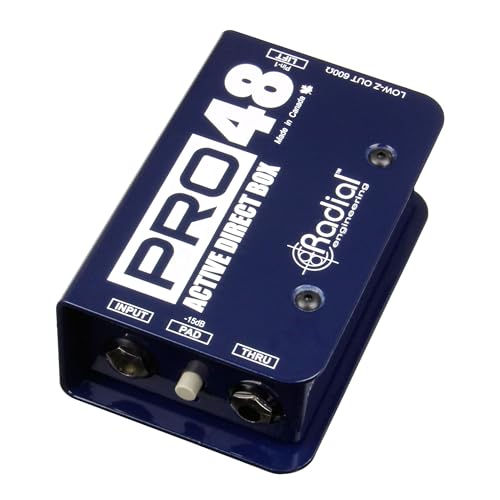
- 48V phantom-powered active design
- -15 dB pad for passive guitars and basses
- Steel enclosure with balanced XLR output
Best For: Guitarists and bassists needing a compact active DI
Hum-Free Value
Donner Special-I Passive DI Box

- Transformer isolation for hum reduction
- Ground lift and amp-through routing
- Compact plastic enclosure
Best For: Stage and studio instrument-to-PA connections
Studio Routing Flexibility
JOYO JDI-48 Active DI and Reamp

- Combines active DI and reamping
- Four useful tone and noise controls
- Rugged pedalboard-friendly metal chassis
Best For: Studios and performers needing DI plus reamping
Reliable Passive Simplicity
Radial Pro DI Passive Direct Box

- Custom-transformer passive design
- Rugged I-beam construction
- Works with multiple instrument types
Best For: Live and studio setups needing a durable passive DI
Most Flexible Power

- Three power options: phantom, battery, or USB
- Dual channels preserve stereo separation
- Ground lift and polarity reversal controls
Best For: Stereo keyboards, synths, and mobile performers
Best Simple Passive Option
Passive DI Box with Merge Function

- Requires no external power
- Ground lift helps reduce connection hum
- Attenuation switch supports level matching
Best For: Basic live sound, PA, and DJ signal balancing
Best for Hum Removal

- Removes 60Hz ground-loop hum
- Two passive channels support mono or stereo
- TRS and XLR inputs and outputs
Best For: Noisy audio systems needing ground-loop isolation
Best All-Around Compact DI Box

- Impedance matching helps preserve instrument tone
- Ground lift and isolation transformer reduce hum
- Thru and XLR outputs support flexible routing
Best For: Versatile live, studio, and sampling setups
Best Compact DI Box for Simple Setups

- Handles instruments, processors, and consumer audio sources
- Ground lift helps address buzz and hum
- Steel chassis is built for practical durability
Best For: Straightforward stage and recording connections
Best Two-Channel Compact DI Box

- Two channels handle multiple sources in one box
- Ground lift and impedance transformer support cleaner signals
- Steel chassis is designed for heavy-duty use
Best For: Dual-instrument live and recording setups
Phantom-Powered Precision – Radial Pro48 Active DI Box
The Radial Pro48 is a compact di box for guitar and bass setups that need an active, balanced output and phantom-powered operation. Its -15 dB pad helps accommodate passive instruments, while the steel enclosure is suited to regular stage or studio use.
Best For: Guitarists and bassists who want a compact active DI with phantom power and a pad.
Pros:
- 48-volt phantom-powered active design
- -15 dB pad for passive guitars and basses
- Balanced mono XLR output
- Steel enclosure with a low-noise proprietary analog circuit
Cons:
- Designed for guitar and bass rather than a broad range of listed instruments
- Requires phantom power for its active operation
The Pro48 is a straightforward choice when clean, balanced connectivity and compact construction matter more than extensive controls. Confirm that your mixer or interface supplies phantom power before buying.
Hum-Free Value – Donner Special-I Passive DI Box
The Donner Special-I is a compact di box for stage and studio signal matching. Its transformer-isolated design converts an unbalanced instrument or line signal to a balanced, low-impedance mic signal, while the ground lift helps address hum and buzz from ground loops.
Best For: Musicians seeking an affordable passive DI for guitars, basses, keyboards, and amp-through routing.
Pros:
- Passive operation with transformer isolation
- Ground lift helps reduce ground-loop hum and buzz
- Thru connection supports sending signal to an amp while feeding the PA
- Compact 7.87-by-2.76-by-2.76-inch format
Cons:
- Plastic body construction
- Does not provide the active, phantom-powered operation of an active DI
- Connector specification includes 1/4-inch TS and XLR rather than a wider set of inputs
The Special-I focuses on practical passive DI duties and ground-loop isolation. It is a sensible compact option for basic instrument-to-PA connections, especially when an amp-through output is useful.
Studio Routing Flexibility – JOYO JDI-48 Active DI and Reamp
The JOYO JDI-48 combines an active compact di box with a reamping circuit for guitar, bass, and keyboard workflows. It uses 48V phantom power, offers flexible XLR and 6.35 mm connectivity, and adds controls for low-cut filtering, signal padding, polarity, and ground lift.
Best For: Home studios, recording engineers, and performers who want DI and reamping in one compact unit.
Pros:
- Combines active DI and reamping functions
- 48V phantom-powered operation avoids disposable batteries
- 80 Hz low-cut, -15 dB pad, polarity reverse, and ground lift
- All-metal chassis sized for pedalboard use
Cons:
- More controls and routing options may be unnecessary for simple DI tasks
- Requires 48V phantom power for the active DI section
- Heavier than the other listed units at 1.02 pounds
The JDI-48 stands out when reamping and tone-shaping are part of the workflow, not just basic signal balancing. Its compact, rugged format makes it practical for both studio setups and frequent gigging.
Reliable Passive Simplicity – Radial Pro DI Passive Direct Box
The Radial Pro DI is a compact di box for passive signal conversion in live and studio systems. Its custom transformer and rugged I-beam construction suit acoustic guitars, basses, keyboards, drum machines, and professional snake or console connections.
Best For: Live and studio users who want a durable passive DI for a variety of musical instruments.
Pros:
- Passive mono design with a custom transformer
- Rugged I-beam construction
- Supports guitars, basses, keyboards, drum machines, and snake systems
- Wired XLR connectivity
Cons:
- Passive design lacks active DI features and controls
- Mono operation is intended for single-channel signal paths
- Specific listed frequency response is 18,000 Hz rather than a more detailed range
The Pro DI is a practical, durable option for users who prefer a simple passive transformer-based box. Its broad listed instrument compatibility makes it a useful fit for general live and studio inventory.
Most Flexible Power – J22 Active Stereo DI Box
For performers who need compact DI boxes with maximum setup flexibility, the Bolanle J22 combines two channels with three power options. It can run from 48V phantom power, a 9V battery, or 5V USB, making it practical for stages, rehearsals, studios, and other setups where power availability varies.
Best For: Keyboard players, synth users, and performers running stereo or dual-instrument signals.
Pros:
- Supports 48V phantom, 9V battery, and 5V USB power.
- Two channels preserve stereo separation through dual XLR outputs.
- Ground lift and polarity reversal controls help manage noise and signal phase.
- Metal housing and compact dimensions suit mobile use.
Cons:
- Batteries are not included.
- At 2.03 pounds, it is heavier than some minimalist DI options.
The J22 stands out among compact di boxes when backup power and stereo operation matter. Its flexible powering and noise-control features make it especially useful for gigging musicians who cannot rely on one fixed setup.
Best Simple Passive Option – Passive DI Box with Merge Function
This passive model is a straightforward choice among compact DI boxes for converting high-impedance, unbalanced instrument signals into low-impedance balanced XLR outputs. Its ground lift and attenuation controls address common connection and level-matching needs in live sound, PA, DJ, and monitor setups.
Best For: Musicians and live-sound users who want a power-free DI for basic signal balancing and noise reduction.
Pros:
- Passive operation requires no external power.
- Ground lift switch can reduce hum from multiple connected devices.
- Attenuation switch helps match signal levels to connected equipment.
- High-strength housing is designed for steady, long-term use.
Cons:
- Passive design does not offer the multiple powering options of an active DI.
- The supplied notes do not specify dimensions or detailed channel-output configuration.
Choose this unit when simplicity is more important than extra controls. It provides the essential passive DI functions—balancing, attenuation, and ground-lift support—in a rugged format suited to common audio-transmission applications.
Best for Hum Removal – Pyle PHE400 Hum Eliminator
If your priority is eliminating buzz rather than adding active DI features, the Pyle PHE400 is one of the compact DI boxes and signal-isolation tools to consider. Its passive two-channel design uses 1:1 isolation transformers to break ground loops while accepting mono or stereo connections through 1/4-inch TRS and XLR inputs and outputs.
Best For: Audio setups affected by 60Hz AC hum, ground loops, or noisy connections between equipment.
Pros:
- Passive operation needs no power.
- 1:1 isolation transformers help break ground loops and reduce AC hum.
- Two channels support mono or stereo connections.
- Compact, portable construction includes both TRS and XLR connectivity.
Cons:
- It is designed primarily as a hum eliminator, not a feature-rich active DI box.
- The listed dimensions are larger than the product’s mini-style name may suggest.
The PHE400 is a focused solution for unwanted AC buzz. Its transformer isolation and dual-channel layout make it a practical choice when a clean connection is more important than battery power or advanced signal controls.
Best All-Around Compact DI Box – PRORECK DC21
The PRORECK DC21 is a practical choice when you need a compact DI box for connecting instruments to mixers, PA systems, or amplifiers. Its passive design combines impedance matching, ground isolation, dual outputs, and broad device compatibility for live performance and studio use.
Best For: Guitarists, bassists, keyboard players, and home or live setups needing flexible signal routing and hum reduction.
Pros:
- Impedance transformer is designed to preserve high-frequency detail and reduce tone loss.
- Ground lift and isolation transformer help address hum and buzz from ground loops.
- Thru and XLR outputs support simultaneous amplifier monitoring and mixer or PA connection.
- Works with instruments, effect processors, submixers, and consumer stereo sources.
Cons:
- Its passive design may not suit setups specifically requiring an active DI box.
- The supplied dimensions and weight may still take up some pedalboard or equipment-bag space.
With useful routing options and noise-control features in a small enclosure, the DC21 is a versatile compact DI box for musicians who need one unit to cover stage, recording, and basic sampling duties.
Best Compact DI Box for Simple Setups – Pyle PDC21
The Pyle PDC21 is a compact DI box for routing unbalanced signals from guitars, basses, keyboards, effect processors, and consumer audio sources into a PA or recording mixer. It adds ground-lift-based hum cancellation and uses an all-steel chassis for practical stage use.
Best For: Musicians and recording users who want a straightforward passive DI unit with broad source compatibility and a durable enclosure.
Pros:
- Supports guitars, basses, keyboards, outboard processors, submixers, and consumer stereo sources.
- Ground lift and impedance transformation help provide cleaner connections to PA and recording equipment.
- All-steel construction is suited to regular handling and live-use environments.
- Can power up to 10 effects pedals, according to the supplied product notes.
Cons:
- The supplied notes do not specify dual-channel operation.
- Its feature set is focused on basic DI and hum-elimination duties rather than advanced routing.
The PDC21 keeps the essentials focused: connect common instruments or line sources, reduce unwanted hum, and send a usable signal to the main audio system. It is a sensible compact DI box for uncomplicated rigs.
Best Two-Channel Compact DI Box – PYLE-PRO PDC22
The PYLE-PRO PDC22 is a two-channel compact DI box designed for connecting instruments, effects processors, keyboards, and other unbalanced sources to PA or recording equipment. It includes impedance transformation, hum cancellation, a detachable AC power cord, and a steel chassis.
Best For: Performers and recording setups that need two DI channels in one enclosure for multiple instruments or signal sources.
Pros:
- Two channels provide more connection capacity than a single-channel unit.
- Supports guitars, basses, keyboards, outboard processors, submixers, and consumer stereo outputs.
- Ground-lift functionality and impedance transformation help address hum while adapting signals.
- Steel construction is intended for long-term, heavy-duty use.
Cons:
- At 1.12 pounds, it is heavier than the smaller single-channel options listed here.
- The larger 4.72 x 5.5 x 1.57-inch footprint may be less convenient for very tight setups.
- The supplied notes do not detail the individual channel controls or output layout.
If you need two channels without carrying separate boxes, the PDC22 offers useful capacity in a steel enclosure. Its larger size and weight are the tradeoffs for a two-channel compact DI box.
How We Picked These Compact Di Boxes
We focused on Compact Di Boxes that address common needs in live performance, rehearsal, home recording, and small-format production. The selection includes passive models for simple, rugged setups and active models that can accommodate instruments with lower-output pickups or require phantom power.
We also considered useful details such as balanced XLR outputs, 1/4-inch inputs, ground-lift switches, input attenuation, stereo operation, reamping support, and alternate power methods. Because specifications and included accessories can vary by seller, confirm the current listing before buying.
Quick Comparison
| Best For | Look For | Typical Advantage |
|---|---|---|
| Passive guitar or bass setup | Transformer isolation, ground lift | Simple operation and no battery required |
| Active or acoustic instruments | Phantom power, battery, or USB power | More input flexibility and gain support |
| Stereo keyboards and playback devices | Dual-channel inputs and outputs | Preserves left/right routing |
| Noise troubleshooting | Ground lift and isolation | Can reduce hum and ground-loop noise |
| Reamping workflows | Dedicated reamp function | Helps send recorded tracks back to amplifiers |
Key Buying Factors for Compact Di Boxes
Active Vs. Passive Design
Passive DI boxes are usually the easiest choice for powered mixers, basses, electric guitars, and situations where rugged simplicity matters. Active units can provide better compatibility with passive pickups and may offer more headroom or input options, but they generally need phantom power, a battery, USB power, or an external supply.
Connections and Channel Count
Check whether you need one channel or two. A mono instrument typically needs a single 1/4-inch input and balanced XLR output. Keyboards, drum machines, phones, and mixers may require a stereo DI with separate left and right channels. Also verify whether the box provides the exact XLR, 1/4-inch, or pass-through connections your rig uses.
Noise Control and Signal Handling
A ground-lift switch can help address hum caused by differences between connected AC-powered devices, though it is not a cure for every noise problem. Input attenuation is valuable when connecting hot outputs, while impedance and frequency-response specifications can help determine whether a model suits a particular pickup or source.
Portability and Durability
Compact dimensions are useful on crowded pedalboards and small stages, but the enclosure, switches, jacks, and strain relief still matter. Choose a design that can withstand regular transport and has controls that are easy to access without being accidentally changed.
Who Should Buy Which Compact Di Boxes?
Choose a passive model if you want a straightforward DI for guitar, bass, or occasional live use with minimal setup. An active model is a better match for passive acoustic pickups, quieter sources, or rigs where phantom, battery, or USB power is readily available. Pick a dual-channel unit for stereo keyboards and playback gear, and prioritize dedicated reamping capability if you record guitar or bass tracks and plan to send them back through an amplifier.
Finally, match the DI to the rest of your signal chain rather than choosing by size alone. A ground lift, attenuation pad, or stereo output can be more valuable than extra features you will never use.