The best studio monitors with room correction help you hear your mix more consistently, even when your room adds unwanted bass, reflections, or tonal color. The right setup can make monitoring more predictable without requiring a professionally treated control room.
This roundup covers active nearfield monitors, compact reference speakers, and dedicated correction hardware for home studios, project rooms, and professional mixing environments.
Best 10 Studio Monitors with Room Correction Picks for 2026
Best Overall
IK Multimedia iLoud Precision 5 MKII

- Built-in ARC calibration with measurement microphone
- Linear-phase response and extended low end
- ARC X monitor emulation and target curves
Best For: Mixing, mastering, and calibrated immersive-audio setups
Best Versatile Value

- App-based room compensation and nine-band EQ
- 80W RMS bi-amped DSP design
- XLR, TRS, RCA, AUX, and Bluetooth inputs
Best For: Desktop studios and hybrid music-listening setups
Best Add-On System

- Includes calibration software and measurement microphone
- Stand-alone processor corrects frequency imbalances
- Adds monitor emulation to existing setups
Best For: Studios upgrading existing monitors with dedicated correction
Best Large Nearfield
KRK RP7G5 7-Inch Powered Monitor
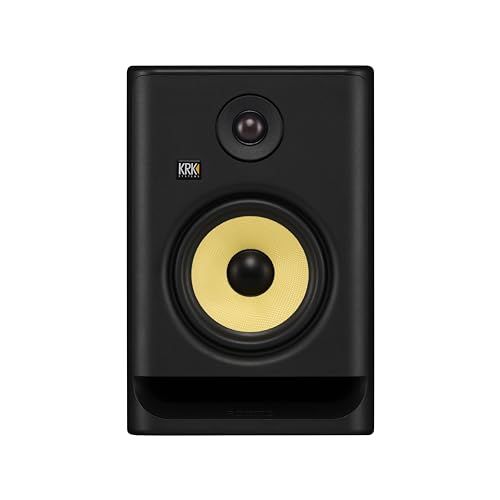
- 25 boundary and tuning EQ combinations
- 7-inch Kevlar woofer for low-frequency detail
- Low-diffraction baffle and isolation pads
Best For: Project studios needing larger nearfield monitors and flexible tuning
Versatile Room Tuning

- 3-way active design with 110W RMS amplification
- App and rear controls for acoustic adjustment
- XLR, TRS, RCA, AUX, Bluetooth, and headphone output
Best For: Home studios and flexible desktop or near-field setups
Portable DSP Correction

- App-based acoustic correction EQ
- 90W RMS bi-amped compact monitor system
- USB, Bluetooth, RCA, AUX, and instrument connectivity
Best For: Mobile production, streaming, and compact workstations
Wide Sweet Spot Tuning

- 6.55-inch woofer with 1.25-inch silk-dome tweeter
- EBM waveguide creates a broad listening sweet spot
- Physical acoustic controls include HPF, trims, and Acoustic Space
Best For: Mixing rooms needing broad coverage and deeper low end
Balanced Boundary Control

- Boundary EQ, LF trim, and HF trim
- 8-inch woofer with 100W output
- XLR, TRS, and RCA inputs
Best For: Large near-field mixing setups and flexible room placement
Automatic Room Tuning
IK Multimedia iLoud Micro Monitor Pro

- Built-in ARC calibration with microphone
- Compact pair with integrated stands
- 42 Hz bass extension and 95 dB SPL
Best For: Small rooms, desktop setups, and portable production
App-Based Sound Adjustment
Edifier MR3 Powered Studio Monitor

- ConneX app with customizable EQ
- Monitor, Music, and Custom modes
- TRS, RCA, AUX, and Bluetooth connectivity
Best For: Desktop home studios and flexible everyday listening
Best Overall – IK Multimedia iLoud Precision 5 MKII
The IK Multimedia iLoud Precision 5 MKII is a strong choice for anyone seeking studio monitors with room correction built in. Its ARC calibration, linear-phase processing, extended low end, and virtual monitor emulation are designed to improve monitoring accuracy in home, professional, and immersive-audio setups.
Best For: Mixing, mastering, and creators who want integrated calibration plus monitor emulation.
Pros:
- Built-in ARC room correction uses the included measurement microphone.
- Linear-phase and time-coherent response supports detailed, accurate monitoring.
- ARC X provides calibration profiles, target curves, and more than 20 monitor emulations.
- 135W Class-D amplification and mounting points suit modern studio workflows.
Cons:
- Its professional feature set may be more than needed for casual listening.
- It uses corded power and XLR connectivity rather than wireless operation.
Choose the Precision 5 MKII when room correction and dependable mix translation are priorities. It offers a particularly complete package for users who want calibration and virtual monitoring without adding a separate correction system.
Best Versatile Value – Edifier MR4.5 Studio Monitor
The Edifier MR4.5 combines room-compensation controls with flexible connectivity, making it a practical option among studio monitors with room correction. Its bi-amped design, DSP processing, app-based EQ, Bluetooth, and compact cabinet suit desktops, home studios, and mixed listening setups.
Best For: Desktop producers and listeners who need room adjustment, multiple inputs, and wireless playback.
Pros:
- Edifier ConneX provides acoustic compensation and nine-band EQ customization.
- Low cutoff, acoustic-space, and desktop controls help address placement-related bass buildup.
- 80W RMS bi-amped output with 4.5-inch woofers and silk-dome tweeters.
- Offers XLR, TRS, RCA, AUX, headphone, and Bluetooth 6.0 connectivity.
Cons:
- The 4.5-inch drivers provide less low-frequency scale than larger monitors.
- Its broad home-listening feature set may not appeal to users seeking a strictly traditional monitor.
The MR4.5 is a flexible pick for smaller workspaces where placement controls matter. It is especially appealing if you want room compensation and studio connections without giving up convenient Bluetooth streaming.
Best Add-On System – IK Multimedia ARC Studio
The IK Multimedia ARC Studio is a dedicated solution for listeners who already own monitors but need studio monitors with room correction capabilities. It combines a measurement microphone, calibration software, and a stand-alone correction processor to address frequency imbalances and improve stereo imaging.
Best For: Home and professional studios adding room correction to an existing monitor setup.
Pros:
- Includes measurement microphone, correction software, and stand-alone processor.
- Designed to correct frequency imbalances and improve stereo imaging.
- Works with a wide range of studio setups and audio interfaces.
- Includes monitor emulation for referencing different tonal profiles.
Cons:
- It is an additional system rather than a pair of monitors.
- It requires compatible external monitors and studio connections.
ARC Studio makes sense when replacing speakers is unnecessary or undesirable. Its dedicated processor and calibration workflow can extend the usefulness of an existing monitoring chain while keeping correction separate from the monitors.
Best Large Nearfield – KRK RP7G5 7-Inch Powered Monitor
The KRK RP7G5 is a 7-inch powered monitor with extensive boundary and tuning controls, making it a useful option for studio monitors with room correction-style adjustment. Its 25 EQ combinations, woven Kevlar woofer, low-diffraction baffle, and isolation pads help users adapt placement and refine monitoring in project studios.
Best For: Music production, editing, and sound design where a larger woofer and placement controls are useful.
Pros:
- Provides 25 boundary and tuning EQ combinations for acoustic adjustment.
- 7-inch woven Kevlar woofer supports tight low and low-mid performance.
- Low-diffraction baffle is designed to improve stereo imaging and reduce distortion.
- Includes acoustic foam wedge isolation pads and XLR/TRS combo input.
Cons:
- Its larger cabinet and 7-inch driver may require more placement space.
- Room adjustment is based on onboard tuning combinations rather than microphone-based automatic calibration.
The RP7G5 is a sensible choice for producers who want more low-frequency authority and practical acoustic tuning. It suits project studios that can accommodate a larger nearfield monitor and prefer straightforward onboard controls.
Versatile Room Tuning – Edifier MR5
The Edifier MR5 is a flexible choice for anyone shopping for studio monitors with room correction. Its rear controls and EDIFIER ConneX app provide high- and low-frequency adjustment, low cut-off, desktop control, and acoustic-space presets, while the 3-way design supports detailed near-field listening.
Best For: Home studios, desktop setups, and listeners who want broad connectivity plus app-based room compensation.
Pros:
- 3-way active design with a 5-inch woofer, 3.75-inch mid driver, and 1-inch silk dome tweeter.
- Room-tuning controls include physical rear knobs and app-based acoustic compensation.
- Offers XLR, TRS, RCA, AUX, Bluetooth 6.0, LDAC, and a front headphone output.
- 110W RMS amplification and MDF cabinets suit near-field use or mid-sized rooms.
Cons:
- Its larger, heavier cabinet may be less suitable for very compact desks.
- It is corded and not water resistant.
The MR5 stands out when room adjustment and connection flexibility matter as much as sound. It is a particularly practical option for a mixed studio and home-listening system.
Portable DSP Correction – NUX AXON 3
The NUX AXON 3 brings advanced DSP and acoustic correction EQ through an app to a compact monitor system. Its 90W bi-amped design, adjustable magnetic footpads, and stand-mounting socket make it useful when you need studio monitors with room correction in a portable or space-conscious setup.
Best For: Mobile producers, streamers, video editors, and compact workstations that need flexible placement.
Pros:
- App-based acoustic correction EQ supports tailored monitoring.
- Four Class-D amplifiers deliver 90W RMS across the monitor system.
- USB DAC, Bluetooth, 1/4-inch stereo, RCA, and 1/8-inch AUX inputs cover varied sources.
- Magnetic footpads offer +9° and -5° tilt, and a 3/8-inch socket supports stand mounting.
Cons:
- Its 3-inch woofers reach down to 55Hz, so it may not suit bass-heavy work without additional low-end support.
- The compact design prioritizes portability over larger-driver room-filling output.
The AXON 3 is a strong fit when portability and positioning flexibility are central requirements. Its DSP-based app correction adds useful control without requiring a larger monitor cabinet.
Wide Sweet Spot Tuning – PreSonus Eris E7 XT
PreSonus Eris E7 XT 2-Way Active Studio Monitor with EBM Waveguide (Pack of 1)
Check Price On AmazonThe PreSonus Eris E7 XT is a larger two-way monitor with acoustic controls for adapting its response to your room. Its EBM waveguide creates a wide horizontal sweet spot, while level, high-pass, low-frequency, high-frequency, and acoustic-space controls make it a practical candidate among studio monitors with room correction.
Best For: Mixing setups that need a wide listening area, deeper low-frequency output, and conventional studio connections.
Pros:
- 6.55-inch woven composite woofer provides deeper low-frequency performance.
- 100° horizontal by 60° vertical EBM waveguide supports broad imaging and a wide sweet spot.
- Acoustic tuning includes level, HPF, LF Trim, HF Trim, and Acoustic Space controls.
- XLR, TRS, and RCA inputs provide standard studio connectivity.
Cons:
- It is sold as a single monitor, so a stereo setup requires two units.
- The larger cabinet may require more desk or stand space than compact monitors.
- The supplied tuning is hardware-based rather than app-based.
The Eris E7 XT is well suited to a more traditional mixing environment where broad coverage and physical acoustic controls are priorities. Its larger driver also makes it a better match for listeners seeking more substantial low-end reach.
Balanced Boundary Control – Kali Audio LP-8 V2
The Kali Audio LP-8 V2 is a strong option for producers seeking studio monitors with room correction features. Its rear-panel boundary compensation EQ, LF and HF trim controls help you adapt the monitor to its placement, while the 8-inch woofer delivers extended, clean bass for mixing and recording.
Best For: Home studios, mixing, recording, and users who need flexible placement controls.
Pros:
- Boundary compensation EQ helps account for room and placement effects.
- 8-inch woofer and 1-inch soft-dome tweeter provide a powerful 100-watt system.
- Offers XLR, TRS, and RCA inputs for versatile connectivity.
- Port design supports deep bass with reduced turbulence noise.
Cons:
- Its 8-inch cabinet and 23.2-pound weight require more desk or stand space.
- Sold as a single monitor, so a stereo setup requires two units.
Choose the LP-8 V2 when you want substantial low-end output and practical onboard adjustment rather than a compact desktop monitor. Its boundary EQ is useful for tailoring the speaker to its position, though it does not include automatic microphone-based calibration.
Automatic Room Tuning – IK Multimedia iLoud Micro Monitor Pro
The IK Multimedia iLoud Micro Monitor Pro is designed for listeners who want compact studio monitors with room correction. Built-in ARC calibration uses the included microphone to tune the pair to the room, while the portable design makes it practical for smaller workspaces and mobile production.
Best For: Compact home studios, mobile producers, and anyone wanting automatic calibration in a small monitor pair.
Pros:
- Built-in ARC calibration automatically tunes the monitors to the room.
- Included calibration microphone simplifies setup.
- Compact, lightweight pair with integrated stands for portable use.
- Reaches down to 42 Hz and produces up to 95 dB maximum SPL.
Cons:
- 3-inch drivers cannot provide the same physical scale as larger studio monitors.
- Its compact output may be less suitable for high-volume monitoring.
This is the most direct match for users specifically prioritizing automatic room correction in a portable format. It trades large-speaker impact for convenience, accurate reference sound, and calibration that can help compensate for different listening spaces.
App-Based Sound Adjustment – Edifier MR3 Powered Studio Monitor
The Edifier MR3 suits buyers looking for approachable studio monitors with room correction-style adjustment. Its EDIFIER ConneX app provides customizable EQ control, while Monitor, Music, and Custom modes let you adapt the sound for production, editing, or everyday listening.
Best For: Desktop home studios, multimedia work, and users who want app-controlled EQ with Bluetooth convenience.
Pros:
- ConneX app offers detailed EQ adjustments and personalized sound control.
- Monitor, Music, and Custom modes support different listening tasks.
- Balanced TRS, RCA, AUX, Bluetooth, and headphone connections provide flexibility.
- Hi-Res Audio certification and a stated 52 Hz–40 kHz flat response support detailed listening.
Cons:
- It provides app-based EQ rather than automatic microphone-based room calibration.
- 18W-per-channel RMS output and 3.5-inch mid-low drivers are aimed at smaller near-field spaces.
The MR3 is a versatile choice when you want monitoring functions alongside Bluetooth and everyday playback. Its app-based customization can help tailor the sound, but buyers seeking automatic room measurement should consider a model with dedicated calibration hardware.
How We Picked the Best Studio Monitors with Room Correction
We focused on monitor systems and correction tools that can improve monitoring accuracy in real-world rooms. Our selection considers frequency response, onboard DSP or software correction, calibration flexibility, amplifier design, connectivity, placement options, and the practical needs of producers, engineers, and content creators.
Because room correction may be built into the speaker or provided by a separate system, these products are not identical substitutes. Some prioritize compact size and portability, while others offer larger woofers, higher output, or more detailed calibration controls.
Quick Comparison
| Best For | What to Prioritize | Typical Choice |
|---|---|---|
| Small home studios | Compact cabinet, controlled bass, flexible placement | 5-inch or micro monitors |
| Mixing and mastering | Neutral response, calibration accuracy, low distortion | DSP-enabled monitors or a dedicated correction system |
| Large rooms and extended bass | Higher headroom, larger woofer, boundary controls | 7- or 8-inch monitors |
| Portable setups | Low weight, simple connections, reliable translation | Compact active monitor pair |
Key Buying Factors for Studio Monitors with Room Correction
Correction Method
Onboard DSP is convenient and keeps calibration close to the speaker, while software and measurement-microphone systems can work with a wider range of monitors. Check whether calibration is automatic, manually adjustable, or dependent on a computer or playback device.
Room Size and Woofer Size
A larger woofer does not automatically mean better monitoring. In a small untreated room, an 8-inch monitor may excite problematic low-frequency modes. Five- to seven-inch models are often easier to place, while larger speakers make more sense when the room and listening distance support them.
Placement and Acoustic Treatment
Room correction cannot eliminate every reflection or null. Place monitors symmetrically, form an equilateral listening triangle, keep tweeters near ear height, and use boundary controls when speakers sit close to walls. Bass trapping and absorption remain valuable additions.
Connections, Output, and Workflow
Confirm that the inputs match your interface or monitor controller. Balanced connections are preferable for longer runs and quieter systems. Also consider maximum SPL, standby behavior, mounting options, and whether the calibration process fits your regular workflow.
Who Should Buy Which Studio Monitors with Room Correction?
Choose compact monitors if you work in a bedroom, editing suite, or portable rig and need dependable nearfield detail without overwhelming the room.
Choose larger 7- or 8-inch monitors if you have adequate listening distance, more space, and a need for stronger low-frequency extension and headroom.
Choose a dedicated correction system if you already own monitors you like or want calibration that can be applied independently of a speaker upgrade.
Choose DSP-equipped monitors if you want an integrated setup with fewer external components. Regardless of the category, use correction as the final refinement—not a replacement for sensible placement, acoustic treatment, and careful reference listening.