Choosing one of the best wireless in-ear monitor systems for home studios can make tracking, rehearsing, and content creation feel far more controlled. The right setup helps you hear a cleaner mix, reduce room bleed, and move around without being tied to a cable.
Below, we focus on practical options that balance sound, latency, range, and everyday usability for home studio workflows.
Best 10 Wireless in Ear Monitor Systems for Home Studios Picks for 2026
Pro Pick

- 5.8 GHz true diversity wireless link
- Channel Scan Mode helps find a cleaner frequency
- 24-bit/48kHz audio with USB-C charging
Best For: Home studio musicians who want a reliable, portable IEM system
Stage-Ready Stereo

- True stereo and mono monitoring modes
- 900MHz band with tunable frequencies
- EQ, balance, limiter, and lock controls
Best For: Users who want rack-friendly stereo monitoring with more onboard control
Portable Long-Run

- Up to 30 hours with the charging case
- Auto-pairing plus OTG support
- One transmitter can feed multiple receivers
Best For: Home studio users who value long battery life and simple setup
Compact Rack-Free
- Compact design for quick setup and transport
- 24-bit/48kHz digital audio path
- UHF 900MHz hopping with stereo support
Best For: Compact home studio monitoring with stereo flexibility
Stability-Focused Pick
5.8GHz Stereo IEM for Cleaner Monitoring

- 5.8GHz wireless helps avoid crowded 2.4GHz interference
- 48kHz/24-bit stereo audio with under-5ms latency
- Auto-pairing supports multiple receivers
Best For: Home studio users who want stable wireless monitoring with low delay and stereo detail
Noise-Isolating Pick
UHF Metal IEM with Included Earphones

- UHF design aims to resist wireless interference
- 16 channels help avoid frequency conflicts
- Includes earphones with 33dB passive noise cancellation
Best For: Home studio monitoring when you want UHF stability, passive isolation, and included earphones
Budget-Friendly Multi-Receiver Pick

- Under-4.5ms mono latency with 24-bit/48kHz audio
- One transmitter can feed up to 4 receiver pairs
- 6-8 hours of battery life with LED indicators
Best For: Small home studios, rehearsals, and multi-performer practice sessions
Runner-Up

- 100 ft wireless range
- Under 5 ms latency
- 10-12 hour battery life
Best For: Home studio users who want an easy stereo IEM setup with channel scanning
Easy Setup Pick
LEKATO MS-1 Wireless IEM System
- Auto-pairing setup
- Up to 6 receivers
- 100 ft open-area range
Best For: Users who want simple one-to-many wireless monitoring in a home studio
Premium 5.8G Pick
- 5.8G anti-interference transmission
- Up to 12 hours battery life
- Auto-sync pairing and onboard volume
Best For: Home studio users who want cleaner 5.8G monitoring with easy plug-and-play setup
Pro Pick – Xvive U45 5.8GHz IEM
If you want wireless in ear monitor systems for home studios that also hold up for rehearsals or live use, the Xvive U45 is built around a stable 5.8 GHz link and simple channel scanning. It delivers a clean monitoring path with low latency, clear 24-bit/48kHz audio, and a compact transmitter/receiver setup that is easy to keep moving between studio and stage.
Best For: Home studio players and performers who want a reliable, low-latency IEM setup with quick channel selection.
Pros:
- 5.8 GHz true diversity wireless connection helps reduce interference from other devices.
- Channel Scan Mode makes it easier to find a cleaner channel before use.
- 20Hz–20kHz response and 24-bit/48kHz audio support detailed monitoring.
- USB-C charging with up to 5 hours of battery life and fast top-up capability.
Cons:
- Battery life is shorter than some longer-run competing systems.
- Manual transmitter channel matching is required after scanning.
- Includes one receiver, so it is not a multi-listener bundle.
This is a straightforward choice if your priority is dependable wireless monitoring with clear audio and minimal setup fuss. For a home studio that occasionally doubles as a rehearsal space, the U45 balances portability and practical performance well.
Stage-Ready Stereo – Phenyx Pro PTM-10 UHF IEM
For wireless in ear monitor systems for home studios that need more control and a more traditional rack-friendly design, the Phenyx Pro PTM-10 stands out with true stereo monitoring and a wide 900MHz UHF platform. It is geared toward users who want flexible monitoring tools, stable coverage, and a more full-featured transmitter for studio, stage, or spoken-word applications.
Best For: Studio users and performers who want stereo monitoring, rack mounting, and detailed control features.
Pros:
- True stereo and mono modes let you choose between spatial detail and focused monitoring.
- 900MHz operation with tunable frequencies is designed to reduce congestion and dropouts.
- Up to 160 ft. range gives solid movement freedom for rehearsals and stage use.
- EQ, balance, limiter, pad, and lock functions add useful control over the monitor mix.
Cons:
- Bulkier than compact portable systems because it is rack-oriented.
- Uses AA batteries in the receiver rather than a built-in rechargeable design.
- May be more system than needed for very simple home studio setups.
The PTM-10 makes sense if you value flexibility and want a more traditional pro-audio feature set. It is especially appealing for users who may move between a home studio, worship setup, or small live venue.
Portable Long-Run – LEKATO MS-20 Wireless IEM
If battery life is your top priority in wireless in ear monitor systems for home studios, the LEKATO MS-20 is built for long sessions and simple everyday use. Its rechargeable case, auto-pairing design, and 2.4GHz wireless link make it convenient for practice, recording, and casual monitoring without needing a complicated setup.
Best For: Home studio musicians who want long battery life, easy pairing, and multi-receiver flexibility.
Pros:
- Up to 30 hours of usage with the charging case helps support longer sessions.
- Auto-pairing and OTG support simplify connection to phones and USB-C devices.
- One transmitter can send to multiple receivers, with support for up to 10 pairs.
- 150 ft. range and low noise/latency are useful for practice and recording.
Cons:
- Earphones are not included, so you must supply your own.
- 2.4GHz systems can be less ideal than higher-band options in crowded wireless environments.
- Plastic construction is less premium than some metal-based systems.
The MS-20 is a practical pick if you want a lightweight, rechargeable monitoring system that is easy to bring into a home studio workflow. It favors convenience and runtime over pro-style rack features.
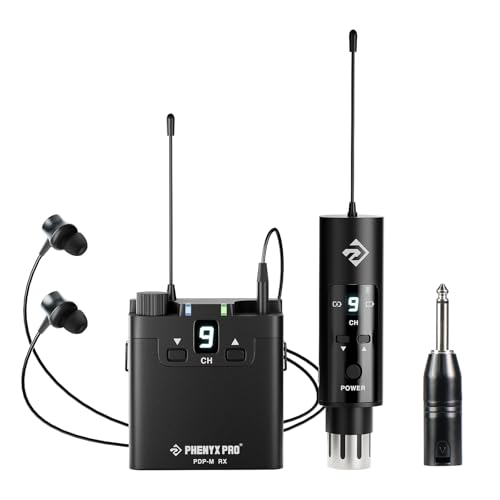
Compact Rack-Free – Phenyx Pro PDP-M IEM
The Phenyx Pro PDP-M is aimed at users who want wireless in ear monitor systems for home studios without a bulky rack setup. It combines compact hardware, flexible mono/stereo monitoring, and a 24-bit/48kHz digital path, making it a practical option for small studios, rehearsals, and portable live use.
Best For: Musicians and home studio users who want a compact, easy-to-carry IEM system with stereo support.
Pros:
- Compact design is easy to pack, carry, and set up quickly.
- 24-bit/48kHz digital audio helps deliver a cleaner monitor feed.
- UHF 900MHz frequency-hopping and 30mW power are aimed at better stability.
- Includes useful adapters and a storage pouch for easier everyday handling.
Cons:
- Rated for up to 4 hours of use, which is shorter than some alternatives.
- Only 16 selectable frequencies, so it is less flexible than more frequency-dense systems.
- Sold as a compact kit, so it may not suit users wanting a full rack-style installation.
This model is a strong fit if you want a portable monitor system that keeps setup simple while still offering stereo capability. It is a sensible middle ground between basic entry-level gear and more complex pro racks.
Stability-Focused Pick – 5.8GHz Stereo IEM for Cleaner Monitoring
If you want wireless in ear monitor systems for home studios that prioritize a clean signal, this 5.8GHz option is built to help reduce the congestion you often see on 2.4GHz gear. It pairs high-resolution 48kHz/24-bit stereo audio with ultra-low latency under 5ms, making it a practical choice for recording, rehearsal, and live-style monitoring at home.
Best For: Home studio users who want stable wireless monitoring with low delay and stereo detail.
Pros:
- 5.8GHz transmission is designed to be cleaner and more interference-resistant than crowded 2.4GHz systems.
- 48kHz/24-bit stereo audio helps preserve detail for vocals and instruments.
- Ultra-low latency below 5ms supports tighter real-time monitoring.
- Auto-pairing makes it easier to share one transmitter with multiple receivers.
Cons:
- Battery life is listed at over 5 hours, so longer sessions may require charging.
- 100ft range is suitable for studios and rehearsals, but not especially long-distance.
- Positioned as a stage system, so some users may find the feature set more than they need for simple home use.
This is a strong fit if your priority is dependable wireless monitoring with minimal delay and a straightforward multi-receiver setup. The 5.8GHz band and stereo audio make it especially appealing for musicians who want a more polished home studio IEM experience.
Noise-Isolating Pick – UHF Metal IEM with Included Earphones
For wireless in ear monitor systems for home studios where signal stability and comfort matter, this UHF model offers a practical monitoring setup with built-in noise reduction and included earphones. The 16 adjustable channels help you move away from interference, while the rechargeable transmitter and bodypack make it easy to keep the system portable for studio work or practice sessions.
Best For: Home studio monitoring when you want UHF stability, passive isolation, and included earphones.
Pros:
- UHF connectivity is designed to resist interference from other wireless devices.
- 16 adjustable channels give you more flexibility if nearby gear shares the same frequency space.
- Included earphones and 33dB passive noise cancellation add convenience and isolation.
- Rechargeable transmitter and bodypack are compact and rated for about 5 hours of use.
Cons:
- Battery life is moderate at around 5 hours, so extended sessions may need recharging.
- Frequency changes are manual, which adds a bit of setup if interference appears.
- The package is geared toward one complete setup, not a larger multi-receiver system.
This model makes sense if you want a self-contained IEM kit with practical isolation and channel flexibility. It is especially useful for home studio users who value a simple, ready-to-monitor setup without needing to source earphones separately.
Budget-Friendly Multi-Receiver Pick – LEKATO MS-02 2.4G IEM
If you are comparing wireless in ear monitor systems for home studios and want a compact setup for practice or tracking, the LEKATO MS-02 focuses on low latency, multi-receiver use, and simple operation. Its upgraded 2.4GHz stereo transmission, 24-bit/48kHz audio, and one-to-many pairing make it a flexible option for small sessions, especially when you need to monitor multiple performers.
Best For: Small home studios, rehearsals, and multi-performer practice sessions.
Pros:
- Upgraded latency is rated below 4.5ms in mono mode for responsive monitoring.
- Supports one transmitter to multiple receivers, up to 4 pairs of devices.
- 6-8 hours of battery life gives it more endurance than some compact systems.
- LED battery and volume indicators plus one-key mute make it easy to manage during sessions.
Cons:
- Earbuds are not included, so you will need to buy those separately.
- The range is 100ft in open areas, which is practical but not exceptional.
- 2.4GHz systems can be more crowded than higher-frequency alternatives.
This is a solid pick if you want a compact, easy-to-use monitoring system with multiple receiver support for home studio work. It is especially appealing when you need a lightweight setup for recording, practice, or education without a complicated configuration.
Runner-Up – MX3 2.4GHz Stereo IEM System
If you want wireless in ear monitor systems for home studios that can also handle rehearsal or small live use, the MX3 is built around a simple 2.4GHz stereo setup with quick channel scanning. It offers a 100 ft reception range, low latency, and a 20Hz-20KHz response, so it fits practice spaces where clean monitoring matters more than fancy extras.
Best For: Home studio musicians who want a portable stereo IEM system with easy channel scanning and long battery life.
Pros:
- 6-channel operation with zero cross-interference support
- Under 5 ms latency and up to 107 dB signal-to-noise ratio
- 10-12 hours of battery life on a full charge
- Includes transmitter, receiver, charging cable, and adapters
Cons:
- Uses 2.4GHz, which may be less ideal in crowded wireless environments
- Channel setup requires matching transmitter and receiver after scan
Overall, the MX3 is a practical pick if you want a straightforward monitoring solution with strong battery life and a compact kit. Its channel scan mode is especially useful for users who do not want to spend time hunting for a clean frequency.
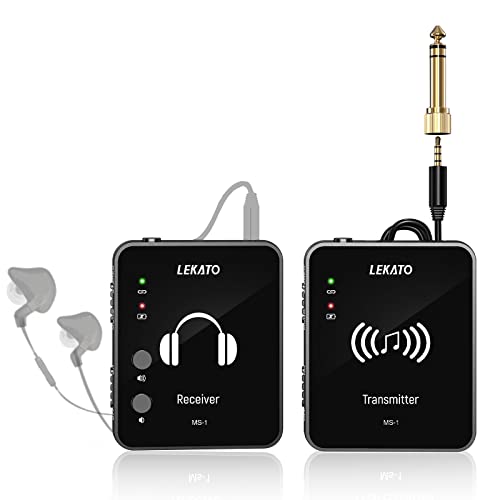
Easy Setup Pick – LEKATO MS-1 Wireless IEM System
The LEKATO MS-1 is a strong option among wireless in ear monitor systems for home studios if you value quick setup and simple stereo monitoring. It supports one transmitter to many receivers, auto-pairing, and a 100 ft open-area range, making it well suited to practice rooms, small studio sessions, and casual band monitoring.
Best For: Home studio players who want an auto-pairing wireless IEM system that can share one transmitter with multiple receivers.
Pros:
- Auto-pairing makes setup fast and simple
- Supports up to 6 receivers with one transmitter
- True stereo transmission with mono/stereo switching
- Low-latency 2.4GHz operation with 24-bit/48kbps audio
Cons:
- Battery life is more limited than some alternatives at over 5 hours
- Open-area range is best suited to small and medium spaces
For home studio use, the MS-1 stands out because it removes much of the setup friction. If you want a dependable monitoring system for practice or recording without a complicated learning curve, this one keeps things simple.
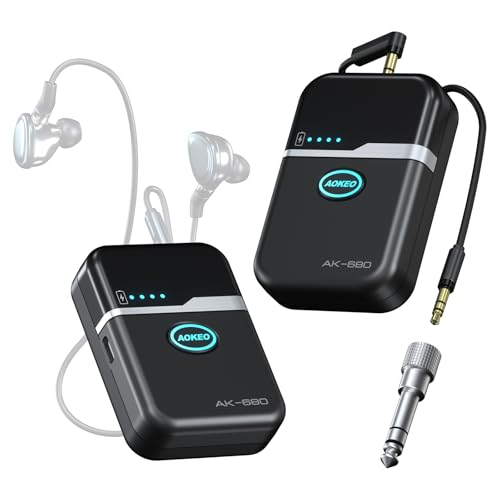
Premium 5.8G Pick – AOKEO AK-680 Stereo IEM
If you’re comparing wireless in ear monitor systems for home studios, the AOKEO AK-680 stands out for its 5.8G transmission and ultra-low latency design. It is aimed at users who want a cleaner signal path, with automatic pairing, built-in receiver volume control, and support for mixers, audio interfaces, laptops, and other standard audio gear.
Best For: Home studio musicians who want a cleaner 5.8G wireless monitor system with simple plug-and-play operation.
Pros:
- 5.8G band is positioned as cleaner than crowded 2.4GHz systems
- Up to 12 hours of battery life
- Automatic pairing for quick setup
- Receiver has onboard volume controls and a clip-on design
Cons:
- Uses a different wireless band than the more common 2.4GHz options
- Focuses on monitoring rather than multi-receiver expansion details
The AK-680 is a solid fit if you want a more polished monitoring experience for recording or home practice. Its combination of longer battery life, easy pairing, and broad gear compatibility makes it especially convenient in a studio workflow.
How We Picked the Best Wireless in Ear Monitor Systems for Home Studios
For wireless in-ear monitor systems for home studios, we prioritized low-latency performance, stable wireless links, sensible range for typical rooms, and features that make setup easier for solo creators and small teams. We also looked at battery life, charging convenience, channel flexibility, and whether the system is compact enough for desktop use or portable recording.
Quick Comparison
At a high level, 2.4GHz models tend to be easy to set up and convenient for short-range use, while UHF and 5.8GHz systems may offer different tradeoffs in interference handling, channel selection, and working distance. If you mainly record in one room, simplicity and latency matter most. If you share gear or work in busier RF environments, more flexible frequency control can be useful.
Key Buying Factors for Wireless In-Ear Monitor Systems for Home Studios
Latency and Monitoring Feel
Latency is the first spec to check. In a home studio, even modest delay can make overdubbing or live vocals distracting. Look for systems designed for low-latency monitoring so timing feels natural.
Wireless Band and Interference
2.4GHz is common and convenient, but it can compete with Wi-Fi and Bluetooth-heavy environments. UHF and 5.8GHz systems may be better depending on your room layout and nearby wireless traffic. Choose the band that best fits your space and device crowding.
Receiver Style and Comfort
Bodypack receivers are standard, but comfort matters if you wear them for long sessions. Secure clip designs, lightweight housings, and stable earphone fit all improve the monitoring experience.
Battery Life and Charging
For home studios, battery endurance is about convenience as much as runtime. Longer battery life means fewer interruptions, while charging cases or dock-style charging can reduce clutter and make the system easier to live with.
Channel Handling and Expansion
If you record multiple performers, look for systems that support multiple channels or one-to-many use. That flexibility helps when you need the same monitor mix for a vocalist, guitarist, or producer.
Who Should Buy Which Wireless in Ear Monitor Systems for Home Studios?
Solo artists and podcasters usually benefit from simple, low-maintenance 2.4GHz systems with easy pairing and portable charging. Home recordists who want more control over signal behavior may prefer UHF options with selectable channels. Producers and small bands using wireless in-ear monitor systems for home studios should lean toward systems with stronger range, stable connection, and the ability to support more than one receiver when needed.
If your priority is everyday convenience, choose the easiest system to deploy. If your priority is the cleanest monitoring path, focus on latency, consistency, and frequency flexibility first.