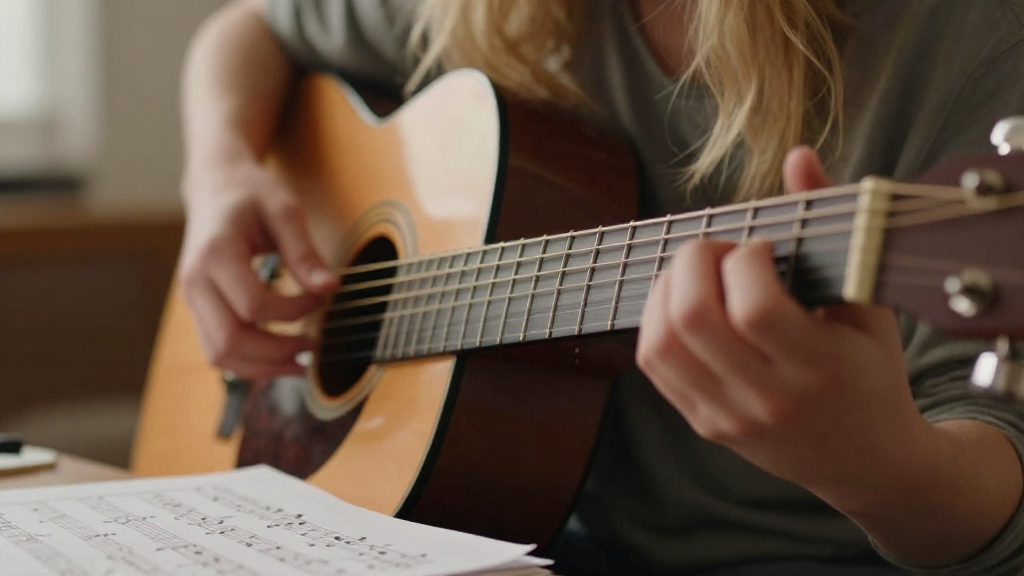
If you’re looking to enhance your guitar playing, mastering guitar counterpoint basics is an excellent step to take.
Counterpoint is a musical technique that involves the relationship between two or more melodies played simultaneously.
This concept can significantly enrich your guitar playing style, leading to more complex and interesting music.
In this article, we’ll explore essential elements of guitar counterpoint basics, techniques to practice them, and tips for implementation.
What are the Fundamentals of Guitar Counterpoint Basics?
Guitar counterpoint basics stem from a rich tradition of Western classical music.
By understanding the foundations, you can gain insights into how to create harmonically rich and melodically complex pieces on your guitar.
Key concepts include:
- Melody: The main musical theme.
- Harmony: The combination of different melodies.
- Independence: Each melody should be able to stand alone.
- Voice Leading: Smooth movement from one note to the next.
Understanding these fundamentals helps you appreciate the layers within music and how they can be expressed through guitar playing.
How to Start Practicing Counterpoint on Your Guitar?
To begin practicing guitar counterpoint basics, follow these steps to develop your skills:
- Learn the Major and Minor Scales:
Scales are the foundation of counterpoint.
Familiarize yourself with major and minor scales across all strings.
- Study Simple Melodies:
Pick simple melodies, like nursery rhymes or folk tunes.
Play them on your guitar while singing or humming the melody to internalize it.
- Create Two-Part Exercises:
Once comfortable with single melodies, try adding a second melody.
Focus on creating a complementary line.
- Utilize Intervals:
Explore different intervals between melodies.
Play a note from your main melody, then try different notes higher or lower that fit harmonically.
- Analyze Classical Music:
Listen to works by composers such as Johann Sebastian Bach, who is famous for his use of counterpoint.
Write down recognizable motifs and patterns to learn how melodies work together.
What Techniques Can You Use to Develop Counterpoint Skills?
To effectively practice and understand guitar counterpoint basics, incorporate the following techniques into your routine:
- Call and Response:
Play a short phrase and then come up with a responding phrase.
Challenge yourself to maintain the relationship between the two.
- Overlay Melodies:
Use a looper pedal or recording software to overlay melodies.
This helps you hear the interaction between parts and fine-tune timing and touch.
- Imitate:
Take a known melody and modify it.
Change notes, rhythms, or articulations.
Create counter-melodies that work with the original.
- Practice with a Partner:
If possible, partner with another musician.
Each can play a melody to create live counterpoint.
Why is Voice Leading Important in Guitar Counterpoint Basics?
Voice leading is a core concept in counterpoint.
It refers to how melodies move from one note to the next to create smooth transitions.
The principles of effective voice leading can help enhance your guitar counterpoint basics using these guidelines:
- Minimize Distance:
When moving from one pitch to another, try to use the closest note.
This helps create a smooth sound in melodies.
- Use Stepwise Motion:
Focus on notes that are next to each other in the scale, such as moving from C to D.
This approach promotes an easy flow in your music.
- Avoid Parallel Motion:
Try to avoid having two melodies move in the same direction by the same interval.
This can lead to a less interesting sound.
How Can You Implement Counterpoint in Your Guitar Playing?
Once you’ve grasped guitar counterpoint basics, it’s time to start implementing them in your playing.
Here are some ideas to get you started:
- Create Original Composition:
Write a piece that employs counterpoint techniques.
Focus on maintaining independent lines.
- Incorporate Counterpoint in Improvisation:
While improvising, deliberately create counterpoint with your left hand.
Alternate between melody and harmony.
- Arrange Existing Songs:
Take your favorite songs and arrange them for two guitars, highlighting counterpoint.
This helps you think critically about the original material.
- Utilize Different Strumming Patterns:
A different strumming or picking pattern can complement your melodies.
Experiment with variations to see what fits best.
What Resources Can Help You Learn Guitar Counterpoint Basics?
There are many resources available to further your understanding of guitar counterpoint basics.
Consider these options to expand your knowledge and skills:
- Books:
- “Counterpoint in Composition” by David Stevenson.
-
“Counterpoint” by Kent Kennan provides a comprehensive look at counterpoint theory.
-
Online Courses:
-
Websites like Udemy and Coursera offer specific courses on counterpoint as applied to guitar.
-
YouTube Tutorials:
-
Searching for counterpoint tutorials can yield many visual aids and practical examples.
-
Working with a Teacher:
- If possible, find a music teacher familiar with counterpoint to guide you through the concepts.
Conclusion: How Will Mastering Guitar Counterpoint Basics Enhance Your Playing?
Mastering guitar counterpoint basics allows you to approach guitar playing with a new perspective.
It enables you to create engaging, multi-layered music that captivates listeners.
By practicing scales, developing voice leading skills, and using creative exercises, you’ll be well on your way to incorporating counterpoint into your guitar repertoire.
Embrace the challenge of exploring counterpoint, and watch as your guitar playing transforms into something uniquely expressive and artistically satisfying!