If you’re looking to enhance your sound design skills, these 10 synth desk modules offer a range of features that cater to all musicians. From versatile polyphonic options to semi-modular designs, each module has something unique to bring to your setup. Understanding the strengths of each can help you make the right choice for your creative needs. Let’s explore what makes these synths stand out and how they can elevate your music-making experience.
Korg minilogue xd Module Polyphonic Analog Synthesizer

If you’re looking for a versatile synth that fits perfectly in both studio and live performance settings, the Korg minilogue xd Module is your go-to choice. This polyphonic analog synthesizer offers four voices and multiple voice modes like POLY, UNISON, and CHORD, catering to various musical styles. You’ll love the 16-step sequencer for crafting intricate patterns. Plus, its micro-tuning capabilities let you fine-tune your sound just right. With built-in effects like modulation, reverb, and delay, your creativity knows no bounds. The bright OLED oscilloscope display enhances real-time visualization, making sound tweaking intuitive and straightforward. Enjoy seamless integration into your setup!
Best For: Musicians and producers looking for a versatile, compact synth that excels in both studio and live performance environments.
Pros:
- Flexible voice modes (POLY, UNISON, CHORD) cater to various musical styles.
- Built-in effects and micro-tuning capabilities enhance sound design options.
- Bright OLED display allows for real-time sound visualization and easy tweaking.
Cons:
- Limited to four voices, which may not satisfy those needing more polyphony.
- The compact design may come with a learning curve for users accustomed to larger synths.
- Some users may find the 16-step sequencer limiting for complex compositions.
Behringer Pro VS Mini Portable Hybrid Synthesizer

The Behringer Pro VS Mini Portable Hybrid Synthesizer stands out as an ideal choice for sound designers seeking versatility and portability. Weighing just 1.15 pounds and measuring 8.45 x 5.45 x 2.35 inches, it’s easy to take anywhere. With four vector morphing oscillators per voice and an analog low-pass filter, you’ll craft rich, textured sounds effortlessly. The 16-step sequencer and arpeggiator enhance your creativity, allowing you to explore new musical ideas. Plus, its USB-C connectivity means you can power it via battery or USB. With an impressive 4.6-star rating, it’s a reliable addition to your sound design toolkit.
Best For: Sound designers and musicians seeking a portable and versatile synthesizer for creative sound exploration.
Pros:
- Compact and lightweight design makes it easy to transport and use in various settings.
- Versatile sound capabilities with four vector morphing oscillators and an analog low-pass filter for rich sound design.
- Integrated sequencer and arpeggiator enhance creativity and facilitate new musical ideas.
Cons:
- Limited to small form factor, which may not suit all users’ preferences for larger equipment.
- Plastic body material may raise concerns about durability compared to metal alternatives.
- Operating system compatibility is restricted to newer versions of Windows and Mac OS, which may limit accessibility for some users.
Korg Volca Modular Micro Synthesizer
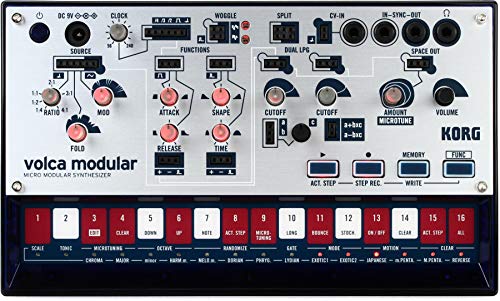
For those seeking an accessible entry into the world of modular synthesis, the Korg Volca Modular Micro Synthesizer stands out as an excellent choice. This semi-modular analog synth boasts eight independent modules and 50 patch points, allowing you to explore extensive signal routing. Its built-in 16-step sequencer and randomize function spark creativity in sound design. Lightweight and portable, you can power it with batteries or an AC adapter, perfect for studio or live settings. With compatibility across the Volca series, you’ll easily immerse yourself in West Coast-style synthesis techniques. Discover endless possibilities with this user-friendly and versatile synthesizer.
Best For: Those interested in exploring modular synthesis in a compact, user-friendly format.
Pros:
- Versatile Sound Design: With eight modules and 50 patch points, it offers extensive signal routing options.
- Portable and Convenient: Lightweight design and battery operation make it ideal for on-the-go music creation.
- Creative Features: The built-in sequencer and randomize function encourage experimentation and inspire new sounds.
Cons:
- Limited to Modular Synthesis: May not suit users looking for more traditional synthesizer features.
- Small Size: The compact design could be challenging for users who prefer larger controls for easier manipulation.
- Learning Curve: Those new to modular synthesis may find the patching process initially overwhelming.
MOOG Minitaur Analog Bass Synthesizer Module

Designed for musicians seeking deep, punchy bass, the MOOG Minitaur Analog Bass Synthesizer Module stands out with its all-analog audio path and intuitive one-knob-per-function interface. With two ultra-stable VCOs, a classic Moog Ladder low pass filter, and robust envelopes, you’ll have full control over your sound. Its compact steel enclosure makes it portable, perfect for gigs or studio sessions. Plus, the MIDI, USB, and audio connectivity options, along with the free Minitaur editor software, simplify integration into your setup. With a solid rating of 4.8 stars, it’s a must-have for serious sound designers.
Best For: Musicians and sound designers looking for a compact, high-quality analog bass synthesizer that delivers deep, punchy tones.
Pros:
- All-Analog Audio Path: Ensures a rich and warm sound, characteristic of classic Moog synthesizers.
- Intuitive Interface: One knob per function design allows for easy and quick adjustments during live performances or studio sessions.
- Portable Design: Compact and rugged steel enclosure makes it ideal for musicians on the go.
Cons:
- Monophonic Only: Limited to producing one note at a time, which may not suit all musical styles.
- No Built-in Effects: Lacks onboard effects processing, requiring external gear for added sound manipulation.
- Limited Preset Storage: May not have enough memory for users who rely heavily on preset sounds.
Korg Monotron Delay Analog Ribbon Synthesizer

With its four-octave range and unique ribbon keyboard, the Korg Monotron Delay Analog Ribbon Synthesizer is perfect for both beginners and seasoned sound designers looking to explore analog synth textures. You’ll love its Space Delay for lush echo effects and the Pitch LFO with adjustable waveshape. The original Analog Filter, borrowed from the classic MS-10 and MS-20, adds depth to your sounds. Its compact design makes it easy to transport, and the built-in speaker guarantees you can create music anywhere. With simple controls and a glowing ribbon keyboard, it’s an engaging tool that sparks creativity in every session.
Best For: The Korg Monotron Delay Analog Ribbon Synthesizer is best for both beginners and experienced musicians seeking to create and experiment with rich analog sounds.
Pros:
- Compact and portable design with a built-in speaker, making it easy to create music on the go.
- User-friendly controls with simple operation, allowing for quick adjustments and experimentation.
- Unique features like the Space Delay and original Analog Filter provide a wide range of sound design possibilities.
Cons:
- Limited polyphony due to the ribbon keyboard design, which may not suit all musical styles.
- Battery-powered operation requires additional batteries for extended use, which can be inconvenient.
- No MIDI connectivity, limiting integration with other digital music equipment.
Roland JD-08 Tabletop Sound Module Synthesizer

The Roland JD-08 Tabletop Sound Module Synthesizer stands out for its authentic sound modeling, making it an ideal choice for sound designers seeking a rich and versatile tool. With 108 original waveforms and 64 presets, plus 21 new ones, you’ll find endless patch design possibilities. Its two-part, 64-step sequencer and onboard arpeggiator enhance your creativity, while the multitimbral structure allows for layered tones with up to 128 voices. The detailed effects section recreates the JD-800’s unique sound, featuring distortion, phaser, and reverb. Compact and lightweight, the JD-08 is perfect for any setup, inviting you to explore new sonic landscapes.
Best For: Sound designers and musicians seeking a versatile and compact synthesizer with authentic sound modeling and extensive patch design capabilities.
Pros:
- Versatile sound design capabilities with 108 original waveforms and 85 presets.
- Two-part sequencer and onboard arpeggiator enhance creative possibilities.
- Lightweight and modern design makes it easy to integrate into any setup.
Cons:
- Keyboard K-25M sold separately, adding to the total cost.
- Limited to two-part multitimbral operation, which may restrict complex arrangements.
- May require a learning curve for those unfamiliar with advanced synth features.
Arturia MicroFreak Synthesizer Keyboard
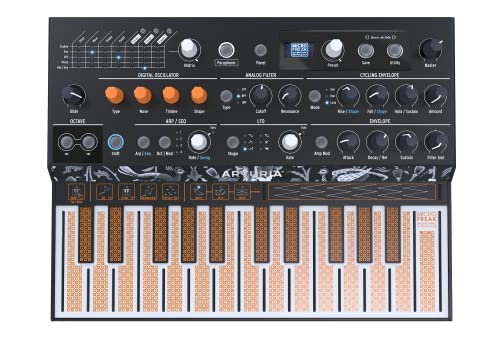
For those seeking a compact yet powerful tool for sound design, the Arturia MicroFreak Synthesizer Keyboard stands out with its innovative hybrid design that merges digital oscillators and analog filters. Weighing just 2.42 pounds, this 25-key synth features 17 paraphonic oscillator modes, including options like vocoder and wavetable. Its super-flat PCB keyboard tracks notes with impressive speed and sensitivity. You can record automations and use the versatile 5×7 modulation matrix to craft unique sounds. With CV outputs, USB connectivity, and MIDI compatibility, the MicroFreak integrates seamlessly into your setup, making it an essential addition to any sound designer’s toolkit.
Best For: The Arturia MicroFreak Synthesizer Keyboard is best for sound designers and musicians looking for a versatile, compact synth with advanced modulation capabilities and a unique keyboard design.
Pros:
- Versatile Synthesis: Offers 17 paraphonic oscillator modes, allowing for a wide range of sound possibilities.
- Compact and Lightweight: Weighs only 2.42 pounds, making it easy to transport for live performances or studio sessions.
- Innovative Keyboard Design: Features a super-flat PCB keyboard that tracks notes with high speed and pressure sensitivity, enhancing playability.
Cons:
- Limited Key Range: The 25-key layout may not be suitable for players accustomed to full-sized keyboards.
- Learning Curve: The extensive features and modulation options may require time to fully master for new users.
- Not Battery Operated: Requires a power source, which may limit portability in certain settings.
Behringer CRAVE Analog Semi-Modular Synthesizer

Designed for both beginners and seasoned sound designers, the Behringer CRAVE Analog Semi-Modular Synthesizer stands out with its impressive 3340 VCO architecture. This analog powerhouse offers a rich, fat sound, thanks to its classic Prophet 5-inspired oscillator. You’ll love the diverse tonal possibilities from its pulse and sawtooth wave outputs. The iconic Moog 24 dB ladder filter adds resonance, enhancing your sound’s performance. With a 32-step sequencer, you can create intricate musical patterns, and the 16-voice poly chain expands your capabilities for more complex arrangements. The CRAVE truly elevates your sound design game effortlessly.
Best For: The Behringer CRAVE Analog Semi-Modular Synthesizer is best for both beginners seeking to explore sound design and experienced musicians looking for a versatile analog synth.
Pros:
- Rich sound quality with classic Prophet 5 VCO design and diverse wave outputs.
- Versatile filter capabilities due to the switchable low/high pass filter mode.
- User-friendly 32-step sequencer for creating intricate musical patterns easily.
Cons:
- Limited polyphony with a maximum of 16 voices, which may not satisfy those needing more extensive arrangements.
- Semi-modular design may require additional modules for full functionality, potentially increasing cost.
- Learning curve for beginners unfamiliar with analog synthesis concepts and equipment.
Korg microKORG Compact Analog Modeling Synthesizer

Compact and versatile, the Korg microKORG Compact Analog Modeling Synthesizer is perfect for musicians seeking a blend of portability and powerful sound design capabilities. With its 37 full-size keys, you can expressively play while exploring a rich palette of sounds thanks to the XMT Sound Engine and 4-voice polyphony. The built-in vocoder lets you create unique vocal effects, and the 6-step arpeggiator sparks your musical creativity. Lightweight and easily transportable, it’s ideal for home studios or live gigs. Plus, with MIDI connectivity and an intuitive interface, editing sounds becomes effortless, making it a fantastic addition to your setup.
Best For: Musicians and producers looking for a portable synthesizer with versatile sound design capabilities and performance features.
Pros:
- Compact and lightweight design for easy transport to gigs or studio sessions.
- Built-in vocoder and 6-step arpeggiator enhance creativity and vocal effects.
- Intuitive user interface with dedicated knobs and buttons simplifies sound editing.
Cons:
- Limited 4-voice polyphony may restrict complex layering of sounds.
- Mini keys may not be suitable for all players, especially those accustomed to full-sized keys.
- Built-in speaker may lack the power and quality for professional performance settings.
Roland JX-08 Tabletop Sound Module Boutique Synthesizer

The Roland JX-08 Tabletop Sound Module Boutique Synthesizer stands out as an excellent choice for musicians and sound designers seeking portability without sacrificing sound quality. This compact module features authentic JX-8P sounds, 32 classic presets, and 111 new ones, complete with 17 fresh effects like JUNO-106 chorus and pitch shifter. You’ll appreciate the two-part, 64-step sequencer and onboard arpeggiator for dynamic sequencing. With up to 20 voices of polyphony and multitimbral capabilities, it allows for complex sound layering. Plus, its USB-C connectivity guarantees versatile integration into any setup. You’ll love the convenience of battery operation for on-the-go creativity.
Best For: The Roland JX-08 is best for musicians and sound designers looking for a portable synthesizer that offers authentic sounds and versatile sequencing capabilities.
Pros:
- Compact and lightweight design makes it easy to transport and use anywhere.
- Features a rich selection of sounds, including classic presets and modern effects.
- Equipped with a powerful sequencer and arpeggiator for dynamic music creation.
Cons:
- Limited onboard controls may require additional programming knowledge for advanced users.
- Battery operation may not provide extended usage time for long sessions.
- Some users may find the interface less intuitive compared to larger synthesizers.
Factors to Consider When Choosing Synth Deskmodules
When you’re choosing synth desk modules, there are several key factors you need to contemplate. Sound engine quality, portability, and connectivity options can greatly influence your experience. Don’t forget to think about the performance features and user interface design that best suit your creative workflow.
Sound Engine Quality
Choosing the right synth desk module often hinges on sound engine quality, which plays a pivotal role in shaping your musical experience. The richness and depth of audio output depend heavily on this aspect. If you’re drawn to warm, organic sounds, consider analog sound engines, ideal for genres like electronic and ambient music. On the other hand, digital sound engines provide a broader array of waveforms and sound design options, perfect for crafting complex textures. Pay attention to the type of oscillators—VCOs offer a classic timbre, while digital oscillators can push boundaries. Finally, high-quality filters are essential for emphasizing or cutting frequencies, making your patches dynamic and expressive. Choose wisely to elevate your sound design game.
Portability and Size
Sound engine quality sets the foundation for your musical journey, but portability and size can greatly influence your workflow and performance. When choosing a synth desk module, consider its dimensions and weight. Smaller, lighter models, like those around 8.45 x 5.45 x 2.35 inches and weighing about 1.15 pounds, are perfect for easy transport and integration into diverse environments. Look for options with battery power, allowing you to perform in places without AC access. A rugged yet lightweight design guarantees durability while maintaining portability, which is essential for musicians on the go. Additionally, built-in speakers can enhance convenience, letting you test sounds and perform without needing extra gear. Prioritize these factors to elevate your sound design experience.
Connectivity Options Available
As you explore synth desk modules, the variety of connectivity options can greatly impact your creative process. Many models offer USB-C connectivity, making it easy to integrate with your computer and facilitating both audio and MIDI communication. Standard MIDI I/O ports are also common, allowing you to connect with other MIDI instruments and controllers for expanded performance capabilities. Some synths provide auxiliary inputs, enabling you to process external audio sources through their filters and effects. You’ll also find headphone jacks for private practice or monitoring, alongside audio outputs for seamless integration with mixing consoles or audio interfaces. Additionally, certain synthesizers feature CV (Control Voltage) outputs, enhancing your sound design flexibility by connecting to modular synth systems.
Performance Features Offered
When evaluating synth desk modules, it’s essential to take into account the performance features that can elevate your creative process. Built-in sequencers and arpeggiators allow you to create intricate musical patterns effortlessly, boosting your creativity. Multi-voice capabilities such as polyphony and multitimbrality let you layer multiple voices or patches, enabling the synthesis of complex sounds. In addition, various oscillator types and modulation options expand your sound design possibilities, catering to different musical styles. Integrated effects like reverb, delay, and distortion enhance your output’s sonic character, adding depth and texture. Finally, user-friendly controls facilitate quick adjustments and real-time manipulation, making your live performances more dynamic and engaging. Choose wisely to maximize your musical potential!
User Interface Design
Choosing the right user interface design for your synth desk modules can greatly enhance your workflow and creativity. Look for a “one knob per function” layout to make quick adjustments easier, and guarantee you have clear visual feedback, like bright OLED displays or LED indicators, to monitor settings in real-time. Ergonomics matter, too—frequently used knobs should be within easy reach to avoid awkward hand positioning. Thorough labeling and color-coding help you grasp functionality and signal routing quickly, reducing the learning curve. Finally, a good balance of hardware controls and digital displays allows for tactile interaction while providing detailed visual information. All these factors together create an intuitive experience that boosts your sound design efforts.