The right audio crossover can make a major difference in system clarity, amplifier efficiency, and speaker protection. The models in this roundup cover digital DSP units, electronic RCA and XLR crossovers, and passive speaker networks.
Use the guide below to match crossover type, channel count, controls, and installation style to your car audio, home HiFi, or PA setup.
Best 10 Audio Crossover Picks for 2026
Flexible Car DSP

- Two inputs and four independently routed outputs
- 15-band EQ with 12 presets
- LCD control and sequencer relay
Best For: Custom multi-channel car-audio systems
Professional Rack Crossover

- Two-way stereo or three-way mono operation
- Balanced XLR inputs and outputs
- Dedicated 30–200 Hz subwoofer control
Best For: Live and studio audio setups
OEM-Friendly Car DSP

- Two inputs and four outputs with flexible routing
- Filters up to 48 dB/octave
- RCA and high-level factory-stereo inputs
Best For: Factory-radio car-audio upgrades
Six-Channel Analog Control

- Three-way, six-channel electronic crossover
- Front, rear, and subwoofer lever controls
- Includes remote subwoofer level control
Best For: Straightforward multi-zone car-audio systems
Compact Car Audio Crossover

- 150W RMS/300W peak handling
- Gold-plated screw terminals
- Enclosed ABS passive design
Best For: Two-way car audio speaker upgrades
Professional PA Crossover

- Three selectable operating modes
- Balanced XLR ins and outs
- Individual gain and phase controls
Best For: PA, DJ, and multi-amplifier systems
HiFi Speaker Crossover

- 200W peak power handling
- 4-8 ohm compatibility
- 860Hz and 6kHz division points
Best For: DIY car or home three-way speakers
High-Output Control
PRV Audio EX4.6 PRO 4-Way Crossover
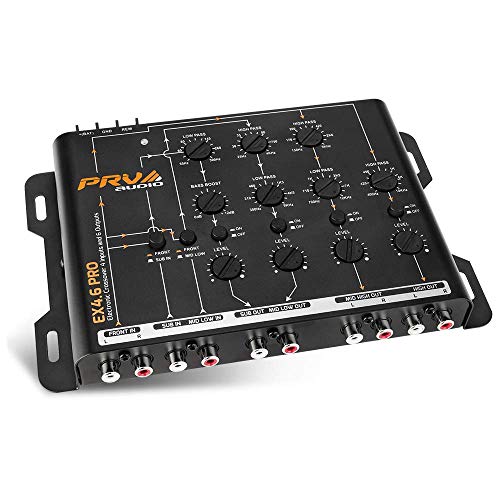
- 2-, 3-, or 4-way RCA input options
- Up to 9 volts RMS maximum output
- 0–12 dB bass boost at 45 Hz
Best For: Multi-amplifier car audio systems needing flexible routing
Compact System Tuning

- Four-channel electronic crossover
- Customizable sound adjustments
- Compact 190 x 145 x 40 mm design
Best For: Space-conscious car audio installations
Flexible Stereo Tuning
PRV Audio EX3.5 3-Way Crossover
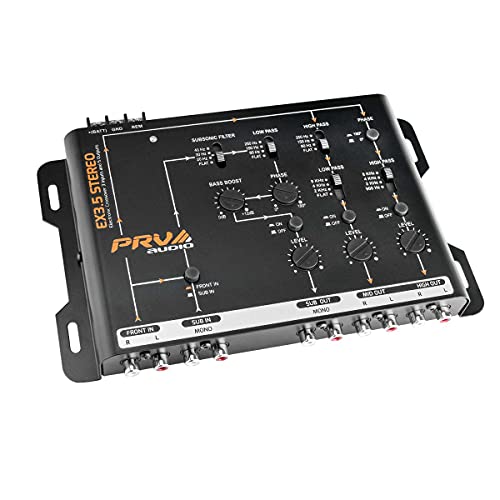
- Selectable 2-way or 3-way operation
- Six RCA outputs with adjustable filters
- Subwoofer bass boost and channel switches
Best For: Expandable car audio systems requiring detailed tuning
Flexible Car DSP – PRV Audio DSP 2.4X
The PRV Audio DSP 2.4X is a versatile audio crossover and equalizer for car systems that need detailed digital signal control. Its two inputs, four independently configurable outputs, LCD interface, presets, and sequencing connection support both everyday tuning and more customized installations.
Best For: Car-audio enthusiasts building multi-channel systems with adjustable routing, equalization, and crossover control.
Pros:
- Provides two inputs and four independent crossover outputs with selectable source routing.
- Includes a 15-band graphic equalizer and 12 sound presets.
- Offers parametric equalizer adjustment for frequency, gain, and bandwidth.
- LCD display and sequencer remote relay support practical system control.
Cons:
- Its feature-rich interface may require more setup than a basic crossover.
- Designed for car audio, so it may not suit conventional home or studio installations.
The DSP 2.4X is a strong choice when an audio crossover needs to handle routing, equalization, and system sequencing in one compact car-audio processor.
Professional Rack Crossover – Rockville RX230 Crossover
The Rockville RX230 is a practical audio crossover for separating mids, highs, and lows in live or studio setups. It supports two-way stereo or three-way mono operation, balanced XLR connectivity, steep 24 dB/octave filters, and a dedicated subwoofer section.
Best For: Live-performance, studio, and powered-speaker systems requiring balanced connections and adjustable subwoofer control.
Pros:
- Supports two-way stereo and three-way mono configurations.
- Balanced XLR inputs and outputs help provide clean signal connections.
- Offers adjustable mid/high crossover ranges from 100 Hz to 1 kHz, expandable to 10 kHz.
- Dedicated subwoofer crossover and gain controls cover 30–200 Hz and -6 to +6 dB.
Cons:
- Its 20.7-inch listed dimension may require substantial rack or installation space.
- It is a powered, venue-oriented component rather than a compact car-audio DSP.
With flexible operating modes, XLR connectivity, and dedicated low-frequency adjustment, the RX230 is suited to larger audio systems where precise analog signal separation matters.
OEM-Friendly Car DSP – Taramps PRO 2.4S DSP
The Taramps PRO 2.4S combines a digital audio crossover with equalization and car-system signal management. Its two inputs, four outputs, flexible routing, adjustable high-pass and low-pass filters, time alignment, phase inversion, and limiter make it useful for upgrading factory or aftermarket stereos.
Best For: Car-audio upgrades that need factory-stereo compatibility and advanced multi-channel DSP tuning.
Pros:
- Provides two inputs, four outputs, and flexible signal routing.
- Includes a 15-band graphic equalizer, parametric EQ, and 12 presets.
- Supports high-pass and low-pass filters up to 48 dB/octave.
- Works with RCA and high-level inputs and includes anti-pop and clip indicators.
Cons:
- The advanced DSP functions may take time to configure correctly.
- Its intended application is car audio rather than general-purpose studio crossover use.
The PRO 2.4S stands out for combining crossover flexibility with factory-radio compatibility, monitoring features, time alignment, and phase control in a compact car-audio processor.
Six-Channel Analog Control – Clarion MCD360 Crossover
Clarion Mobile Electronics Mcd360 3 Way 6 Channel Electronic Crossover with Subwoofer Control
Check Price On AmazonThe Clarion MCD360 is a three-way, six-channel electronic audio crossover designed for car-audio systems with front, rear, and subwoofer sections. It combines multiple RCA inputs and outputs with lever controls, subwoofer boost adjustment, high-pass frequency multiplication, and an included remote level control.
Best For: Car-audio installations needing straightforward front, rear, and subwoofer crossover control.
Pros:
- Provides six-channel outputs for front, rear, and subwoofer signals.
- Includes six-, four-, and two-channel RCA input options.
- Offers front/rear/subwoofer lever controls and subwoofer boost adjustment.
- Includes remote subwoofer level control and gold-plated terminals.
Cons:
- Its feature set is more focused on dedicated car-audio control than advanced digital processing.
- The supplied notes do not specify detailed filter slopes or adjustment ranges.
The MCD360 is a sensible option for organizing a three-way car system when direct front, rear, and subwoofer controls are more important than extensive digital DSP functions.
Compact Car Audio Crossover – 2-Way CRX-203
300 Watts 2 Way Crossover - (2 Pack) Passive Car Audio Speaker Tweeter Mids and Highs CRX-203
Check Price On AmazonIf you are upgrading a car audio system, this passive audio crossover separates woofer and tweeter frequencies without requiring a separate powered processor. The pair uses screw terminals and an enclosed ABS cabinet for a straightforward wired installation.
Best For: Car audio setups using separate tweeters and 6.5-inch mid/woofer drivers.
Pros:
- 150 watts RMS and 300 watts peak power handling.
- Gold-plated screw terminals simplify wiring.
- Two-way filtering covers tweeter and woofer frequency ranges.
- High-grade polymer capacitors are included.
Cons:
- Designed for car stereo systems rather than rack-mounted PA use.
- It is a passive component and does not provide adjustable controls.
The CRX-203 is a practical choice when you need a compact, wired audio crossover for a two-way car speaker system. Verify your speaker power ratings and wiring compatibility before installation.
Professional PA Crossover – Stereo/Mono XLR Crossover
For a PA system with multiple amplifier and speaker bands, this rack-mount audio crossover provides selectable two-way stereo, three-way stereo, and four-way mono operation. Balanced XLR inputs and outputs help integrate it into a professional signal chain.
Best For: PA systems, DJ setups, venues, and installations using amplifiers, subwoofers, and multi-band speakers.
Pros:
- Supports two-way stereo, three-way stereo, and four-way mono modes.
- Separate output gain controls are provided for each band.
- Individual phase-reverse switches help address polarity issues.
- Includes a selectable 40 Hz, 12 dB/octave low-cut filter.
Cons:
- Requires 110-volt AC power.
- Its rack-mount form and professional connections may be excessive for basic home audio.
This is the most flexible option of the three for routing a complex sound system. Its LED mode display, XLR connectivity, and band-specific controls suit users who need active signal management rather than a simple passive speaker network.
HiFi Speaker Crossover – 3-Way 200W Passive Pair
This passive audio crossover is designed to divide a speaker signal among bass, midrange, and tweeter drivers in a car or home audio system. Its screw terminals make installation simpler, while the 860 Hz and 6,000 Hz division points support a three-way speaker design.
Best For: DIY car or home speakers using 4- to 8-ohm drivers and a midrange speaker larger than 4.5 inches.
Pros:
- Three-way design separates bass, midrange, and treble.
- 200-watt peak rating suits compatible speaker builds.
- Works with 4- to 8-ohm impedance.
- Includes convenient screw terminals and two crossover units.
Cons:
- Passive design offers no electronic adjustment controls.
- Compatibility depends on matching the stated impedance and driver requirements.
With two units in the package, the PUV-W3 is a useful option for building or modifying paired three-way speakers. Confirm the drivers’ impedance, power handling, and physical fit before replacing an existing crossover.
High-Output Control – PRV Audio EX4.6 PRO 4-Way Crossover
The PRV Audio EX4.6 PRO is a flexible audio crossover for car systems that need multiple RCA routing options and dedicated channel control. It supports 2-, 3-, or 4-way configurations, offers up to 9 volts RMS maximum output, and includes adjustable bass boost for shaping the subwoofer range.
Best For: Car-audio builders who want a 4-way electronic crossover with flexible RCA inputs, individual channel switching, and higher-voltage output capability.
Pros:
- Supports 2-, 3-, and 4-RCA input signal options.
- Provides up to 9 volts RMS maximum output.
- Includes 0–12 dB bass boost at 45 Hz.
- Quick on/off buttons provide direct control for each channel.
Cons:
- Its 4-way functionality may be more than a basic system requires.
- The unit uses RCA connectivity, so compatibility depends on the rest of the system.
With its multiple routing options and channel-level controls, the EX4.6 PRO is a practical choice for a more elaborate multi-amplifier car audio installation. Its 1.3-inch height and mechanical controls also suit straightforward, hands-on adjustment.
Compact System Tuning – Taramps CRX4 4-Way Crossover
The Taramps CRX4 is a compact audio crossover designed for car audio systems that need four channels and customizable sound adjustments. Its small 190 x 145 x 40 mm footprint makes it a useful option where installation space is limited.
Best For: Car audio users looking for a compact 4-channel crossover with adjustable sound controls and support for low- and high-frequency system tuning.
Pros:
- Provides four channels for flexible system setup.
- Offers customizable sound adjustments.
- Compact dimensions can simplify installation in tighter spaces.
- Includes bass boost for additional low-frequency shaping.
Cons:
- The supplied notes do not specify detailed filter ranges or slope settings.
- Its 8 volts RMS rating is lower than some higher-output crossover options.
The CRX4 focuses on core functionality in a relatively small chassis. It is worth considering when compact size and four-channel control matter more than extensive published adjustment specifications.
Flexible Stereo Tuning – PRV Audio EX3.5 3-Way Crossover
The PRV Audio EX3.5 Stereo is an adaptable audio crossover for 2-way or 3-way car systems. Its 2/4 RCA inputs and six RCA outputs support stereo and mono routing, while adjustable high-pass and low-pass filters allow more precise control of connected amplifiers and speakers.
Best For: Car audio installations that need selectable 2-way or 3-way operation, six RCA outputs, and separate output-level and filter adjustments.
Pros:
- Supports both 2-way and 3-way configurations.
- Offers 2/4 RCA inputs and six RCA outputs.
- Provides adjustable high-pass and low-pass filters across three ways.
- Includes output-level controls, subwoofer bass boost, and channel on/off switches.
Cons:
- Its feature set may be unnecessary for simpler stereo installations.
- The supplied notes specify a 9-volt system but do not provide a maximum output-power figure.
The EX3.5 Stereo is a strong fit for builders who want room to expand from a 2-way to a 3-way layout. Its Butterworth 12 dB/octave slope and dedicated controls make it practical for hands-on system tuning.
How We Picked These Audio Crossovers
We selected models across the main crossover categories rather than treating every unit as interchangeable. The roundup includes digital signal processors with equalization and sequencing features, electronic crossovers for RCA- or XLR-equipped systems, and passive networks designed to divide frequencies between speakers without requiring separate power or signal-processing hardware.
We also considered channel flexibility, two-, three-, and four-way operation, input and output formats, subwoofer controls, voltage handling, installation requirements, and likely use cases. Because compatibility matters more than headline specifications, confirm your amplifier, speaker, connector, and impedance requirements before buying.
Quick Comparison
| System Type | Best Crossover Style | What to Look For |
|---|---|---|
| Car audio with multiple amplifiers | Digital or electronic RCA crossover | Channel count, RCA outputs, voltage handling, remote controls |
| Car audio with advanced tuning needs | DSP crossover | Equalization, delay, presets, sequencing, and app or remote access |
| Home HiFi speaker building | Passive crossover | Impedance, power rating, crossover points, and driver compatibility |
| PA or live sound systems | Electronic XLR crossover | Balanced inputs and outputs, mono or stereo modes, and subwoofer routing |
Key Buying Factors for an Audio Crossover
Active, DSP, or Passive Design
Active and DSP crossovers operate before amplification, making them useful when separate amplifiers power different speaker bands. DSP models generally provide the most adjustment, including equalization and system tuning. Passive crossovers sit between the amplifier and speakers, which simplifies installation but limits adjustment and must be matched to the drivers and impedance.
Channels and Crossover Configuration
Check whether the unit supports the arrangement you need: two-way stereo, three-way stereo, four-way mono, or another combination. Count both inputs and outputs, especially when adding subwoofers, tweeters, midrange drivers, or multiple amplifiers.
Connections and Signal Level
RCA connections are common in car audio, while XLR is preferred for many PA installations because balanced cabling can reduce noise over longer runs. Compare the crossover’s input and output voltage limits with the rest of your system to avoid gain or clipping problems.
Controls and Installation
Useful controls may include separate level knobs, selectable filters, phase or polarity adjustment, bass boost, remote subwoofer control, and memory presets. Also verify power requirements, available mounting space, and whether the unit needs a remote or additional wiring.
Who Should Buy Which Audio Crossover?
Choose a DSP model if you want the most detailed tuning control or are building a complex car audio system. An electronic RCA crossover is a practical fit for straightforward multi-amplifier car installations. XLR-equipped models are better suited to PA systems and balanced signal chains. Choose a passive network for a simpler home speaker project, provided its power rating, impedance, and frequency points match your drivers.