Active audio crossovers help divide a full-range signal into dedicated frequency bands, giving amplifiers and speakers cleaner, more controlled material to reproduce. The right model can also add useful level controls, bass management, equalization, and signal gain for a more flexible system.
This roundup compares 10 options for car audio and PA applications, from compact RCA processors to multi-channel units with XLR connectivity. Use the buying guide below to match channel count, controls, voltage handling, and installation format to your setup.
Best 10 Active Audio Crossovers Picks for 2026
Vehicle Sound Tuning
Autotek ATK2 3X Active Crossover

- 2-way and 3-way crossover operation
- Remote bass control included
- 180-degree subwoofer phase shift
Best For: Car-audio amplifier and subwoofer tuning
Digital System Flexibility
Taramps PRO 2.4S DSP Crossover

- Two inputs and four outputs
- Filters up to 48 dB/octave
- 15-band EQ and time alignment
Best For: Custom car-audio and factory-stereo upgrades
Live Audio Precision

- 2-way stereo or 3-way mono modes
- Balanced XLR connectivity
- 24 dB/octave filtering
Best For: Live sound and studio-style audio setups
Classic Car-Audio Control
Clarion MCD360 3-Way Crossover

- 3-way, 6-channel design
- Front, rear, and subwoofer controls
- Remote subwoofer level control included
Best For: Multi-zone vehicle audio systems
Best Car Audio EQ/Crossover

- Four-band EQ with front/rear active crossover
- 9-volt RCA line-driver output
- Half-DIN car-audio format
Best For: Vehicle systems needing compact EQ and crossover control
Best PA Rack Crossover
Professional 2/3-Way Stereo/4-Way Mono Crossover

- Three selectable crossover operating modes
- Balanced XLR inputs and outputs
- Independent gain, phase, and low-cut controls
Best For: PA and DJ systems with multiple amplifier bands
Best Compact 3-Way Crossover

- Six-channel three-way electronic crossover
- Front, rear, and subwoofer RCA outputs
- Compact 14.4-volt DC design
Best For: Vehicle systems requiring dedicated front, rear, and subwoofer paths
Best All-Around Car Tuning
DS18 XM3 3-Way Active Crossover

- Independent front, rear, and subwoofer tuning
- Built-in 11V line driver with clip-indicating bass remote
- Compact chassis with adjustable filters
Best For: Flexible multi-amplifier car-audio systems
Best for PA and Rack Systems
Professional 2/3-Way Stereo & 4-Way Mono Crossover
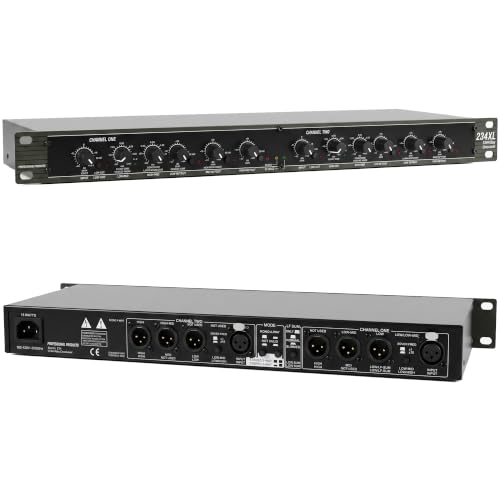
- Supports stereo and mono crossover modes
- Balanced XLR I/O for professional signal routing
- Per-band gain, phase, and low-cut controls
Best For: Live sound, installed audio, and studio systems
Best Flexible Car RCA Processor
PRV Audio EX3.5 Stereo Crossover
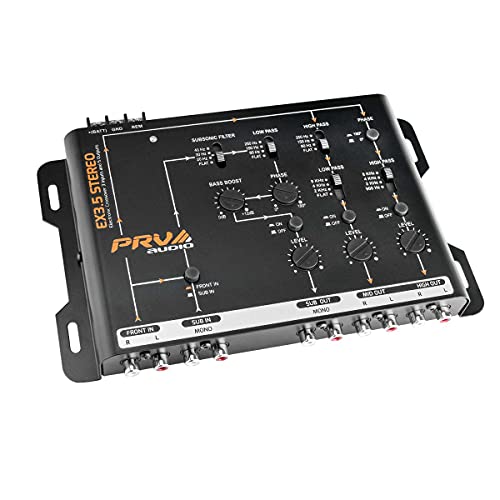
- Selectable 2-way or 3-way RCA routing
- Six outputs with adjustable filters and levels
- Bass boost and quick channel on/off controls
Best For: Customizable car stereo and amplifier systems
Vehicle Sound Tuning – Autotek ATK2 3X Active Crossover
The Autotek ATK2 3X is one of the more straightforward active audio crossovers for tuning a vehicle’s amplifier and subwoofer setup. It supports 2-way and 3-way configurations, offers level and frequency adjustments, and includes a remote bass control for convenient low-end changes.
Best For: Car-audio systems that need adjustable subwoofer control, phase switching, and up to three channels of crossover processing.
Pros:
- Supports both 2-way and 3-way configurations.
- Provides 8.5-volt output and adjustable levels and frequencies.
- Includes remote bass control and a 180-degree phase-shift switch.
Cons:
- Its 6.5 x 5.75 x 1.5-inch housing requires suitable mounting space.
- The supplied notes do not specify advanced digital DSP functions.
Choose this model when practical vehicle-system tuning matters more than extensive digital processing. Its controls focus on amplifier integration, subwoofer adjustment, and phase matching.
Digital System Flexibility – Taramps PRO 2.4S DSP Crossover
The Taramps PRO 2.4S combines active audio crossovers with broader DSP control for custom car-audio installations. Its two inputs and four outputs support flexible routing, while adjustable filters, equalization, time alignment, phase inversion, and limiting provide detailed system setup options.
Best For: Factory-stereo upgrades and custom systems that benefit from multi-output routing, digital equalization, and adjustable crossover slopes.
Pros:
- Offers two inputs and four outputs with flexible routing.
- Provides HPF and LPF adjustment up to 48 dB/octave.
- Includes a 15-band graphic equalizer, time alignment, phase inversion, and limiter.
- Accepts RCA and high-level inputs for OEM and aftermarket radios.
Cons:
- The wider DSP feature set may require more setup than a basic crossover.
- The supplied notes do not identify a remote bass-control accessory.
This is the most feature-rich option in the group for users who want crossover control alongside broader signal shaping. Clip indicators and an anti-pop system add useful monitoring and startup-noise management.
Live Audio Precision – Rockville RX230 Crossover
The Rockville RX230 is a versatile active audio crossover for live-performance and studio-style signal routing. It can operate as a 2-way stereo or 3-way mono unit, with balanced XLR connectivity, adjustable crossover ranges, steep 24 dB/octave filters, and a dedicated subwoofer output.
Best For: Live sound, studio mixing, and powered-speaker setups requiring balanced connections and separate subwoofer control.
Pros:
- Supports 2-way stereo and 3-way mono operation.
- Uses balanced XLR inputs and outputs.
- Provides adjustable mid/high ranges from 100 Hz to 1 kHz, expandable to 10 kHz.
- Includes a 30–200 Hz subwoofer crossover and -6 to +6 dB gain control.
Cons:
- Its listed 8.9 x 20.7 x 4.6-inch dimensions may require substantial rack or shelf space.
- It is less specifically oriented toward vehicle installations than the car-audio models here.
The RX230 is a strong fit when clean balanced connections and flexible stereo/mono operation are priorities. Its dedicated low-frequency controls make it practical for integrating subwoofers into larger audio systems.
Classic Car-Audio Control – Clarion MCD360 3-Way Crossover
Clarion Mobile Electronics Mcd360 3 Way 6 Channel Electronic Crossover with Subwoofer Control
Check Price On AmazonThe Clarion MCD360 is a 3-way, 6-channel electronic crossover designed for car-audio systems with front, rear, and subwoofer sections. It includes front/rear/subwoofer level controls, a subwoofer equalizer and boost adjustment, gold-plated terminals, and a remote subwoofer level control.
Best For: Vehicle systems needing dedicated front, rear, and subwoofer controls with remote low-end adjustment.
Pros:
- Provides 6-channel RCA inputs and 6-channel, 5-volt RCA outputs.
- Offers separate front, rear, and subwoofer lever controls.
- Includes subwoofer equalizer, boost controls, and a remote level control.
- Uses gold-plated terminals.
Cons:
- The supplied notes do not specify detailed crossover slope settings.
- It is a wired, shelf-mounted component and is not water resistant.
For a traditional multi-zone car-audio installation, the MCD360 emphasizes accessible front, rear, and subwoofer adjustment. It is especially useful when remote subwoofer level control is more important than modern DSP features.
Best Car Audio EQ/Crossover – Autotek ATEQ709
The Autotek ATEQ709 combines a four-band preamp equalizer with front/rear active audio crossovers in a half-DIN car-audio chassis. Its 9-volt line driver, selectable 12dB high-pass crossover, and separate source-level controls make it a practical choice for tuning a vehicle system.
Best For: Car-audio users who need equalization, source switching, and front/rear crossover control in one compact unit.
Pros:
- Combines four-band EQ with front/rear active crossover functionality.
- 9-volt preamp output can support stronger RCA signal delivery.
- Includes source selection and independent input-level controls.
- Half-DIN format suits compact installation spaces.
Cons:
- Designed for car-audio systems rather than PA or rack-mounted applications.
- The supplied details do not specify crossover frequency ranges beyond the selectable high-pass function.
Choose this model when consolidating several front-end controls matters more than adding a dedicated multi-band crossover. The combination of EQ, source management, and active crossover outputs gives a vehicle system a flexible control center.
Best PA Rack Crossover – Professional 2/3-Way Stereo/4-Way Mono Crossover
This professional crossover is built for PA setups that need flexible active audio crossovers and balanced XLR connectivity. It supports two-way stereo, three-way stereo, and four-way mono operation, with separate band controls for routing frequencies to the appropriate amplifiers.
Best For: PA systems, DJ rigs, venues, and installations using amplifiers, subwoofers, and multi-band speaker configurations.
Pros:
- Offers two-way stereo, three-way stereo, and four-way mono modes.
- XLR balanced inputs and outputs support professional signal connections.
- Separate output gain controls and phase-reverse switches provide system-level adjustment.
- Includes a 40Hz, 12dB/octave Butterworth high-pass filter and front-panel mode indicators.
Cons:
- Requires 110-volt AC power and rack-style installation.
- Its 18.9-inch length may be excessive for compact setups.
- More control than needed for simple two-speaker systems.
For systems with multiple amplifier channels, this unit offers the broadest routing flexibility of the three options. Its selectable operating modes and independent band controls make it especially useful when a PA system may evolve from two-way to more complex configurations.
Best Compact 3-Way Crossover – Skar Audio SKEC23
The Skar Audio SKEC23 is a compact three-way electronic crossover with six channels: three RCA inputs and three RCA outputs for front, rear, and subwoofer signals. Its 14.4-volt DC operation and 5-volt maximum output suit active audio crossovers in vehicle systems.
Best For: Car-audio installations needing dedicated front, rear, and subwoofer signal paths from a small chassis.
Pros:
- Provides three RCA inputs and three RCA outputs across six channels.
- Separates front, rear, and subwoofer signal paths.
- Offers a 10Hz–30kHz frequency response.
- Compact dimensions make it easier to fit in constrained installations.
Cons:
- Uses 14.4-volt DC power, so it is intended for vehicle-style systems.
- The supplied details do not list adjustable crossover slopes or frequency controls.
This is a focused choice for a car-audio builder who wants three-way signal distribution without a larger rack unit. Its dedicated front, rear, and subwoofer outputs are straightforward, while the compact enclosure helps simplify installation planning.
Best All-Around Car Tuning – DS18 XM3 3-Way Active Crossover
For car-audio builders who want flexible active audio crossovers, the DS18 XM3 combines independent front, rear, and subwoofer control with a built-in 11V line driver. Its adjustable filters, bass boost, and compact chassis make it practical for custom multi-amplifier systems.
Best For: Car-audio systems needing 2-, 3-, or 1-way configuration flexibility and convenient subwoofer adjustment.
Pros:
- Independent front, rear, and subwoofer tuning for precise system control.
- Built-in 11V line driver and stated 0.01% THD for stronger preamp output.
- Remote subwoofer controller includes a clip indicator for on-the-fly bass adjustment.
- Compact design, Tiffany RCA connectors, and adjustable high- and low-pass filters.
Cons:
- Designed for 9–15V car-audio systems rather than balanced professional audio setups.
- Its many controls may require careful setup to achieve the desired system balance.
The XM3 is a strong choice when you want extensive signal routing and bass control in a small car-audio processor. Its line-driving capability and installation-focused features add value for multi-amplifier builds.
Best for PA and Rack Systems – Professional 2/3-Way Stereo & 4-Way Mono Crossover
This professional unit is among the more adaptable active audio crossovers for live sound, installed audio, and recording applications. Selectable 2- or 3-way stereo and 4-way mono modes, balanced XLR connectivity, and per-band controls support detailed system configuration.
Best For: PA mains, studio monitors, installed systems, mobile DJ rigs, and other professional audio applications.
Pros:
- Selectable 2/3-way stereo and 4-way mono operating modes.
- Independent output gain, phase invert, and 40Hz low-cut controls per band.
- Balanced XLR inputs and outputs help support clean signal transfer over long runs.
- LED indicators provide quick visual confirmation of mode and signal status.
Cons:
- Its professional feature set may be more than needed for a simple two-channel setup.
- The supplied notes do not specify exact crossover frequency ranges.
Choose this crossover when routing flexibility and balanced connectivity matter more than a compact car-audio format. The mode selection and independent band controls are particularly useful for building or troubleshooting a larger PA system.
Best Flexible Car RCA Processor – PRV Audio EX3.5 Stereo Crossover
The PRV EX3.5 is a practical active audio crossover for car systems that need either two- or three-way RCA signal distribution. Its six outputs, adjustable filters, channel controls, and subwoofer bass boost provide useful tuning flexibility for upgraded stereo and amplifier setups.
Best For: Car stereos and amplifiers requiring selectable 2-way or 3-way RCA routing.
Pros:
- Supports 2-way or 3-way configurations with up to six RCA outputs.
- Offers adjustable high-pass and low-pass filters plus output level controls.
- Subwoofer channel includes adjustable bass boost for additional low-frequency shaping.
- Quick on/off buttons and a 12 dB/octave Butterworth slope simplify channel control.
Cons:
- Operates within a 10–12V direct-current supply range, limiting it to compatible car systems.
- Uses RCA connectivity rather than balanced professional I/O.
The EX3.5 stands out for straightforward RCA-based flexibility. It is a good fit when you want separate front, rear, and subwoofer outputs without moving to a more complex professional crossover platform.
How We Picked These Active Audio Crossovers
We selected models that cover the most common crossover needs in car audio and PA systems, including two-way, three-way, and four-way configurations. We also considered output count, connection type, adjustable frequency controls, subwoofer management, voltage capability, remote controls, and whether each unit adds useful processing such as equalization or bass boost.
Because system layouts vary significantly, this list includes both dedicated electronic crossovers and crossover processors with additional signal-shaping features. Check the individual specifications carefully before buying, especially when matching a unit to RCA or XLR equipment.
Quick Comparison
| Best For | Look For | Typical Advantage |
|---|---|---|
| Basic car audio upgrade | Two-way RCA crossover | Simple installation and speaker separation |
| Three-way car systems | Six-channel output and subwoofer control | Independent control of sub, midrange, and tweeter bands |
| High-output car systems | Higher line voltage and remote level control | Better signal headroom and convenient adjustment |
| PA or installed audio | XLR input/output and stereo/mono modes | Flexible routing for speakers and subwoofers |
| Sound-shaping setups | Built-in EQ or DSP functions | More control over tonal balance and system tuning |
Key Buying Factors for Active Audio Crossovers
Configuration and Output Count
Choose a two-way crossover for a subwoofer-and-main arrangement, or a three-way model when the system separates bass, midrange, and high frequencies. Four-way mono operation can suit larger PA configurations. Count amplifier channels before ordering: a three-way stereo system generally needs six independently managed outputs.
Frequency Range and Adjustability
Look for adjustable low-pass, high-pass, and, when applicable, band-pass filters. Broad adjustment ranges make it easier to integrate different subwoofers, full-range speakers, horns, and tweeters. Steeper filter slopes can improve separation, but they should be chosen to suit the speaker manufacturer’s recommended operating range.
Connections and Signal Level
RCA connections are common in vehicle systems, while XLR connectors are better suited to many professional audio environments and longer cable runs. Higher output voltage can provide useful headroom when paired with compatible amplifiers, but it does not automatically make a system louder or better. Confirm input sensitivity and connector compatibility on every component.
Controls and Installation
Remote subwoofer or bass controls are convenient when listening conditions change. Built-in equalization, bass boost, and level controls can reduce the need for extra processors, though they also require careful setup. Measure available dash or rack space, check power requirements, and plan grounding and cable routing before installation.
Who Should Buy Which Active Audio Crossovers?
Choose a compact two-way car crossover if you want straightforward separation between subwoofer and full-range channels. A six-channel three-way model is better for a fully active front stage or a system with independently amplified sub, midrange, and tweeter sections. Select a unit with higher line output and remote bass adjustment if you frequently tune a powerful vehicle system from the driver’s seat.
For PA setups, prioritize stereo/mono flexibility, XLR connectivity, clear frequency controls, and output routing. Buyers who want one device to handle crossover duties and tonal shaping should consider a model with built-in EQ or DSP features. Whatever you choose, set crossover points conservatively, verify speaker limits, and tune gain structure before increasing volume.