If you’re a gigging musician, finding the right arranger keyboard can make all the difference in your performance. These instruments offer portability, diverse sound libraries, and advanced features that enhance your live setup. With options from brands like Roland, Yamaha, and Korg, there’s a perfect fit for everyone. Let’s explore the top picks and what makes each one stand out, so you can elevate your musical journey.
Roland E-X50 Electronic Arranger Keyboard

If you’re a gigging musician looking for a reliable and versatile keyboard, the Roland E-X50 is an excellent choice. This electronic arranger keyboard delivers powerful sound through its onboard stereo speaker system, featuring independent woofers and tweeters. You’ll enjoy rich acoustic pianos and nearly 700 additional tones, covering everything from electric pianos to orchestral instruments. The auto-accompaniment function lets you control sophisticated arrangements effortlessly, while you can personalize your experience with 30 custom styles. Plus, with Bluetooth audio streaming and a mic input for effects, the E-X50 enhances your performances, making every gig memorable.
Best For: The Roland E-X50 is best for gigging musicians seeking a reliable and versatile keyboard with professional sound quality.
Pros:
- Powerful onboard stereo speaker system with independent woofers and tweeters for enhanced sound.
- Offers nearly 700 tones and 300 music styles, providing a wide range of musical options.
- Features Bluetooth audio streaming and a mic input with effects, enhancing performance capabilities.
Cons:
- May be overwhelming for beginners due to the extensive features and customization options.
- Limited portability compared to smaller or lighter keyboards.
- Additional software required for creating custom styles may not be user-friendly for all users.
Yamaha 61-Key Arranger Keyboard (PSRSX600)

The Yamaha 61-Key Arranger Keyboard (PSRSX600) is an excellent choice for gigging musicians seeking a portable and versatile instrument. Weighing just 17.86 pounds, it’s easy to transport. With multiple styles and voices, it enhances your performances, especially using features like the Unison and Accent functions for dynamic play. The Style Section Reset lets you smoothly restart songs, while the 1/4 microphone input allows for vocal accompaniment. Plus, with USB connectivity and a headphone jack, you can easily connect to devices or practice privately. Rated 4.6 out of 5 stars, it’s a reliable addition to any performance setup.
Best For: Gigging musicians looking for a portable and versatile arranger keyboard with dynamic performance features.
Pros:
- Lightweight design (17.86 pounds) makes it easy to transport for gigs.
- Enhanced performance capabilities with Unison and Accent functions for dynamic play.
- USB connectivity and headphone jack allow for easy device connection and private practice.
Cons:
- Limited to 61 keys, which may not suit all keyboardists’ playing styles.
- Entry-level model may lack advanced features found in higher-end keyboards.
- Some users may desire more onboard sounds or styles for varied performances.
Casio CT-X5000 61-Key Arranger Keyboard

For songwriters and performers seeking a versatile and powerful tool, the Casio CT-X5000 61-Key Arranger Keyboard stands out with its flagship AiX sound engine. You’ll find 800 editable tones and 235 rhythms, alongside 100 DSP effects to enhance your sound. Its advanced performance features, like phrase pads and a 17-track recorder, boost your creativity on stage. With 30W speakers and multiple connectivity options, including USB MIDI and mic input, it’s perfect for any gig. Designed for creators, its compact yet rugged build guarantees it can withstand various environments, making it an excellent choice for your musical journey.
Best For: Songwriters, performers, and music creators looking for a high-quality arranger keyboard with advanced features and versatility.
Pros:
- Flagship AiX sound engine provides ultra-realistic instrument sounds with rich detail.
- Advanced performance tools like phrase pads and 17-track recorder enhance creativity and control during live performances.
- Compact and rugged design ensures durability across various environments, making it ideal for both stage and studio use.
Cons:
- The 61-key layout may not be suitable for all musicians, especially those accustomed to full-size keyboards.
- Some users may find the learning curve steep due to the extensive features and options available.
- Limited onboard storage for user-created sounds and settings may restrict advanced customization.
Casio CT-X3000 Portable Arranger Keyboard

Musicians seeking a versatile and portable keyboard will find the Casio CT-X3000 a standout choice. Its AiX Sound Source provides impressive realism, from grand pianos to vintage synths, while dynamic articulations enhance every note. With 800 editable tones, 235 rhythms, and 100 DSP effects, you’ve got limitless creative possibilities at your fingertips. The 61 touch-responsive keys and backlit display make navigation easy, and its lightweight design, paired with battery power, means you can perform anywhere. Plus, the USB-MIDI connectivity and expression pedal input allow for expressive play, making it perfect for both stage and studio settings.
Best For: Musicians looking for a versatile and portable keyboard that excels in both live performances and studio settings.
Pros:
- Offers 800 editable tones and 235 rhythms, providing extensive creative options.
- Lightweight design with battery power allows for easy portability and performance anywhere.
- USB-MIDI connectivity and expression pedal input enhance expressive play and versatility.
Cons:
- May have a steeper learning curve for beginners due to the vast number of features and settings.
- The built-in speakers, while functional, may not provide the best sound quality for professional settings.
- Limited advanced features compared to higher-end models, which may not satisfy professional musicians.
Korg PA600 61-Key Professional Arranger with Color Touchview Display

With its enhanced RX and DNC sound engine, the Korg PA600 61-Key Professional Arranger stands out as an ideal choice for gigging musicians seeking realism and versatility. You’ll enjoy over 360 musical styles and 950 built-in sounds, with options to expand your creativity. The user-friendly color touch display makes navigation a breeze, while the compact design guarantees portability. Its built-in MP3 player and dual-speaker system deliver quality sound for any performance. Plus, with MIDI input and various connectivity options, you can easily integrate it with your setup. The PA600 is ready to elevate your musical experience.
Best For: Gigging musicians seeking a versatile and realistic arranger keyboard for live performances and studio work.
Pros:
- Enhanced RX and DNC sound engine for natural performances.
- User-friendly color touch display for easy navigation.
- Built-in MP3 player and dual-speaker system for high-quality sound output.
Cons:
- Limited built-in sounds compared to some competitors.
- Requires additional localized data for region-specific sounds.
- Heavier than some portable keyboard options, weighing 30.15 pounds.
Yamaha 61-Key Arranger Keyboard (PSRA5000)
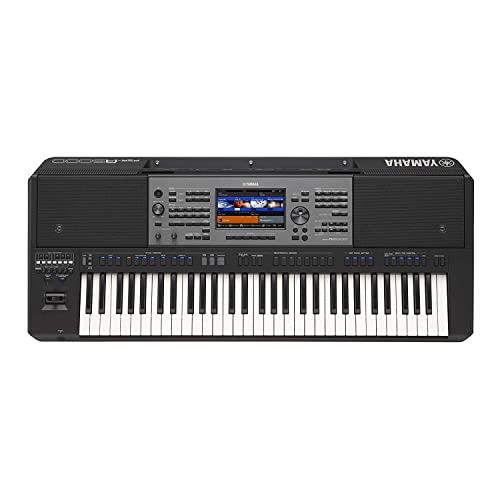
The Yamaha 61-Key Arranger Keyboard (PSRA5000) stands out as an ideal choice for gigging musicians looking to enhance their performances with its diverse range of features. With 210 new world music styles and a variety of voices, including unique samples like Oud and Istanbul Strings, you’ll never run out of inspiration. The assignable joystick controller and knobs let you manipulate effects in real time, while the real-time scale tuning guarantees your performance stays in key. Weighing just 25.4 pounds, it’s portable enough for any gig, making it a top pick for musicians seeking versatility and ease of use.
Best For: Gigging musicians seeking a portable and versatile keyboard with a wide range of styles and features to enhance their performances.
Pros:
- 210 new world music styles provide extensive creative options for performances.
- Real-time manipulation of effects through assignable knobs and joystick enhances musical expression.
- Lightweight design (25.4 pounds) makes it easy to transport for gigs.
Cons:
- Limited to 61 keys, which may not suit all musicians’ preferences for range.
- Plastic material may feel less durable compared to other higher-end keyboards.
- Specific voice samples and styles may not appeal to all musical genres.
Yamaha 61 Touch Sensitive Keys Portable Keyboard for Beginners

For those just starting their musical journey, the Yamaha 61 Touch Sensitive Keys Portable Keyboard stands out as an exceptional choice. With its 61 touch-sensitive keys, you’ll develop proper playing technique while enjoying dynamic volume control through the Touch Tutor feature. The Keys to Success guides you through learning songs step-by-step, while Smart Chord lets you play chords with just one finger. You’ll also find a rich library of built-in songs, perfect for all ages and skill levels. Plus, it comes with a music rest and power adapter, making it a complete package for aspiring musicians like you.
Best For: This keyboard is best for beginners of all ages who want to develop their musical skills in a supportive and engaging environment.
Pros:
- 61 touch-sensitive keys enhance playing technique and dynamic expression.
- Built-in learning tools and song library make it easy for beginners to progress.
- Includes essential accessories like a music rest and power adapter for convenience.
Cons:
- Limited advanced features may not satisfy experienced players.
- The keyboard size may not be suitable for those seeking a full-sized piano experience.
- Battery operation is not supported, requiring a power outlet for use.
Casio Casiotone CT-S500 Portable Keyboard

Designed for musicians on the go, the Casio Casiotone CT-S500 Portable Keyboard weighs in at under 10 lbs, making it incredibly easy to transport to gigs. With 61 full-size touch-responsive keys, you’ll enjoy expressive playability. It boasts 800 studio-quality tones, including a striking German concert grand piano, powered by the AiX Sound Source for rich textures. You’ll love the creative control with three assignable knobs and pitch bend. Built-in production tools like a six-track recorder and 243 rhythms enhance your performance. Plus, with Bluetooth connectivity and support for the Casio Music Space app, you can take your music to new heights.
Best For: Musicians seeking a lightweight, portable keyboard with professional sound quality and extensive creative features for performances and practice.
Pros:
- Compact and lightweight design makes it easy to transport to gigs or rehearsals.
- 800 studio-quality tones and the AiX Sound Source provide a rich and versatile sound palette.
- Built-in production tools like a six-track recorder and Bluetooth connectivity enhance music creation and performance.
Cons:
- Limited polyphony may restrict complex performances with multiple voices.
- No built-in speakers may require external amplification for live settings.
- Learning curve for advanced features could be challenging for beginners.
YAMAHA 61-Key Touch-Sensitive Portable Keyboard (PSRE473)

Musicians seeking a portable yet powerful solution will find the YAMAHA 61-Key Touch-Sensitive Portable Keyboard (PSRE473) an ideal companion. With its pro-quality sound, you’ll enjoy 820 Voices, including Super Articulation Lite Voices, perfect for any performance. The 290 Accompaniment Styles and high-end effects elevate your music, while assignable knobs allow real-time manipulation for added creativity. You’ll appreciate the Mega Boost feature that enhances volume by +6dB, ensuring you’re heard in any venue. Plus, the Motion Effect adds depth with Filter, Pitch, and Modulation effects. This keyboard offers versatility and quality that every gigging musician craves.
Best For: Musicians looking for a portable keyboard with professional sound quality and versatile performance features.
Pros:
- Pro-quality sound with 820 Voices, including Super Articulation Lite.
- 290 Accompaniment Styles and high-quality effects for enhanced creativity.
- Real-time manipulation with assignable knobs and features like Mega Boost and Motion Effect.
Cons:
- Limited to 61 keys, which may not suit all players.
- Some high-end features may not be as robust as those found in more expensive models.
- Portability may sacrifice some weight and build quality compared to larger keyboards.
Roland GO:KEYS 3 Music Creation Keyboard

The Roland GO:KEYS 3 Music Creation Keyboard stands out as an ideal choice for gigging musicians seeking versatility and ease of use. With its 61-note layout and built-in stereo speakers, it’s perfect for live performances. You’ll love the Bluetooth audio/MIDI support for seamless music streaming and creation. The ZEN-Core engine packs over 1,000 iconic Roland sounds and 200 onboard music styles, ensuring you’ll have plenty of options to explore. Plus, with USB connectivity, you can easily integrate it with your favorite music software. Weighing just 12.2 pounds, it’s lightweight and portable, making it a fantastic gigging companion.
Best For: Gigging musicians seeking a versatile and portable keyboard for live performances.
Pros:
- Lightweight and portable: Weighs only 12.2 pounds, making it easy to transport.
- Diverse sound options: Features over 1,000 sounds and 200 onboard music styles for creative exploration.
- Bluetooth connectivity: Allows for seamless music streaming and integration with mobile devices.
Cons:
- Limited advanced features: May not meet the needs of professional musicians seeking advanced functionalities.
- Plastic build quality: Construction may feel less sturdy compared to higher-end models.
- No weighted keys: Lacks weighted keys, which can be a drawback for pianists seeking a more realistic touch.
Factors to Consider When Choosing Arranger Keyboards for Gigging
When choosing an arranger keyboard for gigging, you need to think about several key factors. Portability and weight are essential for easy transport, while sound quality features can make or break your performance. Additionally, consider the user interface, connectivity options, and performance tools to guarantee you have everything you need on stage.
Portability and Weight
Choosing the right arranger keyboard hinges on portability and weight, especially for gigging musicians. A lightweight model, typically under 10 pounds, can make transportation and setup a breeze. Look for compact designs that fit easily into tight spaces and transportation cases. Keyboards with strap pins and line outputs are also beneficial, ensuring secure handling and straightforward connections to amplifiers or PA systems. If you perform in locations without easy access to power, consider battery-operated options for added flexibility. Additionally, aim for keyboards under 40 inches in width, as they’re generally more manageable for transport and quick stage setups. Prioritizing these factors will enhance your gigging experience greatly.
Sound Quality Features
Sound quality features play an essential role in elevating your performance as a gigging musician. Look for keyboards equipped with advanced sound engines like AiX or ZEN-Core, which offer ultra-realistic instrument sounds and rich tonal detail. A diverse selection of onboard tones and voices—think 800 tones and 300 music styles—enhances your versatility and creativity during live shows. High-quality speaker systems with built-in stereo speakers, including independent woofers and tweeters, are vital for delivering powerful sound in various venues. Customizable effects, like DSP effects and assignable knobs, allow you to manipulate sounds in real-time. Finally, check the keyboard’s sampling capabilities and recording features to capture unique soundscapes that will truly impress your audience.
User Interface Design
As you explore the world of arranger keyboards, the user interface design becomes a key factor in your overall performance experience. A user-friendly interface with a large, color touch display enhances navigation, especially during live performances where quick adjustments matter. Intuitive controls like assignable knobs and sliders allow you to manipulate effects in real-time, customizing your sound on the fly. Look for clear labeling and organized features to minimize the learning curve, making it easier to access various functions during gigs. Dedicated buttons for frequently used functions streamline adjustments, helping you focus on your playing instead of searching through menus. Finally, a compact design balances portability and functionality, ensuring you can easily transport your keyboard without sacrificing essential features.
Connectivity Options Available
When selecting an arranger keyboard for gigging, connectivity options play an important role in enhancing your performance flexibility. Look for keyboards with USB connectivity for seamless data transfer and integration with your favorite music software on computers or mobile devices. Bluetooth capabilities are a great addition, allowing for wireless audio streaming and MIDI connections, which can make your setup more versatile. Don’t forget a headphone jack for personal monitoring during practice or performances. Additional ports, like aux inputs for external audio sources and line outputs for amplifiers or PA systems, are vital. Finally, verify MIDI input/output ports are available, enabling you to connect other MIDI devices and expand your performance setup effectively.
Performance Tools Included
Connectivity options set the stage for your performance, but the real magic happens with the performance tools included in an arranger keyboard. Features like phrase pads and auto-accompaniment let you create engaging backing tracks effortlessly, allowing you to focus on your live gig. Chord sequencers help you lay down harmonies in real-time, enhancing your creative options. Assignable knobs are invaluable for manipulating effects and parameters dynamically, giving you control over your sound as you play. Additionally, a variety of built-in rhythms and styles cater to different genres, ensuring you can adapt your performance to any audience. With these tools at your fingertips, you’ll elevate your live shows and captivate your listeners more effectively than ever.
Built-in Recording Capability
Having built-in recording capability can be a game-changer for gigging musicians. This feature lets you capture your performances directly on the keyboard, making it easy to play back and review your work for improvement or sharing. With a 17-track recorder, you can layer and arrange multiple musical elements, enhancing your creative process during live shows. Some keyboards even allow you to save recordings as audio files, which you can transfer to your computer or share online, reaching a wider audience. Plus, built-in recording capabilities often eliminate the need for external equipment, streamlining your setup and saving space. With functions like overdubbing and mixing, you can achieve a more polished and professional sound during your performances.
Style Variety and Customization
To elevate your live performances, the variety and customization of styles on an arranger keyboard are essential factors to evaluate. A diverse selection of over 300 onboard music styles lets you explore different genres, enhancing your set. Customization features, like adding 30 styles via software, allow you to tailor your sound to specific gigs. With Super Articulation Voices and advanced performance tools, you can achieve realistic expression, engaging your audience more effectively. Additionally, the extensive range of 800 editable tones and 235 rhythms opens up limitless creative possibilities. Features such as style section reset and accent functions help you navigate songs smoothly, ensuring you maintain dynamic energy throughout your performances. Choose wisely, and your music will shine!
Price and Value Assessment
Choosing the right arranger keyboard not only enhances your performance but also demands careful consideration of price and value. With models ranging from around $300 to over $2,000, it’s essential to assess your budget and the features you need. Look beyond the initial price; consider long-term benefits like software updates and expandability for additional sounds. Features such as sound quality and the number of built-in voices can greatly influence pricing, with higher-end models offering better creative options. Don’t forget to evaluate warranty and customer support, as these factors contribute to overall value and peace of mind. Finally, think about resale value; some brands maintain better demand and reputation, making them wise investments for gigging musicians.