The best samplers for home studios make it easier to capture ideas, reshape sounds, build beats, and perform without relying entirely on a computer. The right choice depends on your preferred workflow, available space, and how deeply you want to edit and sequence samples.
This roundup covers compact grooveboxes, portable samplers, performance-focused instruments, and advanced production tools. Use the guide below to compare essential features before choosing the sampler that fits your studio.
Best 10 Samplers for Home Studios Picks for 2026
Performance Powerhouse

- OLED waveform editing and velocity-sensitive RGB pads
- 32-voice polyphony with 160 samples per project
- Extensive effects and flexible portable power
Best For: Performance-focused beatmakers and resampling enthusiasts
Touchscreen Tabletop Studio

- Compact touchscreen sampling and sequencing workflow
- Records, edits, and arranges without a computer
- Connects to synths, drum machines, and other hardware
Best For: Space-conscious producers building a computer-free tabletop studio
Portable MPC Entry Point

- Battery-powered standalone sampler with speaker and microphone
- 16 pads, sample chopping, timestretch, and resampling
- Four FX processors with 60 effect types
Best For: Beginners and portable MPC-style beatmakers
Grid-Based Groovebox

- Eight flexible sample tracks for beat and melody work
- 32-step patterns chainable to 256 steps per track
- Four-hour battery with performance FX and resampling
Best For: Hands-on beatmakers and live performers using grid sequencing
Best Portable Groovebox
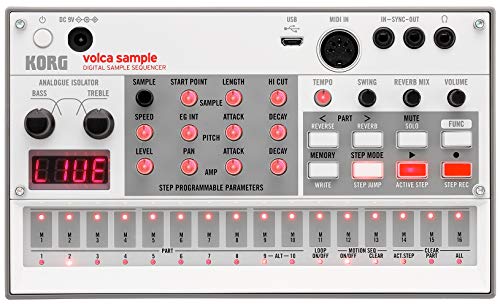
- 16-step sequencer with pattern chaining
- Expanded memory for more samples
- Battery-powered with speaker and headphone output
Best For: Portable beatmaking and compact home studios
Best Pocket Sound-Design Sampler

- Built-in microphone for quick sampling
- Chop, resample, and chromatic playback tools
- Granular controls for advanced sound shaping
Best For: Mobile sampling and experimental sound design
Best Advanced Sequencing Sampler

- 16 audio and MIDI-capable tracks
- 128-step sequencer with Song Mode
- Per-track effects, LFOs, and filter options
Best For: Detailed electronic compositions and advanced beatmaking
Performance Sampler

- 29 DSP effects with seamless switching
- 12 pads, Sub Pad, and pattern sequencer
- Expandable SD storage up to 32GB
Best For: Hands-on beatmaking and live performance
Pocket Sampling Pick
Teenage Engineering PO-33 K.O.!

- Built-in mic and 3.5 mm line input
- Melodic and drum modes with 40-second memory
- 16 effects and battery-powered portability
Best For: Portable beat sketches and quick sampling
Advanced Portable Sampler
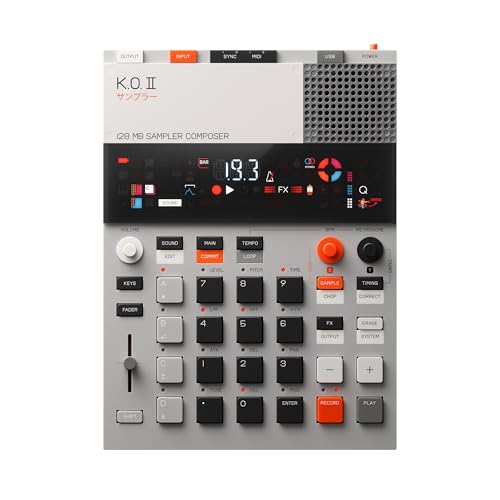
- 128MB memory with 999 sample slots
- Deep pattern, song, and resampling workflow
- Master, punch-in, MIDI, and sync features
Best For: Portable production and performance-oriented arrangements
Performance Powerhouse – Roland SP-404MKII
For home studios that prioritize hands-on beatmaking and live-style performance, the Roland SP-404MKII is a feature-rich choice among samplers for home studios. Its quick workflow, extensive effects, OLED waveform editing, and portable power options make it suitable for both desk-based production and mobile sessions.
Best For: Performance-oriented beatmakers who want deep sampling, resampling, and effects without relying on a computer.
Pros:
- Vivid OLED display supports waveform editing, menu access, and fast sample management.
- Offers 32-voice polyphony, 160 samples per project, and 16 internal projects.
- Includes extensive effects, including Vinyl Simulator, DJFX Looper, lo-fi, cassette, and resonator options.
- Supports USB-C, AC power, mobile battery power, or six AA batteries.
Cons:
- Its broad feature set may take time to learn.
- The supplied details list a weight of 4.6 pounds, which may be less convenient for frequent travel.
The SP-404MKII stands out when expressive pads, rapid resampling, and creative effects matter more than a minimalist workflow. It is a strong fit for producers who want a highly capable centerpiece for beatmaking and performance.
Touchscreen Tabletop Studio – 1010music Blackbox
The 1010music Blackbox is a compact option for samplers for home studios, combining recording, editing, sequencing, and touchscreen control in a small tabletop unit. It can help build a computer-free setup while still connecting to synths, drum machines, and other hardware.
Best For: Producers seeking a compact, touchscreen-based sampler for arranging songs and integrating external gear.
Pros:
- Familiar touchscreen interface supports recording, editing, and sequencing.
- Works without a computer for capturing samples, arranging sequences, and creating songs.
- Compact design suits space-conscious tabletop studios.
- USB connectivity expands performance and control possibilities.
Cons:
- The supplied notes provide fewer details about onboard effects and performance controls than some competing models.
- Its touch-focused interface may be less appealing to users who prefer physical pads and knobs.
The Blackbox is best viewed as a streamlined, hardware-friendly sampling studio. Its small footprint and touchscreen workflow make it especially practical when desk space is limited and computer-free production is a priority.
Portable MPC Entry Point – Akai MPC Sample
The Akai Professional MPC Sample offers an approachable route into samplers for home studios, combining MPC-style sequencing with battery power, a built-in speaker, microphone, and standalone operation. It is designed for quick chopping, beatmaking, and portable idea capture without a computer or DAW.
Best For: Beginners, MPC newcomers, and producers who want a portable sampler with built-in recording and beatmaking tools.
Pros:
- Standalone design includes a rechargeable battery, speaker, microphone, and microSD storage.
- Provides 16 responsive pads, a color display, Instant Sample Chop Mode, and real-time timestretch/repitch.
- Includes four internal effects processors with 60 effect types and dedicated knob control.
- Offers USB-C audio/MIDI connectivity plus line, headphone, MIDI, and sync connections.
Cons:
- MIDI DIN connection requires a separate 1/8-inch-to-MIDI adapter.
- Its compact control layout may offer less physical control than larger MPC systems.
The MPC Sample is a practical pick for getting from recorded sound to a finished groove quickly. Its built-in microphone, speaker, battery, and familiar MPC workflow make it particularly useful for portable creation and straightforward home-studio sampling.
Grid-Based Groovebox – Novation Circuit Rhythm
The Novation Circuit Rhythm is a focused choice among samplers for home studios, pairing direct sample recording with an eight-track sequencer and performance effects. It can capture audio from a phone, turntable, or synth, then slice, reverse, loop, resample, and arrange it into beats.
Best For: Beatmakers and live performers who want an immediate grid-based workflow with flexible sample tracks and sequencing.
Pros:
- Eight sample tracks provide room for drums, basslines, melodies, and chopped audio.
- Each track supports 32-step patterns that can chain to 256 steps.
- Includes hands-on sample processing, performance FX, reverb, delay, and sidechain.
- Four-hour battery life supports portable beatmaking and live use.
Cons:
- The workflow is centered on grid-based sequencing, which may not suit users seeking a touchscreen or linear arrangement interface.
- Its eight-track structure may feel limiting for larger, more layered projects.
Circuit Rhythm is a strong option for producers who value immediacy and tactile sequencing. Its combination of direct sampling, flexible eight-track playback, chainable patterns, and performance FX makes it well suited to both home-studio sketches and live sets.
Best Portable Groovebox – Korg Volca Sample 2
Korg Volca Sample 2 Digital Sample Sequencer Drum Machine w/Pattern Chain Mode and 16-step Sequencer
Check Price On AmazonThe Korg Volca Sample 2 is a compact, battery-powered option for musicians seeking samplers for home studios, beatmaking, and portable production. Its 16-step sequencer, pattern chaining, and expanded memory make it practical for building sample-based grooves without a computer.
Best For: Portable beatmaking, electronic genres, and beginners who want a straightforward sample sequencer.
Pros:
- 16-step sequencing includes pattern chain mode and start delay.
- Expanded memory supports more samples and longer recordings than previous models.
- Built-in speaker, headphone output, batteries, and AC power support standalone use.
- Micro USB and Librarian software simplify computer and DAW connectivity.
Cons:
- Its 16-step workflow may feel limited for longer or more complex arrangements.
- The compact controls may be less suitable for users who prefer a larger workstation.
Choose the Volca Sample 2 if portability and quick pattern-based workflow matter most. Digital reverb, a double filter, and a lightweight design add useful flexibility for home or mobile setups.
Best Pocket Sound-Design Sampler – Roland AIRA Compact P-6
The Roland AIRA Compact P-6 is a pocket-size choice for producers comparing samplers for home studios and mobile sound design. Its built-in microphone, sample chopping, chromatic playback, and granular controls support quick experimentation from captured or imported sounds.
Best For: Producers who want hands-on sampling, portable loop creation, and granular sound manipulation.
Pros:
- Built-in microphone enables quick sample capture without external equipment.
- Chop, step-sampling, and resampling features support flexible sample creation.
- Chromatic and polyphonic playback expands performance options.
- Dedicated filters, envelopes, and granular parameters provide detailed sound shaping.
Cons:
- Its pocket-size form factor may require a learning period for detailed editing.
- Computer sample management depends on the P-6 Sample Tool software.
The P-6 stands out when immediacy and experimentation are priorities. It combines onboard sampling with deep manipulation tools in a small USB-C device that can complement a larger studio setup.
Best Advanced Sequencing Sampler – Elektron Digitakt II
The Elektron Digitakt II is a powerful option for experienced producers evaluating samplers for home studios. With 16 audio tracks, stereo or mono sample support, MIDI capability, and a 128-step sequencer, it is designed for detailed beat construction and complete electronic compositions.
Best For: Advanced beatmakers who need extensive sequencing, track-level effects, and performance-oriented sound design.
Pros:
- Sixteen audio tracks support stereo or mono samples as well as MIDI.
- 128-step Elektron sequencing and Song Mode accommodate longer arrangements.
- Each track includes assignable LFOs, effects, and swappable filter options.
- Euclidean sequencing and multiple trig modes encourage rhythmic experimentation.
Cons:
- At 3.3 pounds, it is less portable than pocket-size samplers.
- The broad sequencing and sound-design feature set may be demanding for beginners.
The Digitakt II is the strongest fit here for structured, hardware-centered production. Its track count, long sequences, Song Mode, and per-track processing make it suitable for building detailed performances and full compositions.
Performance Sampler – Roland SP-404SX
For home studios that need hands-on control and performance-ready effects, the Roland SP-404SX is one of the more capable samplers for home studios. It combines 12 trigger pads, a Sub Pad for rapid repeats, a pattern sequencer, and expandable SD storage in a portable format.
Best For: Beatmakers and performers who want extensive effects, tactile pad control, and expandable sample storage.
Pros:
- 29 DSP effects include filter, delay, voice effects, subsonic, and looper options.
- 12 trigger pads, three control knobs, and a Sub Pad support hands-on performance.
- Includes a 1GB SD card and supports expansion up to 32GB with SDHC.
- Quantized pattern sequencing and shuffle feels support beat creation.
Cons:
- The included storage is only 1GB, so expansion may be useful for larger libraries.
- Its 1/4-inch audio connection may require adapters depending on the rest of the setup.
The SP-404SX stands out when live-style manipulation matters as much as arranging samples. Seamless effects switching and dedicated controls make it a strong choice for turning a home-studio idea into a performance.
Pocket Sampling Pick – Teenage Engineering PO-33 K.O.!
The Teenage Engineering PO-33 K.O.! is a compact entry point for anyone comparing samplers for home studios. Its built-in microphone and 3.5 mm line input make capturing sounds easy, while melodic and drum modes let you turn those recordings into short compositions.
Best For: Portable beatmaking, quick sound capture, and beginners who want a small sampler with sequencing and effects.
Pros:
- Samples through either the built-in microphone or 3.5 mm line input.
- Provides melodic and drum modes with 8 slots for each type.
- Includes 16 onboard effects for shaping sampled sounds and patterns.
- Battery-powered design includes a built-in speaker and headphone-friendly line output.
Cons:
- Its 40-second sample memory is limited compared with larger samplers.
- The compact control layout may be less comfortable for extended, detailed studio sessions.
The PO-33 K.O.! favors immediacy and portability over extensive storage. It is a practical choice for sketching beats, sampling everyday sounds, and building ideas away from a full-size setup.
Advanced Portable Sampler – Teenage Engineering K.O. II
The Teenage Engineering EP-133 K.O. II offers a broader workflow for home producers who want samplers for home studios with more memory, sequencing depth, and connectivity. It adds 128MB of memory, 999 sample slots, a redesigned sequencer, resampling, and both master and punch-in effects.
Best For: Producers who want portable sampling with deeper pattern arrangement, live effects, MIDI, and sync connections.
Pros:
- 128MB memory and 999 sample slots provide substantially more room than the PO-33 K.O.!
- Four groups of 99 patterns, song mode, and a commit button support fast arrangement.
- Offers six master effects and 12 punch-in effects controlled by a multifunctional fader.
- Supports line-in and microphone sampling, resampling, sync in/out, and MIDI in/out.
Cons:
- Its feature-rich workflow may take more time to learn than a simpler pocket sampler.
- The unit uses 4 AAA batteries or USB-C power, rather than an included dedicated power supply.
With its expanded memory, pattern structure, and connectivity, the K.O. II is better suited to developing complete tracks than merely capturing short sketches. The OS 2.0 features further strengthen its resampling, arrangement, and MIDI-focused workflow.
How We Picked the Best Samplers for Home Studios
We evaluated these samplers by looking at the features that matter most in a home setup: sampling method, sequencing flexibility, sound-shaping tools, portability, connectivity, storage, and ease of use. We also considered whether each unit is better suited to beat making, live performance, sound design, or all-purpose production.
A strong home-studio sampler should offer a practical way to record or import audio, organize samples, and turn them into finished patterns. Hands-on controls, reliable timing, and straightforward computer integration are especially valuable when space and setup time are limited.
Quick Comparison
| Best For | Recommended Options |
|---|---|
| All-around performance sampling | Roland SP-404MKII, Novation Circuit Rhythm |
| Compact production and sound design | 1010music Blackbox, Roland AIRA Compact P-6 |
| Deep sequencing and advanced control | Elektron Digitakt II |
| Portable MPC-style workflow | Akai Professional MPC Sample |
| Budget-friendly sample sequencing | Korg Volca Sample 2 |
| Small, immediate beat making | PO-33 K.O.!, EP–133 K.O. II |
| Classic SP-series workflow | Roland SP-404SX |
Key Buying Factors for Samplers for Home Studios
Sampling and Editing Workflow
Check whether the unit records through a microphone or line input, imports audio from a computer, or supports both. Consider how easily you can trim, chop, tune, loop, and assign samples. Fast editing is more valuable than a long feature list if you want to capture ideas spontaneously.
Sequencing and Track Capacity
Look at the number of tracks, patterns, voices, and available sequence controls. A simple 16-step sequencer can be ideal for quick drum patterns, while a deeper multitrack system is better for complete arrangements and detailed automation.
Effects, Connectivity, and Storage
Built-in effects can turn a basic sampler into a performance instrument, but review the available inputs, outputs, MIDI, USB, and memory options as well. A compact device may be convenient, yet limited storage or connectivity can become restrictive as your sample library grows.
Portability and Control Layout
For a desk-based studio, larger pads, knobs, and displays may improve precision. If you plan to create away from the computer or perform live, battery operation, compact dimensions, and immediate hands-on controls may matter more.
Who Should Buy Which Samplers for Home Studios?
Choose the Roland SP-404MKII or Novation Circuit Rhythm if performance sampling, effects, and beat-focused creativity are your priorities. The 1010music Blackbox suits producers who want a compact, screen-based sampling workstation, while the Elektron Digitakt II is the stronger fit for detailed sequencing, parameter control, and experimental sound design.
The Akai Professional MPC Sample is a natural choice for producers who prefer an MPC-inspired workflow. Choose the Korg Volca Sample 2 for inexpensive pattern-based sequencing, or the Roland AIRA Compact P-6 for a small modern sampler with a performance-friendly format. The PO-33 K.O.! and EP–133 K.O. II are best for spontaneous portable sketching, while the Roland SP-404SX remains appealing to buyers who specifically want its established SP-series character and workflow.