Choosing the right studio monitors can make a major difference in how confidently you mix, edit, and produce. The options below range from compact desktop speakers to larger nearfield monitors designed for louder, more detailed listening.
We’ve compared these models by driver size, connectivity, placement flexibility, output, and overall suitability for different studio spaces and workflows.
Best 10 Studio Monitors with Ribbon Tweeters Picks for 2026
Deep-Bass Ribbon Detail

- ART ribbon-derived tweeter with HPS waveguide
- 35Hz–22kHz response and 118dB SPL
- Includes isolation pads and XLR cables
Best For: Bass-heavy production and larger mix rooms
Compact Ribbon Precision

- U-ART tweeter with HPS waveguide
- Room-adjustment high- and low-shelf filters
- XLR, TRS, and RCA inputs
Best For: Compact home studios and desktop monitoring
Small-Desk Simplicity

- Compact 4.5-inch two-way monitor pair
- XLR/TRS, RCA, and stereo mini inputs
- Room Control and High Trim adjustments
Best For: Small workstations and everyday audio production
Extended Bass Monitor

- U-ART accelerated ribbon tweeter
- Bass extension reaches 33Hz
- Wide sweet spot from HPS waveguide
Best For: EDM, hip-hop, and film scoring
Balanced Entry-Level Reference

- U-ART tweeter reaches up to 25kHz
- HPS waveguide supports precise imaging
- Includes XLR cables and room-adjustment filters
Best For: Home-studio mixing and critical listening
Compact Desktop Ribbon Detail
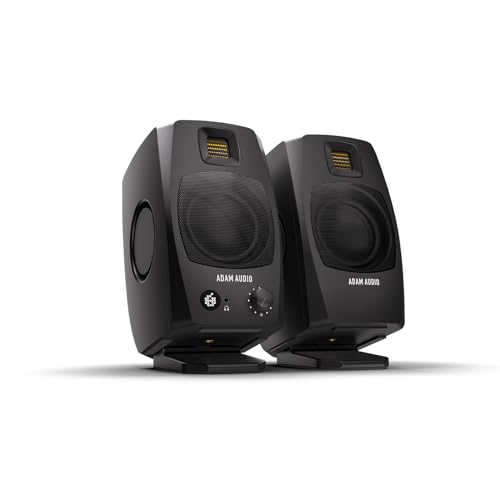
- D-ART ribbon tweeter for detailed highs
- USB-C, 1/4-inch, and RCA connectivity
- Includes angled desktop stands
Best For: Compact computer-based production setups
Extended Low-End Monitoring

- 7-inch woofer reaches down to 39Hz
- U-ART ribbon tweeter reaches 25kHz
- Includes balanced cables and room-trim controls
Best For: Home studios needing fuller bass monitoring
Best Desktop Pick

- D-ART ribbon tweeter for detailed highs
- USB-C and balanced 1/4-inch inputs
- Compact design reaches down to 45 Hz
Best For: Desktop producers and songwriters
Best Ready-to-Connect Pair

- U-ART ribbon tweeter reaches 25 kHz
- Includes XLR and RCA connection cables
- 5-inch woofers with room EQ controls
Best For: Home studios and nearfield mixing
Best Versatile Alternative

- Three-way 110-watt RMS speaker system
- Bluetooth plus XLR, TRS, RCA, and AUX
- App and rear controls for room tuning
Best For: Flexible studio and multimedia setups
Deep-Bass Ribbon Detail – ADAM Audio T8V Bundle
For producers seeking studio monitors with ribbon tweeters, this T8V bundle combines ADAM Audio’s ART ribbon-derived tweeter and HPS waveguide with an 8-inch woofer. Its deep bass extension, high output, isolation pads, and included XLR cables make it a practical package for bass-focused production and larger mix rooms.
Best For: Hip-hop, trap, electronic, R&B, and other bass-intensive work where extended low-end monitoring is important.
Pros:
- ART ribbon tweeter and HPS waveguide support detailed highs and controlled stereo dispersion.
- 35Hz–22kHz response and up to 118dB SPL provide substantial low-end range and headroom.
- Includes large isolation pads, power cables, and multiple balanced XLR cables.
- XLR, TRS, and RCA inputs plus adjustable high- and low-shelf EQ improve setup flexibility.
Cons:
- The 8.5-inch monitors are more suited to larger spaces than compact desktop setups.
- The bundle is less streamlined if you already own cables and isolation pads.
This is the most complete option here for buyers who want ribbon-derived high-frequency detail alongside powerful bass reproduction. The included accessories also address common placement and connection needs.
Compact Ribbon Precision – ADAM Audio T5V
The ADAM Audio T5V is a compact choice for anyone comparing studio monitors with ribbon tweeters for recording, podcasting, music production, or mixing. Its U-ART tweeter and HPS waveguide emphasize high-frequency detail, while rear-panel filters help adapt the monitor to challenging rooms.
Best For: Home studios, desktop workstations, podcast production, guitar tracking, and general nearfield monitoring.
Pros:
- U-ART tweeter and HPS waveguide deliver detailed high-frequency reproduction.
- 5-inch design is practical for limited-space setups.
- High- and low-shelf filters support room adjustment.
- XLR, 1/4-inch TRS, and RCA connections accommodate multiple audio sources.
Cons:
- Its smaller woofer does not offer the same low-end extension as the T8V.
- The supplied listing describes a single-count package, so confirm whether a pair is included before ordering.
The T5V offers a useful balance of detailed ribbon-style highs and compact placement. It is a sensible starting point when desk space matters more than maximum bass output.
Small-Desk Simplicity – Yamaha HS4 Powered Pair
The Yamaha HS4 is a compact pair for buyers who want practical nearfield monitoring in a small workstation. Although it uses a 1-inch dome tweeter rather than a ribbon tweeter, its 4.5-inch woofer, multiple inputs, room controls, and included anti-slip pad make it a useful compact alternative to studio monitors with ribbon tweeters.
Best For: Small DAW workstations, video editing, music production, and monitoring from laptops, tablets, or other compact sources.
Pros:
- Pair includes 4.5-inch woofers and 1-inch dome tweeters in a compact format.
- Room Control and High Trim controls help tailor the response.
- Offers XLR/TRS combo, RCA, and stereo mini inputs.
- Includes speaker cable, stereo mini-to-RCA cable, and anti-slip pad.
Cons:
- The 60Hz–22kHz response provides less low-end reach than the ADAM T8V models.
- It does not use a ribbon tweeter, so it may not suit buyers requiring that driver design.
The HS4 is best viewed as a compact, versatile pair rather than a direct ribbon-tweeter match. Choose it when small dimensions, straightforward connectivity, and included accessories are priorities.
Extended Bass Monitor – ADAM Audio T8V
The ADAM Audio T8V is built for buyers seeking studio monitors with ribbon tweeters and pronounced low-end capability. Its U-ART accelerated ribbon tweeter and HPS waveguide are paired with an 8-inch woofer that reaches down to 33Hz, making it especially relevant for bass-heavy music and film scoring.
Best For: EDM, hip-hop, bass-intensive production, film scoring, and larger desktop or studio monitoring setups.
Pros:
- U-ART accelerated ribbon tweeter reaches up to 25kHz.
- 33Hz bass extension supports detailed monitoring of low frequencies.
- HPS waveguide creates a wider, more controlled listening sweet spot.
- Compatible with XLR, 1/4-inch TRS, and RCA connections.
Cons:
- The 8-inch cabinet requires more space than compact nearfield monitors.
- Its strong low-end capability may be excessive for very small or acoustically untreated rooms.
- The supplied listing should be checked carefully to confirm whether the purchase includes one monitor or a pair.
The T8V is a compelling choice when low-frequency definition is central to the work. Its ribbon tweeter design adds high-frequency reach, while the large woofer helps reduce the need for an immediate subwoofer.
Balanced Entry-Level Reference – ADAM Audio T5V
The ADAM Audio T5V is a practical starting point for anyone seeking studio monitors with ribbon tweeters. Its U-ART tweeter, 5-inch woofer, HPS waveguide, and bi-amplified 70W design aim to provide detailed stereo monitoring for home studios and desktop setups.
Best For: Home-studio mixing, critical listening, and users who need flexible XLR or RCA connectivity.
Pros:
- U-ART tweeter delivers detailed high-frequency reproduction up to 25kHz.
- HPS waveguide supports a wide, precise stereo image.
- Adjustable high- and low-shelf filters help adapt the speakers to the room.
- Includes a pair of monitors and XLR cables for straightforward setup.
Cons:
- The 5-inch woofer reaches down to 45Hz, so very deep bass may require a subwoofer.
- These are wired tabletop monitors rather than wireless speakers.
The T5V balances useful room controls, clear treble, and compact nearfield monitoring. It is a sensible choice when you want ribbon-tweeter detail without moving to a larger monitor.
Compact Desktop Ribbon Detail – ADAM Audio D3V
The ADAM Audio D3V brings ribbon-tweeter monitoring to a compact desktop format. Its 1.5-inch D-ART tweeter pairs with 3.5-inch aluminum woofers, passive radiators, USB-C connectivity, and included angled stands for convenient computer-based production.
Best For: Songwriters, producers, and listeners who need a small active monitor pair for a desk or compact workspace.
Pros:
- D-ART tweeter is designed for precise, less-fatiguing high-frequency reproduction.
- USB-C, balanced 1/4-inch inputs, and RCA support flexible connections.
- Passive radiators extend bass response to 45Hz from the compact enclosure.
- Included 15-degree stands and headphone output suit desktop workflows.
Cons:
- The 3.5-inch woofers provide less low-frequency scale than larger monitors.
- The compact system is rated at 80W total, limiting headroom compared with larger studio monitors.
The D3V is especially appealing when desk space and direct computer connectivity matter. Its ribbon-style D-ART tweeter provides the desired high-frequency character while the passive radiators help the small speakers cover useful bass.
Extended Low-End Monitoring – ADAM Audio T7V
The ADAM Audio T7V is a larger option for buyers comparing studio monitors with ribbon tweeters. Its U-ART ribbon tweeter reaches up to 25kHz, while the 7-inch woofer extends to 39Hz for fuller monitoring of kicks, bass, and synthesizer lows.
Best For: Home studios, project rooms, and mixing setups with an audio interface that need greater low-end reach.
Pros:
- 7-inch woofer reaches down to 39Hz for more extended bass response.
- U-ART tweeter provides fast, detailed high-frequency reproduction.
- High- and low-shelf trims help manage room and desktop placement.
- Balanced XLR and RCA inputs support studio and consumer sources; cables are included.
Cons:
- The larger 7-inch design may be more than a small desk or compact room needs.
- The supplied bundle uses cables intended for balanced 1/4-inch interface outputs, so users may need different cabling for other connections.
Choose the T7V when low-frequency extension and additional scale matter more than the smallest footprint. Its room controls and flexible inputs make it a capable step up for interface-based monitoring.
Best Desktop Pick – ADAM Audio D3V
The ADAM Audio D3V is a compact choice for anyone shopping for studio monitors with ribbon tweeters in a desktop setup. Its 1.5-inch D-ART tweeter, USB-C connectivity, angled stands, and placement-focused DSP controls make it practical for songwriting, production, and everyday listening.
Best For: Desktop producers, songwriters, and listeners who need compact monitors with flexible computer connectivity.
Pros:
- 1.5-inch D-ART ribbon tweeters provide precise, unfatiguing high-frequency reproduction.
- USB-C, balanced 1/4-inch, and RCA connectivity support computers and other sources.
- Compact active design includes angled stands and optional microphone-stand mounting.
- 3.5-inch woofers and passive radiators extend response down to 45 Hz.
Cons:
- The 3.5-inch woofers are designed for desktop use rather than large-room output.
- USB-C connectivity may be less useful for users working only with traditional studio hardware.
The D3V stands out when desk space and direct computer connection matter most. It combines ADAM’s ribbon-tweeter detail with useful placement controls and a compact footprint.
Best Ready-to-Connect Pair – ADAM Audio T5V
The ADAM Audio T5V bundle is a strong fit for buyers comparing studio monitors with ribbon tweeters for a home studio. It includes two 5-inch active monitors plus XLR and RCA-to-1/4-inch cables, while the U-ART tweeter, room EQ controls, and 45 Hz low-end response support practical nearfield monitoring.
Best For: Home studios, mixing setups, and producers who want a complete connection-ready monitoring pair.
Pros:
- U-ART accelerating ribbon tweeters deliver precise highs up to 25 kHz.
- Includes balanced XLR and RCA-to-1/4-inch cables for straightforward setup.
- Five-inch woofers, 70-watt bi-amp design, and 45 Hz response suit nearfield monitoring.
- HF and LF shelf controls help compensate for desk and wall placement.
Cons:
- The rear-firing bass reflex port requires some attention to placement.
- This is a wired monitoring system with no wireless connectivity.
For a traditional home-studio setup, the T5V bundle offers more scale than compact desktop monitors and removes the need to purchase basic cables separately. Its room-tuning controls add useful flexibility as your workspace changes.
Best Versatile Alternative – Edifier MR5
The Edifier MR5 is a versatile 2.0 monitor system, but it is not a ribbon-tweeter design. Instead, it uses a 1-inch silk dome tweeter in a three-way active system, making it worth considering if broad connectivity, wireless streaming, and room-adjustment features matter more than choosing studio monitors with ribbon tweeters.
Best For: Users who want studio-oriented speakers with Bluetooth, multiple wired inputs, and flexible room tuning.
Pros:
- Three-way design combines a 5-inch woofer, 3.75-inch mid driver, and 1-inch tweeter.
- Offers XLR, TRS, RCA, AUX, Bluetooth 6.0, and a front headphone output.
- Rear controls and the EDIFIER ConneX app provide multiple acoustic-tuning options.
- 110-watt RMS amplification and 101 dB peak SPL support nearfield use and mid-sized rooms.
Cons:
- Its silk dome tweeter does not match the ribbon-tweeter focus of the other options.
- The larger feature set may be unnecessary for a simple wired mixing setup.
The MR5 is best viewed as a flexible studio and multimedia speaker rather than a direct ribbon-tweeter alternative. Its three-way architecture, app controls, and wide input selection make it appealing when convenience and versatility take priority.
How We Picked the Best Studio Monitors with Ribbon Tweeters
We focused on monitors that use ribbon, folded-ribbon, or ribbon-style high-frequency drivers, along with closely related models included for practical comparison. The selection covers compact desktop systems, affordable nearfields, larger 7- and 8-inch monitors, and bundled packages with cables or isolation accessories.
Our evaluation priorities were treble detail, midrange clarity, bass extension, amplifier power, cabinet size, input options, stereo-pair availability, and likely room compatibility. Because room acoustics and placement strongly affect monitor performance, no single model is ideal for every studio.
Quick Comparison
| Best For | Recommended Type | What to Prioritize |
|---|---|---|
| Small desks and bedrooms | Compact 3- to 5-inch monitors | Low-volume clarity, front-panel controls, and manageable bass |
| General home-studio mixing | 5- to 7-inch nearfields | Balanced response, usable low end, and flexible inputs |
| Large rooms or bass-heavy work | 7- to 8-inch monitors | Output, bass extension, listening distance, and room treatment |
| Simple plug-and-play setups | Bundled pairs | Included cables, consistent matching, and easy connectivity |
Key Buying Factors for Studio Monitors with Ribbon Tweeters
Room Size and Listening Distance
Larger woofers can deliver deeper bass and higher output, but they also need more space and a suitable listening distance. In a small untreated room, a compact 3- or 5-inch monitor may provide more reliable results than an oversized model that excites room modes.
High-Frequency Detail
Ribbon-style tweeters are often chosen for their fast transient response and extended treble presentation. That detail can reveal hiss, harshness, and editing artifacts, but it may also expose poor recordings or become fatiguing if the monitor is aimed too directly at the listener. Use the available high-frequency controls and angle the speakers carefully.
Bass Response and Placement
Check the published low-frequency range, but do not treat it as a guarantee of flat bass in your room. Keep monitors away from walls when possible, place them on stable stands or isolation pads, and form an equilateral triangle with your listening position. Larger models may benefit from room treatment or bass trapping.
Inputs, Controls, and Accessories
Balanced XLR or TRS inputs are preferable for longer cable runs and interfaces with balanced outputs. RCA or auxiliary connectivity can be useful for desktop systems and casual playback. Bundles that include cables and isolation pads can reduce setup costs, but verify cable types and lengths before buying.
Who Should Buy Which Studio Monitors with Ribbon Tweeters?
Choose a compact desktop monitor if you produce at a desk, work at moderate levels, or have limited room. These models are easier to position and less likely to overwhelm a small space.
Choose a 5- or 7-inch nearfield pair for the best all-around home-studio balance. They typically offer enough bass and headroom for mixing while remaining easier to manage than larger cabinets.
Choose an 8-inch monitor if your room is reasonably large, your listening position is several feet away, and you need stronger low-frequency extension or higher output. Treat the room before assuming the extra bass will improve accuracy.
Choose a bundled package if you want a straightforward setup with matching speakers and included cables or isolation accessories. For critical mixing, prioritize monitor placement and room correction over bonus items.