Choosing midi controllers for apartments means balancing size, noise, and workflow. The best options stay compact, travel easily, and let you create without turning a small room into a gear jungle.
Below, we focus on ten picks that make sense for bedroom studios, shared spaces, and late-night sessions, with an emphasis on portable layouts and practical control.
Best 10 Midi Controllers for Apartments Picks for 2026
Compact Beatmaker Pick

- 25 mini velocity-sensitive keys
- 8 MPC-style pads and 8 knobs
- USB-powered and easy to place in small rooms
Best For: Apartment producers who want an all-in-one compact controller
Keyboard Essentials Pick

- 25 responsive mini keys
- Built-in arpeggiator and octave controls
- USB-powered plug-and-play design
Best For: Apartment musicians who want a simple, keyboard-first controller
Wireless DAW Control
Donner STARRYCTRL for Clean Apartment Setups
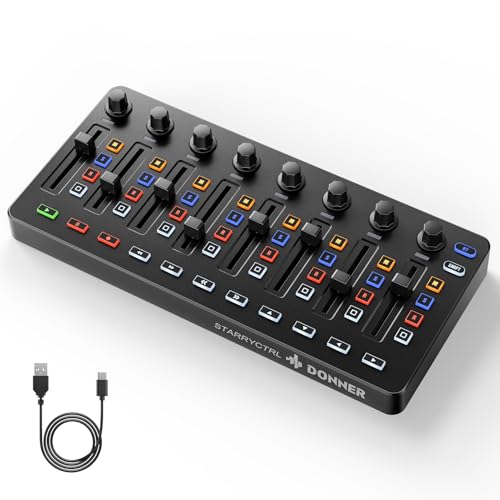
- Wireless, rechargeable design reduces cable clutter
- 8 faders, 8 knobs, and 43 assignable buttons
- MCU support and LED feedback simplify control
Best For: Producers who want a wireless mixer-style controller in a small space
Portable Keyboard Controller
Rhymo 25-Key MIDI for Small Spaces

- Slim 25-key layout fits compact desks
- USB-C powered with no batteries or adapters
- Velocity keys plus arpeggiator and loop controls
Best For: Beginners and mobile producers needing a small keyboard for tight spaces
Compact Mixer Control
Akai MIDImix for Apartment DAWs

- Lightweight mixer-style controller for small desks
- 8 faders, 24 knobs, and channel buttons
- Instant Ableton Live mapping simplifies setup
Best For: Producers who want compact hands-on mix control in an apartment
Compact Wireless Pad Controller
Compact Bluetooth MIDI for apartment beatmaking

- Bluetooth MIDI and USB MIDI for flexible, low-clutter setups
- 16 RGB velocity pads with aftertouch for expressive triggering
- Up to 15 hours of battery life for mobile sessions
Best For: Apartment producers and DJs who want a compact wireless pad controller
Desk-Friendly Keyboard Controller
49-key USB MIDI for home setups

- 49 full-size velocity-sensitive keys for a natural feel
- USB plug-and-play with no drivers or power supply required
- Transport, pitch, mod, and sustain controls for DAW work
Best For: Home producers and keyboard players who want a compact full-size controller
Feature-Packed Mini Controller
USB-C MIDI controller with pads and screen

- 25 mini keys in a portable, desk-friendly design
- 8 pads, 8 knobs, and a full-color screen for hands-on control
- Arpeggiator, chord, and scale modes for quick ideas
Best For: Beat makers and apartment creators who want a compact all-in-one controller
Compact Beatmaker Pick – Akai MPK Mini MK3
For midi controllers for apartments, the Akai Professional MPK Mini MK3 is a practical choice when you want real music-making control without taking over your desk. It runs over USB, keeps the footprint small, and still gives you mini velocity-sensitive keys, MPC-style pads, and plenty of knob control for sketches, beats, and virtual instruments.
Best For: Apartment producers who want a compact all-in-one controller for beat making, melodies, and basic DAW control.
Pros:
- 25 velocity-sensitive mini keys keep the unit compact for small spaces.
- 8 backlit MPC-style pads support drum programming and sample triggering.
- 8 assignable knobs plus a 4-way thumbstick add hands-on control.
- USB-powered design is easy to set up with Mac, Windows, and common DAWs.
Cons:
- Mini keys may feel tight for players who prefer full-size keys.
- No built-in audio output; it only controls software instruments.
If you need a compact controller that covers the essentials, the MPK Mini MK3 is one of the most balanced apartment-friendly options here. It packs in enough performance features to make it useful beyond a basic typing keyboard, while staying small enough for a crowded living room or bedroom studio.
Wireless Groove Station – Synido TempoPAD C16
If your goal is to keep cable clutter down, this wireless option stands out among midi controllers for apartments. The Synido TempoPAD C16 uses a rechargeable battery, BLE MIDI, and USB-C, so you can work from a tablet, phone, or computer while keeping your setup flexible and tidy.
Best For: Apartment beatmakers who want wireless control, portable sequencing, and a hardware-first workflow.
Pros:
- BLE MIDI and a rechargeable battery reduce cable mess in small spaces.
- Standalone editing lets you set notes, CCs, channels, and trigger modes on the device.
- Built-in 16-step/16-track sequencer helps you sketch patterns without a computer.
- 64 pads, 32 knobs, 16 faders, and 48 buttons offer deep control in a compact body.
Cons:
- It does not generate audio on its own.
- Battery runtime is listed at up to 5 hours, so long sessions may need charging.
The C16 is a strong pick if you value portability and a cleaner apartment setup more than traditional keyboard playing. It is especially appealing for mobile beatmaking, pattern sketching, and hybrid studio use where wireless control matters.
Keyboard Essentials Pick – Akai LPK25 MK2
The Akai Professional LPK25 is a slim, straightforward option for midi controllers for apartments when space is limited and you mainly want a responsive keyboard. It is USB-powered, compact, and designed for songwriting, jamming, and DAW use with a simple setup that stays out of the way.
Best For: Apartment users who want a small keyboard controller for melodies, bass lines, and quick composition.
Pros:
- 25 responsive mini keys keep the footprint small.
- Built-in arpeggiator adds creative motion for ideas and sketches.
- Octave up/down buttons extend the playable range.
- USB plug-and-play setup works with popular DAWs on Mac and PC.
Cons:
- It focuses on keyboard control and does not include pads or knobs.
- Mini keys are less spacious than full-size keys.
Choose the LPK25 if you want a minimal controller that is easy to fit on a narrow desk or shelf. It is best for players who prioritize keyboard feel and portability over performance extras.
Portable Pad Performer – EMP16 Bluetooth MIDI Pad Controller
The EMP16 is built for compact beatmaking setups and works well if you want midi controllers for apartments with fewer cables and a performance-first layout. It can run on USB or AA batteries, connects over Bluetooth 5.0, and gives you a banked pad surface plus assignable controls for hands-on rhythm work.
Best For: Apartment producers who want a wireless-capable pad controller with lots of assignable performance controls.
Pros:
- Bluetooth 5.0 and battery power help reduce cable clutter.
- 16 RGB pads expand to 64 assignable pads across banks.
- Assignable faders, buttons, and knobs provide flexible control.
- OLED display and onboard functions reduce the need for extra software editing.
Cons:
- It is a pad controller, so it is not the best fit if you need keys.
- Battery-powered use depends on AA batteries, which are not included.
The EMP16 is a good fit for users who want to finger drum, launch clips, and manage performance controls without filling a room with wires. Its combination of wireless support, banked pads, and onboard editing makes it especially practical for apartment setups.
Wireless DAW Control – Donner STARRYCTRL for Clean Apartment Setups
If you want midi controllers for apartments that cut down on cable clutter, the Donner STARRYCTRL is built around a wireless workflow. Its rechargeable battery and low-latency wireless design make it easier to place on a small desk, while the 8 faders, 8 knobs, and 43 assignable buttons give you plenty of control for DAW mixing without taking over the room.
Best For: Producers who want a wireless, customizable DAW controller for compact home studios and apartment setups.
Pros:
- Wireless design with built-in rechargeable battery helps keep desks cleaner.
- 8 faders and 8 knobs support hands-on volume and pan control.
- 43 assignable keys allow deep MIDI customization.
- Supports Mackie Control Universal for simpler setup.
Cons:
- More of a mixer-style controller than a keyboard for playing melodies.
- Wireless convenience may be more than some basic users need.
This is a strong pick if your apartment setup needs compact hardware that still feels flexible. The combination of soft-takeover style LED feedback, MCU support, and customizable controls makes it practical for mixing and performance without a lot of desk mess.
Portable Keyboard Controller – Rhymo 25-Key MIDI for Small Spaces
For midi controllers for apartments, a compact keyboard can be the easiest way to keep your setup flexible and quiet to store. This 25-key controller is slim, USB-C powered, and designed for quick music-making with velocity-sensitive keys, an arpeggiator, and simple hands-on controls that work well on a small desk.
Best For: Beginners and mobile producers who want a small, easy-to-use keyboard controller for apartment-friendly setups.
Pros:
- Ultra-portable slim design is easy to fit in tight spaces.
- USB-C power means no batteries or adapters are needed.
- Velocity-sensitive keys add expressive playing.
- Includes arpeggiator, loop, tap tempo, octave, and transpose controls.
Cons:
- 25 keys may feel limited for more complex keyboard parts.
- Best suited to lightweight production rather than deep hardware control.
It’s a practical choice if you want a straightforward keyboard controller that doesn’t crowd an apartment studio. The combination of USB-C power, Bluetooth MIDI, and broad DAW compatibility makes it especially convenient for casual composing and portable sessions.
Compact Mixer Control – Akai MIDImix for Apartment DAWs
If you’re comparing midi controllers for apartments and want direct access to mix functions, the Akai Professional MIDImix keeps things compact and simple. It’s a lightweight USB MIDI mixer controller with 8 faders, a master fader, 24 knobs, and transport-style channel buttons, making it a good fit for small desks where you want fast tactile control over your DAW.
Best For: Apartment producers who want a compact, hands-on mixer controller for DAW mixing and Ableton Live.
Pros:
- Compact, lightweight build suits smaller studio spaces.
- 8 channel faders plus 1 master fader support mix control.
- 24 assignable knobs provide broad parameter control.
- Instant 1-to-1 Ableton Live mapping makes setup easy.
Cons:
- Does not include keyboard keys for note input.
- Best for mixing and control rather than performance playing.
This is a solid fit if your apartment setup is centered on mixing, automation, and hands-on DAW control. The MIDImix focuses on practical layout and immediate mapping, which helps it stay useful without adding much footprint.
Compact Wireless Pad Controller – Compact Bluetooth MIDI for apartment beatmaking
If you want midi controllers for apartments that keep setup simple and cable clutter low, this mini wireless pad controller is built for that kind of space-conscious workflow. Bluetooth MIDI and USB MIDI give you flexible connection options, while the compact pad layout makes it easy to trigger beats, samples, and clips without taking over your desk.
Best For: Apartment producers, mobile beat makers, and DJs who want a compact, wireless pad controller for quick sketching and live triggering.
Pros:
- Bluetooth MIDI plus USB MIDI support for cable-free or wired use.
- 16 RGB velocity pads with aftertouch for expressive finger drumming and sample triggering.
- Built-in rechargeable battery lasts up to 15 hours, with ECO mode for longer standby.
- Customizable via PC software or mobile app for pad mapping, MIDI commands, and lighting.
Cons:
- Pad-based design may not suit players who want full piano-style keys.
- Customization adds a setup step if you want to tailor mappings and curves.
Overall, this is a strong fit for small-space music production if portability and clean desk setup matter more than traditional keyboard input. The expandable pad banks and app-based customization make it useful for beginners and performers alike.
Desk-Friendly Keyboard Controller – 49-key USB MIDI for home setups
For shoppers comparing midi controllers for apartments, this 49-key keyboard controller offers a practical balance of playable range and a relatively compact footprint. It connects by USB, is plug-and-play on Mac or PC, and adds enough hands-on controls to handle basic DAW work without crowding a small studio desk.
Best For: Home producers and keyboard players who need a straightforward, desk-friendly MIDI controller with full-size keys.
Pros:
- 49 full-size velocity-sensitive keys for a natural playing feel.
- USB plug-and-play operation with no drivers or power supply required.
- Includes transport, volume, pitch, modulation, octave, and sustain pedal controls.
- Compact design fits well in a desk, studio, or stage setup.
Cons:
- No built-in noise control or battery-powered operation.
- Larger than mini-key options, so it may still feel substantial in very tight spaces.
This is a sensible choice if you want a classic keyboard-style workflow without extra setup complexity. The full-size keys and included software bundle make it especially practical for apartment musicians building a home recording corner.
Feature-Packed Mini Controller – USB-C MIDI controller with pads and screen
If you need midi controllers for apartments that can do more than just play notes, this compact 25-key controller packs in pads, knobs, a screen, and deep DAW integration. Its USB-C, plug-and-play design is easy to live with in a small room, while the mini-key format keeps the footprint manageable for desks shared with a laptop or monitor.
Best For: Beat makers, traveling producers, and apartment creators who want a compact controller with hands-on performance tools.
Pros:
- 25 mini velocity-sensitive keys in a compact, portable form factor.
- 8 assignable 360° knobs plus a full-color screen and encoder for direct control.
- 8 velocity- and pressure-sensitive MPC pads with RGB feedback for finger drumming.
- Includes arpeggiator, chord and scale modes, and pre-mapped DAW integration.
Cons:
- Mini keys may feel less natural than full-size keys for pianists.
- Feature-rich layout may take a little time to learn.
This controller stands out if you want a small but capable apartment studio centerpiece. Between the pads, knobs, screen, and bundled software tools, it offers a lot of creative control without demanding much space.
How We Picked the Best Midi Controllers for Apartments
We prioritized compact footprints, low-noise playability, and flexible connection options. For apartment use, the ideal controller should be easy to store, simple to set up on a desk or lap tray, and useful for both music production and casual beat-making. We also looked for features that reduce clutter, such as USB power, wireless connectivity, and lightweight designs.
Quick Comparison
In general, 25-key controllers are the easiest fit for tight spaces, while 49-key models suit users who need a wider melodic range and still have a dedicated desk. Pad controllers are a smart choice for beat-focused producers who want minimal desk depth. Mixer-style controllers can also work well if your apartment setup centers on DAW control rather than performance playing.
Key Buying Factors for Midi Controllers for Apartments
Size and Desk Space
Measure your available surface before buying. A controller that looks small online can still crowd a narrow desk once you add a laptop, audio interface, and speakers. If space is tight, prioritize shorter keybeds and slim pad controllers.
Noise and Feel
Apartment-friendly controllers should feel responsive without being distracting. Semi-weighted or velocity-sensitive keys can improve control, but lighter synth-action keys often make more sense in shared living spaces and for portable use.
Connectivity and Power
USB-powered controllers reduce cable clutter, and Bluetooth can be convenient when your setup changes often. Just keep in mind that wired connections are usually the most reliable for recording and live timing.
Workflow Features
Look for arpeggiators, pads, assignable knobs, and mixer controls only if you will actually use them. Extra features are helpful, but in small apartments they should earn their place by saving time or replacing another device.
Who Should Buy Which Midi Controllers for Apartments?
If you are a beginner or need the smallest possible setup, a 25-key keyboard controller is usually the best starting point. Beatmakers and producers working mostly in a DAW may prefer pad controllers or compact mixer controllers. If you compose more melodic parts and have a bit more room, a 49-key option offers a better playing range without becoming too bulky.
For apartment dwellers, the best choice is rarely the biggest controller. It is the one that fits your space, supports your workflow, and stays easy to use every day.