Choosing the right pedal can make a solo acoustic set sound bigger, cleaner, and easier to manage on stage. The best options help you shape tone, add ambience, reduce feedback, and connect quickly to a PA.
Below, we focus on practical features that matter for live performance, especially if you need reliable sound, simple controls, and enough flexibility to cover different venues.
Best 10 Acoustic Guitar Pedals for Solo Gigs Picks for 2026
All-in-One Acoustic Workstation
SONICAKE Acoustic Multi-Effects Preamp

- Analog preamp with 2-band EQ
- Chorus, delay, and reverb included
- XLR output for direct PA hookup
Best For: Solo acoustic players needing a simple all-in-one live rig
Drive-With-Definition Pick
Fender Smolder Acoustic Overdrive

- Adds controlled acoustic overdrive
- Pickup compensation and 3-band EQ
- Onboard cabinet simulation included
Best For: Players who want focused drive and tone shaping
Feedback-Control DI Hub
L.R. Baggs Venue DI Preamp and DI
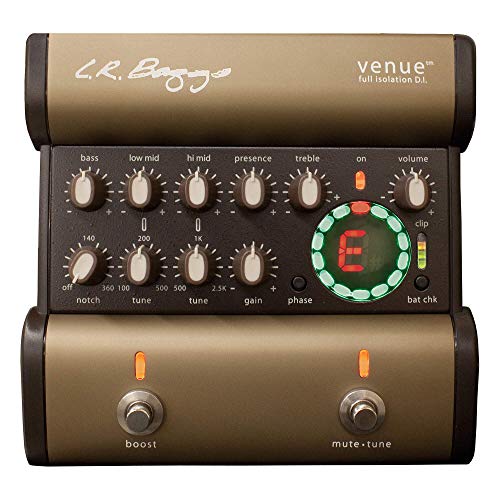
- 5-band EQ with tunable mids
- Garret Null notch filter for feedback
- Built-in tuner and boost footswitch
Best For: Players needing pro-level control and direct out flexibility
Clean and Compact Tone Shaper
Orange Acoustic Pedal for Clear Live Tone

- Bass, treble, middle, and volume controls
- Noise reduction and feedback control
- Compact and lightweight for pedalboards
Best For: Solo musicians prioritizing clarity and portability
Acoustic Tone Restoration
TC Electronic BODYREZ Acoustic Pickup Enhancer

- Restores resonance for under-saddle pickups
- Built-in feedback suppression helps on stage
- One-knob control keeps operation simple
Best For: Solo players who want a natural pickup tone with minimal fuss
All-in-One DI Preamp
VALETON Dapper Acoustic Mini DI Preamp

- XLR DI output for direct-to-PA use
- 3-band EQ plus notch filter for live control
- Compressor, reverb, tuner, and cab sim included
Best For: Solo performers who want one compact pedal for live and practice use
Acoustic Modeling Simulator
BOSS AC-3 Advanced Acoustic Simulator

- Models acoustic-guitar tones from electric guitars
- Four modes cover standard, jumbo, enhanced, and piezo
- Built-in reverb adds depth to the sound
Best For: Electric players wanting an acoustic-style simulator for solo gigs
Multi-Effect Acoustic Preamp

- 16 body/model acoustic simulations
- 9 effects plus EQ, compression, and boost
- Balanced XLR and dual 1/4-inch outputs
Best For: Solo performers needing flexible tone shaping and feedback control
Acoustic Simulator Compact
MOOER Acoustikar Acoustic Pedal

- Three acoustic-style modes: Piezo, Standard, Jumbo
- Compact analog pedal for simple live use
- Designed to restore acoustic texture on electric guitar
Best For: Players wanting a small acoustic simulator for electric guitar
Analog Preamp Stage Tool
SONICAKE A Factory Acoustic Pedal

- Analog preamp with digital reverb
- Notch filter and mute for feedback control
- XLR balanced output with high-impedance input
Best For: Solo acoustic players needing a practical preamp and balanced output
All-in-One Acoustic Workstation – SONICAKE Acoustic Multi-Effects Preamp
If you want acoustic guitar pedals for solo gigs that can cover tone shaping, ambience, and direct-to-PA convenience in one box, the SONICAKE Sonic Wood is built for that role. Its analog preamp with 2-band EQ aims for a warm, natural acoustic sound, while the built-in chorus, delay, and reverb give you the core effects many solo performers need without adding extra pedals.
Best For: Solo acoustic players who want a compact multi-effect preamp with XLR output for simple live setups.
Pros:
- Analog preamp with 2-band EQ designed to recreate a classic acoustic guitar amplifier feel
- Includes chorus, delay, and reverb for different playing scenarios
- Tap tempo and tail on/off help with more controlled effect changes
- XLR output makes it easy to connect directly to a PA, mixer, or audio interface
Cons:
- Focused on essential effects rather than deep editing or advanced routing
- Requires a 9V DC adapter for power
For solo gigs, this is a practical “one-stop” option if you want to keep your setup simple and still have preamp shaping plus the most common ambient effects. It makes the most sense for players who value direct connection and straightforward control over complexity.
Drive-With-Definition Pick – Fender Smolder Acoustic Overdrive
Among acoustic guitar pedals for solo gigs, the Fender Smolder is the choice for players who want a little edge without losing control of the instrument’s core tone. It combines pickup compensation, drive, a 3-band EQ, and filter controls with onboard cabinet simulation, so you can shape a more produced live sound when you need some grit or extra presence.
Best For: Solo acoustic performers who want subtle overdrive and tone-shaping tools for live use.
Pros:
- Acoustic distortion/overdrive design aimed at adding controlled drive
- Pickup compensation helps match the pedal to your pickup setup
- 3-band EQ and filter controls provide practical tone shaping
- Onboard cabinet simulation adds another layer of live sound control
Cons:
- Not a multi-effects unit, so it covers fewer sounds than all-in-one pedals
- May be more specialized than some solo players need
This pedal is a good fit if your solo set benefits from a bit of warmth, drive, or modern edge rather than reverbs and delays. It’s best treated as a focused tone tool for players who already know they want acoustic overdrive in the chain.
Feedback-Control DI Hub – L.R. Baggs Venue DI Preamp and DI
If your solo acoustic setup lives or dies by clean reinforcement, the L.R. Baggs Venue DI is a strong option among acoustic guitar pedals for solo gigs. It combines adjustable gain, a 5-band EQ with tunable low-mid and high-mid bands, a Garret Null notch filter for feedback control, and a full chromatic tuner with mute/tune footswitch functions.
Best For: Solo performers who need detailed EQ, tuner access, and reliable feedback control on stage.
Pros:
- 5-band EQ with tunable mid controls for detailed sound shaping
- Garret Null notch filter helps manage feedback effectively
- Built-in chromatic tuner with footswitch mute/tune function
- Adjustable volume boost footswitch for live level changes
Cons:
- No built-in chorus, delay, or reverb effects
- Larger and heavier than some minimalist pedals
This is the kind of pedal that makes sense when your priority is a clean, controlled live signal rather than onboard ambience. For solo gigs, its strength is utility: shaping tone, killing feedback, and keeping tuning and boost functions within easy reach.
Clean and Compact Tone Shaper – Orange Acoustic Pedal for Clear Live Tone
The Orange Acoustic Pedal is aimed at players who want a straightforward, polished live sound from acoustic guitar pedals for solo gigs. With bass, treble, middle, and volume controls, plus built-in noise reduction and feedback control, it focuses on clarity and ease of use instead of offering a huge effects list.
Best For: Solo acoustic musicians who want a compact, easy-to-use pedal for clear live tone and feedback reduction.
Pros:
- Clear, balanced sound profile suited to acoustic instruments and vocals
- Noise reduction helps eliminate unwanted hum and feedback
- Bass, treble, middle, and volume controls make quick tone changes simple
- Compact, lightweight design is easy to fit on a pedalboard
Cons:
- No built-in delay, chorus, or reverb effects
- Requires 18V, 300mA power
This pedal is a practical pick if you mainly need clean reinforcement and quick tone correction rather than a full effects suite. It works well for solo performers who want a durable, portable unit that keeps the focus on a clear acoustic signal.
Acoustic Tone Restoration – TC Electronic BODYREZ Acoustic Pickup Enhancer
If you want acoustic guitar pedals for solo gigs that help an under-saddle pickup sound more natural, the TC Electronic BODYREZ is built for exactly that job. It focuses on restoring resonance and ambience with a very simple one-knob layout, while also adding feedback suppression to keep your set more controlled on stage.
Best For: Players using under-saddle pickups who want a faster path to a more natural acoustic tone with minimal tweaking.
Pros:
- Restores natural acoustic resonance for pickup-equipped guitars
- Built-in feedback suppression with phase control footswitch mode
- Subtle compression and filters help bring back playing feel and ambiance
- Ultra-simple one-knob control keeps setup quick during solo sets
Cons:
- Designed specifically for acoustic pickup enhancement rather than full multi-effects
- Less flexible if you want detailed EQ or recording features
For solo performers who mainly need better pickup tone and a practical way to manage feedback, BODYREZ is a focused, easy-to-use solution. It’s best viewed as a tone-restoration pedal rather than an all-in-one acoustic rig.
All-in-One DI Preamp – VALETON Dapper Acoustic Mini DI Preamp
VALETON Dapper Acoustic Mini Electric-Acoustic Guitar DI Analog Preamp Multi-Effects Pedal
Check Price On AmazonFor acoustic guitar pedals for solo gigs, the VALETON Dapper Acoustic Mini is the most complete option here if you want DI, EQ, compression, reverb, and tuning in one box. It’s geared toward direct-to-PA and recording use, with an XLR output, cab sim for headphones or direct monitoring, and a notch filter to help reduce unwanted microphonics.
Best For: Solo acoustic performers who want a compact all-in-one pedal for live DI, practice, and simple recording setups.
Pros:
- XLR DI output makes it practical for direct-to-PA setups
- 3-band EQ and anti-feedback notch filter help shape live tone
- Built-in compressor, reverb, and tuner cover core solo gig needs
- Headphones jack with cab sim adds useful recording and practice flexibility
Cons:
- More of a utility multi-effects unit than a dedicated tone-shaping specialist
- Requires regular 9V center-negative pedal power
If you want one pedal to cover the essentials for solo work, this model is easy to justify. It brings together the features most acoustic players actually reach for on stage and during practice.
Acoustic Modeling Simulator – BOSS AC-3 Advanced Acoustic Simulator
If you’re shopping acoustic guitar pedals for solo gigs and need to turn an electric guitar into a more acoustic-style voice, the BOSS AC-3 is the most specialized option in this group. It offers acoustic-guitar modeling in a compact pedal, with four simulation modes and built-in reverb to help shape a convincing solo performance sound.
Best For: Electric guitar players who need an acoustic-style simulator for solo performance or simple gig setups.
Pros:
- Advanced acoustic-guitar modeling for electric guitars
- Four simulation modes: standard, jumbo, enhanced, and piezo-equipped
- Built-in reverb adds space to the simulated acoustic sound
- Compact format fits easily into a small pedalboard
Cons:
- Designed for acoustic simulation, not for real acoustic pickup enhancement
- Less suitable if you need DI, tuner, or onboard EQ features
The AC-3 is a strong pick when the goal is convincing acoustic-style output from an electric guitar. It is more targeted than an all-in-one acoustic processor, but that focus is exactly what makes it useful in the right setup.
Multi-Effect Acoustic Preamp – Zoom AC-3 Acoustic Pedal
If you want acoustic guitar pedals for solo gigs that can handle tone shaping, feedback control, and quick level changes in one box, the Zoom AC-3 is built for that job. It offers acoustic modeling, EQ, compression, and multiple outputs so you can move between practice, PA connection, and recording with less setup.
Best For: Solo performers who need versatile acoustic tone shaping, anti-feedback control, and easy PA-ready connections.
Pros:
- Models 16 guitar body types and 15 specific guitar models for flexible tone matching.
- Includes 9 effects, a 3-band EQ, and a one-knob compressor for fuller live sound.
- Has balanced XLR and dual 1/4-inch outputs for PA systems, monitors, headphones, or interfaces.
- Foot-switchable 9dB boost helps lift solos and lead parts during a performance.
Cons:
- More feature-rich than a simple acoustic preamp, so setup may take longer.
- Runs on batteries for only up to 3 hours if you are not using external power.
The AC-3 is a strong choice when you need one pedal to cover tone matching, feedback suppression, and live performance routing. It is especially practical for players who want a single unit to manage both acoustic sound shaping and stage utility.
Acoustic Simulator Compact – MOOER Acoustikar Acoustic Pedal
For acoustic guitar pedals for solo gigs where you want a simple way to make an electric guitar sound more like an acoustic, the MOOER Acoustikar keeps the approach straightforward. Its three modes are aimed at recreating acoustic textures without adding a lot of extra controls.
Best For: Players who want a compact acoustic simulator for electric-to-acoustic texture on stage.
Pros:
- Three modes cover Piezo, Standard, and Jumbo-style acoustic sounds.
- Compact pedal format makes it easy to fit on a crowded board.
- Analog design keeps the controls simple for quick live use.
Cons:
- Offers simulation rather than the broader tone-shaping tools of a preamp pedal.
- Does not list extras like EQ, tuner, or anti-feedback features.
The Acoustikar is the most streamlined option here, so it makes sense if you mainly need a convincing acoustic texture from an electric guitar. It is less about full live rig management and more about fast, practical sound conversion.
Analog Preamp Stage Tool – SONICAKE A Factory Acoustic Pedal
If you are shopping for acoustic guitar pedals for solo gigs and want a straightforward stage preamp, the SONICAKE A Factory focuses on essential live tools. It combines an analog preamp, digital reverb, a notch filter, mute, and XLR output in a compact layout.
Best For: Solo acoustic players who want a practical preamp with feedback control and balanced output.
Pros:
- Analog preamp with digital reverb adds shaping and space to acoustic sound.
- Notch filter and mute help quickly manage whistle and feedback issues.
- High-impedance input and XLR balanced output suit live acoustic setups.
- Buffer bypass circuit is designed to keep the signal pristine.
Cons:
- Requires a 9V center-negative power supply, which is not included.
- Does not include the broader modeling options found on more feature-heavy pedals.
The A Factory is a solid utility pedal when your priority is clear acoustic amplification and feedback management rather than deep modeling. Its focused feature set makes it a sensible pick for players who want reliable live performance basics.
How We Picked the Best Acoustic Guitar Pedals for Solo Gigs
For this roundup, we prioritized pedals that support live solo use first: dependable DI output, effective EQ, feedback control, onboard reverb or ambience, and easy setup. We also considered whether a pedal is better as a tone-shaping preamp, an acoustic enhancer, or a full multi-effects solution.
Quick Comparison
Most Acoustic Guitar Pedals for Solo Gigs fall into a few useful categories. Preamp/DI pedals are best for clean signal routing and basic tone control. Enhancement pedals are ideal if your guitar already sounds good but needs a little polish. Multi-effects and acoustic simulators offer the most flexibility, which can help if you play different rooms or want built-in extras without carrying more gear.
Key Buying Factors for Acoustic Guitar Pedals for Solo Gigs
Input and Pickup Matching
Make sure the pedal suits your pickup type, whether piezo, undersaddle, or internal mic systems. Some pedals are designed to tame quack and harsh highs, while others are built for broader acoustic modeling.
EQ and Feedback Control
Solo performers often need quick tonal fixes between songs. A strong EQ section, notch filter, phase control, or anti-feedback tool can be more valuable than extra effects.
Direct Output and Stage Connectivity
If you play through a PA, look for balanced XLR out or a solid DI path. Ground lift and pre/post EQ options can make a real difference in noisy venues.
Effects You’ll Actually Use
Reverb is the most common must-have, followed by light compression, delay, or chorus for larger spaces. Avoid paying for features you won’t use regularly.
Size, Power, and Workflow
For solo gigs, compact pedals and straightforward controls are often better than deep menus. If you switch quickly on stage, choose a layout that is easy to read in low light.
Who Should Buy Which Acoustic Guitar Pedals for Solo Gigs?
If you want the simplest live solution, a preamp/DI is usually the safest choice. Players chasing polished, finished tone should look at enhancement pedals with EQ and ambience. If you need the broadest range of sounds, a multi-effects unit may be the better fit, especially for cover sets or varying venue sizes.
For most performers, the best choice is the pedal that solves your main problem first: cleaner direct tone, easier feedback control, or a more produced sound that stands out in a solo setting.