Choosing the right DI box can make a bigger difference to an acoustic rig than many players expect. The best models preserve clarity, tame noise, and make it easier to plug into mixers, interfaces, and PA systems without losing your guitar’s natural character.
This roundup focuses on Radial DI boxes for acoustic guitar, along with a few closely related options, so you can quickly narrow down the best fit for solo performance, stereo setups, and dependable live sound.
Best 10 Radial Di Boxes for Acoustic Guitar Picks for 2026
Best Passive DI
Radial ProDI Passive Direct Box

- Passive transformer helps reduce hum and ground loops
- Rugged I-beam build for live use
- Simple mono DI with no power needed
Best For: Acoustic guitarists who want a reliable, low-noise passive DI for stage or studio.
Best for Dual-Amp Rigs

- Buffers acoustic signal to reduce tone loss
- Isolated output helps fight hum and buzz
- Drag Control adds natural-feeling load correction
Best For: Acoustic players running two amps who want cleaner switching and tone preservation.
Best Stereo DI
Radial ProD2 Passive 2 Channel Direct Box

- Passive stereo DI with isolation transformer
- No power required for operation
- Great for dual-source acoustic rigs
Best For: Acoustic players with stereo pickups or dual outputs who want a rugged passive DI.
Best for Passive Pickups
Radial Pro48 Active 48V Compact DI
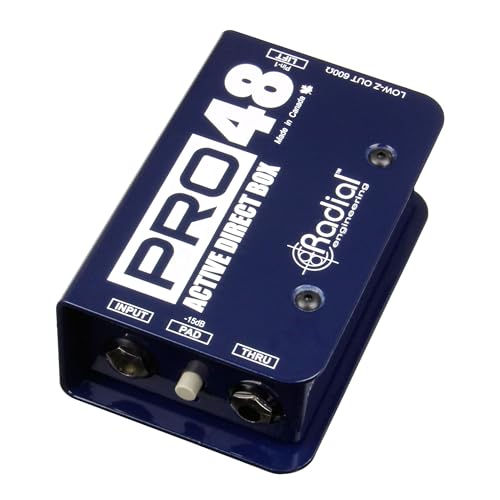
- 48V phantom-powered active DI
- Excellent headroom for passive pickups
- Compact steel build with -15dB pad
Best For: Acoustic guitar players using passive pickups who want a clean, compact direct box.
Best Budget Passive DI

- Passive DI with ground lift
- 0 dB / -20 dB / -40 dB pad options
- Balanced XLR output for simple hookup
Best For: Budget acoustic guitar, bass, and keyboard setups that need a basic hum-reducing DI.
Best Passive Tone Shaping

- Passive transformer adds warmth and smooths peaks
- Reduces hum and buzz from ground loops
- Compact mono DI with a 15dB pad
Best For: Acoustic players who want a compact passive DI with a warmer direct sound.
Best Dual-Channel DI
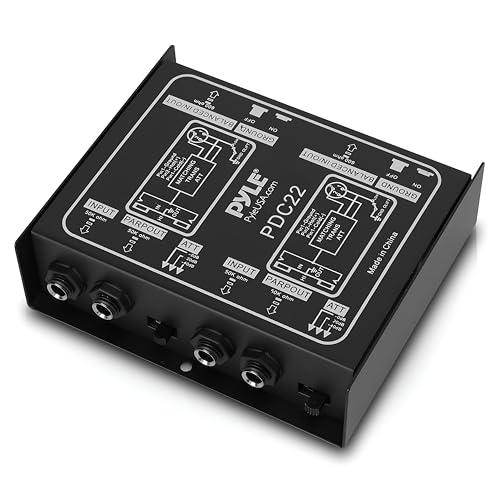
- Two channels in one rugged steel box
- Ground lift plus switchable input attenuation
- Good value for guitars, bass, and keyboards
Best For: Affordable dual-channel DI use in small live rigs or home studios.
Best for Re-Amping
Radial ProRMP Passive Re-Amping Box

- 100% passive operation with no power needed
- Adjustable output level for amp matching
- Compact design with ground lift for noise control
Best For: Engineers and guitarists who want an easy passive box for re-amping recorded tracks.
Best for Stereo Sources
Radial ProD2 Passive Stereo DI Bundle

- Passive stereo DI with clean, hum-free output
- Works well for acoustic guitar, keys, and DJ rigs
- Bundle includes 10ft XLR cable plus polishing cloth
Best For: Players and techs needing a rugged stereo DI bundle for acoustic guitar and other line-level sources.
Best for Clean Signal & Ground-Loop Control
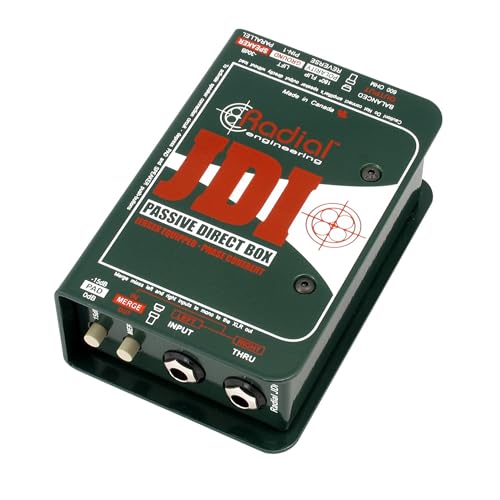
- Jensen transformer for transparent tone
- Reduces buzz and hum from ground loops
- Rugged passive design for live use
Best For: Acoustic guitarists who need a quiet, dependable DI for stage or studio.
Best Passive DI – Radial ProDI Passive Direct Box
If you want a simple, rugged option from the world of radial di boxes for acoustic guitar, the Radial ProDI is built to keep your signal clean and noise-free. Its passive transformer design helps tame ground loops and hum while preserving a natural, full sound at the board or interface.
Best For: Acoustic players who want a dependable passive DI for live shows, rehearsals, and straightforward studio recording.
Pros:
- Passive transformer design helps reduce noise and ground-loop issues
- Works well with acoustic guitar, bass, keyboards, and other mono instruments
- Rugged I-beam construction makes it tour-ready
- Easy plug-and-play setup with no power required
Cons:
- Mono only, so it is not ideal for stereo sources
- Passive design may not suit every high-impedance pickup situation
- Less feature-rich than some active DI alternatives
For players comparing radial di boxes for acoustic guitar, the ProDI stands out as a no-fuss, dependable choice that prioritizes clean signal transfer over extra features. It is a strong fit if you want durability, simplicity, and a consistent direct tone.
Best for Dual-Amp Rigs – Radial Twin-City ABY Switcher
If you’re comparing radial di boxes for acoustic guitar, the Twin-City stands out as a practical way to split your signal to two amps while keeping your tone intact. Its active buffering, Drag load correction, and isolated output are designed to reduce hum, buzz, and the usual high-end loss that can happen with long cables or complex stage setups.
Best For: Players who want a compact ABY and buffer for running an acoustic guitar into two amps with cleaner, more consistent tone.
Pros:
- Buffered ABY design helps preserve tone over longer cable runs
- Drag Control load correction keeps the guitar feel more natural
- Isolated output helps eliminate hum and buzz between amps
- Compact pedalboard-friendly footprint with 9V power operation
Cons:
- More specialized than a simple DI box
- Primarily useful if you actually need dual-amp routing
- May be overkill for straightforward solo acoustic setups
For players who need clean stereo-style or dual-amp routing, this is one of the more polished radial di boxes for acoustic guitar use cases. It’s especially appealing if your priority is maintaining signal quality, avoiding ground noise, and keeping setup simple on a crowded pedalboard.
Best Stereo DI – Radial ProD2 Passive 2 Channel Direct Box
If you need one of the most reliable radial di boxes for acoustic guitar, the Radial ProD2 is a strong choice for players running stereo acoustic setups, onboard pickups, or two instruments at once. Its passive transformer design keeps things simple, quiet, and dependable, making it a practical stage-ready DI for clean direct connection to a mixer or interface.
Best For: Acoustic guitarists with stereo pickups or dual-source rigs who want a rugged passive DI that does not need power.
Pros:
- Passive stereo design works without batteries or phantom power
- Isolation transformer helps reduce noise and ground issues
- 15 dB pad adds flexibility for hotter signals
- Roadworthy build quality suited for live use
Cons:
- More DI than a solo acoustic player needs if only running one source
- Passive design may be less ideal for very low-output pickups than an active DI
For players comparing radial di boxes for acoustic guitar, the ProD2 stands out when you need stereo handling, isolation, and a no-fuss setup in one compact unit. It is less about extra features and more about dependable signal routing, which is exactly what many live acoustic rigs need.
Best for Passive Pickups – Radial Pro48 Active 48V Compact DI
If you’re comparing radial di boxes for acoustic guitar, the Radial Pro48 is a smart pick for instruments with passive pickups that need a clean boost and plenty of headroom. Its 48V phantom-powered active design keeps the signal natural and uncolored, while the -15dB pad helps when you need to handle hotter sources too.
Best For: Acoustic guitars with passive pickups, especially players who want a compact DI that sounds clean and stays quiet on stage or in the studio.
Pros:
- Phantom-powered active circuit offers high headroom and low distortion
- Compact, road-ready steel chassis is built for frequent use
- -15dB pad adds flexibility for stronger signals
- Natural, wide-range response suits transparent acoustic tone
Cons:
- Requires 48V phantom power to operate
- Less ideal for players who want a simple passive DI
For buyers focused on radial di boxes for acoustic guitar, the Pro48 stands out when your instrument has a lower-output passive pickup and you want clean, reliable gain before the mixer. It’s a practical choice rather than a color box, which makes it easy to trust in live sound or recording setups.
Best Budget Passive DI – Pyle PDC21 DI Box
If you’re comparing radial di boxes for acoustic guitar and want a simple, low-cost way to send an unbalanced instrument signal to a mixer, the Pyle PDC21 is a practical pick. It offers passive operation, ground lift, and switchable pad settings, so it can help tame hum and handle hotter sources without extra power or setup.
Best For: Budget-minded players and home-recording users who need a basic passive DI for acoustic guitar, bass, keyboards, or other line-level gear.
Pros:
- Passive design with no power requirement
- Ground lift and 0 dB, -20 dB, -40 dB pad options
- Balanced XLR output for direct mixer or interface connection
- Useful for guitars, bass, keyboards, and other unbalanced sources
Cons:
- Bulkier than some compact DI alternatives
- More of a utility box than a studio-grade acoustic DI
- Not as refined as higher-end options for critical live tone
For players shopping radial di boxes for acoustic guitar on a tight budget, this Pyle unit covers the essentials: clean level conversion, hum control, and straightforward routing. It won’t replace a premium DI, but it can be a dependable no-frills solution for rehearsals, gigs, and basic recording setups.
Best Passive Tone Shaping – Radial StageBug SB-2 DI
If you want a simple, low-noise way to run an acoustic guitar straight to a mixer, the Radial StageBug SB-2 is a strong pick among radial di boxes for acoustic guitar. Its passive transformer design adds a touch of warmth, helps tame harsh peaks, and can reduce ground-loop buzz without needing power.
Best For: Players who want a compact passive DI that smooths acoustic guitar tone and handles stage or rehearsal setups with minimal fuss.
Pros:
- Passive Eclipse transformer adds warmth and natural compression
- Helps reduce hum and buzz from ground loops
- 15dB pad supports hotter instrument signals
- Ultra-compact format is easy to pack and place on stage
Cons:
- Mono-only design may not suit stereo sources without merging
- Passive operation may be less flexible than active DIs for some rigs
For acoustic players who prefer a no-power DI with a warmer, more controlled direct sound, the SB-2 fits the role well. It is especially appealing if you want one of the more practical radial di boxes for acoustic guitar for live use, rehearsal, or a grab-and-go pedalboard rig.
Best Dual-Channel DI – PylePro PDC22 Passive DI Box
If you want a straightforward, two-channel option in the world of radial di boxes for acoustic guitar, the Pyle-Pro PDC22 is built for practical stage and studio use. Its passive design, ground-lift switch, and selectable pad settings make it a handy way to tame hum, balance signals, and feed a mixer from guitars, basses, keyboards, or other unbalanced sources.
Best For: Players or home-studio users who need an affordable dual-channel DI for guitars, bass, or keyboards with simple noise control.
Pros:
- Two DI channels in one steel enclosure
- Ground lift and 0 dB / -20 dB / -40 dB attenuation options
- Passive design helps reduce hum and ground-loop issues
- Works with guitar, bass, keyboards, and other line sources
Cons:
- Bulkier than a single-channel DI
- Not a premium boutique acoustic-guitar DI
- Passive unit may not be ideal for very low-output sources
For shoppers comparing radial di boxes for acoustic guitar, this Pyle-Pro stands out more for utility and value than for audiophile polish. It covers the essentials well, especially if you need two channels and basic hum elimination without paying for a more specialized pro unit.
Best for Re-Amping – Radial ProRMP Passive Re-Amping Box
If you want to experiment with amp tones after recording, the Radial ProRMP is a practical choice among radial di boxes for acoustic guitar and electric tracking workflows alike. It converts a clean, low-impedance signal back into a high-impedance instrument-level signal so you can rerun parts through an amp, pedals, or a preamp without re-recording.
Best For: Players and home-studio recordists who need a simple, passive re-amping box for dialing in tones after the take.
Pros:
- 100% passive design, so no power supply is required
- Compact format fits easily into small recording setups
- Adjustable output level helps match different amp and pedal inputs
- Ground lift switch can help reduce noise and hum
Cons:
- It is a re-amping tool, not a standard all-purpose DI for every job
- No powered features or extras for advanced routing
- Single-channel design keeps it simple, but limits flexibility
For studios that rely on re-amping, the ProRMP is a straightforward, no-frills solution that does the core job well. If your workflow with radial di boxes for acoustic guitar includes sending clean tracks back through amps or effects, this compact passive unit is easy to slot in and easy to trust.
Best for Stereo Sources – Radial ProD2 Passive Stereo DI Bundle
If you’re comparing radial di boxes for acoustic guitar and other stereo instruments, the Radial ProD2 bundle is a strong pick for clean, hum-free signal transfer with a practical add-on cable and cloth. Its passive design, rugged steel shell, and -15dB pad make it a dependable choice when you need a DI that can handle live rigs without adding noise or distortion.
Best For: Players and techs who need a rugged stereo DI bundle for acoustic guitar, keyboards, DJ gear, or other line-level sources.
Pros:
- Passive stereo design keeps the signal clean and simple
- Handles acoustic guitar, keyboards, and DJ setups with ease
- Includes a 10ft XLR cable and polishing cloth for extra value
- Rack-mountable build with pad and ground lift for flexible use
Cons:
- Overkill if you only need a basic single-channel DI
- Passive operation may not suit every high-impedance source equally
- Bundle extras are useful, but the core value is still the DI box
For players shopping radial di boxes for acoustic guitar, this bundle stands out when stereo capability and touring durability matter more than a bare-bones price. It’s especially appealing if you want one unit that can move between acoustic instruments, keys, and hybrid live setups.
Best for Clean Signal & Ground-Loop Control – Radial JDI Passive DI Box
If you want a reliable option among radial di boxes for acoustic guitar, the Radial JDI is built for quiet, transparent signal transfer on stage or in the studio. Its Jensen transformer helps preserve tone while reducing buzz, hum, and other noise issues that can show up with acoustic instruments and amp rigs.
Best For: Acoustic guitarists who need a rugged passive DI for clean direct recording or live sound.
Pros:
- Jensen transformer delivers a clean, natural sound
- Helps eliminate buzz and hum from ground loops
- Passive design is simple, dependable, and stage-ready
- Low distortion keeps acoustic tone intact
Cons:
- No built-in EQ or tone-shaping controls
- Pricier than basic DI boxes
- Overkill if you only need a simple home practice solution
For players comparing radial di boxes for acoustic guitar, the JDI stands out when clean isolation and tonal accuracy matter more than extra features. It is a strong pick for dependable DI duties in both live and recording setups.
How We Picked the Best Radial Di Boxes for Acoustic Guitar
We prioritized units that suit acoustic guitar players who need clean signal transfer, durable construction, and simple setup. For Radial Di Boxes for Acoustic Guitar, the most important factors are low-noise performance, enough headroom for active pickups or onboard preamps, and the right input/output options for your rig. We also considered whether a model is better suited to stage use, studio recording, or more specialized tasks like stereo sources and re-amping.
Quick Comparison
For a straightforward solo acoustic setup, a compact passive DI is often the easiest choice. If your guitar has an active pickup system or you want to connect keyboards, stereo pedals, or dual-source rigs, a dual-channel or active unit may be the better fit. Players chasing maximum transformer quality and consistent pro-audio performance may prefer higher-end Radial models, while budget alternatives can work for backup rigs or lighter-duty use.
Key Buying Factors for Radial Di Boxes for Acoustic Guitar
Passive Vs. Active
Passive DI boxes are typically favored for simple acoustic setups because they are rugged, require no power, and handle strong signals well. Active DI boxes can be useful when you need extra gain, very high input impedance, or better matching for quieter pickups and some onboard preamps.
Channels and Signal Type
Single-channel models are ideal for one guitar. If you run stereo effects, dual pickups, or multiple sources, a 2-channel DI can simplify cabling and reduce clutter. For acoustic players, that matters when you want a fast setup on stage.
Transformer Quality and Noise Rejection
A good transformer helps preserve tone while rejecting hum and interference. This is one of the biggest reasons players choose Radial models for acoustic applications, especially in venues with noisy power or longer cable runs.
Pad, Ground Lift, and Connectivity
Look for a pad if you use hot outputs or active systems, and a ground lift to help eliminate buzz. Balanced XLR output, instrument input, and a thru jack are the core features most acoustic players will use.
Who Should Buy Which Radial Di Boxes for Acoustic Guitar?
Choose a basic passive DI if you want a dependable, no-fuss solution for one acoustic guitar. Pick an active model if your pickup system benefits from more headroom or impedance matching. Go with a dual-channel DI if you need stereo flexibility or multiple inputs. And if your priority is premium signal handling and long-term road reliability, the more robust Radial options are the safest bet for serious performers and recording musicians.