A rechargeable guitar pedal power supply can free your board from a wall outlet, whether you play street sets, quick rehearsals, or stages with awkward power access. The right choice depends less on battery size alone than on whether its outputs match your pedals.
These 10 picks cover compact packs, multi-output supplies, and a board with a built-in battery. Use the guide below to narrow the field by voltage, current, connector type, and how you plan to play.
Best 10 Rechargeable Guitar Pedal Power Supply Picks for 2026
Best All-in-One Board
STRICH ComboFX Battery Pedalboard
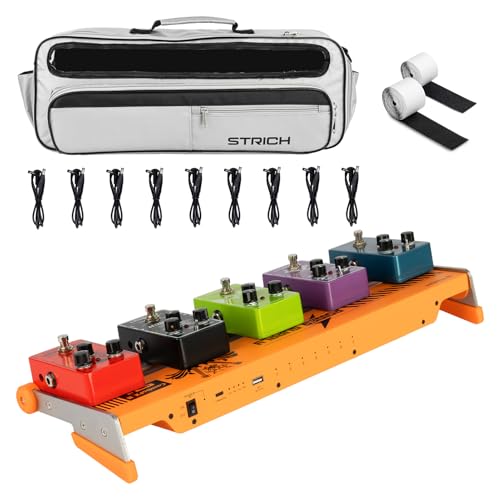
- 10,000mAh battery built into an 18 x 5.8-inch board
- Seven 9V outputs: five 100mA, two 300mA
- Includes bag, cables, and hook-and-loop strips
Best For: Building a compact, outlet-free pedalboard
Best for Mixed Voltages
JOYO JP-05 Rechargeable Power Supply

- Eight DC jacks, including adjustable 9V/12V/18V
- Three fixed 9V outputs rated 500mA
- Runtime varies substantially with pedal load
Best For: Boards needing both standard 9V and selectable voltage
Best for Ten 9V Pedals
STRICH SPS-40B Rechargeable Supply

- Ten independent 9V outputs
- 10,000mAh battery with four-level gauge
- USB charging cable included; adapter not included
Best For: Larger boards of compatible 9V pedals
Best Compact Seven-Output Pick
Vangoa PS-01 Pedal Power Supply

- Seven 9V outputs: six 100mA, one 300mA
- 4,600mAh battery; advertised runtime up to two hours
- Output cables and battery indicator included
Best For: Compact boards and shorter outlet-free sessions
Flexible Daisy-Chain Kit
D'Addario XPND Pedal Power Battery Kit

- 10,000mAh battery; rated for 10+ hours on an average board
- Filtered 9V power through Gateway hub
- Adjustable plug spacing and mounting fastener
Best For: 9V boards needing flexible plug spacing
Multi-Voltage Pick
SOLUTEK PB-051 Rechargeable Pedal Power Supply

- Regulated 5V, 9V, 12V and 18V options
- Rated 2,000mA high-current capacity
- Includes 20W PD charger and eight DC cables
Best For: Mixed-voltage pedals and compatible electronic gear
Isolated 9V Outputs
LEKATO PS-01R Rechargeable Pedal Power Supply

- Ten isolated 9V outputs: eight 100mA, two 300mA
- 10,000mAh built-in battery
- Per-port short-circuit protection and status lights
Best For: Multiple 9V pedals within the stated per-port limits
Best for Mixed-Voltage Pedalboards
AYCRIT MUSTAN-02 Rechargeable Power Supply

- Eight DC outputs with 9V, 12V, and 18V options
- 12,800mAh battery; stated 2.5-hour full charge
- USB-C output rated at 5V/3A
Best For: Mixed-voltage pedalboards needing battery power
Best for Low-Draw 9V Pedals
lotmusic 7-Output Battery Power Supply

- Seven isolated 9V outputs
- 10,000mAh battery; claimed runtime over 10 hours
- Six 100mA outputs and one 300mA output
Best For: Portable boards built around low-current 9V pedals
Best for Simple Cord-Free Setups
LOTKEY LPB-02 7-Output Power Supply

- Seven isolated 9V outputs
- 10,000mAh battery; claimed runtime over 10 hours
- USB port and LED status indicators
Best For: Cord-free boards with low-current 9V effects
Best All-in-One Board – STRICH ComboFX Battery Pedalboard
The STRICH ComboFX combines an 18 x 5.8-inch aluminum board with a built-in 10,000mAh battery, making it a rechargeable guitar pedal power supply and pedalboard in one. Its seven 9V outputs suit a compact setup that needs to work without an outlet.
Best For: Players building a portable pedalboard for rehearsals, street gigs, or outdoor sets.
Pros:
- Five 100mA and two 300mA outputs accommodate different pedal current needs.
- Power switch and battery indicator make operation and charge checks straightforward.
- Angled, open-frame board includes a carry bag, cables, and hook-and-loop strips.
Cons:
- Seven outputs may limit larger pedal collections.
- The fixed 18 x 5.8-inch board size may not suit an existing layout.
Choose this if you want to assemble a compact, outlet-free rig rather than add a separate battery supply to a board you already own. Check each pedal’s current requirement against the available outputs.
Best for Mixed Voltages – JOYO JP-05 Rechargeable Power Supply
The JOYO JP-05 is a rechargeable guitar pedal power supply for players who need more than standard 9V connections. Its eight DC jacks include seven fixed 9V outputs and one adjustable 9V/12V/18V output, backed by a 4,400mAh battery.
Best For: Small to midsize boards mixing standard 9V pedals with a pedal that needs 12V or 18V.
Pros:
- Four 9V 100mA jacks and three 9V 500mA jacks offer useful current options.
- Adjustable 9V/12V/18V jack supports a wider range of pedal voltage requirements.
- Includes a battery indicator, board light, and 5V/1A USB port.
Cons:
- The adjustable-voltage jack is limited to 100mA.
- Stated runtime drops to about two hours with high-current digital pedals, versus more than ten hours with eight analog pedals.
This is the flexible pick when voltage variety matters, but plan battery life around your actual pedals rather than the longest stated runtime. Confirm voltage, current, and polarity before connecting each effect.
Best for Ten 9V Pedals – STRICH SPS-40B Rechargeable Supply
For an existing board with many standard-voltage effects, the STRICH SPS-40B rechargeable guitar pedal power supply offers ten independent 9V outputs and a built-in 10,000mAh battery. STRICH states 10-plus hours of cord-free power, though runtime will depend on the pedals connected.
Best For: Larger 9V-only pedal setups that need multiple battery-powered outputs for gigs or rehearsals.
Pros:
- Eight 100mA and two 300mA outputs provide ten separate pedal connections.
- Four-level battery gauge helps track remaining charge.
- 5V/1A USB port can power or charge a compatible portable device.
Cons:
- All pedal outputs are 9V; there are no listed 12V or 18V options.
- Two outputs are rated 300mA, so check higher-current pedal requirements carefully.
- USB charging cable is included, but an adapter is not.
Its main advantage is output count without needing an external outlet. It makes the most sense when every pedal matches the stated 9V output ratings.
Best Compact Seven-Output Pick – Vangoa PS-01 Pedal Power Supply
The compact Vangoa PS-01 is a rechargeable guitar pedal power supply built around a 4,600mAh battery and seven 9V DC outputs. Its included output cables and one-touch switching make it a practical option for a small mobile board.
Best For: Players with mostly low-current 9V pedals who want a compact supply for rehearsals or short gigs.
Pros:
- Six 100mA outputs and one 300mA output cover a range of 9V pedal needs.
- Battery-level indicator helps you check charge before playing.
- Includes cables for the outputs; the compact aluminum enclosure is easy to carry.
Cons:
- Advertised runtime is up to two hours on a full charge.
- Only one output is rated above 100mA, limiting options for higher-current pedals.
This is a better fit for a short set than an extended outlet-free session. Charge it fully before first use, as Vangoa recommends, and verify each pedal’s voltage, current, and polarity.
Flexible Daisy-Chain Kit – D'Addario XPND Pedal Power Battery Kit
The D’Addario XPND kit is a rechargeable guitar pedal power supply for players who want to run an average-sized board on battery power or connect to USB-C power. Its Gateway hub supplies filtered 9V power, while the adjustable daisy chain lets you set plug spacing for your pedals.
Best For: 9V pedalboards that need flexible plug spacing and an option to play away from an outlet.
Pros:
- 10,000mAh power cell is rated for 10+ hours with an average-sized board.
- Gateway hub provides noise-filtered, consistent 9V power.
- Includes an adjustable daisy chain and hook fastener for pedalboard mounting.
Cons:
- Specified pedal output is 9V, so it is not the listed solution for pedals requiring 12V or 18V.
- Daisy-chain layout may not suit buyers who specifically want separate outputs for each pedal.
Choose this kit if adaptable cable spacing matters more than having multiple independently listed outputs. Check your pedals’ voltage and total power needs before relying on its 9W output.
Multi-Voltage Pick – SOLUTEK PB-051 Rechargeable Pedal Power Supply
The SOLUTEK PB-051 is a rechargeable guitar pedal power supply worth considering when a board needs more than 9V. It offers regulated 5V, 9V, 12V and 18V options, with a stated high-current capacity of 2,000mA.
Best For: Players with mixed-voltage gear who want battery power and the option to use the included USB-C PD charger.
Pros:
- Offers 5V, 9V, 12V and 18V power options.
- Rated for 8–10 hours at a 500mA 9V board load, or 4–5 hours at 1,000mA.
- Includes a 20W PD charger, USB-C cable and eight 24-inch DC power cables.
- Can operate while charging, according to the supplied product information.
Cons:
- Runtime decreases as board current draw rises.
- The supplied notes do not specify isolated outputs; confirm the output arrangement if isolation is essential.
Its range of voltages is the key advantage over a 9V-only battery kit. Match each device’s voltage and current requirements to the available connections before building a mixed-gear setup.
Isolated 9V Outputs – LEKATO PS-01R Rechargeable Pedal Power Supply
The LEKATO PS-01R is a rechargeable guitar pedal power supply built for boards that need several separate 9V connections. Its 10,000mAh battery feeds ten isolated DC outputs: eight rated at 100mA and two rated at 300mA.
Best For: Pedalboards with multiple 9V pedals that fit the supply’s 100mA and 300mA per-output ratings.
Pros:
- Ten isolated 9V outputs provide individual pedal connections.
- Separate short-circuit protection is designed to keep other ports working if one port shorts.
- Battery and output indicator lights help monitor power and identify a shorted port.
- Includes a 5V/1A USB output for temporary charging of portable devices.
Cons:
- No 12V or 18V pedal outputs are listed.
- Pedals drawing more than 300mA exceed the stated per-port ratings.
- Listed charging time is about 6.5 hours.
This is the most direct fit of the three for a many-pedal, 9V board when separate outputs are a priority. Count your pedals and verify each one’s current draw before assigning it to a port.
Best for Mixed-Voltage Pedalboards – AYCRIT MUSTAN-02 Rechargeable Power Supply
The AYCRIT MUSTAN-02 is a rechargeable guitar pedal power supply for boards that need more than standard 9V power. Its 12,800mAh battery feeds eight DC outputs, including a selectable 9V/2A or 12V/1.5A output and a dedicated 18V/450mA output.
Best For: Players running a mix of 9V, 12V, and 18V pedals who want a portable power source.
Pros:
- Eight DC outputs offer a wider range of voltage and current options than a basic 9V-only unit.
- Claimed runtime is over 12 hours with eight analog pedals, or 3–4 hours with high-current digital pedals.
- Includes a 5V/3A USB-C output and a charging adapter; stated full-charge time is 2.5 hours.
Cons:
- Battery runtime drops substantially with high-current digital pedals.
- Each output has its own current limit, so check every pedal’s requirements before connecting it.
The slim aluminum housing can fit under or beside a pedalboard. This is the most flexible voltage option here, provided its output ratings match your setup.
Best for Low-Draw 9V Pedals – lotmusic 7-Output Battery Power Supply
This lotmusic rechargeable guitar pedal power supply pairs a built-in 10,000mAh battery with seven isolated 9V outputs. Six are rated at 100mA each, while one provides up to 300mA, making the output ratings important to check before you build your board around it.
Best For: Portable pedalboards with mostly low-current 9V effects.
Pros:
- Seven isolated outputs are designed to work independently, with short-circuit and overcurrent protection.
- Claimed battery life exceeds 10 hours per charge.
- Includes a 5V/1A USB port and LED power and short-circuit indicators.
Cons:
- Six pedal outputs are limited to 100mA each.
- Stated full-charge time is 6.5 hours.
For pedals that fit its 9V current limits, this is a straightforward way to play without an outlet nearby. Higher-draw pedals will need careful matching to the 300mA output or a different supply.
Best for Simple Cord-Free Setups – LOTKEY LPB-02 7-Output Power Supply
The LOTKEY LPB-02 is a rechargeable guitar pedal power supply aimed at portable, 9V-only rigs. Its built-in 10,000mAh battery powers seven isolated outputs: six rated at 100mA and one rated at 300mA.
Best For: Players who want a cord-free supply for several low-current 9V pedals.
Pros:
- Independent outputs include short-circuit and overcurrent protection.
- Claimed battery life is over 10 hours per charge.
- Provides a 5V/1A USB port plus LED power and short-circuit indicators.
Cons:
- Its stated pedal outputs are 9V only, with no 12V or 18V option listed.
- Most outputs are rated at just 100mA, and a full charge takes a stated 6.5 hours.
Choose this one if portability matters more than high-current or mixed-voltage support. Check each pedal’s voltage and current needs before connecting it.
How We Picked the Best Rechargeable Guitar Pedal Power Supply
We focused on the details that affect whether a battery-powered supply will work with a real pedalboard: available voltages, output count, stated current limits, charging options, and form factor. The selection includes dedicated power supplies, a battery-and-daisy-chain kit, and an integrated pedalboard. Listed capacities and output specifications are useful starting points, but they do not establish real-world runtime or noise performance; check current manufacturer documentation and user feedback before buying.
Quick Comparison: Which Format Fits Your Board?
Integrated board: The STRICH ComboFX combines a mounting surface and battery power, making sense if you need both. Multi-output supplies: Options from JOYO, STRICH, LEKATO, AYCRIT, lotmusic, and Lotkey suit boards that need several connections; compare each output’s actual rating, not just the total number of jacks. Compact or flexible kits: The Vangoa PS-01 and D’Addario XPND battery kit may appeal to smaller or evolving setups. The listed 12800mAh high-current supply is worth examining if your rig has more demanding power requirements, provided its individual outputs match your pedals.
Key Buying Factors for a Rechargeable Guitar Pedal Power Supply
Voltage, Current, and Polarity
Check every pedal’s label or manual first. Most require 9V DC, but some need 12V, 18V, or substantial current. A supply must provide the correct voltage and polarity, while each output must be rated for at least the pedal’s required current. Do not assume a supply’s advertised maximum current is available at every jack. Confirm connector size, too, especially for pedals that do not use a standard barrel plug.
Outputs and Noise Control
Count the pedals you intend to power, then leave room for additions. Separate jacks are convenient, but multiple outputs are not automatically isolated. If you use digital pedals alongside analog drives or have experienced hum, verify the manufacturer’s isolation claims and the ratings of the specific outputs you will use. A daisy chain can be compact, but connected pedals share a power path.
Capacity, Charging, and Portability
Battery capacity is only a rough comparison: mAh figures may be measured at the internal cell voltage rather than at a 9V output. Runtime depends on conversion losses and your pedals’ combined draw. For long sets, look for credible runtime information under a comparable load and allow a margin. Also check charge time, charging connector, whether the unit can power pedals while charging, and whether its size fits your board or bag.
Who Should Buy Which Rechargeable Guitar Pedal Power Supply?
Choose an integrated board if you are building from scratch and want fewer separate pieces. Pick a multi-output unit when you need dedicated connections for several pedals; prioritize verified voltage and current compatibility over the biggest capacity claim. Consider a compact supply or battery kit for a small travel rig, and approach higher-current options by checking the rating at the exact output your power-hungry pedal needs. Whatever you choose, test the complete board for noise and runtime before relying on it at a gig.