A good pedalboard power supply needs to do more than offer enough plugs. Each pedal needs the right voltage and sufficient current, while the supply itself has to fit your board and setup.
These 10 options range from compact units for smaller boards to 12-output supplies for larger rigs. Use the guide below to narrow the field by output count, electrical requirements, and the isolation details worth checking before you buy.
Best 10 Isolated Power Supplies for Pedalboards Picks for 2026
Best for Large Boards

- 12 isolated 500mA outputs
- Two switchable 9V/12V outputs
- X-LINK expansion support
Best For: Large boards with high-current effects
Best for Small Boards

- Five isolated outputs
- Four 9V outputs at 300mA
- Switchable 9V/18V, 800mA output
Best For: Compact boards needing an 18V option
Best for Mixed Voltages

- Six isolated outputs
- Two switchable 9V/12V outputs
- Two switchable 9V/18V outputs
Best For: Boards mixing 9V, 12V, and 18V pedals
Best for Low-Profile Boards

- Eight isolated 9V outputs
- Up to 500mA per output
- Standalone or X-LINK-powered
Best For: Low-profile boards with multiple 9V pedals
Most Outputs

- 10 isolated DC outputs plus USB-C
- Switchable 9V, 12V, and 18V outputs
- Includes ten DC cables
Best For: Larger boards needing many connections and voltage options
Compact Board Pick
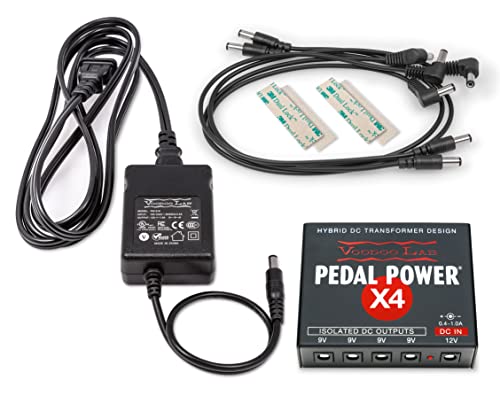
- Four isolated 9V outputs
- Up to 500mA per output
- Compact under-board design
Best For: Low-profile boards with up to four 9V pedals
Adjustable-Voltage Pick

- Eight isolated DC outputs
- Two adjustable 9V–18V outputs
- USB-A port and per-circuit protection
Best For: Eight-pedal boards with mixed voltage needs
Best for Flexible Voltage
LEKATO 10-Port Isolated Supply

- Ten isolated outputs
- Two switchable 9V/12V/18V ports
- USB charging port
Best For: Boards needing flexible voltage and USB charging
Best for Larger Boards
LEKATO 12-Port Isolated Supply

- Twelve independent outputs
- Fixed 9V, 12V, and 18V ports
- Twelve power cables included
Best For: Larger boards with mostly lower-current 9V pedals
Best for Mixed-Voltage Setups

- Ten isolated outputs
- Two switchable 500mA ports
- USB port and fault LEDs
Best For: Boards with a couple of 12V or 18V pedals
Best for Large Boards – Voodoo Lab Pedal Power 3 PLUS
Among isolated power supplies for pedalboards, the Pedal Power 3 PLUS suits players who need plenty of connections: it has 12 isolated outputs rated at 500mA each, including two switchable between 9V and 12V.
Best For: Larger boards with a mix of standard pedals and high-current DSP effects.
Pros:
- Ten 9V outputs plus two switchable 9V/12V outputs.
- X-LINK ports support X4 or X8 expansion units.
- 100–240V AC operation accommodates international touring.
Cons:
- Its built-in outputs offer no 18V setting.
- Expansion requires a separate X4 or X8 unit.
Choose this if 12 isolated outputs cover your current board but you want a path to add more later.
Best for Small Boards – MXR Mini Iso-Brick
The MXR Mini Iso-Brick is a compact choice among isolated power supplies for pedalboards when five outputs are enough. Four deliver 9V at 300mA, while the fifth switches between 9V and 18V at 800mA.
Best For: Small boards that need one higher-current or 18V-capable output.
Pros:
- All five outputs are isolated.
- Switchable 9V/18V output provides up to 800mA.
- Included splitter cable can connect two same-voltage pedals to one output.
Cons:
- Only five independently isolated outputs.
- No 12V output option is listed.
Check each pedal’s current requirement before assigning it to one of the four 300mA outputs.
Best for Mixed Voltages – Truetone 1 SPOT Pro CS6
For players comparing isolated power supplies for pedalboards with different voltage needs, the low-profile Truetone 1 SPOT Pro CS6 offers six isolated outputs: two switchable between 9V and 18V, two between 9V and 12V, and two fixed at 9V.
Best For: Six-pedal setups that need 9V, 12V, or 18V connections.
Pros:
- Six isolated outputs.
- Switchable outputs cover both 12V and 18V needs.
- Low-profile design suits a space-conscious setup.
Cons:
- Limited to six isolated connections.
- Only two outputs can be set to 12V, and only two can be set to 18V.
Its voltage flexibility is the draw; map your pedals to the available switchable outlets before buying.
Best for Low-Profile Boards – Voodoo Lab Pedal Power X8
The Pedal Power X8 stands out among isolated power supplies for pedalboards that need eight 9V connections in a small footprint. Each isolated output supplies up to 500mA, and the unit is designed to mount beneath low-profile boards such as Pedaltrain Nano and Metro.
Best For: Compact, low-profile boards carrying several 9V pedals.
Pros:
- Eight isolated 9V outputs, each rated up to 500mA.
- Runs from its included adapter or a compatible Pedal Power 3 X-LINK port.
- Includes pedal cables and 3M Dual Lock for mounting.
Cons:
- Outputs are 9V only; no 12V or 18V pedal output is listed.
- Fewer built-in outputs than the Pedal Power 3 PLUS.
It works as a standalone supply or as an expansion choice when you already have compatible Voodoo Lab power.
Most Outputs – Truetone True 10 Power Supply
For pedalboards with plenty of effects, this Truetone is one of the more flexible isolated power supplies for pedalboards: it offers 10 isolated DC outputs, a USB-C connection, and switchable 9V, 12V, and 18V outputs. Its low-profile aluminum enclosure can also help when mounting space is tight.
Best For: Larger boards that need many isolated connections and multiple voltage options.
Pros:
- Ten isolated outputs plus USB-C.
- Switchable 9V, 12V, and 18V outputs accommodate different pedal requirements.
- Includes ten center-negative DC cables in three lengths and a three-year manufacturer warranty.
Cons:
- Its 6.7-inch length takes more room than a four-output unit.
- The supplied DC cables are standard 5.5 × 2.1 mm center-negative, so pedals requiring other connectors need additional cables.
The True 10 makes the most sense when output count and voltage flexibility matter more than having the smallest possible power supply. Check each pedal’s voltage, polarity, and current needs before connecting it.
Compact Board Pick – Voodoo Lab Pedal Power X4
Among isolated power supplies for pedalboards, the Voodoo Lab Pedal Power X4 is a practical choice for a small setup. Its four isolated 9V outputs supply up to 500mA each, and the compact 3.4 × 2.75 × 1-inch housing is designed to fit below low-profile boards.
Best For: Compact four-pedal boards, including low-profile setups where under-board clearance matters.
Pros:
- Four isolated, high-current 9V outputs.
- Includes a 12V adapter, pedal cables, and 3M Dual Lock for mounting.
- 100–240VAC adapter supports international use; the unit can also draw power from compatible Pedal Power expansion or 12V outputs.
Cons:
- Limited to four pedal outputs.
- Provides 9V pedal outputs only, so it does not directly accommodate pedals requiring 12V or 18V.
The X4 prioritizes a small mounting footprint over output count. It is a strong fit when your pedals all require 9V and each falls within its output’s 500mA limit.
Adjustable-Voltage Pick – GHOSTFIRE GP8-SV2
If your pedals need a mix of voltages, the GHOSTFIRE GP8-SV2 adds flexibility to the range of isolated power supplies for pedalboards. It has eight isolated DC outputs: six fixed at 9V and two adjustable to 9V, 12V, 15V, or 18V. A separate 5V/1A USB-A port can power a compatible accessory.
Best For: Eight-pedal setups that need two adjustable-voltage outputs and a USB-A accessory port.
Pros:
- Eight isolated DC outputs, including two with selectable voltage.
- Six fixed 9V outputs are rated up to 500mA each.
- Independent short-circuit protection helps prevent a fault on one circuit from interrupting the others.
Cons:
- Each adjustable output is limited to a maximum of 4.5W, so check the current draw of higher-voltage pedals.
- The listed warranty is three months.
The GP8-SV2 is worth considering when fixed 9V outputs alone will not cover your board. Match each pedal to the correct voltage and verify its power draw, particularly on the adjustable channels.
Best for Flexible Voltage – LEKATO 10-Port Isolated Supply
Among isolated power supplies for pedalboards, this LEKATO unit suits a board that mixes standard 9V pedals with pedals requiring 12V or 18V. It provides ten isolated outputs, including two switchable 9V/12V/18V ports rated at 500mA each.
Best For: Players who want flexible voltage options and a USB charging port in one supply.
Pros:
- Seven 9V 300mA outputs, one 9V 500mA output, and two switchable 500mA outputs.
- Separate short-circuit and over-current protection for each channel.
- USB charging port and an aluminum-alloy enclosure.
Cons:
- Only two outputs can be switched to 12V or 18V.
- The other eight outputs are fixed at 9V.
The switchable ports make this a practical choice when your voltage needs may change. Check each pedal’s voltage and current requirements before assigning outputs.
Best for Larger Boards – LEKATO 12-Port Isolated Supply
If you’re comparing isolated power supplies for pedalboards with many pedals, this LEKATO model offers twelve independent outputs. Its fixed-voltage layout includes ten 9V ports, one 12V port, and one 18V port, with current ratings that vary by output.
Best For: Larger boards with mostly lower-current 9V pedals plus one 12V and one 18V pedal.
Pros:
- Twelve outputs, each with separate short-circuit and over-current protection.
- Includes 9V ports rated at 100mA, 300mA, and 500mA.
- Comes with twelve power cables, a conversion cable, and a polarity-reversal cable.
Cons:
- Six of the 9V outputs are limited to 100mA.
- The 12V and 18V outputs are fixed at 300mA each.
This is a useful way to power a fuller board, provided you map each pedal to an output with the correct voltage and enough current. The blue indicators also help identify a shorted channel.
Best for Mixed-Voltage Setups – Mosky 10-Output Supply
The Mosky is another option among isolated power supplies for pedalboards that need more than fixed 9V outputs. Its ten-output layout includes two 500mA ports switchable between 9V, 12V, and 18V, alongside eight fixed 9V ports.
Best For: Players who want switchable-voltage outputs, a USB charging port, and individual fault indicators.
Pros:
- Two switchable 9V/12V/18V outputs rated at 500mA each.
- Separate channel protection and LEDs that go out if a short circuit occurs.
- Seven 9V 300mA ports, one 9V 500mA port, and a USB port.
Cons:
- Only two outputs offer 12V or 18V settings.
- The seven 300mA ports may not suit pedals that require more current.
The adjustable ports give this unit room for a couple of non-9V pedals without giving up a full set of 9V connections. Confirm polarity, voltage, and current before connecting each pedal.
How We Picked the Best Isolated Power Supplies for Pedalboards
We selected a mix of compact, mid-size, and higher-output supplies so players with different pedal counts have relevant options. We prioritized stated output count, available voltages, current capacity, board-friendly size, and practical features such as short-circuit protection. Because product names and listings do not establish how every output is electrically isolated, treat isolation claims as something to verify in the manufacturer’s documentation. This is a buying comparison, not a claim that we bench-tested these units.
Quick Comparison: Match the Supply to Your Board
Start with your pedal count, then leave room for at least one future addition. The Voodoo Lab Pedal Power X4 and MXR Mini Iso-Brick are natural starting points for small boards; the low-profile Truetone 1 SPOT Pro CS6 suits players who need six outputs and multiple voltage choices. For a larger board, compare the eight-output Voodoo Lab Pedal Power X8 and GHOSTFIRE GP8-SV2 with the 10-output options from LEKATO and Mosky. The Voodoo Lab Pedal Power 3 PLUS and 12-port LEKATO are worth considering when output count is the priority. Check the current True 10 listing for its exact output specifications before placing it in your shortlist.
Output count alone is not a capacity rating: a supply with more jacks may still lack the voltage or current a particular pedal requires.
Key Buying Factors for Isolated Power Supplies for Pedalboards
Confirm Voltage, Polarity, and Current
Read the label or manual for every pedal. Match its required voltage exactly, confirm connector size and polarity, and make sure the assigned output supplies at least the pedal’s required current. A pedal draws the current it needs; a higher-rated output is generally acceptable when voltage and polarity match. Never substitute a higher voltage unless the pedal maker explicitly permits it.
Verify Isolation and Output Flexibility
For Isolated Power Supplies for Pedalboards, look for manufacturer documentation describing independently isolated outputs, not just separate sockets. Isolation can help address noise caused by shared power paths, but it cannot fix every source of hum. If you need 12V or 18V, check how many outputs actually provide those settings and whether changing a setting affects another output. Verify any special cables or adapters before planning to power an unusual pedal.
Measure the Board and Plan the Cables
Check the supply’s dimensions, mounting clearance, mains-cable routing, and whether the included DC leads reach each pedal without strain. Leave a little electrical and physical headroom for changes to your rig. USB ports can be convenient, but they should not take priority over correctly specified pedal outputs.
Who Should Buy Which Isolated Power Supplies for Pedalboards?
Choose an X4 or Mini Iso-Brick-sized unit if portability matters more than expansion. Consider the CS6 for a compact board with mixed voltage needs, or an eight-output model when you want moderate room to grow. Players building dense boards should compare the Pedal Power 3 PLUS and 10- or 12-output alternatives against a written output-by-output power plan. Budget-focused buyers can consider the LEKATO, Mosky, GHOSTFIRE, and True 10 listings, but should confirm electrical specifications, isolation details, included accessories, and warranty terms before ordering.