Hearing your guitar clearly onstage takes more than a detailed-sounding earbud. A secure fit, useful isolation, and the right mix matter just as much when drums and amps get loud.
These 10 wired options span budget IEMs, multi-driver models, and musician-focused monitors. Use the picks and buying guide to narrow down what fits your stage setup and budget.
Best 10 Wired in Ear Monitors for Guitarists Picks for 2026
Detailed Hybrid Pick

- Five-driver hybrid design
- Bright detail and dynamic lows
- Detachable cable; secure fit
Best For: Guitarists who want crisp detail
Stage Isolation Pick

- Seven-BA-plus-dynamic design
- Claims up to 36 dB isolation
- Detachable 2-pin cable
Best For: Performers prioritizing passive isolation
MMCX Cable Pick
- Dual dynamic drivers
- Replaceable MMCX cable
- Memory wire; three tip sizes
Best For: Players who prefer MMCX cable flexibility
Lightweight Fit Pick

- Listed 2.3 g per earpiece
- Ear fins and wrap-around hooks
- Detachable 2-pin cable
Best For: Guitarists prioritizing a lightweight fit
Comfort-Focused Stage Pick

- Lightweight, low-profile earpieces
- 10 pairs of foam and silicone tips
- Detachable Linum Bax T2 cable
Best For: Guitarists prioritizing fit and stage isolation
Worship-Team Ready

- Secure over-ear memory wire
- Detachable cable
- Case and 1/4-inch adapter included
Best For: Worship-team guitarists needing a ready-to-pack monitor
Hybrid-Driver Option
- Five balanced armatures plus one dynamic driver per side
- Detachable eight-strand cable
- Ergonomic resin shells with zinc-alloy faceplates
Best For: Guitarists interested in a warm, detailed hybrid IEM
Budget Bass Pick

- Bass-focused single dynamic driver
- Detachable 3.5 mm cable
- Three pairs of silicone tips
Best For: Budget-conscious guitarists who prefer fuller bass
Two-Pair Value

- Two earphone sets included
- Six pairs of silicone tips total
- Fixed cables with microphones
Best For: Guitarists who need a spare or share a pair
Adapter-Included Pick

- Detachable 3.5 mm cable
- USB-C adapter included
- Wrap-around fit and spare tips
Best For: Guitarists switching between monitor gear and personal devices
Detailed Hybrid Pick – Linsoul KZ ZS10 Pro
Among wired in ear monitors for guitarists, the KZ ZS10 Pro is a practical choice if you want a detailed, bright presentation. Its five-driver hybrid design pairs four balanced armatures with a 10 mm dynamic driver, while the over-ear fit helps keep the earpieces secure.
Best For: Guitarists who prefer crisp detail and a secure fit for rehearsals or performances.
Pros:
- Four balanced armatures and one dynamic driver provide dynamic lows and bright resolution.
- Ergonomic shells are designed for a secure, comfortable fit.
- Detachable cable and stainless-steel faceplates add practical durability.
Cons:
- The bright tuning may not suit players who prefer a softer top end.
- Cable appearance may vary between supplied versions.
The specified 3.5 mm connection and 24-ohm impedance make its setup straightforward to assess; check that your monitoring output accepts a 3.5 mm plug.
Stage Isolation Pick – KZ ZAS
The KZ ZAS stands out among wired in ear monitors for guitarists who need help reducing stage distractions. It combines seven balanced armatures with a 10 mm dynamic driver and claims up to 36 dB of sound isolation with a suitable fit.
Best For: Performers seeking a secure over-ear fit and substantial passive isolation.
Pros:
- Seven-BA-plus-dynamic hybrid configuration is designed for detailed monitoring.
- Sound-isolating design claims up to 36 dB of noise reduction.
- Over-ear routing and a detachable 2-pin cable support a secure, replaceable setup.
Cons:
- Its 3.5 mm plug may require an adapter for some monitor outputs.
- The 36 dB isolation figure is a stated maximum, not a guarantee for every fit.
This is the stage-focused option here if isolation and cable replaceability matter most; take time to select tips that seal comfortably.
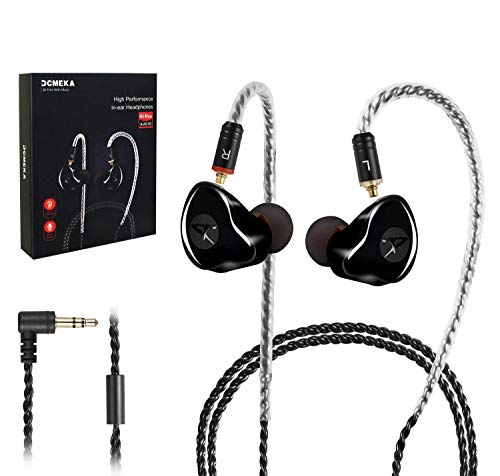
MMCX Cable Pick – DCMEKA A09
If replaceable cables are a priority when shopping for wired in ear monitors for guitarists, consider the DCMEKA A09. Its dual dynamic drivers and detachable MMCX connection offer a different setup from the hybrid models, with memory-wire routing for a secure fit.
Best For: Players who want MMCX cable flexibility and a dual-dynamic-driver earphone.
Pros:
- Detachable MMCX connectors allow cable replacement or upgrades.
- Memory-wire routing and three included ear-tip sizes help with fit.
- Dual dynamic drivers are described as delivering deep bass and clear treble.
Cons:
- Its stated 32-ohm impedance and 96 dB sensitivity differ from the other models; output level may vary by source.
- Fit-dependent noise isolation should not be treated as a fixed level of stage protection.
The A09 makes the most sense if you already use MMCX cables or expect to replace one later. Confirm that its 3.5 mm plug suits your monitor feed.
Lightweight Fit Pick – CCZ Yinyoo Melody
The CCZ Yinyoo Melody is worth considering among wired in ear monitors for guitarists who put comfort first. Each earpiece is listed at just 2.3 g, with soft ear fins, wrap-around hooks, and three pairs of tips to help achieve a stable fit.
Best For: Guitarists seeking a lightweight, secure-fitting wired monitor for longer sessions.
Pros:
- Listed 2.3 g earpieces keep weight low.
- Soft ear fins and shaped ear hooks help the monitors stay in place.
- Detachable 2-pin cable uses a standard 3.5 mm plug.
Cons:
- This listed version has no microphone.
- Only three pairs of included tips are specified, so finding your preferred seal may take experimentation.
Its one-dynamic-plus-one-balanced-armature configuration offers a compact hybrid option. Prioritize getting a comfortable seal before judging its bass or isolation.
Comfort-Focused Stage Pick – Westone Audio Pro X10
Among wired in ear monitors for guitarists, the Westone Audio Pro X10 is a compact option for players who prioritize fit and a clear monitor mix. Its single balanced-armature driver and sound-isolating earpieces are designed for stage monitoring.
Best For: Guitarists who want lightweight, low-profile monitors with a range of included ear tips.
Pros:
- Includes five pairs each of foam and silicone tips to help find a secure seal.
- Detachable Linum Bax T2 cable makes cable replacement possible.
- Left and right earpiece responses are matched within a stated ±2 dB tolerance.
Cons:
- Single-driver design may not appeal to players seeking a multi-driver setup.
- Finding the right seal may take some experimentation with the included tips.
Choose the Pro X10 if comfort, isolation, and a replaceable cable matter more to you than driver count.
Worship-Team Ready – Righteous Roots RR-EV1
The Righteous Roots RR-EV1 is aimed at musicians shopping for wired in ear monitors for guitarists, especially those playing rehearsals, church services, and live sets. Its listed features emphasize a secure over-ear fit, sound isolation, and an easy-to-pack kit.
Best For: Guitarists on worship teams who want a wired monitor with a case and a 1/4-inch adapter included.
Pros:
- Over-ear memory wire is designed to stay secure during movement.
- Detachable cable can be replaced if needed.
- Includes a travel case and a 1/8-inch-to-1/4-inch TRS adapter.
Cons:
- Listed warranty is one month.
- The supplied specifications describe the driver configuration inconsistently, so confirm it if driver count matters to you.
The RR-EV1 offers practical stage accessories, but its short listed warranty and unclear driver specification are worth checking before purchase.
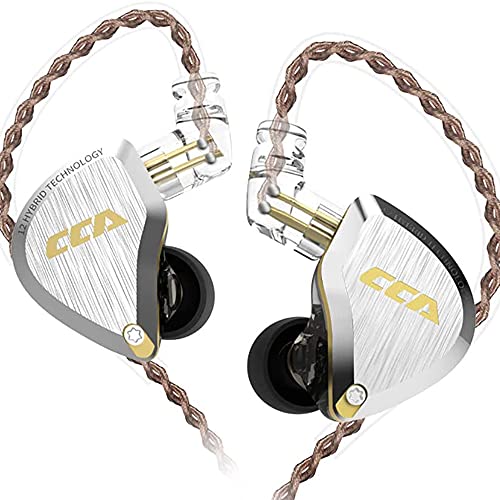
Hybrid-Driver Option – CCA C12
For players comparing wired in ear monitors for guitarists, the CCA C12 offers a hybrid layout with five balanced-armature drivers and one dynamic driver per side. Its stated tuning pairs powerful bass with an open midrange and extended highs.
Best For: Guitarists who want a multi-driver wired IEM for detailed listening as well as monitoring.
Pros:
- Hybrid driver configuration is designed to deliver layering across the frequency range.
- Detachable eight-strand cable allows replacement.
- Zinc-alloy faceplates and resin shells combine sturdy materials with an ergonomic shape.
Cons:
- The supplied notes do not specify included ear-tip choices or a carrying case.
- Its warm tuning may not suit players looking for a strictly neutral monitor presentation.
The C12 makes sense if its hybrid-driver sound appeals to you; check fit and included accessories against your stage needs.
Budget Bass Pick – KBEAR KS1
For guitarists comparing wired in ear monitors for guitarists, the KBEAR KS1 is a budget-friendly option with a single dynamic driver, a 3.5 mm plug, and a detachable cable. Its bass-forward description makes it worth considering if you prefer a fuller low end in your monitor mix.
Best For: Guitarists who want an inexpensive, bass-focused wired IEM with a replaceable cable.
Pros:
- Detachable four-strand copper cable offers a replacement option.
- Ergonomic shells and three pairs of silicone tips help you find a secure fit.
- 18-ohm impedance and a standard 3.5 mm connection suit compatible wired outputs.
Cons:
- Bass emphasis may not suit players seeking a more neutral monitor balance.
- Sound isolation depends on getting a good seal; active noise cancellation is not specified.
The KS1 makes the most sense as a low-cost personal monitor when fit and a fuller bass presentation matter more than a neutral tuning.
Two-Pair Value – H89 IEM Headphones
If you need two sets of wired in ear monitors for guitarists, the H89 package offers a black-and-white pair with 3.5 mm plugs. Each uses an 11 mm dynamic driver, and the supplied description emphasizes fuller bass and clear vocals.
Best For: Guitarists who want two inexpensive sets for sharing or keeping a spare.
Pros:
- Includes two sets of earphones and six pairs of silicone tips in total.
- Lightweight, ergonomic shells are designed for a comfortable fit.
- Built-in microphones add calling functionality when used with compatible devices.
Cons:
- Cables are not detachable, limiting replacement options.
- The supplied compatibility list does not establish whether the microphones or inline controls work with a particular stage monitor output.
The H89’s main advantage is quantity: it is a practical pick when having a second wired set matters more than cable replaceability.
Adapter-Included Pick – JotVira JV02
Among wired in ear monitors for guitarists, the JotVira JV02 stands out for its detachable cable and included 3.5 mm-to-USB-C adapter. Its wrap-around fit and 10 mm dynamic driver make it a candidate for players who also use their IEMs with personal devices.
Best For: Guitarists who want a detachable-cable IEM for both 3.5 mm gear and compatible USB-C devices.
Pros:
- Detachable, tangle-resistant cable offers more flexibility than a fixed cord.
- Includes a USB-C adapter, replacement ear tips, and a protective bag.
- Wrap-around design aims for a secure fit during performance.
Cons:
- The claimed 90% ambient-noise isolation is not backed by a stated test method.
- USB-C adapter compatibility may vary by device; check your equipment before relying on it.
The JV02 is the most accessory-focused option here. Its included adapter is convenient, but a good ear-tip seal remains important for useful isolation onstage.
How We Picked the Best Wired in Ear Monitors for Guitarists
We focused on practical differences guitarists can evaluate before buying: fit, stated isolation, driver configuration, cable setup, and price positioning. The selection ranges from inexpensive single- and dual-driver options to multi-driver hybrids and stage-oriented monitors. Driver count alone does not establish sound quality, and listed specifications are not a substitute for an in-person fit test.
Quick Comparison: Where to Start
For a first set on a tight budget, compare the KBEAR KS1, CCZ Yinyoo Melody, and the more simply described dual-dynamic and HiFi wired IEM options. If you want to explore multi-driver hybrids, look at the KZ ZS10 Pro, KZ ZAS, and CCA C12; their different configurations are a reason to compare tuning, not assume one is automatically clearer. The Westone Audio Pro X10 and Righteous Roots RR-EV1 are worth considering if you prefer options positioned specifically for musicians. The H89 two-pack may make sense when having a spare pair matters more than choosing one specialized set.
Key Buying Factors for Wired In-Ear Monitors for Guitarists
Fit and Isolation
A good seal helps you hear quieter details and reduces the temptation to turn up your monitor feed. Ear tips and shell shape affect both comfort and isolation, so check the included tip sizes and allow time to test the fit before a gig. Isolation claims, including decibel ratings, depend on how well the earpieces seal in your ears.
Sound and Your Monitor Mix
Think about what you need to follow: pick attack, vocals, a click, or low-end cues from bass and kick. A bass-heavy presentation can be enjoyable but may obscure guitar detail in a crowded mix. Balanced armature, dynamic, and hybrid designs can all work; tuning and your actual monitor mix matter more than the number of drivers.
Cable and Connection
Confirm the plug matches your headphone amp, mixer, or wireless bodypack output, and check whether you need a 3.5 mm-to-6.35 mm adapter. Consider cable length, routing around the ear, and whether a replacement cable is available. These are small details until a cable snags or fails before a set.
Who Should Buy Which Wired in Ear Monitors for Guitarists?
New IEM users should prioritize a comfortable seal and a sensible price over a long specification list. Gigging players should put secure fit, dependable cabling, and isolation first. Players who need a backup can consider the H89 two-pack, while those comparing more elaborate sound signatures can audition the hybrid models. Whichever you choose, start with a low monitor level and build a mix that lets you hear your guitar without overpowering everything else.