The right vocal processor can add polished harmony, spacious reverb, pitch correction, looping, and hands-free control to a live vocal setup. The best choice depends on whether you perform with a band, sing with acoustic guitar, stream, or record at home.
We compare 10 vocal processors for singers across essential features, usability, connectivity, and performance flexibility so you can choose an effects unit that matches your voice and workflow.
Best 10 Vocal Processors for Singers Picks for 2026
Best All-Around Vocal Effects

- Comprehensive effects library
- Automatic pitch correction
- Harmony and doubling functions
Best For: Singers needing a portable processor for recording, stage use, and livestreaming
Best for Streaming and Live Performance

- 16 vocal effects
- Three-part real-time harmonies
- USB audio for recording and streaming
Best For: Content creators and singers connecting directly to a computer or mobile device
Best Auto-Tune and Preset Control
HeadRush VX5 Vocal Effects Pedal

- Antares Auto-Tune processing
- 250-preset storage
- Footswitch and harmony control
Best For: Live vocalists and producers wanting programmable real-time pitch effects
Best Simple Harmony Pedal

- 24 harmony options
- Reverb and delay included
- Battery-powered portable design
Best For: Singers wanting straightforward harmonies and basic vocal ambience
Advanced Stage Control

- Up to nine vocal effects at once
- Automatic harmony and pitch correction
- Guitar input, looper, and vocoder
Best For: Singing guitarists and advanced live performers
Flexible Harmony Value
FLAMMA FV04 Vocal Harmony Pedal

- 11 harmony modes for major and minor scales
- Mic and guitar inputs with reverb
- Separate or mixed vocal and guitar outputs
Best For: Budget-conscious singers and guitarists
Simple Vocal Ambience

- Seven adjustable ambience effects
- Double-tracking for thicker vocals
- Enhance and pitch-correction functions
Best For: Singers wanting easy real-time vocal enhancement
Best Value Bundle
Zoom V3 Vocal Effects Processor
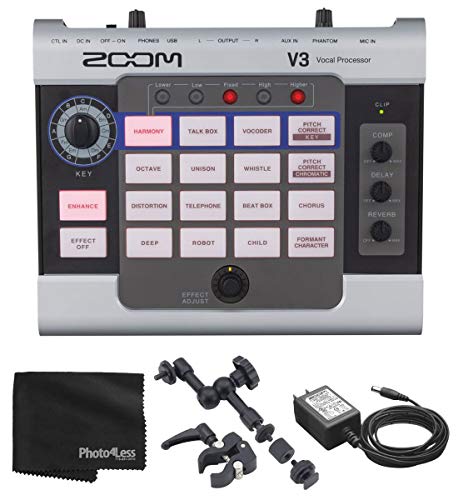
- Dedicated reverb, delay, and compression controls
- Enhance function and switchable 48V phantom power
- Includes AC adapter and recorder mount
Best For: Streaming, recording, and compact vocal setups
Best for Singing Guitarists

- Integrated vocal and acoustic-guitar processing
- Real-time harmonies based on guitar or key settings
- Includes pitch correction, ambience effects, and looping
Best For: Acoustic guitarists performing with vocals
Best Feature Variety
AVE-100 Vocal Effects Processor

- Pitch correction, harmony, reverb, and delay effects
- KeyLearn detects backing-track keys
- Loop recorder, anti-feedback, and 48V phantom power
Best For: Live performers, streamers, and recording singers
Best All-Around Vocal Effects – BOSS VE-22
The BOSS VE-22 is a versatile choice for singers comparing vocal processors for singers across practice, recording, stage performance, and livestreaming. It combines core studio effects with pitch correction, harmony, doubling, and more creative voice treatments in a portable format.
Best For: Singers who want one compact processor for polished vocals, harmonies, pitch effects, and live or online performance.
Pros:
- Includes compressor, EQ, delay, echo, reverb, and specialty effects such as lo-fi and distortion.
- Offers automatic pitch correction for subtle tuning or more pronounced electronic tones.
- Provides real-time harmony and doubling functions.
- Portable, battery-powered design with USB-C connectivity.
Cons:
- Its broad effects library may require time to explore and organize.
- Battery power may be less convenient than a dedicated AC setup for extended use.
The VE-22 stands out as a flexible all-purpose option, especially if you want both conventional vocal polish and creative effects without carrying a larger setup.
Best for Streaming and Live Performance – Zoom V3
The Zoom V3 is a practical pick for singers comparing vocal processors for singers with streaming and computer recording in mind. It offers 16 voice effects, real-time three-part harmonies, microphone enhancement, and USB audio connectivity in a battery-powered unit.
Best For: Singers, performers, and content creators who want direct USB recording or streaming alongside hands-on vocal effects.
Pros:
- Provides 16 vocal effects and up to three-part real-time harmonies.
- Built-in enhancer optimizes microphone input and supports 48V phantom power for condenser microphones.
- Dedicated compression, reverb, and delay controls simplify sound shaping.
- Records via USB at up to 32-bit/44.1kHz and runs up to 3.5 hours on four AA batteries.
Cons:
- USB audio is specified at a maximum sample rate of 44.1kHz.
- The unit has one channel, which may limit more complex multi-source setups.
Choose the V3 if easy computer connection is central to your workflow. Its combination of USB audio, microphone support, harmonies, and dedicated controls suits home recording, streaming, and mobile performance.
Best Auto-Tune and Preset Control – HeadRush VX5 Vocal Effects Pedal
The HeadRush VX5 targets singers seeking vocal processors for singers with hands-free control and prominent Auto-Tune features. Its Antares algorithm, adjustable Retune Speed and Humanize controls, harmony mode, onboard effects, and extensive preset storage support live sets and studio work.
Best For: Vocalists and producers who want real-time Auto-Tune, footswitch control, programmable presets, and instrument-linked harmonies.
Pros:
- Provides subtle pitch correction through classic Antares Auto-Tune effects.
- Includes compressor, reverb, delay, chorus, and flavor effects that can be chained or used individually.
- Stores up to 250 presets, with two footswitches for hands-free control.
- Offers vocal harmony based on a selected key and scale or chords from a connected instrument.
Cons:
- Its corded design is less portable than battery-powered alternatives.
- At 1.2 kg, it is heavier than the compact battery-powered models listed here.
- Its feature-rich layout may take more programming time for new users.
The VX5 is the strongest fit when Auto-Tune character, preset organization, and live foot control matter most. Its USB audio, MIDI, microphone, and guitar connections also make it adaptable for performance and production setups.
Best Simple Harmony Pedal – BOSS VE-2 Vocal Harmonist
The BOSS VE-2 is a straightforward option for singers comparing vocal processors for singers who mainly want harmony and basic studio-style ambience. Its battery-powered design provides 24 harmonies along with reverb and delay in a compact vocal-focused unit.
Best For: Singers who want portable vocal harmonies with simple reverb and delay rather than a broad effects workstation.
Pros:
- Offers 24 harmony options in a portable battery-powered format.
- Includes reverb and delay for additional vocal polish.
- Compact design is convenient for mobile performance and rehearsal setups.
Cons:
- Its listed effects are more limited than those of the VE-22, V3, or VX5.
- The supplied notes do not list USB audio recording, pitch correction, or extensive preset functions.
The VE-2 makes sense for singers who prioritize accessible harmonies and basic ambience. It is a focused alternative to more feature-heavy processors when simplicity and portability are the main goals.
Advanced Stage Control – BOSS VE-500 Vocal Performer
For singers looking for powerful vocal processors for singers, the BOSS VE-500 combines harmony, pitch correction, looping, and extensive effects in a pedalboard-friendly unit. Its guitar input also makes it particularly practical for singing guitarists who want integrated processing on stage.
Best For: Singing guitarists and performers who want deep live vocal customization.
Pros:
- Processes vocals with up to nine effects at once.
- Includes automatic harmony, pitch correction, reverb, delay, modulation, distortion, EQ, and filtering.
- Offers guitar integration, vocoder effects, flexible routing, and a built-in looper.
- Includes XLR output, USB connectivity, and a five-year BOSS warranty.
Cons:
- Its extensive feature set may require more setup than a simpler vocal pedal.
- Best suited to users who need advanced control rather than only basic ambience.
The VE-500 is the most feature-rich option here for building complex live vocal sounds. Choose it when harmony, guitar integration, and effect-routing flexibility matter more than minimal controls.
Flexible Harmony Value – FLAMMA FV04 Vocal Harmony Pedal
The FLAMMA FV04 is a compact choice among vocal processors for singers, adding selectable harmonies and reverb for both microphone and guitar signals. Its 11 harmony modes, phantom-power support, and separate or mixed outputs make it adaptable for small live setups and recording applications.
Best For: Singers and guitarists seeking affordable harmony effects with flexible signal routing.
Pros:
- Provides 11 harmony modes with major and minor scale flexibility.
- Accepts microphone or guitar inputs and includes dedicated reverb effects.
- Supports 48V phantom power and can function as a microphone amplifier.
- Offers mixed or individual outputs for vocal and guitar channels.
Cons:
- Its effects selection is more focused than the BOSS VE-500.
- Requires the included 9V 500mA power supply for operation.
With its straightforward stompbox format and useful routing options, the FV04 is a practical harmony pedal for performers who want core vocal and guitar functions without a larger multi-effects feature set.
Simple Vocal Ambience – BOSS VE-1 Vocal Echo
The BOSS VE-1 offers an approachable way to improve a singer’s sound with adjustable ambience, reverb, double-tracking, enhancement, and pitch correction. Among vocal processors for singers, it is geared toward quick real-time control rather than extensive effect routing or complex programming.
Best For: Vocalists who want simple reverb, ambience, and thickening effects in a compact unit.
Pros:
- Provides seven types of adjustable ambience effects.
- Includes double-tracking to thicken vocals.
- Offers enhance and pitch-correction functions, including an electronic-voice sound.
- Includes a power adapter, batteries, USB cable, and five-year BOSS warranty.
Cons:
- Has a narrower effect range than a full multi-effects processor.
- Does not list harmony, guitar input, or looper functionality.
The VE-1 is a sensible pick when ease of use and vocal ambience are the priorities. It gives singers essential sound-shaping tools without the larger control set of a performance-focused multi-effects pedal.
Best Value Bundle – Zoom V3 Vocal Effects Processor
For singers comparing vocal processors for singers, the Zoom V3 is a practical compact option for streaming, recording, and tabletop setups. It combines dedicated reverb, delay, compression, and an Enhance function with USB audio interface capability, plus this bundle adds an AC adapter and recorder mount.
Best For: Singers who want an effects-focused processor for home recording, streaming, or compact live setups.
Pros:
- Dedicated controls for reverb, delay, and compression make adjustments straightforward.
- Enhance automatically optimizes microphone performance for added clarity.
- XLR input includes switchable 48V phantom power for condenser microphones.
- USB 2.0 audio interface supports two inputs and two outputs.
Cons:
- The listed USB audio support is limited to a 44.1 kHz sample rate.
- The bundle’s included mount and adapter may be unnecessary if you already have compatible accessories.
The V3 stands out as a value-oriented choice when hands-on effects control and USB connectivity matter more than advanced harmony or looping features.
Best for Singing Guitarists – BOSS VE-8 Acoustic Singer
The BOSS VE-8 is among the more specialized vocal processors for singers because it combines vocal and acoustic-guitar processing in one compact unit. It adds real-time harmonies based on guitar input or manual key settings, along with ambience effects, pitch correction, and looping.
Best For: Acoustic guitarists who sing and need integrated vocal, guitar, harmony, and looper functions.
Pros:
- Combines vocal and guitar processing in an all-in-one preamp and effects unit.
- Creates real-time harmonies using guitar input or manual key settings.
- Includes four ambience effects, Enhance, and chromatic pitch correction.
- Built-in looping expands performance possibilities.
Cons:
- Its guitar-focused design may provide more functionality than non-guitarist singers need.
- It uses a corded-electric power source rather than a battery-powered setup.
Choose the VE-8 when your performance centers on acoustic guitar and vocals; its specialized harmony and looping features make it less of a general-purpose vocal-only processor.
Best Feature Variety – AVE-100 Vocal Effects Processor
The AVE-100 offers a broad feature set for singers evaluating vocal processors for singers, including pitch correction, harmony, reverb, delay, key detection, looping, and anti-feedback. Its connection options and 48V phantom power also suit live performance, streaming, recording, and condenser microphones.
Best For: Singers and content creators who want harmony, looping, and feedback-control tools in one processor.
Pros:
- Provides pitch correction, reverb, delay, and multiple harmony modes.
- KeyLearn detects the backing track’s key to support harmony and pitch correction.
- Includes a loop recorder for layering multiple vocal tracks.
- Offers XLR microphone connectivity with 48V phantom power and intelligent anti-feedback.
Cons:
- The notes do not specify USB audio interface functionality.
- Its wide feature set may require more setup than a processor with only basic effects.
The AVE-100 is a flexible pick for performers who value harmony, looping, and live-use safeguards, especially when automatic key detection and anti-feedback are priorities.
How We Picked These Vocal Processors for Singers
We focused on practical performance needs rather than feature counts alone. The lineup includes compact pedals, multi-effects units, vocal harmonizers, streaming-oriented processors, and all-in-one solutions for singer-guitarists. We considered vocal effects quality, harmony control, pitch features, looping, input and output options, footswitch layout, portability, and how easily each unit can be integrated into a live or recording setup.
Because singers use processors in different ways, no single model is ideal for everyone. A simple echo pedal may be preferable for a vocalist who wants reliable ambience, while a larger multi-effects unit can better suit performers who need presets, multiple effects, and hands-free control.
Quick Comparison
| Best For | Features to Prioritize | Typical Product Type |
|---|---|---|
| Live solo singers | Harmony, reverb, looping, easy foot control | Multi-effects pedal |
| Singer-guitarists | Vocal and instrument inputs, anti-feedback, harmony | Integrated vocal and guitar processor |
| Streaming and recording | USB or mixer-friendly connectivity, simple controls | Desktop or compact processor |
| Hands-free harmony | Key detection, guitar-controlled harmony, pitch options | Harmony pedal |
| Subtle vocal enhancement | Echo, ambience, reverb, low-noise operation | Dedicated vocal effects pedal |
Key Buying Factors for Vocal Processors for Singers
Effects and Vocal Control
Decide which effects you will actually use. Reverb and delay add space, harmony creates backing-vocal textures, and pitch correction can provide anything from gentle tuning support to an obvious modern effect. Look for independent controls or presets if you need to change sounds quickly during a performance.
Harmony Tracking and Key Control
Harmony processors may use a manually selected key, automatic key detection, guitar input, or a combination of methods. Guitar-controlled harmony can be especially useful for singer-guitarists, while automatic detection may be more convenient for solo vocals. Check how accurately the unit follows your song and whether harmony voices can be mixed separately.
Connectivity and Setup
Confirm the microphone input type, phantom-power requirements, instrument inputs, balanced outputs, USB support, and headphone or monitor connections. A processor designed for live use may connect easily to a mixer, while a streaming setup may benefit from direct computer connectivity or simple monitoring.
Foot Control, Presets, and Portability
Footswitches should be reachable without forcing you to look down constantly. Presets are valuable when your set uses different vocal sounds, but extra functions can increase the learning curve. Also consider power requirements, pedalboard size, build quality, and whether the unit is convenient to transport.
Who Should Buy Which Vocal Processors for Singers?
Choose a Compact Effects Pedal for Simplicity
If you mainly want reliable reverb, echo, or basic harmony without programming a complicated rig, choose a straightforward pedal with clearly labeled controls. This is often the best starting point for singers who are new to vocal processing.
Choose a Multi-Effects Processor for Setlist Flexibility
Performers who need several vocal sounds, presets, looping, pitch effects, and hands-free changes should consider a full multi-effects unit. These models take more time to learn but can replace several individual pedals.
Choose an Integrated Singer-Guitarist Solution
If you sing and play acoustic guitar, prioritize separate vocal and guitar processing, feedback control, harmony tracking, and outputs that fit your amplifier or PA. An integrated unit can reduce setup clutter and keep both parts of the performance under foot control.
Choose a Streaming-Focused Model for Content Creation
Streamers and home recordists should prioritize easy monitoring, clean signal routing, USB or interface compatibility, and controls that can be adjusted without interrupting the performance. Avoid paying for advanced live features you will not use.