The right subwoofer can add depth, scale, and impact to music without making bass sound loose or overwhelming. This roundup compares 10 powered models suited to studio monitors, stereo systems, home audio, and compact listening spaces.
We focus on useful differences such as driver size, amplifier power, connectivity, placement flexibility, and room-friendly design so you can choose a subwoofer that complements your existing speakers.
Best 10 Subwoofers for Music Picks for 2026
Studio Precision Pick

- 8-inch bass-reflex subwoofer
- 150-watt amplifier with response to 22 Hz
- Adjustable crossover and phase controls
Best For: Music production and recording
Flexible Wireless Studio Choice

- 8-inch driver with 100-watt output
- Bluetooth 5.0 plus TRS, RCA, and aux inputs
- Adjustable highpass and lowpass filters
Best For: Home studios and versatile music listening
High-Output Home Audio Pick

- 12-inch copper-spun front-firing woofer
- 400 watts of dynamic power
- Line/LFE inputs and phase control
Best For: Powerful music and home-theater bass
Compact Value Upgrade
- 10-inch Dynamic Balance woofer
- Up to 100 watts of built-in power
- 80–160 Hz variable crossover
Best For: Affordable bass upgrades in small-to-mid-size rooms
Deep-Bass Powerhouse

- 12-inch spun-copper IMG woofer
- 200W continuous, 400W peak power
- 29 Hz–120 Hz response at ±3 dB
Best For: Powerful bass in music and home-entertainment systems
Balanced Room-Filling Bass

- 10-inch front-firing IMG woofer
- 150W continuous, 300W peak power
- Low-pass crossover and phase control
Best For: Mid-sized music, TV, and gaming systems
Compact Music Upgrade

- 8-inch cone woofer
- 100W dynamic power
- Twisted flare port for tight bass
Best For: Smaller music, desktop, and home-theater setups
Best with Extra Features
- 8-inch woofer with 35Hz bass extension
- 70W RMS Class-D powered design
- Adjustable filter and phase controls
Best For: Compact bookshelf and desktop audio systems
Best Heavy-Duty Pick

- 10-inch cone woofer
- 100W powered output
- Twisted flare port for tight bass
Best For: Music and home theater rooms with floor space
High-Output System Builder

- 300W RMS from a 10-inch woofer
- RCA and high-level connections
- Adjustable volume, crossover, and phase
Best For: Powerful wired home theater and music systems
Studio Precision Pick – Yamaha HS8S
For listeners and creators seeking subwoofers for music, the Yamaha HS8S is a studio-focused 8-inch option with a 150-watt amplifier and bass response extending to 22 Hz. Its adjustable crossover and phase controls make it practical for integrating with a monitoring setup.
Best For: Music production, recording, and live-music monitoring where controlled low-end adjustment matters.
Pros:
- 8-inch bass-reflex design with a 22–150 Hz frequency response
- Powerful 150-watt amplifier
- Adjustable 80–120 Hz low- and high-cut controls plus a phase switch
Cons:
- Wired XLR connectivity rather than wireless subwoofer operation
- Floor-standing cabinet weighs 33.6 pounds
The HS8S is a strong choice when accurate, tunable bass is more important than compact size or consumer-oriented convenience features.
Flexible Wireless Studio Choice – PreSonus Eris Sub 8BT
The PreSonus Eris Sub 8BT combines an 8-inch front-firing driver with Bluetooth 5.0 and flexible wired inputs, making it one of the more adaptable subwoofers for music listening, production, and multimedia setups. Its crossover controls help coordinate the subwoofer with compact monitors.
Best For: Home studios, hi-fi listening, gaming, and users who want both Bluetooth and wired connection options.
Pros:
- 100-watt output with low-frequency extension to 30 Hz
- Bluetooth 5.0, balanced TRS, RCA, and front-panel aux inputs
- Highpass and lowpass controls for smoother monitor integration
- Front headphone output and built-in headphone amplifier
Cons:
- Its 30 Hz low-end reach is less extended than some larger subwoofers
- Plastic-and-metal construction may feel less substantial than larger studio cabinets
With room-tuning controls, power-saving mode, and broad connectivity, the Eris Sub 8BT is a practical all-around option for smaller listening and production spaces.
High-Output Home Audio Pick – Klipsch R-12SW
The Klipsch R-12SW is a large-format choice among subwoofers for music, pairing a 12-inch copper-spun woofer with an all-digital amplifier rated for 400 watts of dynamic power. Line/LFE inputs, a low-pass crossover, and phase control support straightforward receiver integration.
Best For: Music listeners and home-theater owners who want powerful, room-filling bass from a larger cabinet.
Pros:
- 12-inch front-firing copper-spun woofer
- 400 watts of dynamic amplifier power
- Line/LFE inputs for compatibility with many receivers
- Low-pass crossover and phase controls
Cons:
- Large 20-by-20-by-17.7-inch cabinet may require substantial floor space
- Wired only, with no wireless communication technology
- Frequency response is listed to 29 Hz rather than the deepest sub-bass ranges
The R-12SW favors scale and output over compactness, making it a compelling fit for bigger rooms or systems where music and movies both need substantial bass impact.
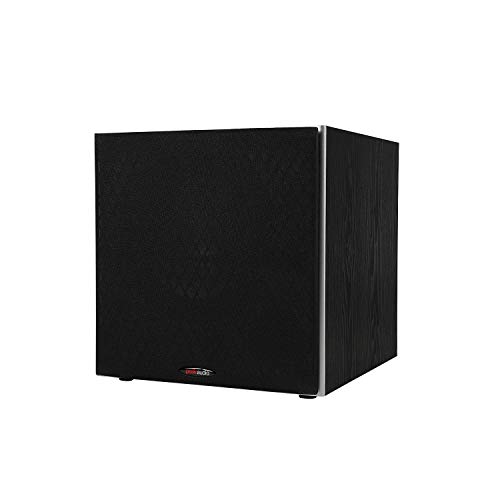
Compact Value Upgrade – Polk Audio PSW10
The Polk Audio PSW10 is a compact 10-inch powered subwoofer designed to add bass depth to music and home-audio systems. Its 50-watt RMS amplifier, continuously variable crossover, and speaker- and line-level connections make it easy to blend with an existing setup.
Best For: Small- to mid-size rooms and budget-conscious listeners wanting a straightforward bass upgrade.
Pros:
- 10-inch Dynamic Balance woofer with a directed port
- Up to 100 watts of power from its built-in amplifier
- Variable 80–160 Hz crossover and phase toggle switch
- Speaker-level and line-level connection options
Cons:
- 40–160 Hz (-3 dB) response is less deep than some studio-oriented models
- Lower amplifier output than the larger Klipsch option
The PSW10 is a sensible entry-level pick when you want fuller bass without moving to a larger, higher-powered enclosure or a more complex studio subwoofer.
Deep-Bass Powerhouse – Klipsch R-120SW
For listeners seeking subwoofers for music with strong low-end impact, the Klipsch R-120SW combines a 12-inch spun-copper IMG woofer with a 200-watt amplifier and 400-watt peak output. Its rear-firing port and RCA connectivity make it a practical wired addition to a home audio system.
Best For: Music listeners and home-entertainment setups that want powerful, room-filling bass.
Pros:
- Large 12-inch high-excursion woofer reaches down to 29 Hz at ±3 dB.
- 200 watts of amplifier power and 400 watts peak output provide substantial headroom.
- Bass-reflex enclosure and rear-firing port support strong low-frequency output.
- Includes a grille, manual, and power cord.
Cons:
- The 31-pound cabinet is relatively substantial for smaller rooms.
- Wired RCA connectivity may be less convenient than wireless options.
- Its high output may be more than needed for compact listening spaces.
The R-120SW is a compelling choice when musical bass authority matters more than a compact footprint. Its 12-inch driver and higher power rating make it the strongest performer of these options for listeners who want pronounced low-end energy.
Balanced Room-Filling Bass – Klipsch R-100SW
The Klipsch R-100SW is a practical pick among subwoofers for music when you want deep bass without moving up to a 12-inch cabinet. Its front-firing 10-inch woofer, 150-watt amplifier, and adjustable controls offer flexible integration with a wired receiver or home audio setup.
Best For: Music, television, and gaming systems that need capable bass from a mid-sized subwoofer.
Pros:
- 10-inch front-firing spun-copper IMG woofer delivers extended low-frequency output.
- 300 watts of peak amplifier power provides useful dynamic headroom.
- Low-pass crossover and 0/180-degree phase control help with system integration.
- Line-level LFE and RCA inputs support receiver compatibility.
Cons:
- Its 32 Hz–120 Hz response does not reach as low as the R-120SW.
- Connectivity is wired, with no wireless communication technology listed.
- The supplied dimensions and 26-pound weight still require dedicated floor space.
The R-100SW offers a sensible middle ground: more bass capability than a compact 8-inch model, while remaining less imposing than a larger 12-inch subwoofer. Its crossover and phase controls are especially useful for tuning it to a music or mixed-use system.
Compact Music Upgrade – Yamaha NS-SW050BL
The Yamaha NS-SW050BL is a compact option for shoppers comparing subwoofers for music in a smaller room or desktop-style setup. Its 8-inch woofer, 100-watt dynamic power rating, and twisted flare port are designed to add tighter low-end support without the bulk of a larger cabinet.
Best For: Compact home-theater, music-player, desktop, and mixed-media systems.
Pros:
- Compact 8-inch design is easier to place than larger subwoofers.
- Twisted flare port is intended to contribute to clear, tight bass.
- Yamaha Advanced YST II technology supports active servo bass control.
- Compatible device listings include computers, mobile devices, televisions, and projectors.
Cons:
- Its 100-watt dynamic rating is lower than both Klipsch models.
- The 8-inch driver is better suited to modest spaces than large-room output.
- Its connectivity is wired rather than a fully wireless subwoofer setup.
The NS-SW050BL is the most space-conscious choice in this group. It makes sense when you want to supplement music playback with cleaner, fuller bass while keeping the subwoofer relatively unobtrusive.
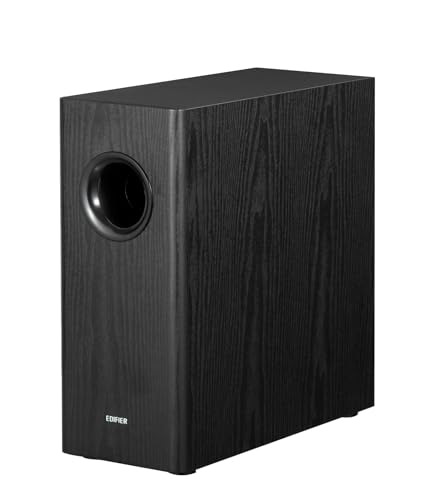
Best with Extra Features – Edifier T5s
The Edifier T5s is a practical choice among subwoofers for music when you want deeper bass without taking up much floor space. Its 8-inch woofer, 70W RMS Class-D amplifier, and 35Hz frequency response are suited to bookshelf speakers, desktop audio, and compact home systems.
Best For: Small to medium indoor listening setups that need adjustable, controlled bass.
Pros:
- 8-inch long-throw woofer reaches down to 35Hz with 70W RMS output.
- Low-pass filter and phase selector help match the subwoofer to different systems.
- Compact MDF cabinet, auto-standby, and included RCA cables simplify installation.
Cons:
- Wired RCA connectivity only; it has no wireless communication.
- Series connection requires main speakers with a wired line input.
The T5s stands out for flexible integration and a space-saving design. It is a sensible pick for music listeners who want cleaner low-end extension from powered bookshelf or desktop speakers.
Best Heavy-Duty Pick – Yamaha NS-SW100
The Yamaha NS-SW100 is a straightforward option among subwoofers for music, pairing a 10-inch cone woofer with 100W of power. Its Advanced YST II technology and twisted flare port are designed to produce clear, tight bass for home audio and entertainment systems.
Best For: Home theater and music setups that need a larger floor-standing subwoofer with a simple design.
Pros:
- 10-inch woofer provides a substantial low-frequency foundation.
- Advanced YST II and the twisted flare port support tight, clear bass.
- Stylish black cabinet blends readily into a living-room system.
Cons:
- Its floor-standing enclosure has a relatively large 17.5-inch footprint in each listed dimension.
- Wired connectivity may be less convenient than a wireless setup.
Yamaha’s NS-SW100 favors dependable, room-filling performance over compact placement. Consider it when your system has enough space for a 10-inch powered subwoofer and you want bass suited to both music and home theater.
High-Output System Builder – Rockville Rock Shaker 10-inch
The Rockville Rock Shaker is aimed at listeners who want forceful low-end impact from subwoofers for music, movies, or gaming. Its 10-inch woofer, 300W RMS amplifier, and adjustable controls make it suitable for building a customizable wired home theater or studio-style setup.
Best For: Users who prioritize powerful bass and broad connection options for a home entertainment system.
Pros:
- 10-inch woofer and 300W RMS output deliver substantial bass capability.
- Volume, crossover, and phase controls allow system-specific tuning.
- RCA and high-level inputs and outputs support varied wired configurations.
- MDF enclosure with detachable foam grille offers a durable, finished presentation.
Cons:
- The 18.9-inch-deep cabinet requires considerable placement space.
- It uses wired connectivity and does not provide wireless communication.
- The listed warranty is one year, shorter than some competing options.
The Rock Shaker is the most output-focused choice in this group. Its flexible inputs and tuning controls are useful, but its larger cabinet makes it better suited to dedicated floor placement than compact listening areas.
How We Picked the Best Subwoofers for Music
We selected models across several common listening setups, including studio monitoring, desktop audio, stereo hi-fi, and home theater. Our comparison emphasizes powered designs that are straightforward to connect and operate, with attention to cabinet size, woofer diameter, rated output, crossover controls, and available inputs.
Because rooms and speakers vary widely, no single model is ideal for everyone. A compact 8-inch subwoofer may integrate more naturally in a small room, while a 10- or 12-inch design can deliver greater low-frequency extension and headroom in larger spaces.
Quick Comparison
| Best For | Typical Size | What to Look For |
|---|---|---|
| Desktop or small-room listening | 8 inches | Compact cabinet, adjustable crossover, low noise |
| General stereo systems | 10 inches | Balanced output, flexible level control, line-level connectivity |
| Large rooms and home theater | 10–12 inches | Higher output, deeper extension, strong enclosure design |
| Studio monitoring | 8 inches | Accurate response, integration controls, professional inputs |
Key Buying Factors for Subwoofers for Music
Driver Size and Output
Larger drivers generally move more air and can play louder with less strain, but they also require more space and may excite room modes more strongly. For many bedrooms, offices, and apartments, an 8-inch model is sufficient. A 10- or 12-inch subwoofer is better suited to larger rooms or listeners who want more physical impact.
Integration and Crossover Controls
Look for adjustable crossover and volume controls so the subwoofer can blend with your main speakers rather than overpower them. Phase adjustment is also useful when placement causes bass cancellation. Studio-oriented models may offer more precise integration features than basic home-audio units.
Connections and Compatibility
Check whether your amplifier, receiver, powered speakers, or audio interface provides a compatible subwoofer output. RCA line-level inputs are common in home audio, while professional systems may use balanced connections. Bluetooth can be convenient, but it does not replace checking wired compatibility with your primary system.
Placement and Room Size
Place the subwoofer near the front speakers when possible, then adjust its level and crossover by ear or with room-measurement tools. Avoid assuming that maximum bass is best; smooth, even response usually sounds more accurate for music.
Who Should Buy Which Subwoofers for Music?
- Choose an 8-inch model for desktop listening, smaller rooms, nearfield monitors, or a restrained upgrade to compact speakers.
- Choose a 10-inch model for versatile stereo listening and a stronger balance of depth, output, and manageable size.
- Choose a 12-inch model for large rooms, demanding playback levels, or listeners who want pronounced low-end impact.
- Choose a studio-focused subwoofer when tonal accuracy, crossover control, and monitor integration matter more than maximum volume.
- Choose a home-theater-oriented model when movies and high-impact effects are as important as music.
Before buying, confirm the subwoofer’s dimensions, input type, power requirements, and return policy. A well-matched, correctly positioned model will usually sound better than a more powerful subwoofer that overwhelms the room or cannot integrate cleanly with your main speakers.