Bluetooth studio monitors make it easier to switch between wired production gear and everyday wireless listening without adding a separate receiver. The best options balance accurate near-field sound, useful inputs, practical controls, and enough output for your workspace.
These 10 picks cover compact desktop monitors, larger creative-reference speakers, and versatile bookshelf-style systems. Use the guide below to narrow your choice by room size, connectivity, bass needs, and intended use.
Best 10 Studio Monitor with Bluetooth Picks for 2026
Best Balanced Pick

- Hi-Res Audio with 52Hz–40kHz response
- Bluetooth multipoint and balanced TRS input
- App-based EQ with three listening modes
Best For: Compact home studios and versatile near-field listening
Best Compact Pair

- Stereo pair with cables and isolation pads
- Bluetooth streaming for everyday playback
- Tone knob and location switch for placement
Best For: Small desks, casual listening, and entry-level monitoring
Best High-Power Option

- 110W RMS three-way active design
- LDAC Bluetooth and 24-bit/96kHz support
- XLR, TRS, RCA, AUX, and headphone output
Best For: Powerful home studios and high-resolution wireless listening
Best for Big Bass
- 8-inch woofer with 140W maximum output
- Bluetooth, TRS, RCA, and 3.5mm inputs
- Tone and desktop/bookshelf placement controls
Best For: Large-room listening, gaming, parties, and bass-forward playback
Versatile Home Studio Pick
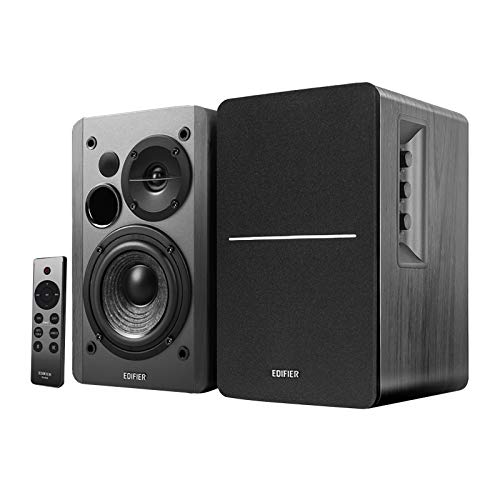
- Bluetooth 5.0 plus optical and coaxial inputs
- 42W stereo output with 4-inch woofer
- Remote control and subwoofer line out
Best For: Flexible desktop and home-entertainment setups
Flexible Creative Monitor
- Bluetooth with TRS, RCA, and 3.5mm inputs
- 4.5-inch woofer and silk-dome tweeter
- Tone control and desktop/bookshelf modes
Best For: Mixed studio, gaming, and everyday listening
Compact Production Pair

- Bluetooth plus 1/4-inch, 1/8-inch, and RCA inputs
- 3.5-inch Kevlar woofers with silk-dome tweeters
- Front headphone access and rear EQ controls
Best For: Small desktop production and multimedia setups
Versatile Wireless Bookshelf Pick
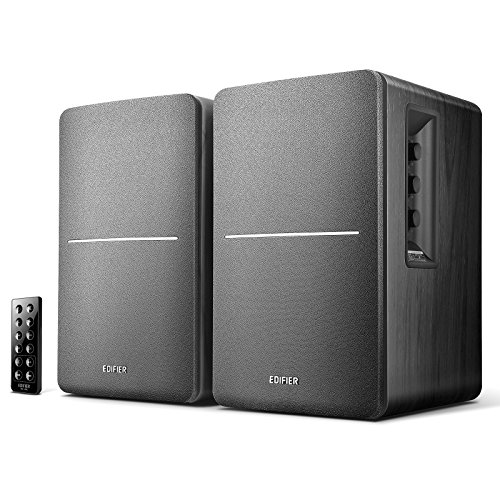
- Bluetooth plus optical, coaxial, and RCA inputs
- 42W RMS stereo output with 4-inch woofers
- Remote control, EQ knobs, and sub-out
Best For: Wireless desktop, TV, and indoor entertainment audio
Room-Filling Monitor Upgrade

- 50W Class A/B stereo monitoring power
- 4.5-inch woofers with 70Hz–20kHz response
- Bluetooth 5.0, balanced TRS, RCA, and aux inputs
Best For: Desktop production, gaming, and fuller multimedia sound
Best Balanced Pick – Edifier MR3
The Edifier MR3 is a versatile studio monitor with bluetooth for near-field listening, home studios, video editing, and everyday music. It combines Hi-Res Audio support with balanced TRS, RCA, AUX, and headphone connections.
Best For: Home studio users who want accurate wired monitoring plus convenient Bluetooth listening.
Pros:
- Hi-Res Audio certification with a stated 52Hz–40kHz response.
- Bluetooth supports multipoint connection, while TRS, RCA, and AUX expand wired options.
- Music, Monitor, and Custom modes allow flexible listening and monitoring.
- EDIFIER ConneX app provides EQ and sound customization.
Cons:
- Its 18W-per-channel output is more suited to near-field use than filling large rooms.
- Bluetooth range is listed at up to 10 meters.
The MR3 is a practical all-rounder for desks and compact studios, especially if you want app-based tuning and broad connectivity without giving up Bluetooth convenience.
Best Compact Pair – Mackie CR3.5BT
The Mackie CR3.5BT is a compact studio monitor with bluetooth designed for desktops, casual listening, and basic studio monitoring. It arrives as a pair and includes the cables and isolation pads needed for a straightforward setup.
Best For: Desktop users who want small, flexible speakers for wired sources and Bluetooth streaming.
Pros:
- Sold as a stereo pair with speaker wire, audio cables, and foam isolation pads.
- Bluetooth enables quick streaming from smartphones, tablets, and other compatible devices.
- Tone knob and location switch help adapt the sound to the room and placement.
- Supports Bluetooth, RCA, and TRS connectivity.
Cons:
- The 3.5-inch woofer limits its low-end reach compared with larger monitors.
- It is intended for tabletop use rather than large-room playback.
With its compact footprint and included accessories, the CR3.5BT is an easy entry point for a small workspace where Bluetooth convenience matters as much as basic monitoring capability.
Best High-Power Option – Edifier MR5
The Edifier MR5 is a high-output studio monitor with bluetooth that adds a three-way driver design, LDAC wireless audio, and extensive wired connectivity. Its 110W RMS amplification and room-tuning controls make it suitable for near-field work and larger listening spaces.
Best For: Creators who need powerful, detailed monitoring with high-resolution wireless and professional inputs.
Pros:
- Three-way design uses a 5-inch woofer, 3.75-inch mid driver, and 1-inch silk dome tweeter.
- Supports 24-bit/96kHz wired and LDAC wireless audio.
- Offers XLR, TRS, RCA, AUX, Bluetooth, and a front headphone output.
- Rear controls and the EDIFIER ConneX app provide room and EQ adjustments.
Cons:
- The larger cabinet and roughly 10.38 kg listed weight require more desk or stand space.
- Its higher output may be excessive for a small desktop listening position.
The MR5 is the most feature-rich choice here for users who want Bluetooth without treating it as an afterthought, while still getting the inputs and tuning options expected in a more advanced monitor.
Best for Big Bass – Mackie CR8BT
The Mackie CR8BT is a large studio monitor with bluetooth built around an 8-inch woven woofer and 140W maximum output. It is designed to cover studio recording, casual listening, gaming, and parties, with controls for tailoring the sound to desktop or bookshelf placement.
Best For: Listeners who want strong low-end output and Bluetooth flexibility for studios, entertainment, and parties.
Pros:
- 8-inch woofer and 1-inch silk dome tweeter provide a larger-scale presentation.
- Bluetooth pairs with smartphones and tablets, while TRS, RCA, and 3.5mm inputs support wired sources.
- Tone knob can add bass and high-end emphasis for casual listening or gaming.
- Location switch offers desktop and bookshelf modes.
Cons:
- Its 35.3-pound listed weight and large dimensions need substantial space.
- The optional CR8SBT subwoofer is not included.
- Its entertainment-focused tone controls may be less suitable for strictly neutral monitoring.
The CR8BT is a compelling pick when room-filling output and bass presence matter more than a compact footprint. Its placement switch and multiple inputs make it unusually adaptable for a large monitor.
Versatile Home Studio Pick – Edifier R1280DBs
The Edifier R1280DBs is a practical studio monitor with Bluetooth for desktop listening, casual production, and home entertainment. Bluetooth 5.0 handles wireless playback, while optical, coaxial, and RCA connections support computers, televisions, and other wired sources.
Best For: Buyers who want flexible connectivity, simple controls, and a built-in subwoofer output for a home studio or entertainment setup.
Pros:
- Bluetooth 5.0 supports wireless playback from phones, tablets, and laptops.
- Optical and coaxial inputs provide wired connection options for TVs and computers.
- 42W continuous power, a 4-inch woofer, and a 13mm silk-dome tweeter support full-range stereo sound.
- Includes a remote and on-speaker bass, treble, and volume controls.
Cons:
- Plastic enclosure may feel less substantial than wood-cabinet alternatives.
- Bluetooth range is listed at 10 meters.
- Designed for tabletop or shelf mounting rather than water-resistant use.
Choose the R1280DBs if connection flexibility matters as much as wireless convenience. Its subwoofer line out and multiple digital inputs make it especially adaptable for a compact desktop or living-room system.
Flexible Creative Monitor – Mackie CR4.5BT
The Mackie CR4.5BT is a studio monitor with Bluetooth that balances wired studio connections with convenient wireless listening. Its 4.5-inch woofer, silk-dome tweeter, tone control, and placement switch make it suitable for desktop work, gaming, and casual playback.
Best For: Creative users who want one pair of monitors for studio use, computer audio, gaming, and everyday listening.
Pros:
- Bluetooth pairs with smartphones and other compatible devices.
- TRS, RCA, and 3.5mm connections accommodate interfaces, PCs, consoles, and playback devices.
- Tone control can add bass and high-end emphasis for nonproduction listening.
- Desktop/bookshelf mode switch and included isolation pads help with placement.
Cons:
- Bluetooth range is listed at 10 meters.
- The optional CR8SBT subwoofer is not included.
- Its tone control may be less suitable when a strictly flat monitoring response is preferred.
The CR4.5BT stands out for versatility. It can support a more neutral starting point for studio work, then adapt to gaming or entertainment through its tone control and placement modes.
Compact Production Pair – M-Audio BX3BT
The M-AUDIO BX3BT is a compact studio monitor with Bluetooth for desktop production, podcasting, gaming, and multimedia. Its 3.5-inch Kevlar woofers, silk-dome tweeters, rear EQ controls, and multiple wired inputs provide useful flexibility in a small workspace.
Best For: Desktop creators who need compact monitors with Bluetooth, headphone access, and connections for computers, mixers, and other wired sources.
Pros:
- Bluetooth supports wireless streaming from compatible phones, tablets, and laptops.
- 3.5-inch Kevlar woofers and silk-dome tweeters are designed for detailed stereo playback.
- Rear 1/4-inch, 1/8-inch, and RCA inputs support a range of wired sources.
- Includes front headphone access, rear high/low EQ controls, and position switching.
Cons:
- 3.5-inch woofers provide less physical low-end capability than larger monitors.
- The compact cabinet may be better suited to near-field desktop listening than larger rooms.
- Bluetooth range specifications are inconsistent in the supplied details, so placement should be tested in your setup.
For a small desk, the BX3BT offers an unusually broad feature set. Its wired inputs and adjustment controls make it more adaptable than basic computer speakers, while Bluetooth keeps casual listening convenient.
Versatile Wireless Bookshelf Pick – Edifier R1280DB
If you want a studio monitor with bluetooth for desktop listening, the Edifier R1280DB combines wireless playback with useful digital inputs. Its 4-inch woofers, silk-dome tweeters, and 42W RMS output suit everyday music, TV, and computer audio.
Best For: Wireless desktop, TV, and indoor entertainment setups that need Bluetooth, optical, and coaxial connectivity.
Pros:
- Bluetooth supports convenient wireless connections to phones, tablets, computers, and Macs.
- Optical and coaxial inputs support digital connections to TVs and computers.
- Side-panel bass and treble controls allow basic sound adjustment.
- Includes a remote control and a sub-out for adding an external subwoofer.
Cons:
- The 4-inch drivers provide less low-end reach than larger monitors.
- It is designed for indoor use and is not water resistant.
The R1280DB is a practical choice when wireless convenience matters as much as flexible connectivity. It leans toward versatile home audio rather than specialized production monitoring.
Compact Studio Desk Choice – PreSonus Eris 3.5 Bluetooth
The PreSonus Eris 3.5 Bluetooth is a compact studio monitor with bluetooth designed for desks and small listening spaces. It delivers 50W of built-in amplification, balanced and unbalanced inputs, and acoustic tuning controls for music, gaming, streaming, and recording.
Best For: Desktop users who want a compact stereo pair with Bluetooth, wired input flexibility, and headphone listening.
Pros:
- Sold as a complete stereo pair with 50W of built-in amplification.
- 3.5-inch woven-composite woofers and 1-inch silk-dome tweeters cover 80Hz–20kHz.
- High- and low-frequency tuning controls help adapt the sound to the room.
- Includes balanced TRS, RCA, front aux, and front headphone connections.
Cons:
- The compact 3.5-inch woofers may offer less bass than larger monitors.
- It is not water resistant and requires corded power.
With its small footprint and broad input selection, the Eris 3.5 Bluetooth makes a flexible desktop setup. It is especially convenient when you alternate between wireless playback, production gear, and headphones.
Room-Filling Monitor Upgrade – PreSonus Eris 4.5BT
The PreSonus Eris 4.5BT is a larger studio monitor with bluetooth for listeners who want stronger low-end output without moving to a full-size system. Its 4.5-inch woofers, 1-inch silk-dome tweeters, and 50W Class A/B amplification support multimedia, gaming, and studio-quality music production.
Best For: Desktop creators and listeners who want Bluetooth plus balanced inputs, room tuning, and a wider low-frequency response.
Pros:
- 4.5-inch woven-composite woofers extend the stated response to 70Hz–20kHz.
- Bluetooth 5.0 supports wireless audio playback.
- Balanced TRS, RCA, and front auxiliary inputs accommodate professional and consumer sources.
- High- and low-frequency controls, a headphone amp, and optional subwoofer support add flexibility.
Cons:
- The pair is larger and heavier than the Eris 3.5, requiring more desk space.
- It requires corded power and is not water resistant.
The Eris 4.5BT is the stronger fit when you want more cabinet and woofer size while keeping Bluetooth convenience. Its connection options and acoustic controls also make it adaptable to a more serious desktop audio setup.
How We Picked the Best Studio Monitor with Bluetooth Options
We focused on powered speaker pairs that combine Bluetooth with the features buyers typically need from a desktop or near-field monitor. Our evaluation criteria included driver size, rated power, input selection, compactness, control placement, and suitability for music production, content creation, gaming, and general listening.
We also considered the practical differences between compact 3.5-inch models and larger 4-inch, 4.5-inch, and 8-inch designs. Bluetooth is convenient, but it should complement—not replace—the wired connections used for critical monitoring.
Quick Comparison
| Best for | Recommended size | What to prioritize |
|---|---|---|
| Small desk or bedroom | 3.5-inch | Compact cabinets, front controls, moderate output |
| Balanced desktop listening | 4-inch to 4.5-inch | Fuller bass, flexible inputs, manageable footprint |
| Larger room or louder playback | 5-inch to 8-inch | Higher output, deeper bass, adequate listening distance |
| Music production | 3.5-inch to 5-inch | Wired inputs, stereo imaging, neutral response |
Key Buying Factors for a Studio Monitor with Bluetooth
Bluetooth and Wired Connectivity
Check whether the speaker includes the inputs you actually use, such as balanced TRS, RCA, 3.5mm, optical, or subwoofer output. Bluetooth is ideal for phones and tablets, while wired connections are preferable for interfaces, mixers, and latency-sensitive work.
Driver Size and Room Fit
Smaller drivers suit close listening on a crowded desk and usually make placement easier. Larger drivers can deliver stronger bass and greater volume, but they need more space and may overwhelm a small room. Leave clearance around rear ports and avoid placing speakers directly against a wall.
Power, Controls, and Placement
Higher wattage does not automatically mean better accuracy, but it provides more headroom for dynamic music. Look for accessible volume controls, tone adjustment when useful, and a design that keeps the tweeters near ear level. Place the pair symmetrically and angle them toward your listening position.
Subwoofer Compatibility
If you produce bass-heavy music or watch films, a dedicated subwoofer connection can be valuable. For ordinary desktop use, accurate compact monitors may provide cleaner, more manageable bass without requiring additional equipment.
Who Should Buy Which Studio Monitor with Bluetooth?
Choose a compact 3.5-inch pair if you have limited desk space, sit close to the speakers, or want an affordable upgrade for a computer. A 4-inch to 4.5-inch model is the most versatile choice for mixed use, offering a useful balance of size, bass, and volume.
Move to a larger monitor when you have a bigger room, need higher playback levels, or want more low-end authority. Producers should prioritize stereo imaging and dependable wired inputs over Bluetooth convenience. For casual listeners, gamers, and streamers, easy wireless pairing, front-panel access, and a pleasing response may matter more than strict neutrality.