Passive speaker selector switches make it easier to route one amplifier to multiple speaker pairs, letting you choose listening zones without adding another receiver or complicated automation system.
This roundup compares 10 practical options, from compact two-way switch boxes to four-zone models with independent A/B/C/D controls. Use the guide below to match the switcher’s layout, power handling, and connection style to your system.
Best 10 Passive Speaker Selector Switches Picks for 2026
Best Multi-Zone Pick
Pyle 4-Channel Speaker Selector

- Routes one stereo system to up to four speaker pairs
- 100W per channel with 8-ohm minimum speakers
- Push-button operation and 14-gauge wire support
Best For: Multi-room or multi-zone speaker distribution
Best for A/B Comparisons
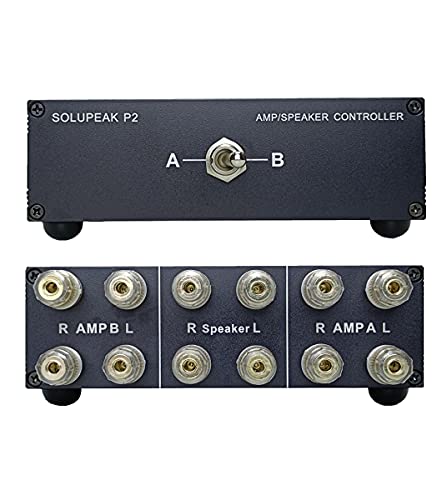
- Works with two amps and one speaker pair or vice versa
- One-press passive A/B switching
- Gold-plated banana jacks support up to 12-gauge wire
Best For: Comparing amplifiers or speaker pairs
Best Modern Two-Way Selector

- Switches between two amps and one speaker pair
- Can also connect one amp to two speaker sets
- Passive, plug-and-play A/B operation
Best For: Alternating between amps or speaker sets
Best for Simultaneous Zones
ADWITS 2-Channel Speaker Switcher

- Controls two speaker pairs from one amplifier
- Can play either pair or both at once
- Metal housing with separate rocker switches
Best For: Basic residential or commercial two-zone audio
Best Flexible 2-Zone Pick

- Independent A/B zone controls
- 150W RMS per channel; 4–16Ω support
- Passive design with no external power
Best For: Simple two-zone home or office audio setups
Best Rugged Compact Option
XtremPro 2-to-4 Way Speaker Switch

- Two dedicated ON/OFF rocker switches
- Metal enclosure with terminal clamps
- 150W RMS per channel; 4–16Ω support
Best For: Basic stereo systems needing separate speaker-pair control
Best Whole-Home Expansion Pick
PROZOR 4-Zone Speaker Selector

- Controls up to four speaker pairs
- Independent A/B/C/D buttons plus AMP switch
- Passive operation with 150W RMS per channel
Best For: Multi-room audio using one amplifier
Compact 2-Zone Control
TENEALAY P21 2-Way Speaker Selector

- Controls two speaker pairs
- Supports 8–16-ohm speakers
- Compact passive metal housing
Best For: Basic home theater and stereo switching
Flexible Dual-Layout Switcher

- Supports two zones or amplifiers
- Handles up to 150W RMS per channel
- Works with 4–16-ohm speakers
Best For: Higher-power DIY and multi-room layouts
Durable Front-Panel Switching

- Controls two speaker pairs
- Uses binding-post connections
- Aluminum chassis with front buttons
Best For: Simple, durable stereo speaker switching
Best Multi-Zone Pick – Pyle 4-Channel Speaker Selector
For anyone comparing passive speaker selector switches, the Pyle PSS4 is designed to route one stereo system to as many as four separate speaker pairs. Its push-button operation and support for speaker wire up to 14 gauge make it a straightforward choice for multi-room or multi-zone setups.
Best For: Users who need four selectable speaker pairs from one stereo system.
Pros:
- Supports up to four separate speaker pairs.
- Handles 100 watts per channel with speaker systems rated at a minimum of 8 ohms.
- Uses simple plug-and-play, push-button operation.
- Accepts speaker wires up to 14 gauge.
Cons:
- Its 8-ohm minimum limits compatibility with lower-impedance speaker systems.
- It is larger than simpler two-way selector boxes.
The PSS4 stands out when the main priority is expanding one stereo system across several speaker pairs. Confirm your speakers meet the stated impedance requirement before choosing it.
Best for A/B Comparisons – SOLUPEAK P2 Passive Switcher
The SOLUPEAK P2 is a flexible option among passive speaker selector switches, working as either two amplifiers to one speaker pair or one amplifier to two speaker pairs. Its one-press A/B control is useful for quick equipment or speaker comparisons without repeatedly changing cables.
Best For: Audiophiles comparing two amplifiers or two speaker pairs with a passive, non-powered switch.
Pros:
- Supports reversible 2-in-1-out or 1-in-2-out configurations.
- Gold-plated banana jacks accept speaker wire up to 12 gauge.
- Passive design requires no external power.
- Rated for 100W RMS and 200W peak per channel.
Cons:
- Only one speaker pair operates at a time in the amplifier-to-speakers configuration.
- Banana plugs are required; RCA cables are not suitable.
- Tube amplifiers require standby or power-off precautions before switching.
This is a practical comparison switch for systems using banana-plug connections. Its reversible routing adds versatility, but users should follow the stated precautions with tube amplifiers.
Best Modern Two-Way Selector – PROZOR Amp/Speaker Switcher
The PROZOR selector is a compact choice for passive speaker selector switches when you need to alternate between two amplifiers and one speaker pair, or one amplifier and two speaker sets. Its A/B design is plug and play, with no external power required.
Best For: Users who want simple switching between two amplifiers or two passive speaker sets.
Pros:
- Supports two amps to one speaker pair or one amp to two speaker pairs.
- Gold-plated banana plug ports accommodate up to 12-gauge wire.
- Requires no external power and switches with an A/B control.
- Rated for 100W RMS and 200W peak per channel.
Cons:
- Only one input or output position can be selected at a time.
- It uses banana-plug connections rather than a broader range of cable types.
The PROZOR focuses on uncomplicated source or speaker selection while keeping the signal path passive. It is a good fit when simultaneous playback is not required and your system uses banana plugs.
Best for Simultaneous Zones – ADWITS 2-Channel Speaker Switcher
A ADWITS 2-Channel Speaker Switcher Selector Box with Terminal Claps 150W RMS per Channel, Black
Check Price On AmazonThe ADWITS 2-channel unit is a practical option among passive speaker selector switches for running two speaker pairs from one amplifier. Separate rocker switches let you select either pair or both, making it suitable for basic residential or commercial distributed audio.
Best For: Low-cost two-zone audio where either or both speaker pairs may be used.
Pros:
- Controls two pairs of speakers from one amplifier.
- Allows either pair or both pairs to play.
- Metal housing and two separate rocker switches.
- Rated at 150W RMS per channel and includes a 12-month manufacturer warranty.
Cons:
- Provides two speaker zones rather than four.
- The supplied notes do not specify a supported speaker-wire gauge or impedance range.
Choose the ADWITS when straightforward two-zone control and the option to play both pairs matter more than compact A/B comparison switching. Its separate rocker controls make zone selection easy to understand.
Best Flexible 2-Zone Pick – PROZOR 2-Zone Speaker Switch
For shoppers comparing passive speaker selector switches, the PROZOR 2-Zone model offers a straightforward way to manage two speaker pairs or switch between two amplifier inputs. Its independent A/B buttons and passive design keep installation simple, while the spring-clip terminals support a tidy connection.
Best For: Homes or small offices needing independent control of two speaker zones from one amplifier.
Pros:
- Controls Zone A, Zone B, or both with independent buttons.
- Supports up to 150W RMS per channel and 4–16Ω passive speakers.
- Requires no external power and supports wire runs up to 164 feet.
- Solid metal housing includes anti-slip feet.
Cons:
- When using two amplifiers with one speaker pair, only one amplifier input should be switched on at a time.
- Spring-clip terminals may be less convenient than binding posts for some installations.
This is a practical choice when you want basic two-zone switching without adding another powered component. Its 150W-per-channel rating and broad impedance support make it suitable for many passive home-audio systems.
Best Rugged Compact Option – XtremPro 2-to-4 Way Speaker Switch
The XtremPro 61048 is a compact option among passive speaker selector switches, using two dedicated rocker switches to control speaker pairs separately or together. Heavy-duty terminal clamps and a metal enclosure make it suited to users who prioritize straightforward wiring and a durable housing.
Best For: Stereo receivers and home audio systems that need simple, separate on/off control for two speaker pairs.
Pros:
- Dedicated rocker switches allow quick control without unplugging cables.
- Speaker pairs can operate simultaneously or separately.
- Heavy-duty terminal clamps support stable wiring.
- Supports up to 150W RMS per channel and 4–16Ω passive speakers.
Cons:
- The supplied listing identifies the product as a 1 x 2-way version, so verify the configuration before ordering.
- The notes do not specify a no-power requirement or maximum cable-run distance.
Choose this model if a physical rocker-switch layout and rugged metal construction matter more than advanced zone management. Its isolated switching design is intended to help minimize interference and unwanted volume reduction during use.
Best Whole-Home Expansion Pick – PROZOR 4-Zone Speaker Selector
For larger distributed-audio setups, the PROZOR 4-Zone selector connects one amplifier or receiver to up to four pairs of passive speakers. Independent A/B/C/D buttons provide room-by-room control, while the dedicated AMP master switch can mute every zone at once.
Best For: Multi-room home, patio, shop, or studio audio systems using one amplifier across up to four speaker pairs.
Pros:
- Independent controls manage four speaker zones.
- Dedicated AMP switch provides master control and helps simplify daily operation.
- Passive design needs no external power adapter.
- Supports up to 150W RMS per channel, 4–16Ω speakers, and 164-foot wire runs.
Cons:
- It is designed for one amplifier or receiver feeding multiple speaker pairs, not independent amplification per zone.
- Volume is controlled by the amplifier rather than the switch box.
- Proper power-off and connection steps are important during setup.
This is the strongest fit of the three for whole-home or multi-area audio. The four zone buttons and master AMP switch offer more control than a basic two-pair selector while retaining a simple, passive installation.
Compact 2-Zone Control – TENEALAY P21 2-Way Speaker Selector
The TENEALAY P21 is a straightforward choice for shoppers comparing passive speaker selector switches for a stereo amplifier. It controls two speaker pairs, supports simultaneous or combined operation, and uses a compact metal housing without requiring an extra power supply.
Best For: Home theater and stereo setups using 8–16-ohm speakers at up to 80W per channel.
Pros:
- Controls up to two pairs of speakers.
- Supports speaker wire up to 14 AWG.
- Compact, slim metal tabletop design.
Cons:
- Limited to 80W maximum per channel.
- Designed for 8–16-ohm speakers.
Choose this model when simple two-zone switching and a small footprint matter more than advanced multi-zone features or higher power handling.
Flexible Dual-Layout Switcher – YGiTK 2-Zone Speaker Selector
The YGiTK 2-Zone Speaker Selector is a versatile option among passive speaker selector switches, with independent on/off controls for two zones or amplifiers. Its spring-clip terminals provide a tool-free connection, while the passive design avoids the need for external power.
Best For: DIY home stereo or commercial-style layouts needing flexible amplifier and speaker switching.
Pros:
- Supports one amplifier with two speakers or two amplifiers with one speaker.
- Handles up to 150W RMS per channel.
- Compatible with 4–16-ohm speakers and cable runs up to 50 meters.
- Includes independent on/off switches and spring-clip terminals.
Cons:
- Spring-clip terminals may be less secure than binding posts for some installations.
- Its flexible amplifier/speaker configurations require careful wiring.
This is the strongest fit of the three for higher-power systems and unusual routing needs, provided the installation matches the supported connection layouts.
Durable Front-Panel Switching – SOLUPEAK SP2 2-Zone Selector
The SOLUPEAK SP2 offers simple passive switching for shoppers seeking passive speaker selector switches with a sturdy build. It manages two speaker pairs from one stereo amplifier, uses front-panel ON/OFF buttons, and connects through speaker binding posts.
Best For: Stereo systems that prioritize convenient front-panel control and durable aluminum construction.
Pros:
- Controls two speaker pairs from one stereo amplifier.
- Requires no external power supply.
- Uses a sturdy aluminum chassis and binding-post connections.
- Front-panel buttons simplify speaker selection.
Cons:
- The supplied notes do not specify a power rating or speaker-impedance range.
- Provides two-zone control rather than a larger multi-zone setup.
The SP2 is a sensible choice when physical controls, binding-post connections, and a durable enclosure are more important than published power specifications.
How We Picked These Passive Speaker Selector Switches
We focused on selector boxes designed for passive stereo systems, prioritizing useful zone configurations, straightforward operation, durable enclosures, and compatibility with common speaker-wire setups. The selection includes two-way and four-way models, units for switching between amplifiers and speakers, and boxes rated for higher-powered home audio systems.
Because specifications and real-world installations vary, treat advertised wattage as a reference rather than a guarantee. Your amplifier, speaker impedance, wiring length, and listening volume all affect safe operation.
Quick Comparison
| Type | Best suited for | Typical advantage |
|---|---|---|
| Two-way selector | Two speaker pairs or zones | Compact and simple to operate |
| Four-way selector | Several rooms or listening areas | More routing flexibility from one box |
| Amp/speaker switcher | Switching source or speaker paths | Useful for shared equipment setups |
| Terminal-equipped model | Permanent speaker-wire installations | More secure, organized connections |
Key Buying Factors for Passive Speaker Selector Switches
Number of Zones and Switching Layout
Choose a two-way model for a basic A/B setup. If you need separate rooms or several speaker pairs, a four-zone unit with independent buttons is more convenient. Confirm whether the box switches one input to multiple outputs, multiple inputs to one output, or both.
Power and Impedance Compatibility
Check the selector’s stated RMS or maximum power rating against your amplifier and speakers. Also verify impedance requirements, especially if more than one speaker pair may be active at once. A selector without suitable impedance protection can place excessive demand on the amplifier.
Connection Terminals
Binding posts, screw terminals, and terminal clamps each support different installation preferences. Binding posts are convenient for banana plugs, while clamps or screw terminals can work well with bare wire. Make sure the terminals accept your wire gauge and provide enough room for a clean connection.
Build and Controls
A metal enclosure and non-slip feet are useful for equipment racks, shelves, and frequent switching. Clearly labeled buttons make multi-zone systems easier to manage, particularly when several rooms use similar speaker pairs.
Who Should Buy Which Passive Speaker Selector Switches?
- For a simple living-room A/B setup: Choose a compact two-way selector with clearly labeled controls.
- For multiple rooms: Look for a four-zone model with independent A/B/C/D buttons.
- For a permanent installation: Prioritize sturdy terminals, a stable enclosure, and support for your speaker-wire gauge.
- For shared amplifier and speaker equipment: Select a model whose input and output direction matches your intended signal path.
- For higher-powered systems: Compare RMS ratings and impedance guidance carefully instead of relying on a broad “high power” label.
Before connecting any of these Passive Speaker Selector Switches, turn off the amplifier and double-check polarity, zone labels, and the number of active speaker pairs. That simple check helps prevent wiring errors and unnecessary strain on your equipment.