Partial guitar capos let you change the behavior of selected strings without fully clamping the fretboard. They are useful for alternate tunings, drone notes, modal voicings, and fast experimentation without retuning every string.
This roundup compares 10 options, including three-string and five-string designs, adjustable models, and versatile full-guitar capos from Kyser, Shubb, D’Addario, and G7th.
Best 10 Partial Guitar Capos Picks for 2026
Best DADGAD-Style Pick
Kyser Short-Cut Three-String Capo

- Designed for DADGAD tuning simulation
- Lightweight aluminum construction
- Parks on the headstock when unused
Best For: Acoustic players seeking DADGAD-like sounds
Best Limited-Edition Brass Option

- Covers three inside strings
- Polished brass construction
- Rubber grip material
Best For: Players wanting a distinctive brass partial capo
Best Adjustable Full-Capo Alternative

- Precise micrometer tension adjustment
- Works with acoustic and electric guitars
- Lightweight aluminum body with pick holder
Best For: Players prioritizing adjustable six-string coverage
Best Adjustable Three-String Design

- Covers either 2-3-4 or 3-4-5 strings
- Set-and-forget pressure design
- Brass body with custom rubber grip
Best For: Electric players exploring adjustable partial voicings
Flexible Fit
D'Addario Pro Plus Guitar Capo

- Automatically adapts to fretboard radius
- Works with 6- or 12-string guitars
- Adjustable pressure helps reduce fret buzz
Best For: Players wanting versatile, easy-to-adjust full-neck coverage
Open-Tuning Specialist
G7th Newport 3-String Partial Capo
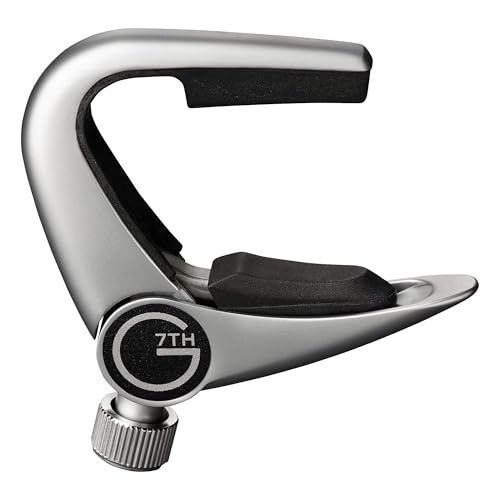
- Creates DADGAD-style and open-G effects
- Fine-tune knob controls string pressure
- Quick-release lever supports fast changes
Best For: Players experimenting with alternate voicings without retuning
Classic Acoustic Grip
Shubb C1 Standard Acoustic Guitar Capo

- Long-established acoustic capo design
- Set-and-forget pressure adjustment
- Rubber grip supports secure, in-tune playing
Best For: Acoustic guitarists wanting simple conventional capo use
Best Drop-D-Style Option
G7th Newport 5-String Partial Capo

- Five-string design creates drop-D-style sounds
- Quick-release flip lever for fast changes
- Fine-tune tension control and silicone pads
Best For: Alternate-tuning experiments without retuning
Best Adjustable All-Rounder

- Micrometer tension adjustment
- Works on acoustic and electric guitars
- Compatible with six- and 12-string guitars
Best For: Players wanting adjustable full-neck capo coverage
Best Simple Quick-Change Pick

- One-handed operation
- Lightweight aluminum and steel-spring construction
- Parks on the guitar headstock
Best For: Quick changes on six-string acoustic guitars
Best DADGAD-Style Pick – Kyser Short-Cut Three-String Capo
For guitarists seeking partial guitar capos for alternate voicings, the Kyser Short-Cut is designed to simulate a DADGAD-like sound profile. Its three-string format and quick-change design make it a focused option for acoustic guitar players.
Best For: Acoustic guitarists exploring DADGAD-style sounds and fast key changes.
Pros:
- Designed specifically for DADGAD tuning simulation.
- Three-string partial-capo design creates distinctive voicings.
- Lightweight aircraft-grade aluminum construction.
- Can park on the headstock when not in use.
Cons:
- Its specialized three-string design is less versatile than a full capo.
- Supplied details identify it for acoustic guitar rather than electric guitar.
The Kyser is a practical choice when DADGAD-inspired chord colors are the priority. Choose it over a general-purpose capo if you specifically want a dedicated partial-capo setup.
Best Limited-Edition Brass Option – Shubb C7B Three-String Capo
The Shubb C7B is a brass partial capo that covers three inside strings. For players comparing partial guitar capos, its polished brass body and rubber grip offer a traditional, distinctive design for targeted string coverage.
Best For: Guitarists who want a brass three-string partial capo with a polished finish.
Pros:
- Covers three inside strings for selective capo effects.
- Polished brass body provides a distinctive appearance.
- Rubber grip is designed to hold the instrument securely.
Cons:
- It covers only three inside strings, limiting its application to specific voicings.
- As a limited-edition model, availability may be less consistent.
The C7B suits players who value a focused partial-capo format and brass construction. Its three-inside-string layout is best considered for specific arrangements rather than broad, all-purpose use.
Best Adjustable Full-Capo Alternative – D'Addario NS Tri-Action
Although the D’Addario NS Tri-Action is not a partial capo, it is a useful comparison for shoppers considering partial guitar capos alongside versatile full-neck options. Its micrometer tension adjustment is designed for buzz-free, in-tune performance on six-string acoustic and electric guitars.
Best For: Players who need precise tension control and one-handed operation across acoustic and electric guitars.
Pros:
- Micrometer adjustment provides precise control over neck tension.
- Tri-Action geometry applies even tension with less operating force.
- Aircraft-grade aluminum keeps the capo lightweight and durable.
- Includes an integrated pick holder and parks on the headstock.
Cons:
- It is a standard six-string capo, not a selective partial-capo design.
- Its broader coverage may not provide the specialized voicings sought from partial capos.
Choose the NS Tri-Action when dependable, adjustable coverage matters more than selective string changes. It complements a partial-capo collection but does not replace the specialized function of a three-string model.
Best Adjustable Three-String Design – Shubb C7B Brass Partial Capo
The Shubb C7B is a three-string partial capo built for selective string coverage. Unlike fixed-position designs, it can cover the 2-3-4 or 3-4-5 strings, giving players more control when experimenting with partial guitar capos and alternate effects.
Best For: Electric guitarists who want adjustable three-string coverage and repeatable setup.
Pros:
- Supports coverage of either the 2-3-4 or 3-4-5 strings.
- Set-and-forget design avoids resetting pressure with each use.
- Custom-made rubber works like a fingertip to help keep the guitar in tune.
- Brass body with polished finish offers a durable, distinctive build.
Cons:
- Its three-string coverage is specialized and will not suit every arrangement.
- Supplied details identify this model for electric guitar.
The C7B stands out when adjustable string positioning is more important than a simple fixed layout. It is a strong fit for players who want to explore multiple three-string voicings without repeatedly resetting capo pressure.
Flexible Fit – D'Addario Pro Plus Guitar Capo
For players comparing partial guitar capos with versatile full-fret coverage, the D’Addario Pro Plus is designed to fit different fretboard shapes automatically. Its adjustable pressure and one-handed operation make it a practical option for 6- or 12-string guitars.
Best For: Guitarists who want a versatile, buzz-free capo for 6- or 12-string instruments.
Pros:
- FlexFit Technology automatically adjusts to different fretboard radii.
- Designed for both 6- and 12-string guitars, including instruments with octave pairs.
- Adjustable pressure helps prevent fret buzz and support in-tune playing.
- Single-hand operation makes repositioning easy.
Cons:
- It is a full guitar capo rather than a dedicated partial capo.
- Its feature set may be more than needed for players seeking a simple fixed partial effect.
The Pro Plus stands out for automatic fit and broad instrument compatibility. Choose it when reliable full-neck coverage and easy adjustment matter more than a specialized partial-capo layout.
Open-Tuning Specialist – G7th Newport 3-String Partial Capo
The G7th Newport is a purpose-built choice for musicians exploring partial guitar capos and open-style tunings. Its three-string design can create DADGAD-style or open-G effects without retuning, while the fine-tune knob helps control string pressure.
Best For: Players seeking quick DADGAD-style and open-G effects without retuning.
Pros:
- Three-string partial design supports open-style tuning effects without retuning.
- Fine-tune knob provides precise pressure adjustment for tuning stability.
- Quick-release mechanism enables fluid attachment and removal.
- Silicone pads help protect the finish and keep the capo secure.
Cons:
- Its specialized three-string coverage is less suitable for standard full-capo use.
- Compatibility is specified for a 7.25-inch to flat fingerboard radius and up to 27 mm neck depth.
Among these partial guitar capos, the Newport is the most specialized option for alternate voicings. Its low-profile flip lever, tension control, and lifetime warranty make it especially appealing for players who frequently change tuning effects during practice or performance.
Classic Acoustic Grip – Shubb C1 Standard Acoustic Guitar Capo
The Shubb C1 is a traditional acoustic guitar capo rather than a dedicated partial model, but it is worth considering alongside partial guitar capos if dependable everyday operation is your priority. Its rubber grip and adjustable design are intended to help keep the guitar in tune.
Best For: Acoustic guitarists who prefer a proven, simple locking capo.
Pros:
- Established design trusted by musicians for over 35 years.
- Set-and-forget pressure avoids resetting tension with each use.
- Lever operation makes locking and removal straightforward.
- Custom rubber grip is designed to act like a fingertip and support tuning stability.
Cons:
- It is a standard acoustic capo, not a three-string partial capo.
- Its supplied details specify acoustic guitar use rather than broad multi-instrument compatibility.
The C1 is a sensible choice for acoustic players who want familiar mechanics and minimal fuss. Select it for conventional capo duties; choose the G7th Newport instead when partial coverage and alternate-tuning effects are the goal.
Best Drop-D-Style Option – G7th Newport 5-String Partial Capo
If you want partial guitar capos for quick alternate tunings, the G7th Newport is designed to clamp five strings and create drop-D-style sounds without retuning. Its flip lever, fine-tune tension control, and protective silicone pads make it a focused choice for players who want fast changes with minimal disruption.
Best For: Guitarists seeking drop-D-style tuning changes and other open-style experiments without retuning.
Pros:
- Creates drop-D-style sounds by clamping five strings at the second fret.
- Quick-release flip lever supports fast transitions between capoed and standard tuning.
- Fine-tune knob helps set precise string pressure for tuning stability.
- Silicone pads help protect the guitar finish and reduce damping.
Cons:
- Its five-string partial design is more specialized than a standard full-neck capo.
- Fit is limited to fingerboard radii of 9.5–18 inches and a maximum width of 2 1/16 inches.
The Newport is the most purpose-built option here for partial-capo techniques. Choose it when alternate-tuning flexibility and rapid operation matter more than broad six- or 12-string coverage.
Best Adjustable All-Rounder – D'Addario Pro Capo
Although it is not a partial capo, the D’Addario Pro Capo is a useful comparison for shoppers considering partial guitar capos alongside conventional designs. Its micrometer tension adjustment is intended to provide buzz-free, in-tune operation on radiused acoustic and electric guitar fretboards.
Best For: Players who want one adjustable capo for six- or 12-string acoustic and electric guitars.
Pros:
- Micrometer adjustment lets you dial in the required tension at each fret.
- Designed for both acoustic and electric guitars with radiused fretboards.
- Works with six-string and 12-string guitars.
- Aircraft-grade aluminum construction is durable and lightweight.
Cons:
- It is a full-guitar capo rather than a partial design for selective string changes.
- The screw-style adjustment is less immediately quick than a one-handed spring capo.
The Pro Capo suits buyers who value controlled tension and broad guitar compatibility. If your goal is specifically to alter only selected strings, look to a dedicated partial capo instead.
Best Simple Quick-Change Pick – Kyser KG6BA Quick-Change Capo
The Kyser Quick-Change is another full-neck alternative to partial guitar capos, emphasizing simple one-handed operation. Its aluminum body and steel spring provide a lightweight, familiar design for six-string acoustic guitar players who want quick capo placement.
Best For: Six-string acoustic guitarists who prioritize straightforward, one-handed capo changes.
Pros:
- One-handed Quick-Change design is convenient during playing.
- Strong, lightweight aluminum body with a steel spring.
- Can park on the guitar headstock when not in use.
- Made in the USA and guaranteed for life, according to the supplied notes.
Cons:
- Designed for six-string acoustic guitars, not selective partial capo work.
- Its spring-based design does not offer the adjustable tension control listed for the D’Addario or G7th models.
The Kyser is a practical choice for uncomplicated full-neck capo changes. It is best viewed as a convenient standard capo rather than a tool for creating partial or drop-D-style tunings.
How We Picked These Partial Guitar Capos
We selected these models based on string coverage, tuning applications, tension control, instrument compatibility, construction, and ease of use. The list includes dedicated three-string capos for DADGAD and open-style approaches, a five-string option for drop-D-style playing, and standard capos for shoppers who want broader versatility.
Because a partial capo can affect intonation and pressure differently from a full capo, we also considered whether its design appears easy to position consistently and whether it offers useful adjustment or quick installation.
Quick Comparison
| Type | Best For | What to Look For |
|---|---|---|
| Three-string partial | DADGAD, modal chords, drone effects | Correct string placement and secure pressure |
| Five-string partial | Drop-D-style shapes and broader coverage | Compatibility with your chord vocabulary |
| Adjustable full capo | Multiple guitars and tunings | Fine tension control and wide compatibility |
| Quick-change full capo | Live performance and fast transitions | One-handed operation and stable grip |
Key Buying Factors for Partial Guitar Capos
String Coverage
Confirm exactly which strings the capo covers. Three-string models are often chosen for DADGAD or drone-based arrangements, while five-string designs can support drop-D-style playing. A mismatch between the capo pattern and your intended tuning will limit the result.
Pressure and Intonation
A capo should hold the strings firmly enough to prevent buzzing without pulling notes sharp. Adjustable designs make it easier to fine-tune pressure, especially on guitars with different neck shapes or string gauges. If you use a fixed-pressure model, test its position and tuning before recording or performing.
Instrument Compatibility
Check whether the capo is intended for acoustic, electric, or both types of guitar. Neck radius, fretboard width, and string height can affect fit. Standard full-guitar models may be more practical if you regularly switch instruments.
Materials and Handling
Metal construction can provide durability, while padded contact surfaces help protect the neck and strings. For frequent stage use, prioritize a design that is quick to reposition and easy to store without snagging other gear.
Who Should Buy Which Partial Guitar Capos?
Choose a dedicated three-string capo if your main goal is DADGAD, open-style, or modal experimentation. A five-string partial capo is better suited to players exploring drop-D-style chord shapes while retaining more familiar fingering options.
Pick an adjustable D’Addario or similar full capo if you need one accessory for acoustic and electric guitars, multiple neck profiles, or occasional partial-capo experimentation. A quick-change Kyser model is a practical choice for performers who value speed, while Shubb and G7th designs appeal to players who prioritize controlled placement and alternate-tuning techniques.
Before buying, identify the exact songs or tunings you want to play, then match the capo’s string pattern to those arrangements. That simple check is more important than appearance or brand alone.