If you’re looking to enhance your bass sound, exploring the best mono synths can make a significant difference. These instruments offer unique features that can transform your music, providing rich tones and creative possibilities. Whether you’re into live performance or studio work, each synth has something special to offer. Let’s take a closer look at some top contenders that could reshape your approach to bass synthesis.
Electro-Harmonix Bass Mono Synth Bass Synthesizer Pedal

If you’re a bassist looking to expand your sound palette without complicated setups, the Electro-Harmonix Bass Mono Synth Bass Synthesizer Pedal is an excellent choice. Its user-friendly controls let you make quick sound adjustments, ensuring you can easily dial in your tone. With the EXP pedal input, you gain real-time expressive control over your sound. You can create, save, and recall up to eleven user presets, giving you a unique synth sound for every occasion. Plus, it comes with a power adapter, making it versatile and ready for any performance. Elevate your playing with this powerful and flexible tool!
Best For: Bassists looking to enhance their sound with a versatile and easy-to-use synthesizer pedal.
Pros:
- User-friendly controls allow for quick sound adjustments.
- EXP pedal input provides real-time expressive control.
- Ability to create, save, and recall eleven unique user presets.
Cons:
- Limited to bass applications, may not suit all musicians.
- Some users may require time to fully explore all sound options.
- Potentially overwhelming for beginners unfamiliar with synth pedals.
Novation Bass Station II Analog Monosynth

The Novation Bass Station II Analog Monosynth stands out as an exceptional choice for bass enthusiasts, thanks to its two tuneable analog oscillators and powerful sub-oscillator. With a selection of four waveforms and a versatile multi-mode filter, you can craft enormous bass sounds and aggressive leads. The built-in pattern-based step sequencer allows you to record rhythms in real-time, enhancing your creativity. Plus, with 128 patch slots (64 factory presets), you’ll have plenty of sonic options. Its MIDI compatibility means you can integrate it with other gear, making it a perfect addition to your music setup. Elevate your sound with the Bass Station II!
Best For: The Novation Bass Station II Analog Monosynth is best for musicians and producers seeking rich, powerful bass sounds and versatile sound design capabilities in a compact synthesizer.
Pros:
- Powerful sound engine: Features two tuneable analog oscillators, a sub-oscillator, and a multi-mode filter for diverse sound creation.
- User-friendly sequencer: The pattern-based step sequencer allows for real-time recording of rhythms, enhancing creative workflow.
- Extensive patch storage: With 128 patch slots and downloadable artist packs, users have ample options for sound exploration.
Cons:
- Limited to monophonic sounds: As a monosynth, it cannot play chords, which may not suit all styles of music.
- Learning curve: New users may require time to fully understand and utilize all features effectively.
- No onboard effects: Lacks built-in effects, which may necessitate additional processing gear for some users.
Electro-Harmonix Mono Synth Guitar Synthesizer Pedal

For guitarists looking to immerse themselves in the world of synth sounds, the Electro-Harmonix Mono Synth Guitar Synthesizer Pedal offers an intuitive interface that’s hard to beat. You’ll love the easy-to-use controls that let you adjust sounds quickly, plus the EXP pedal input for real-time expressive control. With eleven unique synth sounds, you can create, save, and recall your favorite presets effortlessly. Each sound can be stored in its own preset, allowing for seamless shifts during your performance. Plus, it comes with a power adapter, so you’re ready to plug in and unleash your creativity right away.
Best For: Guitarists seeking an easy-to-use synthesizer pedal for exploring a variety of unique synth sounds during performances.
Pros:
- User-friendly controls allow for quick sound adjustments on the fly.
- EXP pedal input offers real-time expressive control for dynamic performances.
- Eleven user presets enable easy creation, saving, and recalling of favorite sounds.
Cons:
- Limited to only eleven synth sounds, which may not satisfy all users’ needs.
- Power adapter included, but no battery option may restrict portability.
- Some users may find the learning curve for creating complex sounds slightly challenging.
Novation Bass Station II Monophonic Analog Synthesizer Bundle

Looking to create deep, resonant bass lines? The Novation Bass Station II Monophonic Analog Synthesizer Bundle is your perfect companion. With its 25-key layout, it features two analog oscillators and a sub-octave oscillator for rich tonal diversity. You’ll love the built-in arpeggiator with 32 patterns and a step sequencer for intricate sequences. Tweak your sounds with classic and Acid filters, dual ADSR envelopes, and LFOs. The bundle comes with essential accessories like a sustain pedal and MIDI cables, ensuring you’re ready to immerse yourself in sound creation. Plus, it’s backed by a solid warranty, making it a reliable choice.
Best For: Musicians and producers looking for a versatile analog synthesizer to create rich bass lines and melodic leads.
Pros:
- Three analog oscillators provide a wide range of sound possibilities.
- Built-in arpeggiator and step sequencer allow for complex rhythmic patterns and sequences.
- User-friendly front-panel controls enable hands-on manipulation of sound parameters.
Cons:
- Monophonic design limits the ability to play multiple notes simultaneously.
- Weight of 8.2 pounds may make it less portable for some users.
- Limited factory patches might require additional time to create custom sounds.
Sequential Pro 3 Multi-filter Monosynth

With its powerful sound engine featuring two VCOs and a wavetable oscillator, the Sequential Pro 3 Multi-filter Monosynth stands out as an exceptional choice for bass enthusiasts. Weighing 22.2 pounds, this hybrid monosynth boasts a 37-key semi-weighted keyboard and a stunning wood body. You’ll appreciate the three classic filter types, including the renowned ladder filter, perfect for sculpting deep bass tones. Its 16-track sequencer and extensive modulation matrix give you limitless creative possibilities. Plus, with features like hard sync and per-oscillator glide, the Pro 3 allows you to explore complex textures and dynamic sounds effortlessly.
Best For: The Sequential Pro 3 Multi-filter Monosynth is best for musicians and producers seeking a versatile and powerful synth that excels in bass sounds and complex textures.
Pros:
- Powerful Sound Engine: Features two VCOs and a wavetable oscillator for a wide range of sound design possibilities.
- Extensive Modulation Options: The 32-slot modulation matrix allows for intricate sound manipulation and creativity.
- Quality Build: The wood body and semi-weighted keyboard provide a premium feel and durability.
Cons:
- Weight: At 22.2 pounds, it may be less portable compared to lighter synths.
- Price Point: The hybrid monosynth may be considered expensive for beginners or casual users.
- Learning Curve: The extensive features and capabilities may require time to fully master, which could be daunting for new users.
MOOG Messenger Monophonic Analog Keyboard Synthesizer

The Moog Messenger Monophonic Analog Keyboard Synthesizer stands out as a top choice for bass enthusiasts seeking rich, classic analog sounds fused with modern capabilities. With 32 semi-weighted keys, a 64-step sequencer, and 256 presets, you’ll find endless creative potential. Its robust design guarantees portability without sacrificing durability. The dual wavefolding VCOs and next-gen ladder filter deliver powerful bass tones, enhanced by a sub-oscillator. Plus, you’ll appreciate the extensive modulation options and connectivity features, including MIDI over USB-C. Whether you’re crafting intricate basslines or experimenting with generative sequencing, the Moog Messenger elevates your sound to new heights.
Best For: The Moog Messenger is best for bass enthusiasts and musicians looking for a powerful, portable synthesizer that combines classic analog sound with modern features.
Pros:
- Rich, classic analog sound enhanced by modern synthesis capabilities.
- Portable design with a robust metal panel, making it easy to transport.
- Extensive modulation options and connectivity features, including MIDI over USB-C.
Cons:
- Monophonic nature limits the ability to play multiple notes simultaneously.
- Potential learning curve for beginners unfamiliar with synthesizer features.
- Limited key range with only 32 keys, which may restrict complex compositions.
IK Multimedia UNO Synth Portable Monophonic Analog Synthesizer
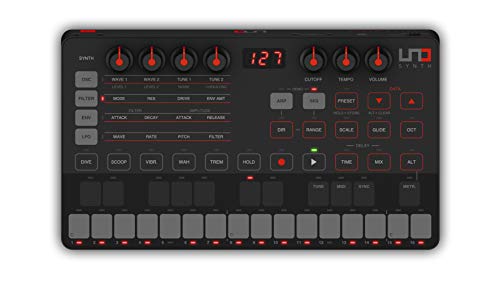
For musicians seeking portability without sacrificing sound quality, the IK Multimedia UNO Synth Portable Monophonic Analog Synthesizer stands out as an excellent choice. Weighing just 1.2 pounds, it’s easy to take anywhere, powered by batteries or USB. With two oscillators and a multimode filter, you’ll enjoy rich, all-analog sound across genres. The built-in sequencer and arpeggiator make music creation a breeze, while the 100 onboard presets offer instant inspiration. Its intuitive controls cater to both beginners and pros, ensuring you can dive right in. Plus, its compatibility with MIDI and computers enhances your creative possibilities.
Best For: Musicians and producers looking for a portable analog synthesizer that delivers high-quality sound and ease of use for both live performances and studio work.
Pros:
- Lightweight and portable: Weighs only 1.2 pounds, making it easy to transport.
- Rich sound quality: Features two oscillators and a multimode filter for versatile, all-analog sound.
- User-friendly interface: Intuitive controls and 100 onboard presets cater to both beginners and experienced users.
Cons:
- Monophonic limitation: Can only produce one note at a time, which may not suit all musical styles.
- Plastic construction: Some users may prefer a more durable material for a synthesizer.
- Battery operation may require frequent replacements: Depending on usage, the need for AA batteries can be inconvenient.
Korg Monologue Monophonic Analog Synthesizer

Designed for bass enthusiasts and electronic music producers, the Korg Monologue Monophonic Analog Synthesizer stands out with its microtuning capabilities, allowing you to craft unique scales and tonalities. Its 16-step sequencer and built-in OLED oscilloscope provide real-time waveform visualization, enhancing your sound design process. Weighing just 1.7 kg, this portable, battery-powered synth is perfect for music creation on the go. With durable aluminum construction and versatile connectivity options like MIDI and USB, you can easily integrate it into your setup. Rated 4.6 out of 5 stars by users, it’s a reliable choice for any serious producer.
Best For: The Korg Monologue Monophonic Analog Synthesizer is best for bass enthusiasts and electronic music producers looking for a portable and versatile synth.
Pros:
- Microtuning capabilities allow for the creation of unique scales and tonalities.
- Built-in OLED oscilloscope provides real-time waveform visualization for enhanced sound design.
- Portable and battery-powered, making it convenient for music creation on the go.
Cons:
- Limited to monophonic sounds, which may not suit users looking for polyphony.
- Some users may find the interface less intuitive than more complex synthesizers.
- Battery life may vary depending on usage, potentially limiting extended play sessions.
IK Multimedia UNO Synth Pro Monophonic Analog Synthesizer

Ideal for bass enthusiasts and live performers, the IK Multimedia UNO Synth Pro delivers a powerful combination of portability and versatility. This three-oscillator monophonic analog synthesizer features a stunning all-analog audio path and wave-morphing capabilities. With dual state-variable filters and a multi-mode filter, you’ll craft rich, complex bass sounds effortlessly. The 64-step sequencer is perfect for on-the-go creativity, while the user-friendly design offers 256 presets and simple controls. Plus, it connects seamlessly via USB, MIDI, and CV for extensive compatibility. Whether you perform solo or in a band, this synth elevates your sound to new heights.
Best For: Musicians and live performers seeking a portable and versatile analog synthesizer for crafting rich bass sounds.
Pros:
- Great sound quality with a fully analog audio path and wave-morphing oscillators.
- User-friendly design with simple controls, 256 presets, and extensive parameter options.
- Versatile connectivity through USB, MIDI, and CV, allowing for seamless integration with other gear.
Cons:
- Monophonic limitation may not suit those looking for polyphonic capabilities.
- Portability may come at the expense of some advanced features found in larger synths.
- Learning curve for some users due to the array of parameters and settings available.
Korg monotron DUO Analog Ribbon Synthesizer

The Korg monotron DUO Analog Ribbon Synthesizer stands out as an excellent choice for musicians seeking both portability and powerful sound shaping capabilities. Weighing just 6.4 ounces, its compact design makes it easy to transport and integrate into your setup. With a simple, intuitive interface, you can quickly adjust parameters to create dynamic and complex sounds. The extra modulation options add versatility for creative exploration, while its durable carbon fiber construction guarantees reliability for years to come. Plus, it’s an affordable option for both beginners and seasoned musicians looking to elevate their sound. Don’t miss out on this innovative synth!
Best For: Musicians and sound designers looking for a portable and versatile synthesizer to enhance their sound exploration.
Pros:
- Compact and lightweight design makes it easy to transport and integrate into various setups.
- Simple, intuitive interface allows for quick adjustments and creativity in sound shaping.
- Durable construction ensures long-lasting use, making it suitable for both beginners and experienced musicians.
Cons:
- Limited advanced features compared to more expensive synthesizers, which may not satisfy professional users.
- Requires batteries (2 AAA), which may need frequent replacement depending on usage.
- The ribbon controller may not provide the tactile feedback some musicians prefer for performance.
Factors to Consider When Choosing Mono Synths for Bass
When you’re choosing a mono synth for bass, you’ll want to take into account several key factors. Sound quality and versatility are essential, as they influence how your bass will fit into your music. Additionally, look at oscillator types, filter options, and user interface to guarantee you get the best experience for your creative needs.
Sound Quality and Versatility
Choosing a mono synth for bass means considering both sound quality and versatility, as these factors greatly impact your music. The type of oscillators, like analog VCOs, plays a significant role in delivering rich, warm tones that enhance your bass sound. To achieve versatility, look for features such as multi-mode filters that let you shape your sound for various genres. Built-in effects and modulation capabilities can further expand your sound design options, allowing for dynamic performances. Additionally, the ability to save and recall presets guarantees you can quickly switch between different bass sounds. Finally, connectivity features like MIDI compatibility and audio inputs make it easier to integrate your synth with other gear, broadening your creative possibilities.
Oscillator Types and Features
While exploring mono synths for bass, understanding oscillator types and features is essential to achieving the sound you desire. Mono synths typically feature one or more oscillators, with common types including sawtooth, square, triangle, and sine waves, each bringing unique tonal characteristics. Consider models with sub-oscillators to deepen your bass tones, adding lower frequencies that enhance the overall sound. Some synths also include noise generators, perfect for creating percussive effects or adding texture. Look for oscillator features like wave modulation, hard sync, and frequency modulation, as these allow you to manipulate your sound for greater versatility. Ultimately, these elements will help you craft the perfect bass sound tailored to your musical vision.
Filter Options and Design
Understanding filter options is essential for achieving the right bass tones in mono synths, as these elements shape your sound’s character. You’ll find various filter types like low-pass, high-pass, band-pass, and multi-mode, each offering unique tonal shaping capabilities. Classic designs, such as the 24dB Acid Filter, deliver that sought-after sound in bass music. Switching between filter modes enhances your flexibility, allowing you to craft distinctive bass tones tailored to your style. Pay attention to filter slope, typically ranging from 12dB to 24dB, as it affects how aggressively frequencies are cut off. If you’re aiming for richer harmonic content, consider synths with multiple filter stages or dual filters for even more complex sound manipulation.
Sequencing and Arpeggiator Capabilities
When you’re looking to create compelling bass lines with a mono synth, sequencing and arpeggiator capabilities can make a significant difference. A robust 64-step sequencer allows you to record notes, ties, and rests in real-time, helping you craft complex rhythm patterns effortlessly. Arpeggiators automatically play notes in a specific order, opening up creative possibilities for your bass lines. Some synths come with pattern-based step sequencers that support multiple sequences, giving you extensive composition options and adaptability for live performances. Plus, MIDI integration guarantees seamless synchronization with other equipment and software, expanding your creative potential. Advanced features like probability-based generation and parameter recording let your bass lines evolve dynamically, keeping your sound fresh and engaging.
User Interface and Controls
Choosing the right mono synth for bass often hinges on its user interface and controls. A user-friendly interface with intuitive controls is essential for making quick sound adjustments, allowing you to create and modify sounds efficiently. Look for features like an expression (EXP) pedal input, which enhances your ability to manipulate sounds dynamically during live performances. Synths that let you create, save, and recall multiple presets offer a personalized sound experience. Hands-on access to front-panel controls enables immediate interaction with the synth’s parameters, inspiring creativity and streamlining your sound design process. Additionally, a well-designed interface with visual indicators, such as LED displays or OLED screens, helps you understand sound-shaping options and enhances your overall experience.
Connectivity and Compatibility
To maximize your bass synth experience, consider the connectivity and compatibility features of your mono synth. First, check for MIDI connectivity; it lets you integrate with other gear, enhancing your performance options. USB connectivity is another must-have, making it easy to connect to your computer for DAW integration and sound editing. If you plan to explore modular synth systems, verify your synth has CV outputs and inputs for expanded sound design. Additionally, audio input options are valuable, allowing you to run external instruments through your synth’s filters and effects. Finally, confirm compatibility with various devices, like sequencers and samplers, so your synth fits seamlessly into your existing setup and expands your creative possibilities.
Portability and Power Source
Portability and power source are essential factors that can make or break your experience with a mono synth, especially if you’re constantly on the move. Look for lightweight designs that weigh under 5 pounds, making it easy to transport in your backpack or gig bag. Battery-powered options typically use 4 AA batteries, giving you the freedom to perform anywhere without needing a power outlet. Additionally, some synths feature USB power capabilities, allowing you to connect to laptops or USB power banks, further enhancing their versatility. When choosing a synth, consider models that offer both battery and AC power options to cater to your diverse performance needs and setups, ensuring you’re always ready to create killer bass sounds.
Price and Value Proposition
When it comes to selecting a mono synth for bass, price and value proposition play a crucial role in your decision-making process. You’ll notice that models vary greatly, from budget-friendly options to high-end gear. Consider not just the initial cost but also features like sound quality, versatility, and durability that enhance your experience. Look for synthesizers with a wide range of sound design capabilities and presets, as they add long-term value. Don’t forget to evaluate the resale value; some brands retain their worth better than others. Finally, check for included accessories and warranties, as these can greatly contribute to the overall value and longevity of your synth purchase, making your investment worthwhile.