When you’re on stage, the right guitar monitor can make all the difference in your performance. These monitors not only deliver exceptional sound quality, but they also offer features that cater to your specific needs as a musician. From lightweight designs to customizable sound options, finding the best fit can elevate your playing experience. Curious about which models stand out? Let’s explore the top contenders in the market.
Behringer Eurolive B205D Active 150-Watt PA/Monitor Speaker System
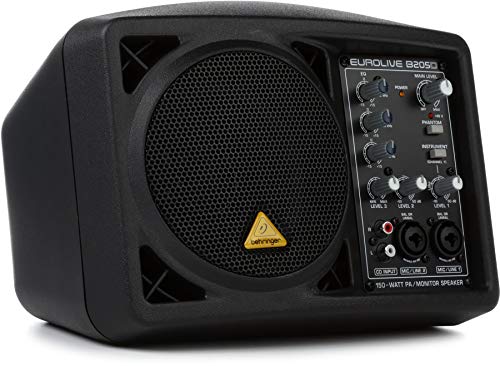
If you’re looking for a compact and versatile solution for your guitar monitoring needs, the Behringer Eurolive B205D Active 150-Watt PA/Monitor Speaker System could be your best choice. This active speaker, weighing just 7.05 pounds, features a 5.25” neodymium driver that delivers clean, punchy audio. With its ultra-low noise 3-channel mixer and built-in mic preamps, you can easily connect multiple sources. Perfect for home practice or small gigs, it offers impressive sound quality for up to 70 people. Users appreciate its portability and durability, making it an excellent option for both amateur and semi-professional use.
Best For: The Behringer Eurolive B205D is best for musicians, speakers, and presenters seeking a portable and affordable audio solution for small venues and home practice.
Pros:
- Compact and lightweight design allows for easy transport and setup.
- High-fidelity sound quality suitable for various applications, from music playback to speech amplification.
- Versatile connectivity options with a 3-channel mixer and built-in mic preamps.
Cons:
- Limited volume capacity may not suffice for larger events.
- Some users reported initial product quality issues that required replacements.
- Lack of individual EQ controls for each input channel.
HeadRush FRFR108 MKII – 2000W Electric and Bass Guitar Amp

The HeadRush FRFR108 MKII is an excellent choice for guitar and bass players seeking powerful sound and versatility on stage. With a 2000W amplifier, it delivers professional audio clarity through its 8″ woofer and 1″ HF compression driver. You’ll appreciate features like the HPF EQ switch for clearer mixes and a Ground-Lift switch to eliminate noise. Weighing just 21 lbs, it’s portable and can be positioned as a wedge, upright, or pole-mounted. Bluetooth 5.0 connectivity allows you to stream music effortlessly, while dual XLR/TRS inputs guarantee you can connect multiple devices easily.
Best For: Guitar and bass players looking for a powerful, versatile amp for rehearsals and live performances.
Pros:
- Powerful Sound: 2000W amplifier provides professional audio clarity and performance.
- Versatile Design: Can be used in multiple positions (wedge, upright, or pole-mounted) for different setups.
- Bluetooth Connectivity: Stream music wirelessly from mobile devices, enhancing rehearsals and breaks.
Cons:
- Weight Limitations: While lightweight at 21 lbs, some users may still find it slightly heavy for prolonged transport.
- Limited Built-in Effects: Lacks built-in effects, requiring external processors for sound customization.
- Potential Feedback Issues: May require careful positioning to avoid feedback in certain live settings.
Behringer EUROLIVE B105D Ultra-Compact PA/Monitor Speaker with Bluetooth

For musicians seeking an ultra-compact and versatile speaker, the Behringer EUROLIVE B105D stands out with its impressive 50 watts of power and Bluetooth connectivity. Weighing just 8.2 pounds, it’s perfect for small venues or home studios. Its 3-channel mixer and 3-band EQ let you customize sound effortlessly. Plus, you can easily connect your devices via Bluetooth or USB to play audio files. While some users mention minor issues with Bluetooth and bass response, the overall sound quality and convenience make it a reliable choice for both live events and practice sessions. Enjoy unmatched performance in a compact design!
Best For: Musicians and content creators looking for a compact, versatile speaker suitable for small venues and home studios.
Pros:
- Ultra-compact design makes it easy to transport and set up in various locations.
- Bluetooth connectivity allows seamless audio playback from multiple devices, enhancing convenience.
- 3-channel mixer with 3-band EQ provides customization options for sound quality tailored to individual needs.
Cons:
- Some users report Bluetooth connectivity issues, affecting user experience.
- Limited bass response due to the speaker size may not meet the expectations of bass-heavy music genres.
- Inconsistencies in performance across different units can lead to a lack of reliability for some buyers.
JOYO Wireless in Ear Monitor System (JW-07)

Looking for a reliable in-ear monitor system that delivers exceptional audio clarity? The JOYO Wireless In Ear Monitor System (JW-07) is designed just for you. Operating at 2.4GHz, it provides 48kHz/16bit audio quality with low latency under 5ms, ensuring real-time feedback. Its high anti-interference technology uses frequency hopping to maintain a stable connection within a 40-60ft range, perfect for live performances. You’ll enjoy over 8 hours of battery life and 12 channel banks for diverse instrument compatibility. Just keep in mind, it’s tailored for single-user applications, so one transmitter connects to one receiver only.
Best For: Musicians and performers seeking a high-quality, reliable in-ear monitor system for live performances and practice sessions.
Pros:
- Exceptional audio clarity with 48kHz/16bit quality and low latency of less than 5ms.
- High anti-interference technology ensures a stable connection within a 40-60ft range.
- Long battery life of over 8 hours and multiple channel banks for diverse instrument compatibility.
Cons:
- Designed for single-user applications; one transmitter cannot connect to multiple receivers.
- Limited operational range may not suit larger venues without additional equipment.
- 2.4GHz frequency may be subject to interference in crowded wireless environments.
On-Stage RS7000 Tilt-Back Amp Stand for Guitar Combo Amplifiers

Elevating your sound with the On-Stage RS7000 Tilt-Back Amp Stand is a game-changer for guitarists who want to enhance their performance. This sturdy stand angles your amp upward, directing sound towards the audience and minimizing floor reflections. With an adjustable height from 17” to 24”, it accommodates various setups. Weighing only 2.09 pounds, it folds flat for easy transport and storage. The nonslip padded arms provide grip protection, ensuring your gear stays secure. Rated 4.7 out of 5 stars by satisfied users, this stand is perfect for both practice sessions and live gigs, giving you unmatched sound projection.
Best For: Guitarists looking to enhance sound projection and stability during practice sessions and live performances.
Pros:
- Sturdy Construction: Heavy-duty braced steel legs support up to 150 pounds, ensuring stability during use.
- Adjustable Height: Ranges from 17” to 24”, making it versatile for different amplifier setups.
- Portability: Folds flat for easy transport and compact storage, weighing only 2.09 pounds.
Cons:
- Limited to Amplifiers: Specifically designed for guitar combo amplifiers, may not suit other types of equipment.
- No Assembly Required: While easy to set up, some users might prefer a more customizable stand.
- Height Range Constraints: The height may not be sufficient for all performance situations or preferences.
Behringer EUROLIVE F1220D Bi-Amped Monitor Speaker System

The Behringer EUROLIVE F1220D Bi-Amped Monitor Speaker System stands out as a top choice for musicians seeking powerful and reliable stage monitoring. With 250 watts of power, its 12-inch woofer and 3-inch tweeter deliver exceptional sound quality across a wide frequency range. You’ll appreciate the Class-D amplifier technology, offering enormous power while remaining lightweight. The adjustable feedback filter and integrated limiter provide ultimate system control, guaranteeing your sound stays clear and protected. With its dynamic range and speaker protection features, the F1220D guarantees your performance remains unmatched, allowing you to focus on what you love—playing your music.
Best For: Musicians and performers seeking a powerful and reliable stage monitor with exceptional sound quality.
Pros:
- Exceptional sound quality with a wide frequency bandwidth and dynamic range.
- Lightweight design due to Class-D amplifier technology, making it easy to transport.
- Integrated limiter and adjustable feedback filter for ultimate sound control and protection.
Cons:
- Limited portability due to its size despite being lightweight.
- May require additional equipment for optimal setup in larger venues.
- Not suitable for extreme outdoor conditions without proper protection.
Adjustable Mobile Guitar Amplifier Stands

For musicians who want to enhance their sound while performing, adjustable mobile guitar amplifier stands are essential tools. These stands lift your amp off the stage and tilt it back, improving monitoring and projection. With a base width that adjusts from 10 to 14 inches, they fit various amplifier sizes perfectly. The height can be set between 21 to 32 inches, secured by a safety pin locking device. You can easily adjust the angle from 0° to 67.5° using a convenient knob. Plus, four spinner wheels make transport easy, while brakes guarantee stability during your performance.
Best For: Musicians looking to enhance their sound projection and monitoring during live performances.
Pros:
- Versatile Adjustability: Accommodates various amplifier sizes with adjustable width, height, and angle settings.
- Enhanced Sound Projection: Lifts amplifiers off the stage and tilts them back for better sound monitoring.
- Easy Mobility: Equipped with spinner wheels for effortless transport and brakes for stability when in use.
Cons:
- Potential Stability Issues: Depending on the weight of the amplifier, stability may be compromised if not properly secured.
- Setup Time: Adjusting the various settings may take time, especially in fast-paced performance environments.
- Weight: The stand itself may add extra weight to transport along with the amplifier.
LEKATO Wireless in Ear Monitor System MS-02

Looking for a reliable in-ear monitoring solution? The LEKATO Wireless In-Ear Monitor System MS-02 offers an upgraded 2.4G stereo system with ultra-low latency under 4.5ms. You’ll enjoy high sound quality with a 24bit/48KHz sampling rate and a frequency response from 20 Hz to 24 KHz. This system connects one transmitter to up to four receivers within a 100-foot range. Setup is a breeze with automatic pairing, and the compact design guarantees portability. With 6-8 hours of battery life, it’s perfect for live performances or studio use. Many users praise its lightweight structure and sound clarity, making it a solid choice.
Best For: The LEKATO Wireless In-Ear Monitor System MS-02 is best for small to medium stage bands and churches seeking a reliable and portable audio monitoring solution.
Pros:
- Lightweight and easy to use, enhancing portability for performers.
- Offers good sound quality with minimal latency, ideal for live performances.
- Simple setup with automatic pairing and convenient controls for live scenarios.
Cons:
- Inconsistent sound quality at low volumes can be a drawback for some users.
- Occasional audio dropouts may occur, affecting performance reliability.
- Volume control may be too extreme, making adjustments challenging in live settings.
Pair of 10 Floor Monitors PA/DJ Speakers

Designed for musicians and performers alike, the SA-10M.3 pair of floor monitors delivers impressive sound quality with its 2-way 10″ configuration. These passive speakers pack a punch with 100 watts RMS and a frequency response from 40 Hz to 20,000 Hz, ensuring clear audio for any setting. Weighing just 22 lbs each, they’re easy to transport with built-in handles. Whether you’re on stage, in a studio, or hosting a karaoke night, these monitors suit various applications. While some users mention a slightly muddy sound at flat settings, their durability and portability make them a solid choice for small setups.
Best For: Musicians, DJs, and performers looking for a portable and affordable floor monitor solution for small to medium-sized venues.
Pros:
- Clear sound quality with a wide frequency response suitable for various audio applications.
- Lightweight and portable design with built-in handles for easy transport.
- Durable construction with solid materials that ensure longevity.
Cons:
- Some users report a muddy sound when settings are flat.
- Quieter performance compared to larger, more powerful speakers.
- Limited to passive design, requiring an external amplifier for use.
LEKATO Wireless In-Ear Monitor System (MS-1)
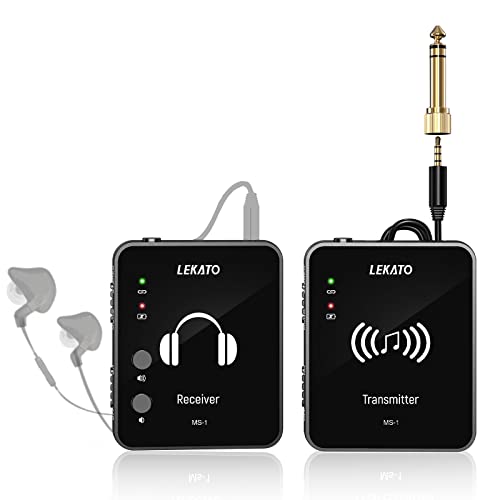
The LEKATO Wireless In-Ear Monitor System (MS-1) is an excellent choice for musicians who need reliable audio performance during rehearsals and live gigs. Operating on a 2.4GHz frequency, it supports up to six receivers, making it perfect for small to medium stage settings. With its auto-pairing feature, you just power it on and press the PAIR buttons to connect effortlessly. Expect true 100% stereo audio with low latency and a wide frequency range. Plus, enjoy over five hours of battery life and a wireless range of up to 90 feet, ensuring you stay connected and sound great on stage!
Best For: Musicians and performers seeking a reliable and high-quality wireless in-ear monitoring solution for rehearsals and live performances.
Pros:
- Multi-receiver capability: Supports up to six receivers simultaneously, ideal for small to medium stage setups.
- Auto-pairing feature: Easy pairing process makes setup quick and hassle-free.
- High audio quality: Offers true stereo audio with low latency and a wide frequency response.
Cons:
- Limited battery life: The built-in battery lasts over five hours, which may not be sufficient for longer events.
- Wireless range limitations: While effective in open areas, the 90-foot range may be restrictive in larger venues.
- Potential interference: Operating on a 2.4GHz frequency may experience interference from other wireless devices.
Factors to Consider When Choosing Guitar Stage Monitors
When choosing guitar stage monitors, you need to take into account several key factors. Think about your power output requirements, speaker size, and how portable the monitors need to be for your gigs. Sound quality and connectivity options are also vital to guarantee you get the best performance on stage.
Power Output Requirements
Choosing the right power output for your guitar stage monitors is essential, as it directly impacts your sound clarity and volume. For small venues, monitors with around 50 watts can suffice, but larger performances may require over 250 watts. If you’re monitoring personally, aim for at least 100 watts to cut through ambient stage noise. Always guarantee the speaker’s power rating meets or exceeds the combined wattage of your amplifiers to avoid distortion. Additionally, match the impedance rating of your monitors to your amplifier for maximum efficiency and to prevent damage. In live settings, achieving a sound pressure level of at least 95 dB is ideal for clear monitoring, especially in louder environments.
Speaker Size Considerations
Power output is just one piece of the puzzle; speaker size plays a significant role in your overall sound experience. Larger drivers, like 12-inch models, deliver deeper bass and handle higher power levels, while smaller 5-inch drivers may struggle with low frequencies. If you want a broader frequency response and enhanced sound quality, opt for larger monitors. Consider your performance venue too; larger monitors provide better sound coverage in bigger spaces, while compact models work well for intimate settings or personal monitoring. Finally, think about your intended use. For small practice sessions, a compact model is sufficient, but larger setups shine during live performances. Choosing the right size directly impacts your sound quality and performance.
Portability and Weight
As you navigate the world of guitar stage monitors, portability and weight become essential factors to evaluate, especially if you’re a musician on the move. Lighter models, typically under 10 pounds, are ideal for frequent gigs, ensuring you can transport them without hassle. Look for compact designs, around 8 to 12 inches in height and width, to maintain sound quality while enhancing portability. Additionally, consider weight distribution; monitors that fold or disassemble make transport even easier. Features like carrying handles or built-in wheels greatly improve your ability to set up and move in various performance environments. With the right choice, you’ll find a monitor that fits your active lifestyle without sacrificing quality or convenience.
Sound Quality Specifications
When selecting guitar stage monitors, understanding sound quality specifications is essential for achieving the best performance. Look for monitors with a wide frequency response, ideally from 40 Hz to 20,000 Hz, to capture low and high-end sounds effectively. Pay attention to sensitivity ratings; a higher sensitivity of around 95 dB or more means the speaker needs less power to produce sound. Consider power handling capabilities, with RMS ratings indicating continuous power without distortion—100 watts RMS is suitable for small to medium venues. Evaluate driver configurations; a combination of woofers and tweeters offers balanced sound and clarity. Finally, features like built-in EQ controls and adjustable feedback filters can enhance your sound quality tailored to your performance environment.
Connectivity Options Available
Choosing the right connectivity options for your guitar stage monitors can make a significant difference in your setup and performance. Look for monitors with Bluetooth connectivity, allowing you to wirelessly stream audio from your mobile devices. This feature enhances convenience during performances and rehearsals.
Additionally, opt for models with multiple input options, like XLR/TRS combo inputs, to accommodate various audio sources and instruments, giving you greater versatility. Confirm the monitor includes a direct output feature for easy chaining of additional speakers or connecting to a front-of-house mixing system for larger events.
Finally, check for adjustable EQ controls to customize sound according to your preferences and the performance space, and evaluate wireless transmission capabilities to guarantee reliable audio delivery.
Durability and Build Quality
Selecting the right connectivity options is just one part of the equation; equally important is the durability and build quality of your guitar stage monitors. You need monitors that can withstand frequent transportation and the rigors of live performances, so look for heavy-duty steel or reinforced plastic materials. Good build quality often includes protective grills, padded corners, and rugged housing to prevent damage. While weight can indicate robustness, make sure it still allows for easy setup. If you perform outdoors, consider weather-resistant designs to handle moisture and temperature changes. Finally, check the manufacturer’s warranty; a solid warranty typically reflects the durability of the product, giving you peace of mind against defects and failures from regular use.