Choosing among the best DJ mixers for professionals depends on your workflow, not just the number of channels. Some performers need deep software integration and creative performance controls, while others prioritize standalone operation, reliable inputs, or flexible studio connectivity.
This roundup compares 10 professional-focused DJ controllers and audio mixers across different budgets and use cases. Use the guide below to match features, connections, and control layouts to the way you actually perform, record, or manage sound.
Best 10 Dj Mixers for Professionals Picks for 2026
Pro Performance

- Four-channel layout for club-style workflows
- Track Separation enables live mashups
- Rekordbox, Serato, and DMX support
Best For: Mobile DJs and open-format performers
Studio-Ready Mixing

- Ten inputs for flexible small-system mixing
- USB, SPX effects, and Class A D-PRE preamps
- EQ, filters, and one-knob compression
Best For: Live audio setups and home studios
Laptop-Free DJing

- Standalone Engine DJ operation
- Seven-inch touchscreen and wireless streaming
- Built-in speakers with pro outputs
Best For: Mobile, streaming, and laptop-free DJs
Compact Analog Control

- Six-channel compact analog design
- Two microphone preamps and four stereo line channels
- Built-in digital effects for small setups
Best For: Compact PA and basic audio systems
Versatile Serato Control

- Four-deck Serato DJ Lite control
- Six-inch displays on capacitive jog wheels
- Effects, loops, pads, and 24-bit audio
Best For: DJs wanting hands-on four-deck control with visual feedback
Feature-Packed Analog Mixing
6-Channel Professional DJ Mixer

- Six channels with four XLR inputs
- 99 DSP effects and seven-band output EQ
- USB, Bluetooth, phantom power, and AUX
Best For: Live and recording setups with multiple audio sources
Compact Party Performance

- Two-deck Serato DJ Lite control
- Built-in LED light show
- Compact USB controller with performance pads
Best For: Beginners and home DJs mixing at parties
Flexible Channel Control
8-Channel Professional Audio Mixer

- Individual XLR and 6.35mm channel inputs
- Selectable 48V phantom power
- USB recording and computer editing
Best For: Small bands and multi-input audio production
Streamlined DJ Control
Pioneer DJ DDJ-FLX4 Controller
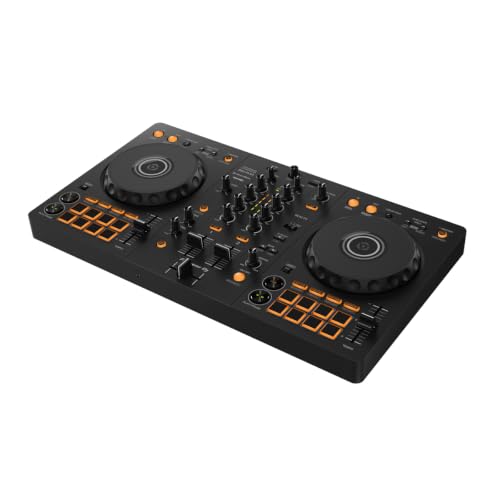
- Two-deck control with 16 performance pads
- Smart Fader simplifies genre blending
- USB and Bluetooth device compatibility
Best For: Practice, streaming, and portable software-based DJing
Connected Live Mixing
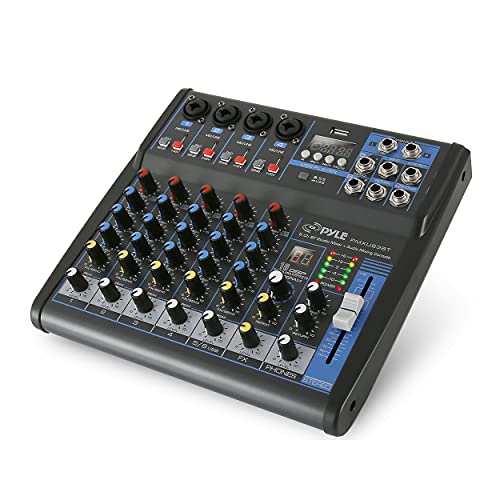
- Bluetooth, USB, flash, and MP3 playback
- 48V phantom power with three-band EQ
- Steel chassis for live and karaoke use
Best For: Live gigs, karaoke, and flexible playback setups
Pro Performance – Pioneer DJ DDJ-FLX10
For DJs seeking dj mixers for professionals, the Pioneer DJ DDJ-FLX10 is a four-channel performance controller built for serious hobbyists, mobile DJs, and professional open-format workflows. Its track-separation features, large jog wheels, rekordbox and Serato DJ Pro support, and club-oriented layout make it a versatile choice for live sets.
Best For: Mobile DJs, open-format performers, and DJs who want a professional four-channel controller with lighting integration.
Pros:
- Track Separation splits songs into vocals, drums, and instruments for live mashups.
- Four-channel layout and professional effects resemble a CDJ/DJM booth workflow.
- Large jog wheels include multicolor displays for waveforms, artwork, and active parts.
- Supports rekordbox and Serato DJ Pro, with built-in DMX output for lighting.
Cons:
- At 14.8 pounds, it is less convenient to transport than a compact controller.
- Its feature set may be more than casual DJs need.
The DDJ-FLX10 stands out when hands-on control and future-ready performance features matter more than simplicity. It is especially compelling for DJs who regularly perform with software and want a booth-style layout.
Studio-Ready Mixing – Yamaha MG10XU 10-Input Mixer
The Yamaha MG10XU is a practical option for buyers comparing dj mixers for professionals who also need broader live or studio audio control. This 10-channel mixer combines USB connectivity, SPX digital effects, discrete Class A D-PRE preamps, three-band EQ, high-pass filters, and one-knob compressors in a rugged metal chassis.
Best For: Small live setups, rehearsal spaces, and home studios needing microphone inputs, effects, and straightforward analog mixing.
Pros:
- Ten-channel design provides room for microphones and stereo sources.
- USB connectivity and 48 kHz operation support computer-based recording or playback.
- SPX effects, three-band EQ, and high-pass filters offer useful mix shaping.
- One-knob compressors simplify control of guitars, bass, snare, and vocals.
Cons:
- It is an audio mixer rather than a dedicated DJ performance controller.
- At 7.7 pounds, it is not the lightest compact mixer option.
The MG10XU favors dependable signal management over DJ-specific performance controls. Choose it when your setup includes several microphones or instruments and you want built-in effects plus USB connectivity.
Laptop-Free DJing – Denon DJ SC LIVE 4
The Denon DJ SC LIVE 4 is a strong fit for performers shopping for dj mixers for professionals who want to play without a laptop. Its Engine DJ OS, seven-inch touchscreen, wireless streaming, media slots, built-in speakers, and four-deck control support mobile, streaming, and club-oriented use.
Best For: Mobile and streaming DJs who want standalone operation, broad music access, and flexible equipment connectivity.
Pros:
- Engine DJ OS enables laptop-free performances using SD cards and USB drives.
- Wi-Fi streaming supports services including Amazon Music Unlimited, Apple Music, TIDAL, and others.
- Four-deck control includes stem separation and integration with Serato DJ Pro and Virtual DJ.
- Built-in speakers, Bluetooth input, microphone inputs, and XLR main output suit mobile setups.
Cons:
- Its 28.3-inch width and 13.6-pound weight require a reasonably large transport case or workspace.
- Streaming features depend on compatible services and network access.
The SC LIVE 4 is especially convenient when portability means reducing the amount of additional equipment, not choosing the smallest controller. Its standalone workflow and connectivity make it one of the most flexible options in this group.
Compact Analog Control – Yamaha MG06X Compact Mixer
The Yamaha MG06X offers a compact alternative for simple audio duties among dj mixers for professionals. It provides six channels, two microphone preamps, four dedicated stereo line channels, digital effects, and a small footprint suited to limited workspaces or lightweight setups.
Best For: Small rehearsals, compact PA systems, and basic DJ or audio setups needing microphone and stereo line inputs.
Pros:
- Six-channel configuration fits smaller audio systems.
- Two microphone preamps support vocal or announcement microphones.
- Four dedicated stereo line channels accommodate playback sources.
- Compact 7.9-by-5.9-by-2.4-inch design is easy to place in tight spaces.
Cons:
- It has fewer channels and features than the larger MG10XU.
- It is an analog mixer with digital effects, not a dedicated DJ controller.
- The supplied specifications list USB connectivity, but the product notes do not describe computer-focused features.
The MG06X makes sense when your priority is a straightforward, space-saving mixer rather than advanced DJ performance control. Its microphone and stereo inputs cover the essentials for smaller setups.
Versatile Serato Control – Numark Mixtrack Platinum FX
For professionals seeking dj mixers for professionals in a controller format, the Numark Mixtrack Platinum FX combines four-deck Serato DJ Lite control with a built-in 24-bit audio interface. Its large displays, performance controls, and straightforward connectivity make it practical for detailed sets on Mac or Windows.
Best For: DJs who want four-deck control, visual feedback, and hands-on effects in a USB-powered controller.
Pros:
- Four-deck control with Serato DJ Lite included.
- Six-inch capacitive jog wheels include high-resolution displays for BPM, platter position, beats remaining, and pitch information.
- Six effects, dual paddle triggers, loop controls, and eight performance pads per deck support expressive mixes.
- Includes microphone, headphone, and RCA connections plus a three-band EQ and filter controls.
Cons:
- Its controller-focused design may not suit users seeking a standalone mixer.
- USB bus power means operation depends on a connected computer.
The Mixtrack Platinum FX is a strong choice when detailed software control matters more than standalone operation. The displays and expanded four-deck layout give experienced users useful information and flexibility without requiring a separate audio interface.
Feature-Packed Analog Mixing – 6-Channel Professional DJ Mixer
For users comparing dj mixers for professionals for live performance, recording, or multi-source setups, this six-channel mixer offers broad connectivity and hands-on signal shaping. It combines microphone and stereo line inputs with phantom power, DSP effects, USB audio, Bluetooth, and output EQ.
Best For: Live performers, recording setups, and DJs who need multiple inputs, microphone support, and built-in processing.
Pros:
- Four XLR inputs, two stereo line inputs, and independent 48V phantom power support varied sources.
- Ninety-nine DSP effects and a clear display provide accessible sound enhancement.
- Seven-band main-output EQ allows detailed final tonal adjustment.
- USB-B recording/playback, USB-A recording, Bluetooth streaming, and AUX output expand connection options.
Cons:
- Bluetooth range is specified at approximately 15 feet.
- It is a conventional audio mixer rather than a dedicated computer DJ controller with jog wheels or performance pads.
This model is best suited to users who prioritize input flexibility and signal management over deck-style performance controls. Its phantom power, effects, USB functions, and output EQ make it adaptable for small live and studio applications.
Compact Party Performance – Numark Party Mix II
For beginners or casual performers exploring dj mixers for professionals, the Numark Party Mix II offers a compact two-deck Serato DJ Lite setup with an integrated light show. Its touch-sensitive jog wheels, performance pads, and plug-and-play USB connection keep core DJ controls easy to access.
Best For: Beginners, home users, and party DJs who want a lightweight controller with built-in lighting.
Pros:
- Two-deck Serato DJ Lite control with a built-in audio interface.
- Integrated LED light show syncs to the mix.
- Performance pads provide effects, cue, loop, and sampler functions.
- Includes headphone and 1/8-inch main outputs, filter knobs, pitch sliders, and an integrated two-band mixer.
Cons:
- Two-deck control and a two-band EQ offer less flexibility than larger professional controllers.
- The plastic construction and compact layout are oriented toward portability and entry-level use.
The Party Mix II is a straightforward way to start mixing with Serato while adding visual energy through its built-in lights. It is less appropriate for complex professional workflows, but its compact size and focused controls suit home practice and small parties.
Flexible Channel Control – 8-Channel Professional Audio Mixer
For professionals comparing dj mixers for professionals, this 8-channel mixer emphasizes hands-on channel control and computer-based recording. Each channel includes XLR and 6.35mm inputs, while the master section handles output, effects routing, monitor mixes, and external playback.
Best For: Small bands, audio production, and users who need individual control across multiple microphones or instruments.
Pros:
- Eight channel strips provide separate control with dual XLR and 6.35mm inputs.
- Selectable 48V phantom power supports condenser and dynamic microphones.
- USB recording, mixing, editing, and multi-source playback support computer integration.
- All-metal construction and a two-year manufacturer warranty add practical value.
Cons:
- It is a corded mixer rather than a portable battery-powered option.
- The supplied notes do not identify included software or current software-update support.
This is a sensible choice when channel-by-channel flexibility matters more than compact controller-style operation. Its eight inputs suit small-band setups, with USB connectivity for recording and editing workflows.
Streamlined DJ Control – Pioneer DJ DDJ-FLX4 Controller
Among dj mixers for professionals, the Pioneer DJ DDJ-FLX4 is best understood as a portable two-channel DJ controller for learning, streaming, and developing live-mixing skills. Its layout supports rekordbox, Serato DJ Pro, and djay, with 16 performance pads and a built-in sound card.
Best For: DJs who want a lightweight two-deck setup for practice, streaming, and mobile performance.
Pros:
- Two-channel, two-deck layout offers a straightforward path into DJ mixing.
- Sixteen performance pads support hot cues, Pad FX, Beat Jump, and sampler functions.
- Smart Fader can automatically adjust volume, bass, and BPM for easier blends.
- Works with PC, Mac, iPhone, iPad, and Android through USB or Bluetooth connections.
Cons:
- It has two channels, so it offers less hardware mixing capacity than larger audio mixers.
- Its feature set is centered on controller software rather than standalone mixing.
The DDJ-FLX4 is a strong fit for software-based DJing and livestreaming rather than complex multi-source sound reinforcement. Its compact 2.8 kg design and broad device compatibility make it especially convenient for developing DJs.
Connected Live Mixing – Pyle PMXU63BT 6-Channel Mixer
For buyers seeking dj mixers for professionals with flexible playback options, the Pyle PMXU63BT combines six-channel mixing with Bluetooth, USB, flash-drive, and built-in MP3 support. It also includes 48V phantom power, three-band EQ on all channels, and 16-bit DSP effects.
Best For: Live gigs, karaoke, band setups, and users who want wireless or USB playback alongside microphone inputs.
Pros:
- Bluetooth supports wireless streaming from iPhone, iPad, and Android devices.
- USB, flash-reader, computer, and MP3 functions support playback and recording workflows.
- XLR and unbalanced 1/4-inch inputs include 48V phantom power and three-band EQ.
- Rugged steel chassis, sealed controls, and a 100V-240V power supply suit varied setups.
Cons:
- It provides six channels, offering less expansion than larger professional mixers.
- The warranty is one year, shorter than some competing options.
This mixer is practical for performers who need conventional inputs plus convenient wireless and digital playback. Its compact steel chassis and multi-voltage power supply make it a versatile option for stage, studio-ready, and karaoke applications.
How We Picked the Best Dj Mixers for Professionals
We evaluated these mixers and controllers by looking at the features that matter most in real performance and production environments: channel count, input and output options, software or standalone operation, effects, EQ control, recording connectivity, portability, and ease of use. We also considered how well each model fits a specific workflow, since a club DJ, mobile entertainer, studio producer, and beginner do not need the same hardware.
The selection includes advanced four-channel controllers, standalone DJ systems, compact controllers, and traditional audio mixers. That range makes it easier to compare performance-focused equipment with flexible sound-routing tools.
Quick Comparison
- Best for advanced controller performance: Pioneer DJ DDJ-FLX10
- Best standalone option: Denon DJ SC LIVE 4
- Best compact professional controller: Pioneer DJ DDJ-FLX4
- Best value performance controller: Numark Mixtrack Platinum FX
- Best beginner-friendly controller: Numark Party Mix II
- Best traditional mixer family: Yamaha MG10XU and MG06X
- Best for budget input flexibility: the listed six- and eight-channel audio mixers
Key Buying Factors for Dj Mixers for Professionals
Channel Count and Workflow
Four channels provide more room for layered transitions, external decks, microphones, and live instruments. Two-channel controllers are generally easier to transport and learn, while six- and eight-channel audio mixers are better suited to combining multiple sound sources than to software-style DJ performance.
Software, Standalone, or Traditional Mixing
Controller-based systems depend on a computer or DJ software, although some offer advanced track controls and performance pads. Standalone units reduce setup complexity and can be preferable for mobile or club work. Traditional mixers are useful when you already have playback devices or need broader audio routing.
Connectivity and Recording
Check for balanced outputs, microphone inputs, USB audio, computer integration, and external-device connections. Phantom power is important for compatible condenser microphones, but it should be used carefully with connected equipment. Built-in Bluetooth or MP3 playback can be convenient for events, though it is not a substitute for professional playback control.
Effects, EQ, and Monitoring
Look for the type and placement of effects, independent channel controls, headphone cueing, and responsive EQ. These details affect how quickly you can correct a mix, prepare the next track, and manage vocals or announcements during a live set.
Portability and Durability
Mobile DJs should consider weight, footprint, protective cases, and power requirements. Studio users may value a compact chassis and quiet operation, while frequent performers should prioritize sturdy controls, dependable connections, and a layout they can operate without constantly looking down.
Who Should Buy Which Dj Mixers for Professionals?
Choose the Pioneer DJ DDJ-FLX10 if you need extensive four-channel control, modern performance features, and a computer-based setup for demanding sets.
Choose the Denon DJ SC LIVE 4 if you want a more self-contained system with less dependence on a laptop. It is especially appealing for mobile performers and DJs who value an integrated setup.
Choose the Pioneer DJ DDJ-FLX4 or Numark Mixtrack Platinum FX for a portable controller with hands-on software control. The DDJ-FLX4 favors a streamlined, accessible layout, while the Mixtrack emphasizes performance features and visual feedback.
Choose the Numark Party Mix II for entry-level mixing, casual performances, and users who want built-in lighting in a compact package.
Choose a Yamaha MG mixer when your priority is dependable analog-style mixing, microphone handling, and general audio production rather than software-based deck control. The MG10XU offers more inputs and flexibility than the MG06X.
Choose one of the generic six- or eight-channel mixers when input quantity, USB recording, Bluetooth, MP3 playback, or phantom power matters more than premium DJ software integration. Confirm connector types, build quality, driver support, and warranty details before buying.