Compact stage monitors help performers hear vocals, instruments, cues, and backing tracks without taking up the floor space of larger PA cabinets. The right model can improve confidence and reduce the need to push the main system louder.
This roundup compares 10 powered and passive options across different sizes, output levels, connection types, and performance needs. Use the guide below to narrow your choice by setup, venue, and budget.
Best 10 Compact Stage Monitors Picks for 2026
Best Compact Pick

- 8-inch speaker with 350W bi-amplified output
- Built-in mixer and Bluetooth/TWS streaming
- Portable wedge-monitor design with pole socket
Best For: Small gigs, DJs, presenters, and home studios
High-Power Compact Monitor
SAMSON RSXM12A Active Stage Monitor

- 800W active 2-way monitor output
- Coaxial 12-inch driver and 1-inch tweeter
- FOH/Monitor selector with XLR linking
Best For: Live performers and DJs needing high output
Feedback-Control Choice
Behringer EUROLIVE F1220D Monitor

- Adjustable feedback filter and integrated limiter
- 12-inch powered monitor with Class-D amplification
- Multiple XLR, 1/4-inch, RCA, and Speakon connections
Best For: Live performance setups needing feedback control
Passive Stage Classic

- 12-inch passive 2-way floor monitor
- 300W program and 600W peak handling
- Pole socket, handles, and protection circuitry
Best For: PA systems with a separate amplifier or powered mixer
Best Lightweight Pick
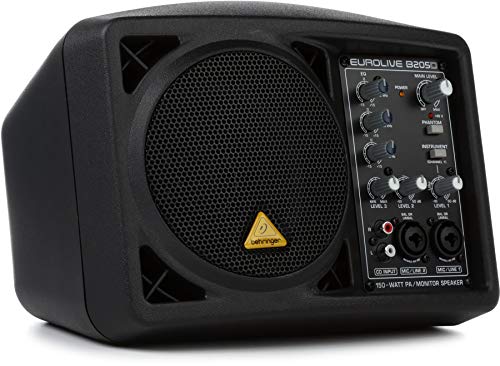
- 150-watt active monitor
- Built-in 3-channel mixer
- Weighs 7.05 pounds
Best For: Vocal, keyboard, rehearsal, and home-studio monitoring
Best Higher-Output Wedge

- 10-inch 2-way powered monitor
- 300-watt integrated amplifier
- XLR daisy-chain output
Best For: Live sound, rehearsals, churches, bars, and small venues
Best With Built-In Playback

- 150-watt active monitor
- Built-in USB MP3 player
- Four-channel mixer with EQ
Best For: Compact monitoring with USB playback for rehearsals and small events
Ultra-Compact Personal Monitor

- 3-inch ceramic driver with 25 watts of output
- Stand/wall bracket and power supply included
- 150Hz–17kHz frequency response
Best For: Personal monitoring and compact mounted setups
Touring Floor Monitor
Sound Town METIS-10M 10-inch Monitor

- 10-inch woofer with 1-inch compression tweeter
- 150W RMS/300W peak at 8 ohms
- Parallel 1/4-inch jacks for daisy chaining
Best For: Live sound systems with a separate amplifier
Self-Powered Gig Monitor
Gemini AS-2108P 8-inch Powered PA

- 300-watt powered 8-inch PA speaker
- XLR/1/4-inch, RCA, and AUX inputs
- ABS cabinet with handle and 35mm pole mount
Best For: Small gigs, rehearsals, and portable wired PA setups
Best Compact Pick – ALTO TX408 Powered PA Speaker
The ALTO TX408 is a practical choice for shoppers seeking compact stage monitors with modern connectivity. Its 8-inch driver, 350W bi-amplified design, built-in mixer, Bluetooth streaming, and wedge-monitor configuration suit small gigs, rehearsals, presentations, and home studios.
Best For: Performers, DJs, presenters, and home-studio users who want a portable powered monitor with Bluetooth.
Pros:
- Compact 8-inch design with 350W of Class-D amplification.
- Built-in mixer supports microphone, line-level, and Bluetooth inputs.
- Bluetooth True Wireless Stereo, mix output, pole socket, and ergonomic handles add flexibility.
- Metal grille and sturdy enclosure are suited to frequent transport.
Cons:
- Not waterproof or water resistant.
- Its 8-inch driver may provide less low-end output than larger 12-inch monitors.
- Bluetooth operation requires corded power.
Choose the TX408 when portability and input versatility matter more than maximum cabinet size. It is especially well suited to intimate venues and setups that benefit from wireless playback.
High-Power Compact Monitor – SAMSON RSXM12A Active Stage Monitor
The SAMSON RSXM12A brings substantial output to a compact coaxial format, making it a strong contender among compact stage monitors for live music and DJ setups. Its 12-inch low-frequency driver, 1-inch tweeter, 800W output, and FOH/Monitor selector provide a focused feature set for stage use.
Best For: Live performers and DJs who need a high-output active monitor with straightforward wired connections.
Pros:
- 800W output provides considerable power for an active stage monitor.
- Coaxial 2-way design combines a 12-inch driver and 1-inch tweeter.
- FOH/Monitor selector helps optimize the speaker for its role.
- XLR-1/4-inch combo input and XLR Link output support common stage connections.
Cons:
- At 36 pounds, it is heavier than smaller 8-inch monitor options.
- The 12-inch cabinet is relatively large for a compact-monitor category.
- The supplied notes do not identify onboard Bluetooth playback controls or a mixer.
The RSXM12A is best viewed as a power-first option. Its coaxial design and selector switch make it useful when consistent stage coverage and simple signal routing are higher priorities than minimum size.
Feedback-Control Choice – Behringer EUROLIVE F1220D Monitor
The Behringer EUROLIVE F1220D is a powered 12-inch monitor designed for live performance and music playback. For shoppers comparing compact stage monitors, its adjustable feedback filter, integrated limiter, Class-D amplification, and broad wired connectivity are the main reasons to consider it.
Best For: Live performers and multi-purpose users who want feedback control and several wired input options.
Pros:
- Adjustable feedback filter helps manage unwanted stage howl.
- Integrated limiter supports system control and speaker protection.
- Class-D amplifier technology combines high output with a relatively light 23.6-pound cabinet.
- Supports XLR, 1/4-inch, RCA, and Speakon connections.
Cons:
- The 12-inch enclosure is larger than compact 8-inch alternatives.
- It is a wired monitor with no wireless communication listed in the supplied details.
- The supplied notes list 250W maximum output, which is lower than some high-power alternatives.
The F1220D makes the most sense when feedback management is central to your setup. It offers useful protection and connection flexibility, though its larger 12-inch format is less travel-friendly than smaller monitors.
Passive Stage Classic – Yamaha BR12M Floor Monitor
The Yamaha BR12M takes a traditional passive approach to compact stage monitors. Its 12-inch woofer, 1-inch compression driver, 300W program handling, 600W peak handling, and 97dB sensitivity make it a practical match for users who already have an amplifier or powered mixer.
Best For: Bands, venues, and sound systems that need a durable passive floor monitor with stand-mount capability.
Pros:
- 12-inch woofer and 1-inch compression driver provide full-range stage monitoring.
- 300W program and 600W peak power handling support live sound applications.
- 97dB sensitivity can help it produce useful output with suitable amplification.
- Built-in pole socket, handles, corner protectors, and integral protection circuitry aid installation and transport.
Cons:
- It requires a separate amplifier, mixer amplifier, or powered speaker system.
- No wireless communication or onboard mixer is listed.
- At 15.6 kg, it is not the lightest option for frequent carrying.
The BR12M is a sensible choice for established PA systems that value familiar passive connectivity and rugged construction. It is less convenient for users seeking an all-in-one powered monitor.
Best Lightweight Pick – Behringer Eurolive B205D
The Behringer Eurolive B205D is a compact stage monitor for performers who need an easy-to-carry active speaker with built-in mixing. Its 150-watt output, full-range neodymium driver, and lightweight 7.05-pound design suit vocal, keyboard, rehearsal, and small recording setups.
Best For: Vocalists, keyboard players, home studios, and portable presentation setups.
Pros:
- Lightweight 7.05-pound enclosure with a 5.25-inch full-range neodymium driver
- Built-in 3-channel mixer with three-band EQ
- Two microphone preamps with phantom power plus an instrument-ready input
- Class-D amplification provides 150 watts in a compact format
Cons:
- Its compact 5.25-inch driver is less suited to applications requiring substantial low-end output
- It has a single-speaker configuration
The B205D stands out when portability and input flexibility matter more than large-room volume. It is a practical compact stage monitor for close-range monitoring and multipurpose use.
Best Higher-Output Wedge – Sound Town METIS-10MPW
The Sound Town METIS-10MPW is a compact stage monitor designed for live sound, rehearsals, and small venues. Its powered two-way configuration combines a 10-inch woofer with a 1-inch titanium compression driver, while the low-profile wedge enclosure keeps it stage-friendly.
Best For: Live performers, small venues, churches, bars, and rehearsal spaces needing stronger stage output.
Pros:
- Powered 2-way design with a 10-inch woofer and 1-inch titanium compression driver
- Integrated 300-watt amplifier for stage monitoring and small-venue use
- XLR input and output support daisy chaining, with additional 1/4-inch and 1/8-inch inputs
- Onboard three-band EQ enables quick tonal adjustments
Cons:
- At 19.1 inches wide and 10.8 inches high, it is less portable than ultra-compact monitors
- The carpet-covered enclosure is not water resistant
- It is a corded-electric speaker with no stated wireless operation
The METIS-10MPW is the stronger choice when a compact wedge needs more driver size and output than small personal monitors provide. Its flexible connections and daisy-chain output also support straightforward stage setups.
Best With Built-In Playback – Behringer EUROLIVE B207MP3
Behringer EUROLIVE B207MP3 Active 150 Watt 6.5" PA/Monitor Speaker System with MP3 Player
Check Price On AmazonThe Behringer EUROLIVE B207MP3 is a compact stage monitor with an integrated MP3 player for convenient playback from a USB stick. Its 150-watt Class-D design, four-channel mixer, and three-band EQ make it useful for vocal and keyboard monitoring, presentations, meetings, and intimate gigs.
Best For: Users who want compact monitoring plus built-in USB audio playback for rehearsals, presentations, or small events.
Pros:
- Built-in MP3 player supports audio files from a USB stick
- Four-channel mixer with three-band EQ offers flexible source control
- 150-watt Class-D amplification in a lightweight multipurpose format
- Supports XLR and 1/4-inch TRS connectivity
Cons:
- Its 6.5-inch speaker size is less substantial than a 10-inch stage monitor
- At 12.4 pounds, it is heavier than the B205D
- The supplied specifications list conflicting water-resistance information, so it should be treated as unsuitable for wet conditions
The B207MP3 is a versatile compact stage monitor for setups where playback convenience is valuable. Choose it over a simpler monitor when USB audio and four-channel mixing are priorities.
Ultra-Compact Personal Monitor – Galaxy Audio NSPA Nano Spot
The Galaxy Audio NSPA Nano Spot is an especially compact choice for musicians or presenters who need focused monitoring without a large floor cabinet. Its 3-inch ceramic driver delivers 25 watts, while the included stand/wall-mount hardware supports flexible placement in small performance or installation spaces.
Best For: Personal monitoring, compact installations, and spaces where wall or stand mounting is more practical than a traditional floor monitor.
Pros:
- Very compact 3-inch monitor design with 25-watt output.
- Includes stand/wall bracket mount kit, power supply, and rubber feet.
- Offers wired and Wi-Fi connectivity plus a bass-boost feature.
- Backed by a stated three-year limited warranty.
Cons:
- 150Hz–17kHz frequency response is narrower than larger PA monitors.
- Its 3-inch driver is designed for compact monitoring rather than high-output full-range coverage.
- It is not waterproof.
The NSPA stands out when minimizing equipment size is the priority. It is a practical compact stage monitor for close-range use, but larger venues or bass-heavy applications will likely call for a more powerful speaker.
Touring Floor Monitor – Sound Town METIS-10M 10-inch Monitor
The Sound Town METIS-10M is a passive 10-inch floor monitor for live sound systems that already have an amplifier. It combines a 10-inch woofer with a 1-inch compression tweeter, handles 150 watts RMS or 300 watts peak at 8 ohms, and uses parallel 1/4-inch jacks for straightforward daisy chaining.
Best For: Bands, DJs, churches, and live sound setups needing a rugged passive monitor with conventional floor placement.
Pros:
- 10-inch woofer and 1-inch compression tweeter provide a two-driver design.
- 150W RMS/300W peak power handling at 8 ohms.
- Parallel 1/4-inch jacks simplify connection and daisy chaining.
- Carpet finish, metal grille, protective corners, and side handle support transport.
Cons:
- Passive design requires a separate amplifier.
- At 12.6 by 19.1 by 10.8 inches, it is less compact than miniature personal monitors.
- It is not waterproof.
For buyers comparing compact stage monitors, the METIS-10M offers a useful balance of manageable size and traditional PA output. Its passive format is best suited to systems where amplifier power and cabling are already part of the setup.
Self-Powered Gig Monitor – Gemini AS-2108P 8-inch Powered PA
The Gemini AS-2108P is a powered 8-inch PA speaker that can serve as a floor monitor or compact main speaker. Its 300-watt output, ABS cabinet, onboard bass and treble controls, and multiple wired inputs make it a self-contained option for rehearsals, small venues, church services, and DJ setups.
Best For: Performers and small-event users who want an all-in-one powered monitor with flexible wired connections.
Pros:
- 300-watt powered design eliminates the need for a separate amplifier.
- 8-inch woofer and piezo HF driver support bass and high-frequency detail.
- Two channels accept switchable XLR/1/4-inch mic and line inputs, plus RCA and AUX.
- ABS cabinet, top handle, 35mm pole mount, and clip LED protection support portable use.
Cons:
- Wired-only operation does not provide Bluetooth connectivity.
- At 11 pounds, it is heavier than miniature personal monitors.
- It is not waterproof.
The AS-2108P is a strong middle ground among compact stage monitors: more capable and self-contained than a tiny personal speaker, while remaining portable for small gigs. Its wired-only design favors dependable, low-latency connections over wireless convenience.
How We Picked These Compact Stage Monitors
We selected models that suit common live-sound applications, including bands, DJs, churches, presenters, rehearsal spaces, and small venues. We considered cabinet size, amplifier configuration, speaker-driver design, portability, input and output options, feedback-control features, and whether each monitor requires an external amplifier.
Because “compact” depends on the application, this list includes small personal monitors as well as larger 8-, 10-, and 12-inch floor wedges. A smaller cabinet is easier to transport, while a larger driver generally offers more low-frequency output and headroom.
Quick Comparison
| Type | Best For | Main Advantage |
|---|---|---|
| Small powered monitor | Speech, vocals, desktop or tight stages | Simple setup and low weight |
| 8-inch powered monitor | Small bands, DJs, and rehearsal spaces | Good portability with useful output |
| 10-inch powered monitor | Vocals, instruments, and compact live rigs | Balanced size, projection, and bass |
| 12-inch powered monitor | Louder stages and fuller monitoring | More headroom and low-end authority |
| Passive monitor | Installed or amplifier-based systems | Flexible integration with existing gear |
Key Buying Factors for Compact Stage Monitors
Powered or Passive Design
Powered monitors include a built-in amplifier and usually offer the fastest setup: connect a mixer or source, add power, and position the cabinet. Passive models need a correctly matched external amplifier and speaker cable, but they can work well with an existing PA system.
Driver Size and Output
Eight-inch monitors are often easier to carry and adequate for vocals, speech, and modest stages. Ten-inch models are a versatile middle ground. Twelve-inch cabinets can provide stronger bass and headroom, but they are typically heavier and may be excessive for simple vocal monitoring.
Inputs, Controls, and Feedback Management
Check whether the monitor accepts the connections your mixer provides, such as XLR, quarter-inch, or auxiliary inputs. Volume and tone controls simplify positioning. Feedback filters, EQ controls, and careful microphone placement can make high-volume operation more manageable.
Portability and Placement
Look for angled enclosures, carry handles, durable grilles, and a weight you can move safely. A floor wedge should aim sound toward the performer while staying clear of foot traffic, cables, and microphone pickup patterns.
Who Should Buy Which Compact Stage Monitors?
Choose a small personal monitor if you mainly need clear vocals, announcements, playback, or close-range monitoring. These models are convenient for presenters, solo performers, and compact setups.
Choose an 8-inch powered wedge for rehearsal rooms, small acoustic groups, DJs, and performers who prioritize portability. It is a practical compromise when stage space and transport capacity are limited.
Choose a 10-inch powered monitor when you want a flexible all-purpose option for vocals, instruments, bars, churches, and small live events.
Choose a 12-inch model when the stage is louder, the monitor mix includes more low end, or you need additional headroom. Make sure the added size and weight suit your transport and storage plans.
Choose a passive monitor when you already own a suitable amplifier or powered mixer. Confirm impedance, continuous power handling, and connector compatibility before connecting it.